

Starting a staffing agency requires more than finding clients and recruiting candidates. Before the first placement, founders need to establish the business, understand state licensing requirements, arrange insurance and payroll, and secure enough working capital to pay temporary employees before clients settle their invoices.
Key takeaways
- Settle the niche, the entity, the state licences, workers' compensation, payroll funding and the recruiting stack, in that order, before signing the first job order.
- The agency is the employer of record for its temps, so it pays the payroll taxes, completes the I-9s and reports new hires from the first payroll.
- Licence rules differ by state: the Illinois Department of Labor lists an annual renewal fee of $3,000 per agency and a surety bond, and no primary source names a state with no staffing licence at all.
- Temps are paid weekly while clients pay on invoice terms, so price a bank line and written payroll funding quotes before the first client signs.
- No public source prints a market markup, so build the bill rate from the pay rate, the statutory burden, the workers' compensation class, funding costs and your own margin.
Anyone learning how to start a staffing agency should know that the agency is often the employer of record for its temporary workers. This means it is responsible for paying wages, managing payroll taxes and meeting applicable employment obligations, even when clients pay their invoices weeks later. Getting the financial and compliance foundations right is therefore just as important as finding the right candidates.
This guide is for recruiters and entrepreneurs planning to establish a staffing agency in the United States, as well as owners of young firms reviewing their existing operations. All financial figures are attributed to their publishing organisations. Where reliable public data does not establish a figure, such as a standard market markup, the guide explains how to calculate it instead.
The legal and tax information is general guidance, not legal or tax advice. Founders should confirm the requirements in every state where they intend to operate with a qualified lawyer and accountant.
In this article
- Is there room in the staffing market for a new agency?
- Which niche and staffing model should a new agency choose?
- How do you set up the entity, EIN and registrations?
- Which states require a staffing agency licence or registration?
- What does it mean to be the employer of record?
- Who is responsible for joint employment and workplace safety?
- How does workers' compensation work for temporary staff?
- How do you fund payroll before clients pay?
- How do you price a bill rate from the payroll burden?
- What recruiting stack does a new agency need for its first job order?
- What should the first 90 days look like?
- What mistakes do new staffing agencies make?
- Conclusion: Build the foundations before you fill the vacancies
- Frequently asked questions
Is there room in the staffing market for a new agency?
There is still room for new staffing agencies in the US, but the market is smaller than it was a few years ago. Founders need to understand where demand remains before deciding which sector to target.
The Bureau of Labor Statistics (BLS) Current Employment Statistics series tracks employment in temporary help services. Its seasonally adjusted figures, measured in thousands, show a decline from 3161.4 in March 2022 to 2526.0 in October 2026 (preliminary).1 These figures represent jobs on the payrolls of temporary help firms and provide a useful indication of how the sector has changed.
The American Staffing Association (ASA) measures the industry differently. It reports that nearly 2 million temporary and contract employees worked for US staffing companies during an average week in 2025. Across the full year, staffing companies hired approximately 9.5 million temporary and contract employees.2
These figures should not be combined. The BLS uses payroll records to measure employment within a specific industry classification, while the ASA uses its own industry-wide survey. Both provide useful information, but they measure different aspects of the staffing market.
Revenue forecasts suggest that the industry could return to modest growth. Staffing Industry Analysts (SIA) raised its 2026 growth estimate for the US staffing industry from 0.8% to 2.4%, projecting total revenue of $183.1 billion.3
Industrial staffing is forecast to remain the largest US segment, with estimated revenue of $40.9 billion.3 Healthcare staffing follows closely, with projected revenue of $40.1 billion. These figures are forecasts rather than confirmed results, but they indicate where significant staffing activity is expected.
For a new agency, competing with established national firms across multiple industries is rarely a sensible starting point. Most successful entry strategies begin with a specific market, a manageable client base and a clear understanding of the workers those clients need.
The BLS Quarterly Census of Employment and Wages classifies establishments with fewer than five employees as size class 1.4 This provides a useful reference point for understanding how small a new staffing operation can begin, although it does not mean every new agency must follow that staffing level.
Survival rates also deserve attention. According to the US Small Business Administration (SBA) Office of Advocacy, 67.7% of new employer establishments survived for at least two years between 1994 and 2022.5 The five-year survival rate was 49.2%.
These figures cover all new employer establishments, not staffing agencies specifically. There is no equivalent public survival rate identified for staffing firms alone, so founders should avoid treating general small-business survival statistics as a direct prediction of their agency's prospects.
For a closer look at how established staffing firms describe current market conditions, see the staffing industry outlook for Q4 2026.
Which niche and staffing model should a new agency choose?
Choose your niche and staffing model together. The type of workers you recruit determines which clients you serve, while the staffing model determines your payroll responsibilities, cash requirements and compliance obligations.
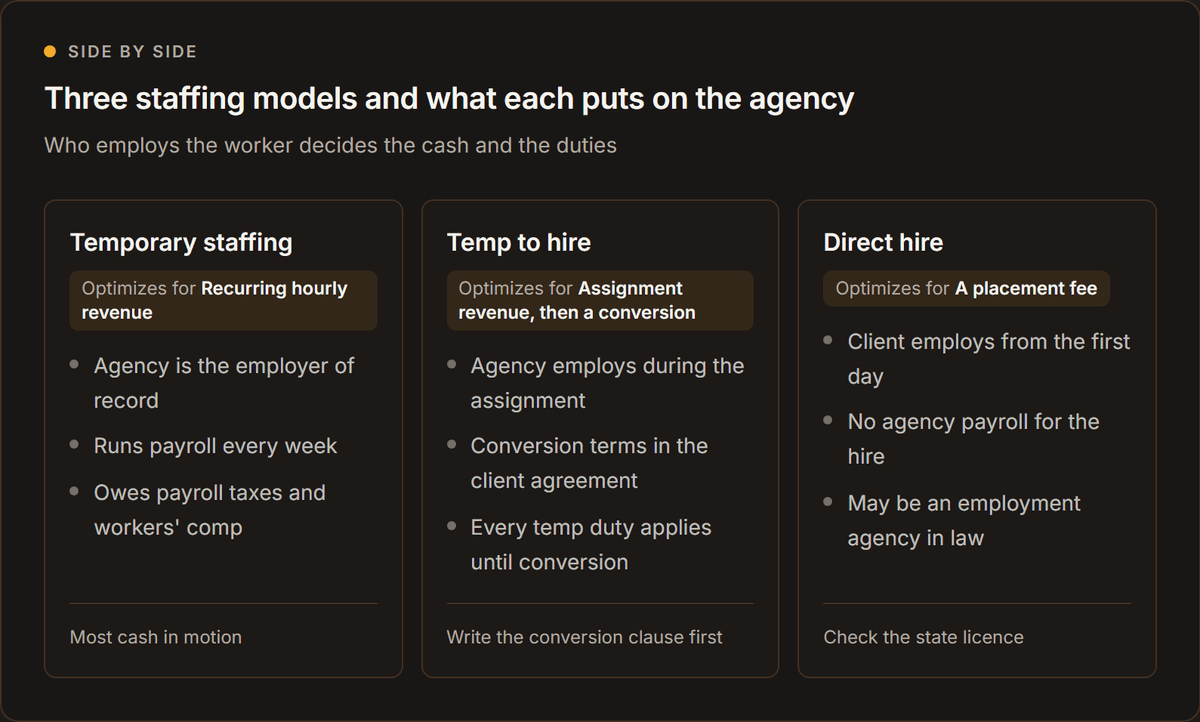
There are three common staffing models: temporary staffing, temp-to-hire and direct hire. Each creates a different relationship between the agency, the client and the worker.
Temporary staffing
In a temporary staffing arrangement, the agency employs the worker and assigns them to a client. The client directs the employee's day-to-day work, but the staffing firm remains responsible for payroll and other employer obligations.
The Texas Workforce Commission's Guidebook for Employers identifies the temporary help firm as the primary employer of workers supplied to client companies.6 The Commission also explains that the staffing firm handles wage reporting and unemployment tax payments under its own Texas Workforce Commission tax account.
This is the model that requires the most working capital because the agency must pay employees regularly, even when clients have not yet paid their invoices. Most of this guide focuses on temporary staffing and the responsibilities that come with it.
Temp-to-hire
Temp-to-hire begins with a temporary assignment but gives the client the option to employ the worker permanently, usually after an agreed conversion period or in exchange for a conversion fee.
The agency remains the employer during the temporary assignment, meaning its payroll, insurance and employment obligations continue until the worker is formally transferred to the client. The client agreement must also establish the conversion conditions, including when a permanent hire can take place and whether a fee applies.
These terms should be agreed upon before the assignment begins. The temp to hire guide explains how to structure conversion clauses in a client agreement.
Direct hire
Direct hire, also known as permanent placement, works differently. The agency identifies and recruits candidates for a client, but the client employs the successful candidate directly from their first day.
Instead of earning recurring revenue from an hourly billing arrangement, the agency receives a placement fee. It does not run payroll for the candidate or carry the same ongoing wage obligations associated with temporary staffing.
A direct-hire-only agency therefore has a lighter payroll burden, although the available research does not establish a reliable figure for the difference. However, founders should not assume that direct placement removes all licensing requirements. Some states classify businesses that charge employers to find workers as employment agencies, which can require a separate licence.
The niche matters just as much as the business model. Staffing Industry Analysts forecasts industrial and healthcare staffing as the two largest US segments by revenue. Both can involve significant workers' compensation exposure and, depending on the state and job duties, additional certification requirements.
Clerical and professional staffing generally involve less physical workplace risk. For a new agency, starting in an industry where the founder already has recruitment experience is often the more practical option. Existing relationships can provide access to the first clients, while familiarity with the roles makes it easier to assess candidates and understand what employers need.
Before moving forward, document three decisions: the industry you intend to serve, the staffing model you will use and the states where your workers will be based. These choices will determine the legal registrations, insurance arrangements and financial resources required in the next stages.
How do you set up the entity, EIN and registrations?
Once the niche and staffing model are established, the next step is to create the legal business and register it for tax and employment purposes. The process generally follows three stages: form the entity, obtain an Employer Identification Number (EIN) and register as an employer in the states where the agency will operate.
Choose and register the legal entity
The first decision is how the agency will be structured legally. The US Small Business Administration (SBA) explains that business structure affects taxation, personal liability, the paperwork a company must file and its ability to raise capital.7
Many staffing founders choose a limited liability company (LLC) or corporation. These structures can help separate the business's liabilities from the founder's personal assets, although the level of protection depends on the structure, state law and how the company is operated.
This distinction matters in staffing because the agency can face claims involving workers, clients, payroll and workplace incidents. Speak to a business attorney and accountant before deciding which structure best suits the planned operation.
Apply for an Employer Identification Number
After registering the legal entity, apply for an EIN through the Internal Revenue Service (IRS).8 This is the federal tax identification number the business uses for tax administration and other official purposes.
The IRS issues EINs free of charge when applying directly through its website. It also advises that legal entities such as LLCs, partnerships and corporations should register with their state before applying.
Register as an employer in each state
An agency that employs temporary workers must also complete the relevant employer registrations in every state where it pays employees.
Depending on the state, this generally includes:
- A state income tax withholding account, where applicable.
- An unemployment insurance account for reporting wages and paying unemployment taxes.
Temporary staffing firms must pay attention to unemployment reporting because they are generally responsible for reporting their employees' wages under their own employer accounts.
Once these registrations are complete, establish the operational foundations of the business. Open a dedicated business bank account, select a payroll system capable of processing weekly payments and obtain quotes for general liability insurance.
A lawyer should also prepare the client services agreement. This document needs to establish the responsibilities of the agency and client, including payment terms, workplace obligations and the other employment matters discussed throughout this guide.
Which states require a staffing agency licence or registration?
Staffing agency licensing is one of the most important compliance issues to investigate before launching. The requirements vary by state and can depend on the type of workers supplied, the services offered and whether the agency is legally classified as an employment agency or temporary help firm.
There is no single federal staffing agency licence. Instead, individual states establish their own licensing, registration and certification requirements. Illinois, Massachusetts, New Jersey and New York illustrate how different these rules can be.
The following examples are based on the relevant state agencies and legislation. They are not a complete list of all state requirements. The absence of a state from this section should never be interpreted as confirmation that no licence or registration is required there.
Illinois
The Illinois Department of Labor requires certain staffing and temporary labour agencies covered by the Day and Temporary Labor Services Act to register before operating in the state.9
Agencies that exclusively supply clerical or professional workers may be exempt from registration under the Act. However, founders should confirm whether their particular activities qualify for that exemption.
The Department's published information also identifies the following requirements:
- Annual renewal fees of $3,000 per agency and $750 per branch office or location.
- Proof of a surety bond for new applications and renewals.
- Registration verification by third-party client companies on March 1 and September 1 each year.
There is an important discrepancy in the Department's published fee information. Its separate application instructions still list a $1,000 agency registration fee and $250 for each branch office or location, which conflicts with the higher amounts on its day and temporary labour page.10
Founders should contact the Illinois Department of Labor to confirm the applicable fees before submitting an application.
The consequences of operating without the required registration can also extend to clients. The Department warns that client companies contracting with unlicensed staffing or temporary labour agencies may violate the Act and face penalties.
Massachusetts
Massachusetts takes a different approach. The Department of Labor Standards explains that there is no separate staffing agency licence or registration.11 However, staffing agencies must hold either an employment agency licence or placement agency registration.
Both credentials are valid for one year.
Staffing agencies must also comply with the state's Temporary Workers Right to Know Law, which establishes information that temporary workers must receive about their assignments.
For founders entering Massachusetts, the distinction between the two credentials is important. The absence of a separate staffing licence does not mean the business can operate without the appropriate employment or placement agency authorisation.
New Jersey
New Jersey's Temporary Workers' Bill of Rights introduces certification requirements for certain temporary labour placements.
The legislation makes it a violation for a third-party client to contract with an uncertified temporary help service firm when assigning workers to designated classification placements. Clients must verify the agency's certification before entering into an agreement and again on March 1 and September 1 each year.
Agencies applying for certification must provide evidence of:
- An employer account number for unemployment insurance contributions.
- Valid workers' compensation insurance.
The legislation also allows the Commissioner to impose penalties of up to $5,000 for each violation.12
Importantly, these certification requirements apply to designated classification placements rather than every temporary staffing assignment. Founders should check the statutory list of covered classifications against the types of workers they intend to supply.
New Jersey also establishes a pay protection for temporary workers in designated classification placements. The legislation states that they must receive at least the average rate of pay and average cost of benefits provided to the client's employees performing the same or substantially similar work.
This requirement needs to be considered when calculating bill rates and agreeing on client contracts.
New York
New York General Business Law Section 172 prohibits operating an employment agency without first obtaining a licence under Article 11.13
Section 177 establishes a minimum licence fee of $500, with a higher fee applying to agencies operating with more than four placement employees.14
The New York Department of Labor's compilation of Article 11 defines an employment agency as a person who, for a fee, procures or attempts to procure employees for employers seeking their services.15
Whether a particular temporary staffing firm falls within this definition depends on its activities and circumstances. The available primary sources do not establish a definitive answer for every type of staffing business.
Founders should therefore confirm their position with the New York Department of Labor or, when operating in New York City, the Department of Consumer and Worker Protection before placing workers.
Staffing agency licensing requirements at a glance
| State | What the state requires | Issuing authority | Published fees or requirements |
|---|---|---|---|
| Illinois | Registration before operating for covered day and temporary labour agencies. Clerical or professional-only agencies may qualify for an exemption. | Illinois Department of Labor | Published renewal fees of $3,000 per agency and $750 per branch. Surety bond required. |
| Massachusetts | Employment agency licence or placement agency registration. No separate staffing licence. | Department of Labor Standards | Both credentials valid for one year. |
| New Jersey | Certification for designated classification placements. | Department of Labor and Workforce Development | Unemployment insurance account number and valid workers' compensation insurance required. |
| New York | Employment agency licence under Article 11 where the business falls within the statutory definition. | Department of Labor; New York City Department of Consumer and Worker Protection | Minimum licence fee of $500, with higher fees for agencies with more than four placement employees. |
Licensing is not the only state-level compliance issue. Compensation disclosure laws can also affect how staffing agencies advertise vacancies.
Colorado's Division of Labor Standards explains that its Equal Pay for Equal Work Act requires employers to disclose compensation in all job postings and notices, including internal and public advertisements.16
Founders should agree with clients on who publishes the advertisement and who ensures that the required compensation information is included.
What does it mean to be the employer of record?
Being the employer of record (EOR) means the staffing agency, rather than the client, carries the legal and administrative responsibilities of employing its temporary workers. Even though the client directs their day-to-day activities, the agency remains responsible for payroll, employment taxes, wage compliance, work eligibility checks and required employee records.
Payroll taxes and employer contributions
The first responsibility is payroll tax. The Internal Revenue Service (IRS) requires employers to withhold and pay several federal employment taxes.
The published rates include:
- Social Security: The employer pays 6.2% of an employee's wages, while the employee contributes another 6.2%.
- Medicare: The employer pays 1.45%, with the employee contributing the same amount.
- Federal Unemployment Tax Act (FUTA): The standard rate is 6.0% on the first $7,000 paid to each employee during the year.
Employers who pay their state unemployment taxes in full may qualify for a FUTA tax credit of up to 5.4%. This reduces the effective federal rate to 0.6%.
State unemployment insurance (SUI) is an additional employer expense. Each state establishes its own rates for individual employers, so founders must check the applicable state requirements when calculating payroll costs.
Payroll deposits and quarterly reporting
Collecting payroll taxes is only part of the responsibility. Employers must also deposit the amounts owed according to the IRS schedule, regardless of whether their clients have paid their invoices.
The deposit schedule depends on the employer's tax liability:
- Monthly depositors: Employment taxes for wages paid during a month must generally be deposited by the 15th day of the following month.
- Semiweekly depositors: Taxes on wages paid on Saturday, Sunday, Monday or Tuesday must generally be deposited by the following Friday.
- Next-business-day deposits: Employers accumulating $100,000 or more in employment taxes on any day during a deposit period must deposit those taxes by the next business day.17
Employers must also report wages, tips and other compensation through Form 941, the IRS Employer's Quarterly Federal Tax Return.17
Minimum wage, overtime and payroll records
Temporary workers are entitled to the applicable wage and hour protections under the Fair Labor Standards Act (FLSA).
Section 6(a)(1)(C) of the Act establishes the federal minimum wage at $7.25 per hour.18 However, employers must also check state and local requirements, which may establish higher minimum wages.
Overtime is another important consideration. Under the Department of Labor's regulation at 29 CFR 778.101, the FLSA generally requires overtime compensation when an employee works more than 40 hours in a workweek.19 The additional compensation must be at least one and a half times the employee's regular rate of pay.
The agency must also maintain accurate payroll records. Under 29 CFR 516.5, employers are required to preserve payroll records for at least three years.20
Employment eligibility and Form I-9
Every staffing agency hiring employees in the United States must verify their eligibility to work.
US Citizenship and Immigration Services (USCIS) requires employers to complete Form I-9 for every individual hired for employment in the country, including both US citizens and non-citizens.21
Employers must retain the completed form for three years after the employee's hire date or one year after employment ends, whichever is later.21
Agencies may also use E-Verify, an internet-based system that compares information entered from an employee's Form I-9 against records held by the Department of Homeland Security and Social Security Administration.22 This helps confirm employment eligibility.
Staffing firms should establish a consistent verification process for every new temporary employee. For a closer look at common compliance problems, see the guide on what a staffing agency must re-check on its I-9s.
New hire reporting
Another easily overlooked requirement is reporting new employees to the relevant state authorities.
The US Department of Health and Human Services' Administration for Children and Families explains that employers must report new hires to their State Directory of New Hires within 20 days of the employee's hire date.23 This requirement comes from Section 453A of the Social Security Act.
The scale of the process is considerable. The Administration for Children and Families reports that employers submitted information on 66 million new and rehired employees during fiscal year 2024.
The Affordable Care Act and growing headcount
As the agency expands, its obligations under the Affordable Care Act (ACA) may also change.
The IRS classifies an employer as an applicable large employer (ALE) when it has an average of at least 50 full-time employees, including full-time equivalent employees, during the previous calendar year.24
An ALE is subject to the ACA's employer shared responsibility provisions.
For this calculation, the IRS generally considers an employee full-time if they work an average of at least 30 hours of service per week during a month or 130 hours of service during that month.25
Staffing agencies need to monitor their workforce numbers as they grow. Temporary employees count towards the relevant calculations where the applicable rules require them to be included. Reaching the threshold can introduce additional reporting and healthcare coverage responsibilities.
Employer of record responsibilities at a glance
| Duty | Issuing body | What the agency must do |
|---|---|---|
| Social Security and Medicare | IRS | Withhold 6.2% and 1.45% from employee wages and pay matching employer contributions. |
| Federal unemployment tax (FUTA) | IRS | Pay 6.0% on the first $7,000 of applicable employee wages, potentially reduced to 0.6% after the state tax credit. |
| Payroll deposits and quarterly returns | IRS | Follow the applicable monthly or semiweekly deposit schedule and file Form 941. |
| Minimum wage, overtime and payroll records | Department of Labor | Meet applicable wage and overtime requirements and retain payroll records for at least three years. |
| Form I-9 and E-Verify | USCIS and DHS | Complete and retain Form I-9 for every new hire and use E-Verify where required or chosen. |
| New hire reporting | HHS, Administration for Children and Families | Report new employees to the relevant State Directory of New Hires. |
| ACA employer provisions | IRS | Monitor full-time and full-time equivalent employee numbers and meet applicable employer responsibilities. |
Who is responsible for joint employment and workplace safety?
Both the staffing agency and the client have responsibilities towards temporary workers. The client agreement should clearly define how those responsibilities are divided, but it cannot remove legal duties that apply to either employer.
Workplace safety is one area where federal guidance is clear. OSHA and NIOSH identify the staffing agency and its client, known as the host employer, as joint employers of temporary workers.26 Both are responsible for providing and maintaining a safe working environment. OSHA also explains that each employer's obligations depend on the conditions of the workplace and should be set out in the agreement between the staffing agency and the host employer.26
The test is narrower under federal labour relations law. The National Labor Relations Board's final rule, effective February 27, 2026, confirms that the US District Court for the Eastern District of Texas vacated the 2023 joint employer rule on March 8, 2024.27 Under the revised rule at 29 CFR 103.40, an organisation is a joint employer only when it possesses and exercises substantial direct and immediate control over at least one essential term or condition of another employer's workers.28
The position under federal wage and hour law is less settled. In its April 2026 notice of proposed rulemaking, the Department of Labor says it has issued no regulatory guidance on joint employer status under the Fair Labor Standards Act since 2021. It proposes restoring rules under Part 791, but this remains a proposal rather than a final rule.29
States also apply their own joint employment tests. The Texas Workforce Commission, for example, says temporary workers may be considered employees of both the staffing firm and the client for wage and hour statutes and other laws.6 If a staffing firm fails to pay its workers, the commission may hold the client responsible because it can also be considered their employer.
Independent contractor classification creates another risk. Some clients may ask a staffing agency to classify placed workers as independent contractors to reduce costs. However, the Department of Labor's February 27, 2026 notice of proposed rulemaking proposes rescinding the analysis under 29 CFR Part 795 and replacing it with the approach adopted in its January 7, 2021 final rule.30 The comment period closed on April 28, 2026. This is also a proposal, not a final rule.
Until a final rule changes the position, the analysis in 29 CFR Part 795 remains the applicable regulatory text. The agency must assess each assignment against the relevant factors rather than simply accepting the client's preferred classification. If a worker is incorrectly classified, the agency may face liability for unpaid wages and employment taxes.
The following table shows how responsibilities are generally divided. The exact position depends on the applicable state laws, the work being performed and the terms of the assignment.
| Item | Agency | Client | Where it is settled |
|---|---|---|---|
| Wages, payroll taxes, I-9 and new hire reporting | Carries the responsibility | May be exposed if the agency defaults, depending on state law | Agency payroll and client agreement |
| Workplace safety and training | Shares responsibility | Shares responsibility | Contract between the two employers |
| Daily direction of the work | Usually has limited involvement | Usually directs the work | Assignment details and job order |
| Workers' compensation for the temp | Usually carries the cover | Covers its own regular workforce | State workers' compensation rules |
| Registration checks | Holds the required registration | Verifies it where state law requires | State registration rules |
The practical lesson is to agree on responsibilities before placing the first worker. The contract should address safety procedures, training, supervision, payroll responsibilities and registration checks. It should also reflect the law in the state where the worker is assigned. A contract can clarify who does what, but it cannot override statutory obligations.
How does workers' compensation work for temporary staff?
Workers' compensation is governed by state law, so the requirements differ depending on where the agency operates. In Oregon and Washington, the staffing agency is responsible for insuring its temporary workers. This needs to be arranged before the first assignment because premiums depend on the type of work the client asks the worker to perform.
The state determines which insurers can provide coverage. Washington's workers' compensation statute requires employers covered by the law to secure compensation through the state fund or qualify as self-insurers.31 Private insurance carriers cannot provide this cover. A staffing agency placing workers in Washington must therefore insure with the state fund, or qualify as a self-insurer, before assigning them to a client.
The state also determines who is responsible for paying the premiums. Oregon's Workers' Compensation Division says temporary staffing providers must provide workers' compensation insurance for their temporary employees.32 The client must maintain separate coverage, or qualify as self-insured, for its regular workforce.
Washington has an additional safeguard for unpaid premiums. Under a rule issued by the Department of Labor and Industries, if a staffing provider fails to pay the required premium, the client customer becomes responsible for the outstanding amount.33 This makes it important for clients to verify that their staffing providers are meeting their insurance obligations.
The type of work performed also affects the premium. SAIF, Oregon's workers' compensation insurer, instructs temporary labour providers to classify workers assigned to clients as though they were employees of the client organisation.34 This is SAIF's guidance as an insurer, rather than a universal national classification rule. The applicable classification is determined through the relevant state rating bureau or NCCI and should be confirmed with the agency's carrier.

How do you fund payroll before clients pay?
A staffing agency must be able to pay its temporary workers before receiving payment from clients. This gap between paying wages and collecting invoices is one of the biggest cash-flow challenges for a new agency.
The Atradius 2026 US Payment Practices Report provides useful context. It finds that US businesses make an average of 45% of their B2B sales on credit, rather than receiving payment upfront.35 Around three in five US suppliers allow business customers 30 days to pay after invoicing, while roughly half that number offer payment terms of one to two months.35 The report also finds that late payments affect an average of 22% of US B2B receivables, with around seven in ten companies across the US and North America still experiencing late payments.35
These figures cover suppliers across different industries, rather than staffing agencies specifically. However, Advance Partners, a provider of staffing payroll funding, describes the same problem in the staffing sector: agencies often pay workers weekly while waiting 30, 60 or even 90 days for clients to settle invoices.36
The wider small-business picture reinforces the risk. The Federal Reserve Banks' 2025 Report on Employer Firms, based on the Small Business Credit Survey, found that 56% of firms identified paying operating expenses as a financial challenge.37 A further 51% cited uneven cash flow.
An agency cannot simply wait for its client to pay before paying its workers. As the Texas Workforce Commission guidance discussed earlier explains, the staffing firm is responsible for reporting wages and paying unemployment taxes. Federal payroll tax deposits are also tied to payroll dates, not to when the client settles its invoice.
Founders therefore need a reliable source of working capital before accepting their first assignment. This could be their own cash reserves, a business credit line or a specialist payroll funding provider.
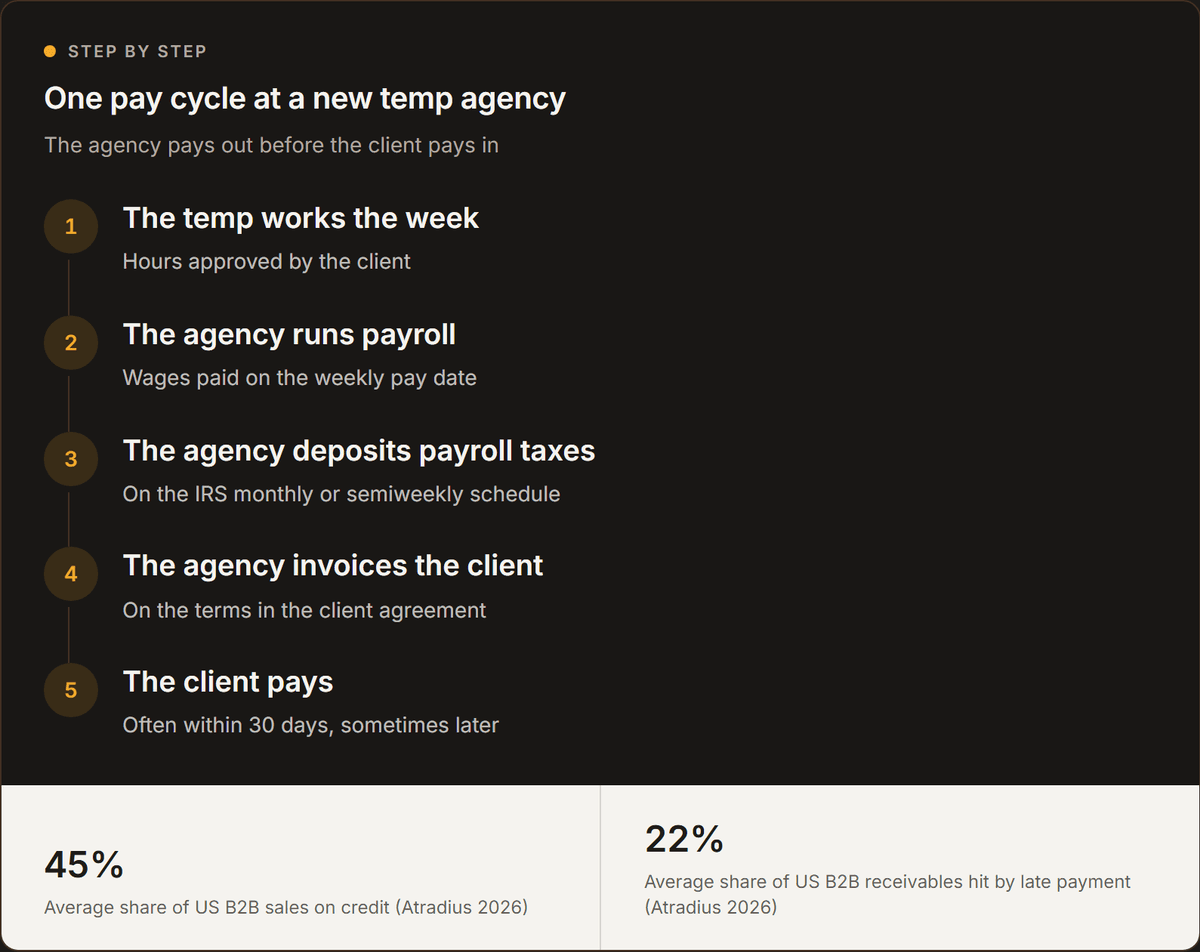
There are three common ways to fund this gap.
Use the founder's own cash
The simplest option is to fund payroll from the business's own reserves. However, you need enough money to cover several weekly payroll cycles, including employer payroll taxes, before the first assignment begins. Your reserve should also account for the possibility that a client pays late.
Apply for a bank credit line
A business credit line can provide access to working capital when payroll falls due but client invoices remain unpaid. One route is through a lender participating in the US Small Business Administration's 7(a) loan programme.
The SBA states that 7(a) loans have a maximum loan amount of $5 million. Its 7(a) Working Capital Pilot offers monitored lines of credit within the programme and includes borrowing against accounts receivable or inventory among the needs it supports.38 Speak to an SBA lender early, as it may require evidence of operating history before approving a facility.
Use specialist payroll funding or factoring
A third option is payroll funding, often structured as invoice factoring. A provider advances money against the agency's unpaid client invoices, allowing the agency to cover wages and other operating expenses while waiting for payment.
Advance Partners says that its typical upfront advance is 80% to 90% or more of an invoice, with advances of up to 100% available through some full-service arrangements.36 These are the provider's own published figures, not guaranteed terms across the industry.
Because funding providers do not all publish comparable fee schedules, it is difficult to establish whether factoring is cheaper or more expensive than a bank credit line. Ask at least two providers for written quotes. Check how fees increase when a client pays late, whether there are additional charges and what happens if an invoice is disputed. Compare the total cost with the interest and fees on a bank facility before committing.
For a new staffing agency, startup costs are therefore not limited to registering the business, obtaining licences and arranging insurance. Working capital is a major part of the initial investment, and it needs to be in place before the first worker starts.
How do you price a bill rate from the payroll burden?
A staffing agency should calculate its bill rate from the worker's pay rate upwards. Start with the hourly wage, add the employer costs required by law, include the other costs associated with the assignment and then add the margin needed to run a profitable business.
There is no reliable public figure that establishes a universal staffing agency markup, state unemployment tax range or payroll funding fee. Rather than using an unsupported industry average, founders should calculate these costs using their own insurance, tax and funding quotes.
Use the following variables to work out the rate:
- P is the hourly pay rate received by the temporary worker. It must meet or exceed the minimum wage that applies where the work is performed.
- T is the statutory payroll burden as a share of pay. This includes the employer's share of Social Security and Medicare, FUTA and state unemployment tax.
- W is the workers' compensation cost for the relevant job classification, calculated as a share of pay using the rate provided by the insurer or state fund.
- O covers other costs associated with each hour worked, such as payroll funding fees, benefits and any paid leave required by law or contract.
- M is the margin the agency needs to cover its own employees, administration, operating expenses and profit.
The bill rate, B, is calculated as follows: B = P + P(T + W + O) + M.
In other words, the agency starts with the worker's hourly pay, adds the associated employment and operating costs, and then adds its required margin.
Calculate the statutory payroll burden
The federal components of T are published by the IRS. The employer's Social Security contribution is 6.2% of applicable wages, while the employer's Medicare contribution is 1.45%. FUTA is charged at a headline rate of 6.0% on the first $7,000 paid to each employee during the year. Employers that qualify for the full state unemployment tax credit can reduce the effective FUTA rate to 0.6%.
These taxes do not all apply indefinitely to every dollar earned. FUTA and most state unemployment taxes have wage bases, meaning the taxable amount is capped once an employee reaches the applicable limit. Applying one flat percentage to every hour of a long assignment can therefore overstate the burden, while using the same percentage for a short assignment may understate it.
Ask your state unemployment agency for your assigned tax rate and applicable wage base. Use those figures alongside the federal rates to calculate the actual payroll burden for your business.
Get the workers' compensation rate before quoting
Workers' compensation is another cost that founders should not estimate without supporting figures. Obtain the rate for each relevant job classification from your insurer or state fund before agreeing to a client bill rate.
An office administrator and a warehouse worker can have very different insurance costs because their work involves different levels of risk. If the agency quotes both assignments using the same assumed insurance percentage, it could significantly underprice one of them.
Include funding fees and set a realistic margin
The O component should include the cost of financing payroll, where applicable. If the agency uses invoice factoring, the funding fee can increase when clients take longer to pay. The bill rate should account for that possibility rather than assuming every invoice will be settled on time.
The M component is a commercial decision. It needs to cover the agency's own operating costs while leaving enough profit to make the assignment worthwhile. Since no primary source establishes a reliable market-average markup, founders should calculate their own costs and compare the resulting rate with what clients in their chosen niche are prepared to pay.
Once the agency is operating, track gross profit by placement to see which assignments are performing as expected. For more on this, see the guide to the numbers that run a staffing desk.
One state requirement can also affect the starting point of the calculation: the worker's pay rate. As discussed earlier, New Jersey requires temporary workers in designated classification placements to receive at least the average rate of pay and average cost of benefits received by the client's employees doing the same or substantially similar work.12 Before quoting a New Jersey assignment in one of these classifications, ask the client to provide the relevant averages. The agency must account for this requirement before calculating its bill rate.
What recruiting stack does a new agency need for its first job order?
Keep the stack small and make it hold the records the law asks for. A new agency needs a place to take and track job orders, a candidate database, a way to screen and contact candidates quickly, and a link to payroll and onboarding for I-9 and new hire reporting.
The job order comes first. Take it on a structured intake call that sets the pay rate, the bill rate, the start date, the shift, the site safety contact and the duties. The job order intake call guide covers the questions to ask.
The candidate database is where the agency's value builds up, because every applicant not placed today is a candidate for the next order. Anyone working out how to start a recruitment agency usually begins from a network of past candidates; record skills, availability, pay expectations and consent to be contacted.
Screening and contact are where speed matters, since temp orders are often filled in hours or days. The stack should let a recruiter screen resumes, run short assessments where the job warrants them, and message candidates by email and text, with text consent set up first.
Onboarding closes the loop: capture the I-9, the W-4, the new hire report and the workers' compensation class before the first shift. Payroll, timekeeping and invoicing usually run in separate systems, so decide early which one is the record for hours worked.
What should the first 90 days look like?
The first 90 days turn the plan into a working agency, and the order matters more than the speed. Use this as a checklist and adjust it for your states and niche.
- Write down the niche, the model and the states where the workers will sit.
- Form the entity, open a business bank account, and apply for the EIN with the IRS.
- Register for state withholding and unemployment insurance in each state where you pay people.
- File each state's licence or registration and post any bond it asks for.
- Get workers' compensation cover, or register with the state fund, and learn the rate for each class of work.
- Have a lawyer draft the client services agreement, with the split of safety duties and payment terms.
- Set up weekly payroll, the IRS deposit schedule, Form 941 filing, I-9s, E-Verify where used, and new hire reporting.
- Settle payroll funding with your cash, an SBA lender, or written quotes from funding providers.
- Build the pricing sheet with P, T, W, O and M for each job class.
- Set up the recruiting stack and build a candidate bench in the niche.
- Take the first job order on a structured intake call.
- Run the first payroll, deposit the taxes, invoice the client, and review cash and compliance gaps after the first month.
Keep a dated file for each item, so a client or an auditor asking for your registration or records gets them the same day.
What mistakes do new staffing agencies make?
Most of the costly mistakes are made before the first placement, while the founder is focused on winning a client.
- Taking a large job order before funding is settled, when the IRS deposit dates do not wait for the client.
- Pricing with a markup copied from a competitor instead of your own burden, workers' compensation class and funding cost.
- Skipping the state rule, when Illinois clients can be fined for using an unregistered agency and New Jersey clients cannot use an uncertified firm for designated work.
- Treating temps as contractors to win a deal; a proposal to change the federal test does not change it.
- Leaving safety to the client, when OSHA holds both employers responsible.
- Getting the workers' compensation class wrong for the client's work.
- Losing the paper trail on payroll records, I-9s and new hire reports.
- Missing the ACA line, since temps can count toward the applicable large employer test.
For keeping temps working between assignments once the agency is running, see staffing redeployment and the bench.
Conclusion: Build the foundations before you fill the vacancies
Starting a staffing agency is a little like building a bridge. Winning your first client and finding the right candidates may get you to the starting point, but neither will carry the business across the gap between payroll and payment. For that, you need solid foundations: the right legal structure, state registrations, insurance, reliable payroll, sufficient working capital and agreements that clearly define everyone's responsibilities.
The real test of a staffing agency is not how quickly it can fill a vacancy. It is whether it can pay its workers on time, meet its obligations, protect the people it places and remain financially stable while waiting for clients to pay. A single poorly priced assignment, missed registration or unexpected payroll shortfall can put pressure on an agency before it has had the chance to establish itself.
That is why the best approach is to build the business in the right order. Choose a niche you understand, establish the compliance and financial systems, calculate your bill rates properly and secure funding before taking on work. Then build a recruiting operation that can source, screen and place candidates efficiently.
A successful staffing agency is not built on placements alone. It is built on the ability to deliver the right people, meet every obligation and keep the business moving long after the first invoice has been sent. Build the foundations properly, and every placement has a stronger business behind it.
How Hivemind handles hiring for a new staffing agency
The payroll, the funding, the licences and registrations, the insurance and the client agreement stay with the agency, its accountant, its lawyer and its carrier. The recruiting work around them is where a hiring OS fits.
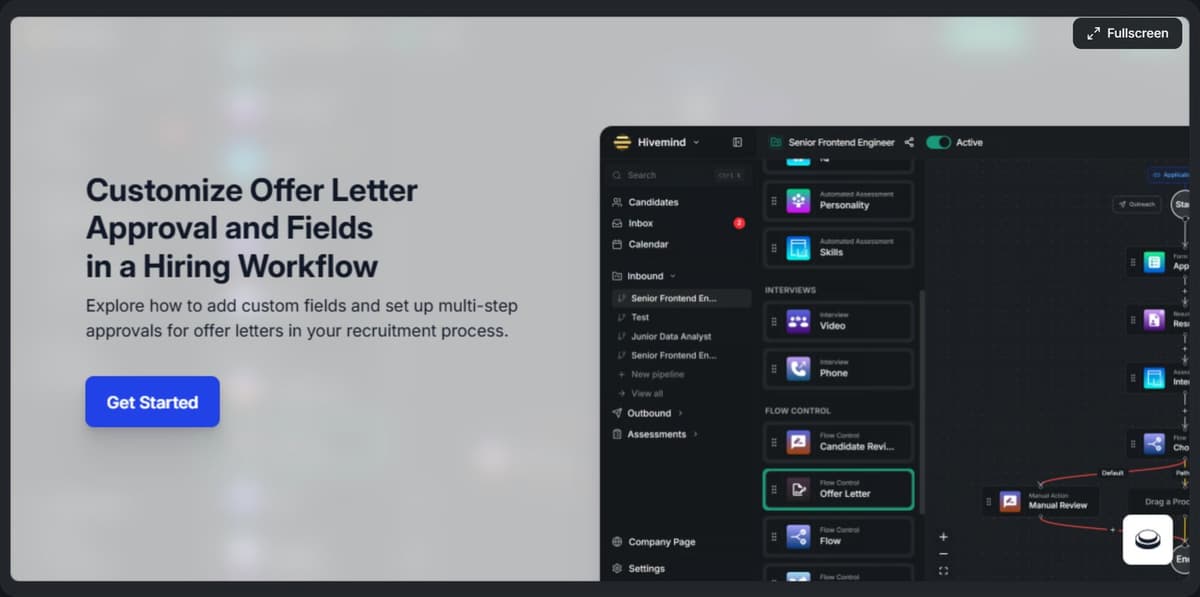
Hivemind is the hiring OS for sourcing, screening, interviews, offers, and the admin around them. With Hivemind a team can manage every candidate from inbound to offer in one unified workflow, and build the exact pipeline your team deserves. Hivemind's modules include Resumatic, an AI-powered resume filtering system, Automatic Video Assessment for video interview analysis, and automated skills assessments. Candidate contact runs through Hivemind's Automated Emails and SMS Follow-Ups, its automated candidate text messaging. Hivemind offers 15 native modules and 275 integrations, so an agency can run Hivemind end to end, connect your existing tools, or mix and match both.
Frequently asked questions
How much does it cost to start a staffing agency?
The main startup costs for a temporary staffing agency are working capital to cover payroll while waiting for clients to pay, as well as licences, registration fees, bonds and insurance. Some state requirements can add significant costs. For example, the Illinois Department of Labor's day and temporary labor page lists an annual renewal fee of $3,000 per agency and $750 per branch office or location.9 However, its separate application instructions still list fees of $1,000 per agency and $250 per branch. Confirm the current fees directly with the Department before budgeting. There is no reliable public figure for the typical total startup cost, so build your budget using actual quotes for your chosen states and staffing model.
Do you need a licence to start a staffing agency?
It depends on the state and the type of staffing services you provide. Illinois requires covered day and temporary labor agencies to register, Massachusetts requires employment agencies to be licensed or placement agencies to be registered, New Jersey requires certification for firms placing workers in designated classifications, and New York licenses employment agencies under Article 11. Requirements vary, so check the relevant state rules before accepting job orders or placing workers.
How do staffing agencies pay temporary workers before clients pay?
Staffing agencies generally use their own cash reserves, a bank line of credit or specialist payroll funding. The US Small Business Administration's 7(a) Working Capital Pilot offers monitored lines of credit within its 7(a) loan programme. Payroll funding providers can also advance money against unpaid client invoices. For example, Advance Partners says its typical advance is 80% to 90% or more of the invoice value. Compare written quotes, fees and repayment terms before choosing a funding arrangement.
Who is the employer of a temporary worker: the agency or the client?
The staffing agency is generally the employer of record and is responsible for payroll, employment taxes and other employer obligations. However, the client may share certain legal responsibilities. The Texas Workforce Commission identifies the temporary help firm as the primary employer of workers supplied to client companies, while OSHA and NIOSH explain that both the staffing agency and host employer have responsibilities for temporary workers' workplace safety.
What payroll taxes does a staffing agency pay?
The agency must account for the employer's share of Social Security and Medicare, as well as federal and state unemployment taxes. The IRS sets the employer Social Security rate at 6.2% and the employer Medicare rate at 1.45%.39 FUTA has a headline rate of 6.0% on the first $7,000 of each employee's wages, which can fall to 0.6% after the full state unemployment tax credit.40 State unemployment tax is charged separately at the rate assigned to the employer.
Does a staffing agency need workers' compensation insurance?
Staffing agencies generally need workers' compensation coverage for their temporary employees, but the requirements and insurance arrangements depend on state law. Oregon's Workers' Compensation Division says temporary staffing providers must cover their temporary workers. Washington requires covered employers to insure through the state fund or qualify as self-insurers. Agencies should confirm the rules and rates for every state and job classification in which they operate.
What is the difference between temporary staffing, temp-to-hire and direct hire?
In temporary staffing, the agency employs the worker and assigns them to a client for a defined period. In temp-to-hire arrangements, the agency employs the worker during the initial assignment, after which the client may hire them under agreed conversion terms. In direct hire, the client employs the candidate from the beginning and pays the agency a placement fee. The model you choose affects your payroll responsibilities, cash requirements and potential licensing obligations.
When does the Affordable Care Act apply to a staffing agency?
The Affordable Care Act's employer shared responsibility provisions apply when an agency qualifies as an applicable large employer. The IRS defines this as an employer with an average of at least 50 full-time employees, including full-time equivalent employees, during the previous calendar year. Staffing agencies should monitor their employee numbers as they grow because temporary workers can count towards this threshold.
Sources
- US Bureau of Labor Statistics: BLS CES series CES6056132001, temporary help services employment ↩
- American Staffing Association: ASA, Staffing Industry Statistics ↩
- Staffing Industry Analysts: SIA, Staffing industry seeing growth for first time in 3 years ↩
- US Bureau of Labor Statistics: BLS QCEW, establishment size class titles ↩
- US Small Business Administration, Office of Advocacy: SBA Office of Advocacy, Frequently Asked Questions About Small Business, 2026 ↩
- Texas Workforce Commission: TWC, Guidebook for Employers, Alternatives to hiring ↩
- US Small Business Administration: SBA, Choose a business structure ↩
- Internal Revenue Service: IRS, Employer ID numbers ↩
- Illinois Department of Labor: Illinois Department of Labor, Day and Temporary Labor ↩
- Illinois Department of Labor: Illinois Department of Labor, DTLSA registration instructions ↩
- Massachusetts Department of Labor Standards: Massachusetts DLS, Information about registering an employment, placement or staffing agency ↩
- New Jersey Department of Labor and Workforce Development: New Jersey, Temporary Workers' Bill of Rights, P.L. 2023, c.10 ↩
- New York State Senate: New York General Business Law section 172 ↩
- New York State Senate: New York General Business Law section 177 ↩
- New York State Department of Labor: New York DOL, Article 11, Employment Agencies, LS 390 ↩
- Colorado Department of Labor and Employment: Colorado DLSS, Equal Pay for Equal Work Act ↩
- Internal Revenue Service: IRS, Employment tax due dates ↩
- US Government Publishing Office: 29 U.S.C. 206, Minimum wage ↩
- US Department of Labor: DOL overtime compensation rules, eCFR ↩
- US Department of Labor: 29 CFR 516.5, Records to be preserved 3 years, eCFR ↩
- US Citizenship and Immigration Services: USCIS, I-9, Employment Eligibility Verification ↩
- US Citizenship and Immigration Services, E-Verify: E-Verify, What is E-Verify ↩
- US Department of Health and Human Services, Administration for Children and Families: OCSE, New Hire Reporting, FY2024 ↩
- Internal Revenue Service: IRS, Determining if an employer is an applicable large employer ↩
- Internal Revenue Service: IRS, Questions and Answers on Employer Shared Responsibility Provisions Under the Affordable Care Act ↩
- US Occupational Safety and Health Administration and NIOSH: OSHA and NIOSH, Protecting Temporary Workers, OSHA 3735 ↩
- National Labor Relations Board: NLRB, Standard for Determining Joint-Employer Status, final rule, 27 February 2026 ↩
- National Labor Relations Board: 29 CFR 103.40, Joint employers, eCFR ↩
- US Department of Labor, Wage and Hour Division: DOL WHD, Joint employer status, notice of proposed rulemaking, Federal Register public inspection 2026-07959 ↩
- US Department of Labor, Wage and Hour Division: DOL WHD, Employee or independent contractor classification, notice of proposed rulemaking, 27 February 2026 ↩
- Washington State Legislature: RCW 51.14.010, Self-insurers and the state fund ↩
- Oregon Department of Consumer and Business Services: Oregon WCD, Worker leasing vs. temporary staffing ↩
- Washington Department of Labor and Industries: WAC 296-17-31027, Temporary staffing services ↩
- SAIF Corporation: SAIF, Specific classification rules ↩
- Atradius: Atradius, B2B payment practices trends in the US, 2026 ↩
- Advance Partners: Advance Partners, How factoring works ↩
- Federal Reserve Banks: Small Business Credit Survey, 2025 Report on Employer Firms ↩
- US Small Business Administration: SBA, 7(a) loans ↩
- Internal Revenue Service: IRS, Topic no. 751, Social Security and Medicare withholding rates ↩
- Internal Revenue Service: IRS, Topic no. 759, Form 940, Employer's Annual Federal Unemployment (FUTA) Tax Return ↩