

A phone screening interview is a short, structured call used to establish whether an applicant meets a role's essential requirements before moving to the next stage of recruitment. It helps recruiters confirm availability, salary expectations, start dates and other knockout criteria without spending time on candidates who are unlikely to be a match.
Key takeaways
- Keep the phone screen to the advertised knockouts, the pay range and availability, and leave skill judgement to the structured interview.
- Ask every candidate the same questions in the same order and write each answer on one form, so screens can be compared.
- Tell the candidate how long the call will take; the University of Northern Iowa template says most phone screens do not take more than 30 minutes.
- Ask what the candidate expects to be paid, never what they earn now, because New York City, New York State, Washington and California bar salary history questions.
- If you record the call, announce it at the start and get a yes, since California Penal Code 632 requires the consent of all parties.
This guide provides recruiters and staffing agencies with a practical phone screening script and a set of questions for handling large applicant pools. It also explains how to keep screening consistent, document answers and identify candidates worth progressing to a structured interview, where their skills and experience can be assessed in greater depth.
The legal information is provided for general guidance and does not constitute legal advice.
In this article
- What is a phone screening interview for?
- Why does a big applicant pool call for a short screen?
- How long should a phone screen run?
- What should the phone screen script say?
- Which phone screening questions should you ask?
- What should a recruiter leave out of the call?
- How do you handle pay and salary history on the call?
- Can you record a phone screen?
- What does a slow or inconsistent screen cost with candidates?
- Conclusion: A better hiring process starts with a better first conversation
- Frequently asked questions
What is a phone screening interview for?
A phone screen has one main purpose: to decide whether a candidate should progress to a full interview. It gives recruiters an opportunity to confirm that applicants meet the advertised requirements before investing time in a more detailed assessment. The University of Northern Iowa's Human Resource Services recommends using phone screens to establish whether candidates meet the advertised qualifications or to narrow down a large applicant pool.1
Consistency is essential. The university's guidance recommends asking all candidates the same general set of questions so they can be evaluated against the same criteria. This makes it easier to compare applicants fairly and reduces the risk of decisions being influenced by personal impressions.
The US Office of Personnel Management (OPM) applies the same principle to structured interviews, where every candidate receives predetermined questions in the same order and responses are assessed against consistent rating standards.2 A phone screen uses this approach on a smaller scale. Its purpose is to establish basic suitability, not to test technical ability or make a final hiring decision. Those assessments belong in the structured interview, which is covered in the guide on how to structure an interview.
Why does a big applicant pool call for a short screen?
The larger the applicant pool, the less time recruiters can afford to spend on each initial call. Gem, a recruiting software vendor, reports that recruiters on its platform are handling 93% more applications than in 2021.3 Its data for June 2021 to May 2025 also shows that only 8% of applicants progress beyond initial screening, while 0.5% receive offers.3 That works out to roughly one hire for every 200 applications.
Survale, which conducts the Candidate Experience (CandE) benchmark research, reports that 32% of participating employers received more than 100 applications per job on average in 2025.4 These figures come from the companies' own platforms and research participants, rather than representing the entire labour market, but they illustrate the screening pressure facing recruitment teams.
When most applicants will not progress, a lengthy initial call is an inefficient use of recruiter time, particularly when a candidate fails an essential requirement early in the conversation. A short, consistent phone screen allows recruiters to identify unsuitable applicants quickly while giving qualified candidates a fair opportunity to move forward.
How long should a phone screen run?
There is limited public research establishing an ideal phone screening duration or showing that a fixed-length script predicts future job performance. The University of Northern Iowa's Human Resource Services template states that most phone screens take no longer than 30 minutes and recommends telling candidates how long to expect the call to last.1
For high-volume recruitment, however, the screening script should be considerably shorter. Focus on essential requirements, salary expectations, availability and the next steps. Treat 30 minutes as an upper limit rather than a target, and tell candidates the expected duration during the opening of the call. This sets clear expectations and helps keep the conversation focused.
What should the phone screen script say?
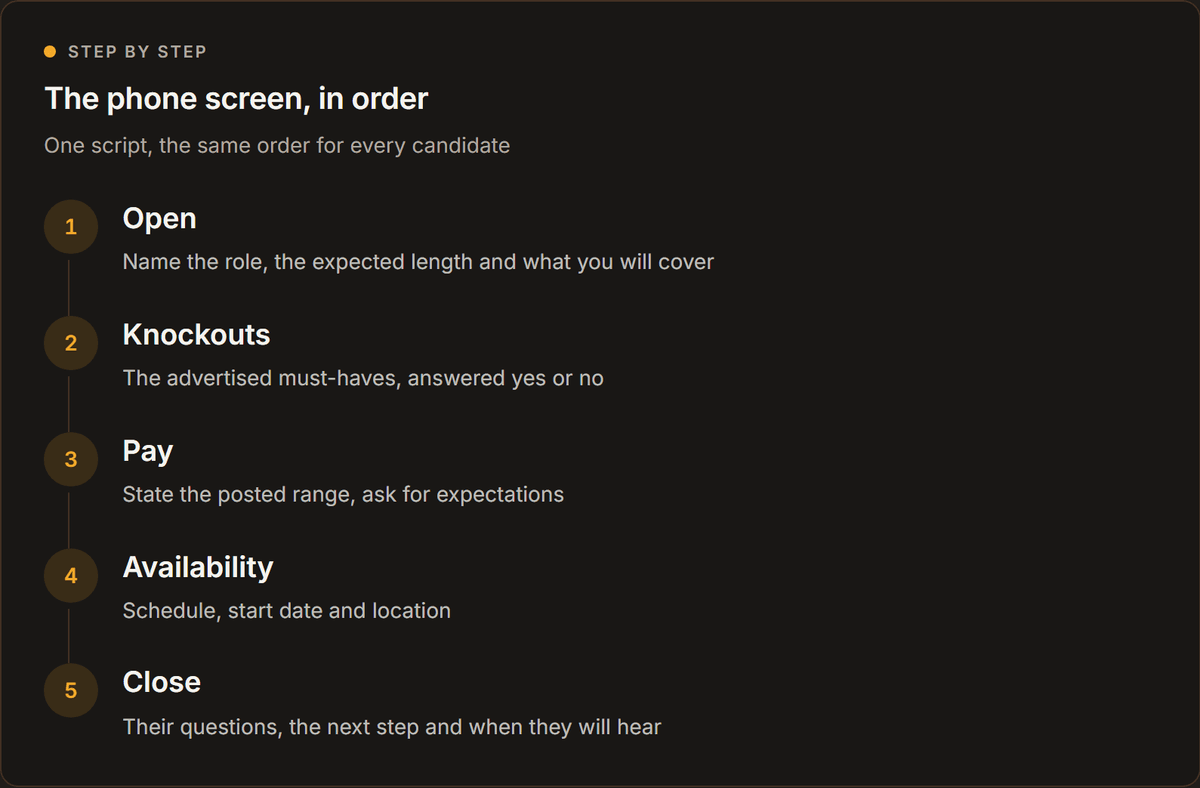
Prepare the script before making the first call by filling in the relevant details from the job requisition. Keep the questions in the same order for every candidate so that responses can be compared consistently.
- Opening. "Hi [name], this is [your name] from [company]. I'm calling about the [role] you applied for. Is now still a good time? The call should take around [X minutes]. I'll confirm a few essential requirements, discuss the pay and your availability, and leave time for any questions you have."
- Recording notice, if applicable. "I'd like to record this call for my notes. Is that all right with you?" Only begin recording after obtaining the candidate's agreement and following applicable recording and privacy requirements.
- Knockout requirements. "The role requires [essential qualification, certification or experience]. Do you meet this requirement?" Repeat for each essential requirement listed in the job posting.
- Location and work authorization. "The position is [on-site, hybrid or remote within a specified region]. Would that arrangement work for you? Are you legally authorized to work in [country] for this employer?"
- Pay expectations. "The advertised pay range is [posted range or rate]. Is that in line with your expectations?" If the candidate is looking for a different amount, ask what they would expect to earn.
- Schedule. "The working hours are [days and times]. Are you available to work this schedule?"
- Start date. "If you were offered the position, when would you be available to start?"
- Candidate questions. "Is there anything you would like to know about the role, the team or the company?"
- Close. "The next step is [a structured interview with the hiring manager]. You can expect to hear from me by [day], whether or not you progress to the next stage. Thank you for your time."
The University of Northern Iowa's phone screening template includes similar questions about whether candidates can work the required days and hours and when they would be available to start if offered the position.1 Steps 6 and 7 follow this practical approach.
Which phone screening questions should you ask?
Phone screening questions should be grouped according to the hiring decision they help a recruiter make. Every question should serve a specific purpose, whether it confirms an essential qualification, establishes the candidate's ability to perform the job, checks salary expectations or confirms availability. Anything that does not contribute to one of these decisions can be left out.
Knockout requirements
Start with the essential qualifications listed in the job posting. These are the requirements a candidate must meet to be considered for the position.
- Do you hold [the required licence, certification or clearance]?
- Have you performed [the core task] in a previous paid role? If so, where?
Ability to perform the job
Recruiters can also establish whether a candidate can perform the actual functions of the position. Under 29 CFR 1630.14(a) of the Americans with Disabilities Act (ADA), covered entities may ask pre-employment questions about an applicant's ability to perform job-related functions.5 The Equal Employment Opportunity Commission (EEOC) also confirms that employers can explain a job's physical requirements and ask whether an applicant can meet them.6
- The role involves [the specific requirement from the job posting]. Are you able to perform this function, with or without reasonable accommodation?
Pay expectations
Be transparent about compensation before progressing a candidate to the next stage. This avoids unnecessary interviews with applicants whose salary expectations are significantly outside the available budget.
- The advertised pay range is [range]. Is that in line with your expectations?
Availability and attendance
The EEOC also allows employers to explain their attendance requirements and ask whether applicants can meet them. Keep the question focused on the actual working arrangements rather than asking about personal circumstances.
- The schedule is [days and hours], with [specific attendance requirement]. Are you able to meet these requirements?

What should a recruiter leave out of the call?
A phone screen should focus on job-related requirements, not a candidate's personal circumstances or characteristics. Some questions can also create legal problems. The US Office of Personnel Management (OPM) advises interviewers not to ask questions or make comments about a candidate's age, sex, race, national origin, religion, marital or familial status, disabilities or health status.7
The Americans with Disabilities Act (ADA) places additional restrictions on pre-employment questions. Under 29 CFR 1630.13(a), covered entities generally cannot ask applicants whether they have a disability or inquire about its nature or severity before making a conditional job offer.8 The EEOC also explains that employers generally cannot require medical examinations or ask disability-related questions until this stage of recruitment.9
These restrictions apply to employment agencies as well as covered employers. The ADA regulations define a covered entity to include an employment agency, meaning staffing firms operating in this capacity must also observe these requirements.
Recruiters can ask whether an applicant can perform specific job functions, including relevant physical requirements, but should avoid questions about medical conditions or personal health.6 The distinction is between assessing someone's ability to do the job and asking for private medical information. The following examples illustrate the difference.
| Ask this | Leave this out |
|---|---|
| Can you perform the job's stated functions? | Do you have a disability or health condition? |
| Can you meet the stated schedule and attendance requirements? | Do you have children or plans for a family? |
| Is the advertised pay range in line with your expectations? | What do you earn now, or what did you earn in your previous job? |
| When would you be available to start? | How old are you, or where were you born? |
Important: The legal examples in this section refer to US federal requirements, particularly the ADA. State and local employment laws may impose additional restrictions. This information is general guidance, not legal advice.
How do you handle pay and salary history on the call?
Recruiters should disclose the advertised salary range and ask candidates about their expectations rather than their current or previous earnings. This keeps the conversation focused on what the position pays and helps avoid salary-history discrimination. Several US jurisdictions have laws restricting employers and recruitment agencies from requesting this information.
New York City Local Law 67 of 2017 made it unlawful for employers, employment agencies and their agents to ask applicants about their salary history during the recruitment process.10 New York State Labor Law 194-a extends this restriction further by prohibiting employers from seeking an applicant's wage or salary history as a condition to be interviewed.
Washington's RCW 49.58.100 similarly prohibits employers from requesting an applicant's wage or salary history from the applicant or a current or former employer.11 California Labor Code 432.3 also generally prevents employers and their agents from requesting salary history, including previous compensation and benefits.12 Employers can also ask candidates what they expect to earn in the position.
Pay transparency requirements also affect how recruiters communicate compensation. New York State Labor Law 194-b requires employers and employment agencies to disclose the compensation or a range of compensation when advertising a job performed at least in part in New York. Washington's RCW 49.58.110 requires employers to include the wage scale or salary range in each job posting.13 California gives applicants the right to the pay scale for a position upon reasonable request to the employer.12
These requirements differ in their coverage and application. New York, Washington and California are examples rather than a complete list of US salary-history and pay-transparency laws. Other states and local jurisdictions have their own restrictions, so recruiters should check the rules applying wherever the position is based and the candidate is located.
Can you record a phone screen?
Recording consent requirements depend on the applicable federal and state laws. Under the federal Wiretap Act, 18 U.S.C. 2511(2)(d), a person who is a party to a communication may generally record it without obtaining consent from the other participants. The same provision allows recording when one party has given prior consent, provided the recording is not being made for an unlawful criminal or tortious purpose.
Some states impose stricter requirements. California Penal Code 632 prohibits recording a confidential communication without the consent of all parties.14 This includes confidential conversations conducted over the telephone. Washington's RCW 9.73.030 also generally requires consent from all participants before recording private telephone communications.15 Its provisions allow consent to be established through an announcement to the other participants that the conversation is about to be recorded, provided the announcement itself is recorded.
California and Washington are examples of states with stricter recording requirements, not a complete list. The location of both the recruiter and the candidate may matter, particularly when calls cross state lines.
For recruitment teams, the safest practical approach is to notify candidates before recording, obtain their explicit agreement and ensure that any legally required recording announcement is captured. Where a candidate declines, the recruiter should continue without recording and take notes instead. Staffing agencies should check the applicable recording laws before adopting a standard recording process across different locations.
What does a slow or inconsistent screen cost with candidates?
The way recruiters conduct phone screens can affect the candidate experience and influence whether applicants remain in the hiring process. Survale's 2025 Candidate Experience (CandE) research found that the leading reason candidates withdrew from recruitment processes was feeling that their time had been disrespected during interviews and appointments. This was cited by 32% of candidates who withdrew.
Communication is another problem. Survale reports that 31% of North American candidates in 2025 said they had not heard back from employers.4 Its research also found that only 20% of rejected candidates received a phone call, while 32% received a personal email from a recruiter or hiring manager.4
A consistent screening process helps recruiters manage expectations and avoid leaving candidates uncertain about what happens next. The closing question should explain the next recruitment stage and give applicants a specific date by which they can expect feedback. Recruiters should also follow through, including when the decision is not to progress someone.
For the next stages of recruitment, see the guides to phone interview invitation email templates and interview questions to ask candidates.1
Conclusion: A better hiring process starts with a better first conversation
A phone screening interview may be one of the shortest stages in recruitment, but it can have a significant influence on the quality of the entire hiring process. Get it wrong, and recruiters waste hours on candidates who do not meet the essential requirements, qualified applicants lose interest, and hiring teams spend valuable time repeating work that could have been completed in the first few minutes. Get it right, and the rest of the recruitment process starts on much stronger ground.
The answer is not to ask more questions, make longer calls or turn an initial conversation into an unofficial technical interview. It is to establish what matters before the first call, ask every candidate the same relevant questions and record the answers against consistent criteria. Be transparent about compensation, respect privacy, explain the next steps and, above all, follow through on the promises made during the conversation.
A strong phone screen gives recruiters something more valuable than a shorter interview: a reliable basis for deciding who deserves the next one. The best hiring processes do not start with the longest interview. They start with the right conversation.
How Hivemind handles the first screen
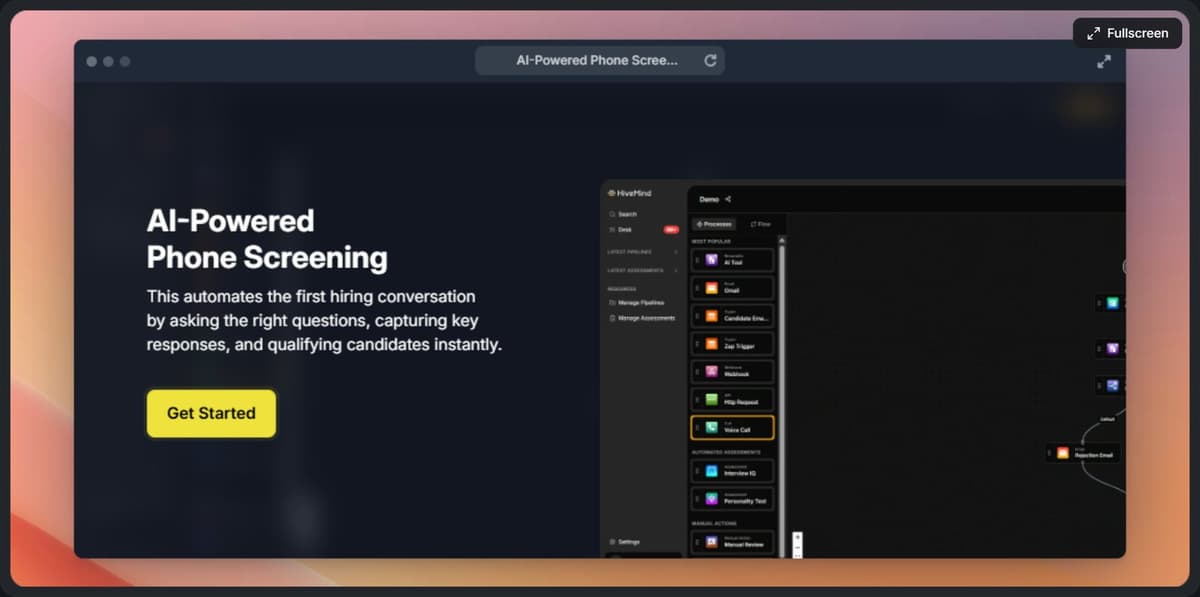
Hivemind covers the stages around the call: sourcing, screening, interviews, offers, and the admin around them. Its screening modules include Resumatic: AI-Powered Resume Filtering System, and Automatic Video Assessment: AI-Powered Video Interview Analysis. Hivemind also runs Automated Emails: Smart Email Automation for Recruitment, and SMS Follow-Ups: Automated Candidate Text Messaging.
Hivemind is the hiring OS: manage every candidate from inbound to offer in one unified workflow. A team can run Hivemind end to end, connect your existing tools, or mix and match both.
Frequently asked questions
How long should a phone screening interview be?
A phone screen should be brief and focused on essential requirements, salary expectations, availability and next steps. The University of Northern Iowa's HR template states that most phone screens take no longer than 30 minutes. For high-volume recruitment, however, a focused script should take considerably less time.
Can a recruiter ask about salary history during a phone screen?
This depends on the applicable employment laws. New York City, New York State, Washington and California have laws restricting employers or recruitment agencies from requesting applicants' salary histories. Recruiters should disclose the advertised pay range and ask about salary expectations instead.
Can I record a phone screening interview?
Recording laws vary by location. Under the US federal Wiretap Act, a person who is party to a call may generally record it without obtaining consent from the other participants, unless the purpose is a criminal or tortious act.16 California and Washington have stricter consent requirements for recording confidential communications. The safest approach is to notify candidates and obtain their agreement before recording.
What questions should a recruiter ask during a phone screen?
Focus on questions that establish whether a candidate meets the role's essential requirements. These should cover required qualifications, relevant experience, ability to perform the job, salary expectations, working hours, location and availability to start. Ask every candidate the same core questions in the same order to make comparisons more consistent.
What questions should recruiters avoid during a phone screening interview?
Avoid questions about age, race, religion, marital or family status, disabilities and medical conditions. Under the Americans with Disabilities Act (ADA), covered employers and employment agencies generally cannot ask applicants disability-related questions or require medical examinations before making a conditional job offer. Keep the conversation focused on job-related requirements rather than personal circumstances.
Sources
- University of Northern Iowa, Human Resource Services: Phone Screen Template ↩
- US Office of Personnel Management: Structured Interviews ↩
- Gem: Key takeaways from the 2026 Recruiting Benchmarks Report ↩
- Survale: 2025 Candidate Experience (CandE) Benchmark Research key statistics ↩
- US Equal Employment Opportunity Commission: 29 CFR 1630.14, eCFR ↩
- US Equal Employment Opportunity Commission: Enforcement Guidance on Preemployment Disability-Related Questions ↩
- US Office of Personnel Management: Structured Interviews training presentation ↩
- US Equal Employment Opportunity Commission: 29 CFR 1630.13, eCFR ↩
- US Equal Employment Opportunity Commission: Pre-Employment Inquiries and Disability ↩
- New York City Council: Local Law 67 of 2017 ↩
- Washington State Legislature: RCW 49.58.100 ↩
- California Department of Industrial Relations, Labor Commissioner's Office: California Equal Pay Act and pay transparency FAQ ↩
- Washington State Legislature: RCW 49.58.110 ↩
- California Legislature: Penal Code section 632 ↩
- Washington State Legislature: RCW 9.73.030 ↩
- United States Code: 18 U.S.C. 2511, GPO 2023 edition ↩
- US Equal Employment Opportunity Commission: 29 CFR 1630.2, Definitions, eCFR
- New York State Legislature: Labor Law section 194-a
- New York State Legislature: Labor Law section 194-b