

A job requisition is the formal request to create a new position or fill an existing vacancy. The University of Wisconsin-Madison defines it as a request for the creation of a new role or the replacement of an open position.1 For recruiters, it is the document that establishes the budget, approval authority, salary range, essential requirements and interview process before sourcing begins.
Key takeaways
- Settle the budget, the approver, the pay range, the hard requirements and the interview plan on the requisition before sourcing starts.
- Published procedures name two sign-offs: UW-Madison lists the Position Budget Manager and an HR Partner as approvers on a job requisition.
- Put the pay range on the requisition, because New York State requires private employers with four or more employees to include a range of pay for advertised jobs.
- Under the FLSA regulation a job title alone does not settle exempt status, so record the FLSA status and the reason for it.
- No public source splits time to fill into a requisition stage, so the case for a complete requisition rests on process, not measurement.
Without an approved requisition, recruiters risk starting a search without knowing whether the position is funded, who has authority to approve it or what the hiring manager actually expects. Settling these details upfront reduces delays, prevents confusion and gives everyone involved a clear understanding of the role.
This guide is for recruiters, talent acquisition (TA) leads and staffing agencies handling new vacancies or job orders. The legal points summarise relevant agency guidance and regulations and are not legal advice.
In this article
- What is a job requisition, and how is it different from a job description and a job posting?
- Who approves a job requisition?
- What should a job requisition form include?
- What does the law put on a job requisition?
- How does a staffing agency's job order map to a requisition?
- Where does hiring delay come from when the requisition is left open?
- Conclusion: A successful hire starts before the first application
- Frequently asked questions
What is a job requisition, and how is it different from a job description and a job posting?
A job requisition is an internal request for permission to fill a position. It establishes the business case and approval requirements before a vacancy is advertised or candidates are approached. At the University of Wisconsin-Madison, a requisition is required whenever a position is posted for recruitment or a recruitment waiver is requested.1
The terminology varies between employers. The US Office of Personnel Management (OPM), for example, uses the term request to fill, while many HR departments use position requisition when referring to an existing, budgeted role.
Although the three documents are closely connected, a job requisition, job description and job posting serve different purposes.
| Document | Question it answers | Who reads it | When it is written |
|---|---|---|---|
| Job requisition | Should the position be filled, what will it cost and who must approve it? | Budget owner, HR and recruiter | Before advertising or sourcing |
| Job description | What responsibilities will the employee have, and what qualifications are required? | HR, hiring manager and eventually candidates | Alongside the requisition, before advertising |
| Job posting | Why should a qualified candidate apply for this position? | Prospective candidates | After the requisition is approved |
The requisition provides the internal approval and business justification for the hire. It usually includes or references the job description, which establishes the responsibilities and requirements. The recruiter then uses both documents to prepare the job posting that candidates will see.
Who approves a job requisition?
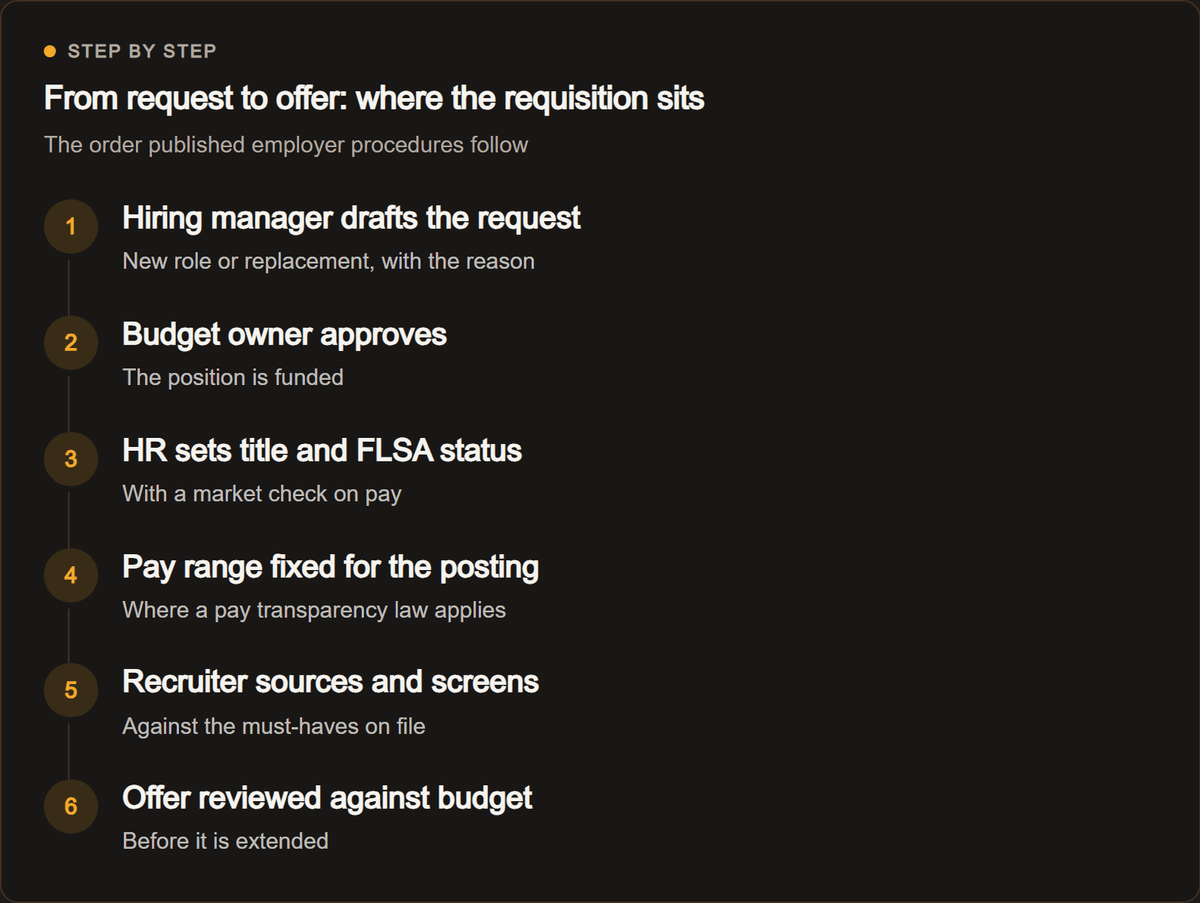
Job requisitions generally require approval from the people responsible for the hiring budget and the organisation's HR or compensation structure. The exact approval chain depends on the employer, but published procedures show how these responsibilities are divided.
The University of Wisconsin-Madison identifies the Position Budget Manager and an HR Partner as the standard approvers for a job requisition.1 A Compensation Partner is also required when the proposed salary range is considered extraordinary. This ensures that the organisation has confirmed the financial commitment and reviewed the position's compensation before recruitment proceeds.
The federal hiring process uses a similar approach through OPM's USA Staffing system. A hiring manager can save a request to fill as incomplete for further review and approval or submit it to HR.2 The request is then forwarded to the Human Resources office for action.
Some organisations introduce additional approval stages for strategic or more complex vacancies. At the University of Kansas, for example, strategic hiring requests go through HR Compensation.3 The department reviews the position description, assigns the appropriate job title and Fair Labor Standards Act (FLSA) designation, and conducts a market analysis.
The University of Kansas also operates on a scheduled review process. Forms must reach HR by noon on Wednesday, while the Leadership Committee typically meets on Tuesdays.3
These examples reflect the individual procedures of each institution rather than universal approval requirements. However, the underlying principle is consistent: the budget must be authorised, the position must be correctly classified and the compensation must be reviewed before the recruiter begins the search.
What should a job requisition form include?
A good job requisition form captures the decisions a recruiter needs before starting a search. Leaving important details unresolved can lead to delays, disagreements over candidate requirements or problems when an offer is ready to be made.
The following eight fields provide a practical checklist for recruiters, TA leads and staffing agencies. If an essential field is blank, the search should be put on hold until the information is confirmed.
-
Role and reason: Record the job title, department, team, work location or remote arrangement, and whether the vacancy is a new position or a replacement. For replacement hires, include the departing employee's name and expected departure date.
-
Budget and pay range: Identify the approved budget line and the minimum and maximum salary that will appear in the job posting. Specify whether an offer above the approved range requires additional authorisation.
-
Approver: Name the budget owner and HR partner responsible for signing off on the requisition. Also identify who has authority to approve the eventual employment offer.
-
Must-have requirements: List three to five essential qualifications, skills or experience requirements that a candidate must meet to be considered. Keep these separate from preferred qualifications or nice-to-haves.
-
FLSA status: Record whether the position is exempt or non-exempt under the US Fair Labor Standards Act (FLSA). HR should determine the classification using the applicable salary and duties tests and document the reason.
-
Essential functions: Outline the main responsibilities and duties of the position. These should be established before the role is advertised so that candidates are assessed against clearly defined expectations.
-
Interview plan: Specify each interview stage, identify the people responsible for conducting interviews and agree on the questions that will be asked consistently across candidates.
-
Target dates: Set the expected sourcing start date, shortlist deadline and target employment start date. These dates give the recruiter and hiring manager a shared timeline.
For the interview stage, recruiters can also refer to the guide on interview questions to ask candidates for a scored question bank that helps standardise candidate assessments.
The offer approval process deserves particular attention. Ashby explains that moving from a hiring decision to an employment offer can involve several stakeholders, including finance, people teams and leadership.4 These additional approvals can slow down an otherwise straightforward process.
Carnegie Mellon University similarly advises departments to review proposed staff offer details with their recruiter and HR business partner before extending an offer.5 The review checks that compensation aligns with the approved budget, market competitiveness and internal equity.
Identifying the offer approver in the original requisition means that the final compensation decision starts with an agreed salary range.

What does the law put on a job requisition?
Employment regulations affect several parts of the requisition, particularly the salary range, employee classification, essential job functions and recruitment records. Recruiters working across different states need to understand which requirements apply before publishing a vacancy.
The following examples cover US federal and state requirements. This is not legal advice, and regulations can change. Always check the relevant state's current guidance before advertising a position.
Pay range and salary transparency
Pay transparency legislation increasingly requires employers to disclose compensation information in job advertisements.
New York State requires private employers with four or more employees to include a pay range in advertisements for job opportunities, promotions and transfers.6 Washington's Department of Labor and Industries requires employers with 15 or more employees to disclose a wage scale or salary range, together with general descriptions of benefits and other compensation, when recruiting Washington-based employees.7 Illinois also requires employers with 15 or more employees to include the position's pay scale and benefits in covered internal and external job postings.8
These requirements make the approved salary range an important part of the requisition. Recruiters should not have to establish the advertised compensation independently after the position has already been approved.
Salary disclosure is also becoming more common beyond jurisdictions where it is legally required. Indeed Hiring Lab reported that 60% of US job postings on its platform included at least some salary information in February 2025, compared with 18% in 2020.9
FLSA exempt and non-exempt classification
The second important consideration is the position's classification under the Fair Labor Standards Act.
The US Department of Labor makes clear that a job title alone does not determine whether an employee qualifies for an exemption from minimum wage and overtime requirements. Classification depends on whether the employee's salary and actual job duties satisfy the applicable regulatory tests.
This is why the requisition should record the proposed classification and the reasoning behind it. HR should review the position before recruitment begins rather than relying on a title such as manager or executive to establish exempt status.
Essential job functions
The third consideration is the definition of essential job functions.
Under the Americans with Disabilities Act (ADA), the Equal Employment Opportunity Commission (EEOC) identifies written job descriptions prepared before advertising or interviewing applicants as evidence of whether particular duties are essential to a position.10
Attaching the approved job description to the requisition helps establish that these responsibilities were identified before recruitment started. It also gives recruiters a consistent basis for assessing candidates and considering reasonable accommodation requirements where applicable.
Recruitment and employment records
The final consideration is recordkeeping.
The EEOC's recordkeeping regulations generally require employers to retain personnel and employment records, including applications and other hiring documentation, for one year from the date the record was made or the relevant personnel action occurred, whichever is later.11
The approved requisition, associated job posting and candidate applications should therefore form part of the employer's recruitment records. Keeping these documents together creates a record of what was approved, what candidates were told and how the hiring process was conducted.
For recruiters, this is another reason to complete the requisition before sourcing begins. It provides an established record of the role and its requirements, rather than relying on informal discussions or decisions made during the recruitment process.
How does a staffing agency's job order map to a requisition?
A staffing job order is the client's requisition arriving at the agency, and it needs the same fields before the agency starts sourcing. We found no source that states what a staffing agency's job order must contain by law, so the mapping below follows the requisition fields and the two agency-specific rules the agencies themselves publish.
New York State's law does not apply to temporary help firms seeking workers for other organizations, but employers hiring through a temporary help firm must include a range of pay.6 California's Labor Commissioner says that when such an employer engages a third party to post a job, it must provide the pay scale to the third party and the third party must include it.12 Either way, the client's pay range has to reach the agency before posting. Other states may treat agency postings differently.
On the intake call, take the client's pay range, the offer approver, the must-haves, the FLSA status and the client's interview stages. For the call itself, see how to take a staffing job order on the intake call.
Where does hiring delay come from when the requisition is left open?
Delay builds up across many steps, and some of those steps return to questions the requisition could have closed. Ashby reports that, across organizations on its platform, time to hire is not driven by a single bottleneck and comes from a combination of smaller delays across each stage of the process.4
Ashby's report covers over 54M applications and 93K jobs from January 2021 through March 2026, and Ashby defines Time to First Fill as the time from when a job was opened to when the first hire was made.4 Ashby's platform data shows senior roles take 37% longer to fill than junior level positions.4 SHRM's 2026 recruiting benchmarking brief, drawing on data from over 4,600 organizations, reports a median time to fill of 39 calendar days for nonexecutive positions, with executive time to fill unchanged from last year.13 For how those two measures differ, see time to fill vs time to hire.
Recruiter load matters too, because an open question waits in a queue of other roles. Gem reports from its platform data that recruiters are managing 13.4 open roles at a time.14 SHRM's 2026 benchmarking brief says extra-large organizations experienced a 67% increase in median requisitions per recruiter in 2026.13
The approval step itself can add a wait. The University of Kansas says a position must go back through approval if its description is materially modified or reposting is delayed by 3 months.3 On a weekly committee cycle like the one Kansas publishes, a late or changed form waits for the next meeting.
No public source splits time to fill into a requisition stage and the stages after it. The link between a question left open on the requisition and a later wait is argued here from process and from the employers' own procedures, not measured. The procedures do show where open questions resurface: a range reworked at offer approval, or a description changed after posting that sends the role back for approval.
Conclusion: A successful hire starts before the first application
A job requisition is more than an administrative form or another approval step in the hiring process. It is the foundation of a successful recruitment campaign. When the budget, salary range, reporting structure, essential requirements and interview process are agreed before a vacancy opens, recruiters can focus on finding the right person instead of chasing decisions that should already have been made.
For hiring managers and TA teams, the value is just as significant. A properly completed requisition creates accountability, establishes realistic expectations and gives everyone involved a shared definition of what a successful hire looks like. It also reduces the risk of wasted sourcing time, inconsistent candidate assessments and last-minute disagreements over compensation.
However, getting the requisition right is only the beginning. Once the position is approved, recruiters still need to manage applications, screen candidates, coordinate interviews, secure feedback and move successful applicants towards an offer. That process needs the same structure and visibility as the approval stage that came before it.
The best recruitment processes do not begin when a job goes live. They begin when everyone agrees on exactly who they need, why they need them and what it will take to bring them on board.
How Hivemind handles the step after the requisition
The requisition, its approvals and the pay decision stay with the employer, its budget owner and its HR team.
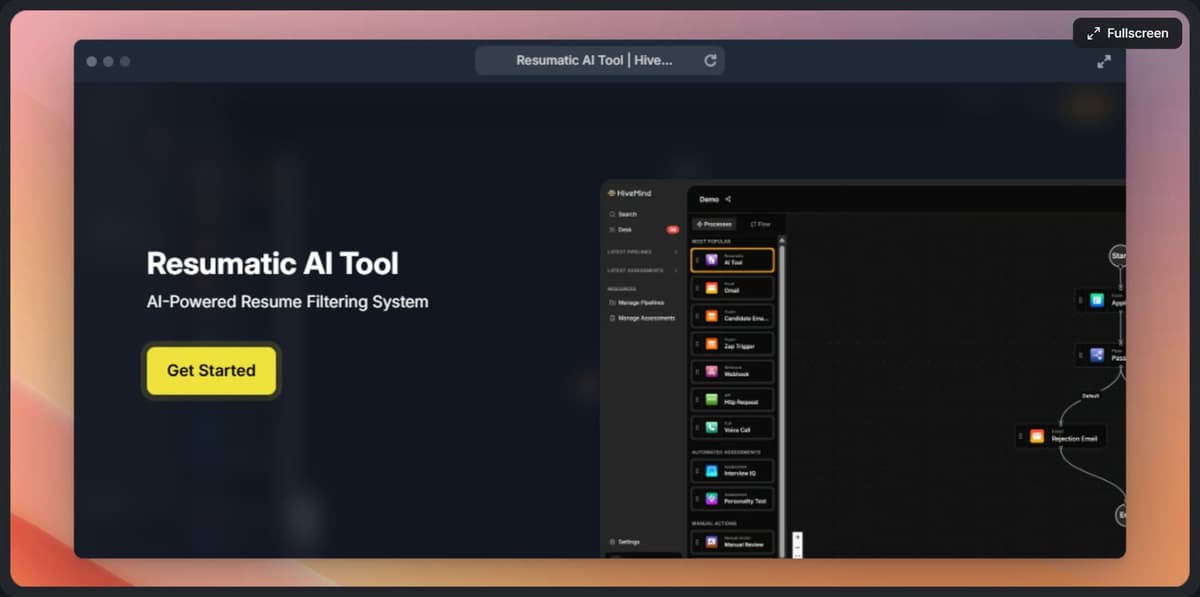
Once a role is approved, Hivemind runs sourcing, screening, interviews, offers, and the admin around them. Hivemind is the hiring OS: manage every candidate from inbound to offer in one unified workflow. In Hivemind a team can build the exact pipeline for the role, with the interview stages the requisition set out. A team can run Hivemind end to end, connect your existing tools, or mix and match both.
Frequently asked questions
What is a job requisition?
A job requisition is a formal request for the creation of a new role or replacement of an open position, according to the University of Wisconsin-Madison. It is approved before the role is advertised and records the budget, approvers, pay range and requirements that guide the recruiter.
Who approves a job requisition?
Usually, a budget owner and an HR partner. UW-Madison's guide identifies the Position Budget Manager and an HR Partner as the standard approvers, adding a Compensation Partner when extraordinary salary ranges are proposed.
Does a job requisition need a pay range?
Yes. The requisition should include an approved pay range, particularly because several US states require salary disclosure in job advertisements. New York State requires private employers with four or more employees to include a pay range in covered job postings, while Washington and Illinois generally apply their requirements to employers with 15 or more employees.
How long should you keep requisition and hiring records?
The EEOC's recordkeeping regulations generally require employers to retain hiring records, including applications, for one year from the date the record was made or the relevant personnel action occurred, whichever is later.
What is the difference between a job requisition and a staffing job order?
A job requisition is an employer's internal request to approve a vacancy, while a staffing job order is the information a client provides to an agency when requesting recruitment services. A good job order should capture the same essential details, including the pay range, offer approver, must-have requirements and interview stages, so the agency can recruit against an agreed brief.
Sources
- University of Wisconsin-Madison Human Resources: UW-Madison HR guide, Create a Job Requisition ↩
- US Office of Personnel Management: OPM USA Staffing help center, Creating a request to fill position, updated 9 October 2025 ↩
- University of Kansas Human Resources: University of Kansas HR, Strategic Hiring ↩
- Ashby: Ashby, Recruiting Operations Benchmarks, 2026 Talent Trends Report, 7 May 2026 ↩
- Carnegie Mellon University Human Resources: Carnegie Mellon HR, Staff Hiring and Extension Approvals, updated 8/31/2026 ↩
- New York State Department of Labor: NYS Department of Labor, Pay Transparency Law for Employers, P687 ↩
- Washington State Department of Labor and Industries: Washington L&I, Equal Pay and Opportunities Act Q&A ↩
- Illinois Department of Labor: Illinois Department of Labor, Equal Pay Act Salary Transparency ↩
- Indeed Hiring Lab: Indeed Hiring Lab, A Stubborn Divide, 20 March 2025 ↩
- US Equal Employment Opportunity Commission: 29 CFR 1630.2, Definitions, eCFR ↩
- US Equal Employment Opportunity Commission: 29 CFR 1602.14, Preservation of records made or kept, eCFR ↩
- California Department of Industrial Relations: California DIR, Labor Commissioner's Office, Equal Pay Act FAQ ↩
- SHRM: SHRM, 2026 Recruiting Executives Benchmarking: Attracting Critical Talent ↩
- Gem: Gem, Key takeaways from the 2026 Recruiting Benchmarks Report, 1 December 2025 ↩
- US Department of Labor: 29 CFR 541.2, Job titles insufficient, eCFR