

A good job order intake process gives staffing recruiters a fixed set of questions for every client call: what the person will actually do, which requirements are essential, the pay range, the start date and who makes the hiring decision. Read the order back to the client and confirm it in writing before sourcing begins. If the first submittal misses the brief, look at the intake call first.
Key takeaways
- Ask the same fixed questions on every intake call: what the person will do, which requirements are essential, the pay range, the start date and who makes the hiring decision.
- Tie every must-have to a specific duty; a degree, years of experience or a past job title is often a proxy for a skill the client actually needs.
- Read the order back on the call, send it in writing the same day, and do not submit against a brief the client has not confirmed.
- Track why first-round candidates are rejected, by recruiter and client, and fix the intake call when they miss on requirements that were never on the order.
This playbook is for recruiters taking new orders from clients and desk leads responsible for coaching them. It covers the questions to ask, how to separate genuine requirements from preferences, what certain laws may require agencies to address during intake, and how to create a written record of the agreed brief. It also explains how quickly recruiters should move once the order is confirmed.
There is no reliable public source showing how often candidate submittals miss the brief on a typical staffing desk. Instead of relying on an industry-wide figure, this playbook shows you how to measure the rate on your own desk and use the results to improve the intake process.
In this article
- Why does the first submittal miss?
- What must you ask before you leave the call?
- Which requirements are real, and which are habit?
- When should you push back on a requirement?
- What does the law make you get on the intake call?
- How do you read the order back?
- What do you record, and where?
- How fast should the first submittal go?
- How does a desk lead know intake is working?
- Conclusion
- Frequently asked questions
Why does the first submittal miss?
A first submittal misses when the client sees something in the candidate that was never captured in the job order. The recruiter matched the requirements that were written down, but the hiring manager was judging the candidate against a different set of expectations, including requirements that were never stated.
Research into employer-led hiring shows how easily this happens. A 2024 study by the Burning Glass Institute and Harvard Business School on skills-based hiring found that much of the hiring process is left to individual hiring managers, who apply criteria that are both stated and unstated, as well as objective and impressionistic.1 The study also notes that hiring managers compare candidates with the other people available in their candidate pool rather than with an abstract definition of what the job requires.1 On a staffing desk, that means a client who has already interviewed two people for the same role may judge your candidate against those two people, even if that comparison was never mentioned during the intake call.
Candidates can experience the same gap from the other side. Greenhouse's 2024 Candidate Experience Report, which is based on a vendor survey, found that 53% of employees said companies had advertised job responsibilities that differed significantly from what they encountered after starting the job.2 The finding is not specific to staffing agencies, but it shows how easily the written description of a role can differ from the reality.
The labour market makes the problem harder. SHRM's 2025 recruiting benchmarking found that 61% of recruiting executives considered a lack of qualified candidates for open roles an organisational challenge, while 31% identified it as their most pressing challenge.3 When qualified candidates are difficult to find, both the recruiter and the client have more reason to move quickly. That can lead to searching against a job title before the actual requirements have been established.
Hiring processes can also give clients a very specific idea of what they want. Ashby, a recruiting software company, reports from its own platform data that business roles averaged 11.7 interviews per hire, 36% more than in 2021.4 This is an in-house recruiting figure rather than a staffing benchmark, so it should be treated as Ashby's data. It does show, however, how many interviews can sit behind a single hire before a decision is made. After that many interviews for one role, a hiring manager may have a firm view of what a successful candidate looks like.
Clients also evaluate the staffing firms they use. ClearlyRated, which operates a client rating programme for staffing companies, reports an average Net Promoter Score of 36% among rated staffing companies.5 ClearlyRated does not publish its methodology on the page reporting this figure, so it should be treated as its own reported measure rather than a universal staffing-industry benchmark.
Quality is not always measured clearly on the hiring side either. SHRM found that only 20% of organisations used quality-of-hire metrics in 2025, compared with 23% in 2017 and 27% in 2022.3 If a client does not measure why candidates are rejected, the recruiter is unlikely to receive a precise explanation after a miss. The intake call therefore becomes an important opportunity to capture the client's expectations before sourcing begins.
There are three common sources of a miss that a good intake process can uncover. Not every missed submittal starts with the intake call, but these are areas the recruiter can test:
- A requirement the client expects but never states. The hiring manager may consider it obvious, but the recruiter cannot screen for something they do not know.
- A requirement the client states but does not actually use. A degree may appear on the job order, for example, even though the hiring manager would accept someone without one.
- A fact about the job that changes the candidate's decision. Pay, working hours, location, travel or other working conditions can affect whether a candidate is interested, yet these details may not be discussed during intake.
What must you ask before you leave the call?
Start with the legal requirements where they are clearly defined. In Great Britain, the Conduct of Employment Agencies and Employment Businesses Regulations 2003 state that an agency or employment business must not introduce or supply a work-seeker to a hirer unless it has obtained enough information from the hirer to select a suitable person for the position.6 An American staffing desk is not subject to these regulations, but the requirement provides a useful public benchmark for what a thorough intake call should capture.
Regulation 18 sets out the information the agency must obtain from the hirer.67 This includes the date the worker is needed and the duration, or likely duration, of the work. It also covers the position itself, including the type of work, location, hours and any health or safety risks known to the hirer. The agency must also establish the experience, training, qualifications and authorisations the hirer considers necessary. For an agency, the required information also includes the minimum rate of pay, any other benefits offered by the hirer and how often the worker will be paid.
UK government guidance on Regulation 18, updated in June 2026, adds useful detail to two of these requirements. The description of the type of work should provide an overview of the duties the worker will perform during the assignment.7 For known risks, the agency must establish what the hirer is doing to control those risks, including any protective equipment the worker must wear. This can be particularly important for warehouse, manufacturing, construction and site-based roles.
Turn those requirements into a fixed sequence of questions that every recruiter follows. A desk lead should be able to hear the same core questions on every recorded intake call.
- The role and why it is open.
Ask, "Is this a new seat or a replacement? If it is a replacement, what did the last person do well, and why did they leave?" A replacement gives the recruiter a useful benchmark. A new role may mean the client is still working out exactly what the job should involve.
- What the person will do.
Ask, "Walk me through a normal week. What will they be doing in their first month that tells you the hire is working?" This creates the duties overview and gives the recruiter something against which to test every requirement.
- The must-haves.
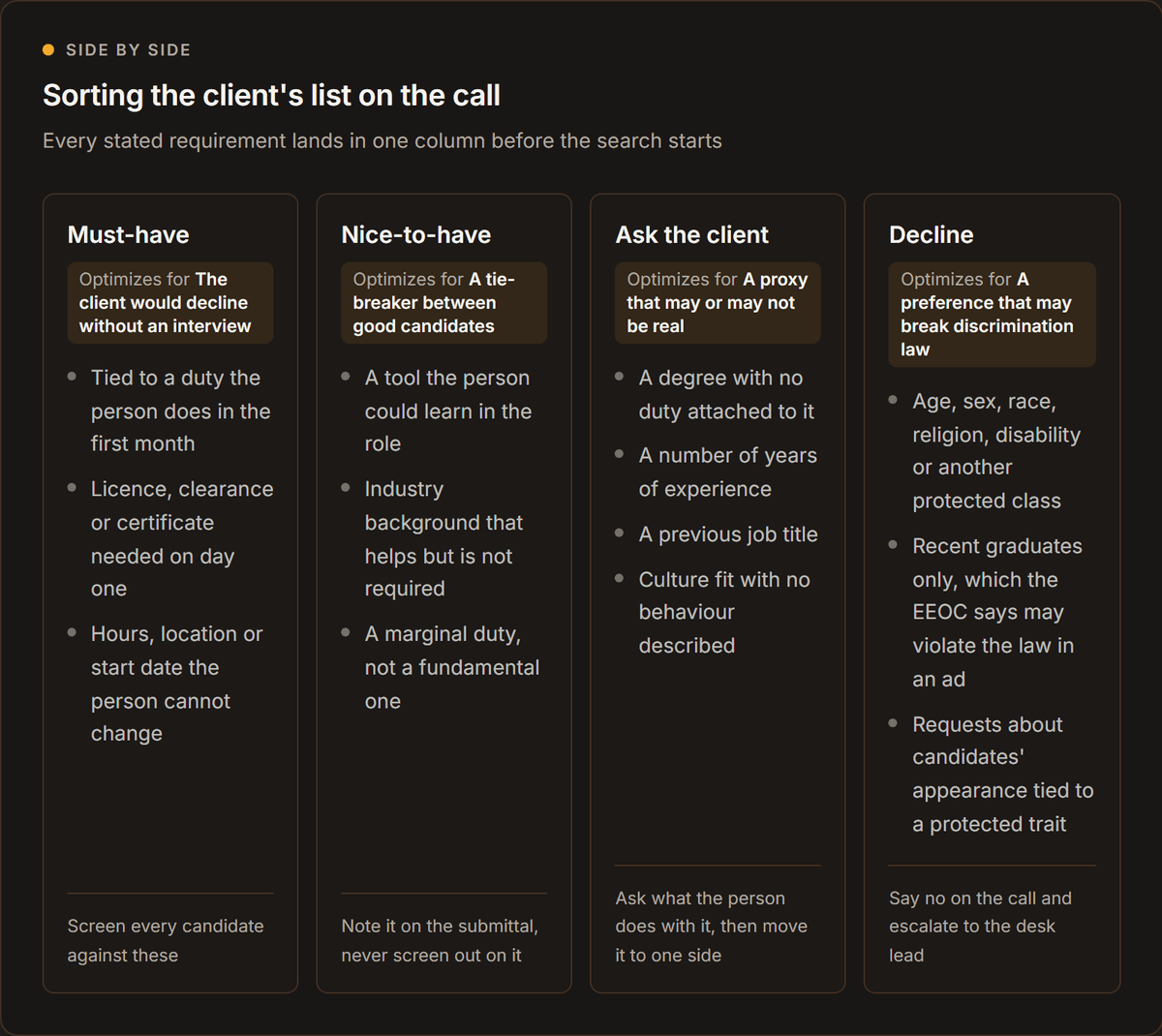
Test each requirement separately: "If a candidate lacked this, would you turn them down without an interview?" If the client hesitates, the requirement may be a preference rather than a genuine screening criterion. Mark it accordingly rather than treating every item on the job description as equally important.
- Start date, duration and hours.
Ask, "When do they start, how long will they be needed, and what hours, shifts or overtime will apply?" For temporary and contract roles, the expected end date is part of the job and should not be left until later.
- Location.
Ask, "Where is the work, where do they report on their first day, and is any of the work remote?" This gives the recruiter the actual working arrangement rather than relying on a generic location in the job description.
- Risks and equipment.
Ask, "Is there anything about the site or the work that a candidate should know about, and is there protective equipment they need to bring or wear?" The answer can materially affect whether a candidate is suitable and whether they will accept the role.
- Pay and benefits.
Ask, "What is the pay range for this role, and what benefits come with it?" If the role will be advertised in a jurisdiction with pay-transparency requirements, establishing the range at intake means the recruiter does not have to chase it later.
- Qualifications and authorisations.
Ask, "Which licences, certificates or clearances does the person need on day one, and which can they obtain after they start?" This separates genuine entry requirements from qualifications that can be completed later.
- The decision.
Ask, "Who sees the CVs, who interviews, and who gives final approval? How many candidates do you want to see in the first round, and in what format?" Knowing the decision process prevents the recruiter from sending candidates into an unclear approval chain.
- The last search.
Ask, "Who did you interview for this or a similar role last time, and why did the candidates you rejected miss?" This question is easy to skip, but it can reveal criteria that the client has not put into the written order. If hiring managers compare candidates with the pool they have already seen, understanding that previous pool gives the recruiter another way to understand what the client considers a fit. A completely new role will not have this history, so the duties and first-month questions become more important.
Send the confirmed order in writing the same day and wait for the client's confirmation
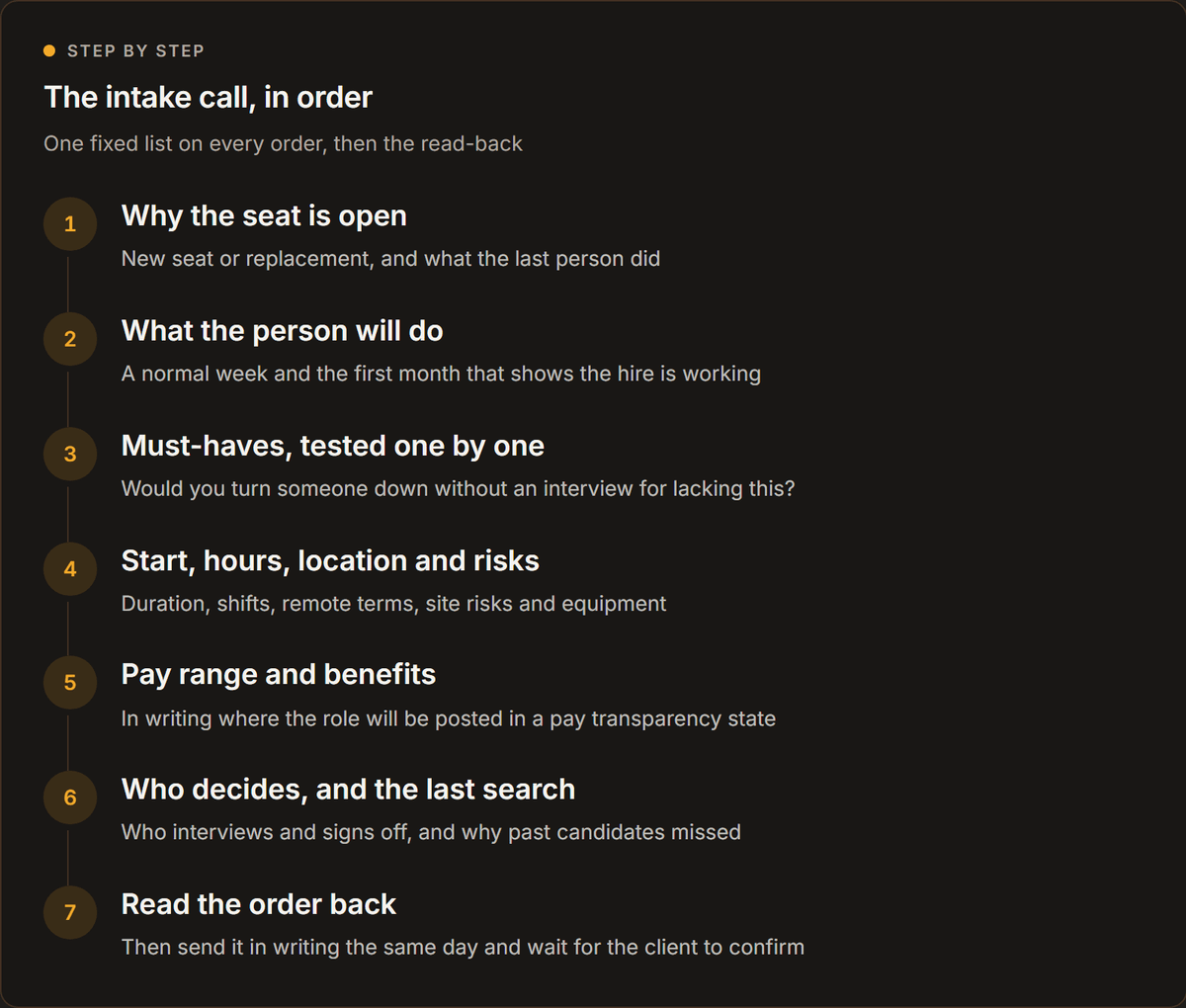
None of this needs to make the intake call unnecessarily long. The questions stay the same from order to order, so clients learn the process and recruiters spend less time improvising. We could not find reliable public data showing how long a structured staffing intake call typically takes or whether clients are more likely to accept orders using one, so measure that on your own desk.
If the client cannot explain what a successful first month would look like, do not take the order as complete. Arrange a short follow-up with the hiring manager before sourcing begins. The extra conversation is cheaper than sending candidates against a brief that the decision-maker has not actually agreed to.
Which requirements are real, and which are habit?
Most job orders arrive with a list of requirements: a degree, a certain number of years of experience, a previous job title or familiarity with particular tools. Some of these requirements describe what the person actually needs to do. Others are habits that have been carried forward because they are familiar or easy to screen for. The recruiter's job during intake is to separate the two and record the difference before sourcing starts.
The federal Uniform Guidelines on Employee Selection Procedures provide a useful rule of thumb. They say job analysis should focus on the important work behaviours and tasks required for successful performance.8 They also say content validity is not appropriate when a selection procedure tests knowledge, skills or abilities that an employee is expected to learn on the job.8 These rules govern how employers validate selection procedures rather than how staffing agencies conduct intake calls, but they give recruiters a useful test for every requirement: What will the person actually do with this, and do they need it on day one?
Disability law draws a similar distinction. Under the Americans with Disabilities Act regulations, essential functions are the fundamental duties of the position rather than marginal functions.8 For a recruiter, asking which duties are fundamental and which are marginal provides a practical way to sort requirements before candidates are screened.
Degrees are one of the clearest examples of a requirement that may be based on habit rather than the work itself. Indeed Hiring Lab reported in January 2026 that 19.3% of US job postings on Indeed required a bachelor's degree or higher in November 2025, compared with 16.6% in November 2023.9 Hiring Lab found that a substantial part of this increase came from higher degree requirements within occupations rather than simply from a change in the types of jobs being advertised.9 In other words, more roles within the same occupations were asking for degrees.
Research into large employers also suggests that removing degree requirements does not automatically change who gets hired. The Burning Glass Institute and Harvard Business School studied 11,300 roles at large companies and found that the increased opportunity created by removing degree screens resulted in fewer than one in 700 hires in the year they studied.1 Neither study measures staffing clients specifically, but both give recruiters a reason to question a degree requirement rather than automatically treating it as a must-have. Ask the client whether the person would actually be rejected without it, and record the answer.
Previous job titles can work in the same way. LinkedIn's Economic Graph Research Institute estimated in 2025 that using a skills-based approach could expand global talent pools by 6.1 times compared with searching based on previous job titles.10 LinkedIn's title-based pool counts people who held the same or an equivalent title during the previous five years, so it excludes people who may have the required skills under a different title.10 This is LinkedIn's own member data and measures potential reach rather than actual hires. The useful takeaway for a recruiter is to question the title requirement in the same way as the degree requirement.
When a client struggles to describe the work itself, the US Department of Labor's ONET programme provides a useful starting point. ONET describes occupations through knowledge, skills, abilities, activities and tasks, with more than 19,000 task statements linked to more than 2,000 detailed work activities.11 Reviewing the relevant tasks before an intake call can help the recruiter ask a simple question: Will this person actually be doing this?
When should you push back on a requirement?
Most pushback on a job order is about fit. A client may have a requirement that unnecessarily narrows the candidate pool without improving the chances of finding someone who can do the work. Other requests raise legal concerns. In those cases, the staffing firm cannot simply follow the client's instruction.
The US Equal Employment Opportunity Commission (EEOC) addressed staffing firms and their clients in enforcement guidance issued in December 1997, which remains in effect.12 Its position is clear: a staffing firm's reliance on a client's discriminatory assignment request does not protect the staffing firm from liability. The guidance also states that a client can be liable when it establishes discriminatory criteria for assigning workers.12 Both parties therefore need to take the requirement seriously. The fact that the client made the request does not make it safe for the agency to follow.
The EEOC's general guidance on prohibited employment practices applies the same principle to referrals. Employers, employment agencies and unions cannot consider race, colour, religion, sex or another protected characteristic when making decisions about job referrals.12 The EEOC also gives "recent college graduates" as an example of wording that could discourage people over 40 from applying and may violate age-discrimination law.12
That makes requests such as "someone young and hungry" or "a recent grad" requirements that a recruiter should not accept as written. Do not try to interpret what the client meant or quietly apply the preference during sourcing. Explain the concern, decline to screen on it and escalate the request to the desk lead.
State law can create additional requirements around the application process itself. Colorado's Job Application Fairness Act, for example, prohibits employers from asking for certain age-identifying information on an initial job application, including a person's date of birth, graduation dates or dates of attendance at an educational institution.13 The Act applies to an employer's initial application. If a Colorado client gives the staffing firm an application form that asks for graduation years, flag it during intake rather than assuming the form is acceptable.
The Uniform Guidelines on Employee Selection Procedures provide another reason to question requirements that have no clear connection to the work. Under the guidelines, a selection rate for a racial, sex or ethnic group that is less than four-fifths of the rate for the group with the highest selection rate is generally regarded as evidence of adverse impact.8 A recruiter is not expected to calculate this during an intake call. The point is that a requirement can have a disproportionate effect even when nobody intended it to. If a requirement has no clear connection to the work, there is a reason to question whether it belongs on the order.
For a request that crosses a legal line, the recruiter's response should be short and consistent:
- Decline the criterion on the call.
Say, "I can't screen on that, and I won't be sending candidates selected on that basis."
- Give a brief reason.
Say, "Staffing firms cannot take protected characteristics into account when referring candidates, and a client's request does not change that."
- Return to the work.
Say, "Tell me what the person needs to be able to do, and I'll find candidates who can do it."
- Record and escalate it.
Write down the request and the response, then tell the desk lead the same day.
The fourth step protects the recruiter as well as the firm. A junior recruiter may not feel comfortable challenging an important client. The desk lead can take over that conversation, and a written record means the outcome does not depend on anyone's memory.
Pushback on fit rather than law should be handled differently. The goal is not to tell the client that their preference is wrong. It is to test whether the preference is actually necessary to achieve the outcome they want.
For example, if the client says they need someone with a degree because the person must be able to run a night shift without supervision, connect the requirement to that outcome: "You want someone who can run the night shift unsupervised. I know people who have done that successfully without a degree. Can I send you one in the first round?"
That keeps the decision with the client while giving them an opportunity to test their own requirement against a real candidate. If the candidate can do the work, the client has evidence that the proxy was not necessary. If they cannot, the client has a clearer reason for keeping the requirement.
What does the law make you get on the intake call?
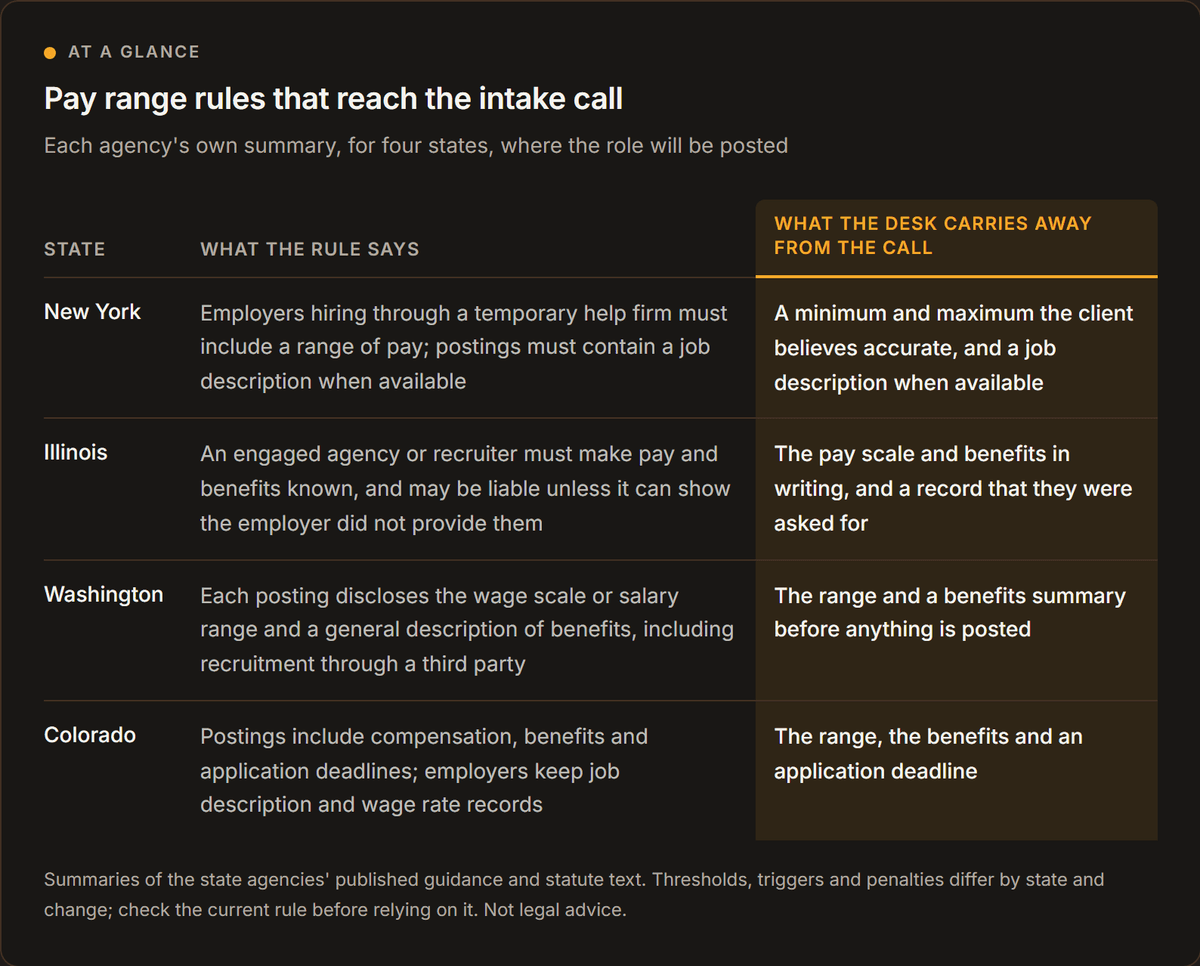
Pay is one of the clearest places where staffing intake and employment law meet in the United States. Several states have pay-transparency rules that require employers to include compensation information in job postings, and some of those rules also apply when a staffing agency or other third party posts the role. The requirements vary by state, including their thresholds, triggers and deadlines, and they can change over time.
The four states below illustrate how those rules can affect what a staffing desk needs to collect from a client. They are based on guidance and statutory information published by the relevant state agencies. They are not legal advice and are not a complete list of states with pay-transparency requirements.
New York.
The New York State Department of Labor says its pay-transparency law does not apply to temporary help firms seeking workers for other organisations. It does, however, require employers using temporary help firms to include a pay range. The range must contain the minimum and maximum annual salary or hourly rate the employer believes in good faith is accurate when the posting is made.14 The department also says a posting must include a job description when one is available, and that the employer must create one unless the job title adequately describes the duties.14 For a New York role, the intake call should therefore establish the pay range and obtain the job description where one is available.
Illinois.
The Illinois Department of Labor says that when an employer uses a third party, such as an employment agency or recruiter, to announce or publish a job opportunity, the third party must make the position's pay and benefits information available. The department also states that the third party may be liable if the posting does not contain the required information, unless it can show that the employer did not provide the necessary pay and benefits information.15 For an Illinois order, ask for the pay scale and benefits during intake and keep a record of the request and the client's response.
Washington.
Washington law requires an employer to disclose the wage scale or salary range and a general description of benefits and other compensation in a posting for each job opening.16 The definition of a posting also covers recruitment carried out indirectly through a third party. The law provides for statutory damages of between $100 and $5,000 per violation for each affected applicant or employee, and amendments made in 2025 introduced a cure period running through July 27, 2027.16 Because the rules can change, the current statutory text should be checked before relying on the cure period or penalty provisions. For intake, the desk should have the pay range and benefits information before the role is posted.
Colorado.
The Colorado Department of Labor and Employment says Part 2 of the Equal Pay for Equal Work Act requires employers to include compensation, benefits and application deadlines in job postings, to notify employees of job opportunities and hiring decisions, and to keep job description and wage rate records.13 So if a Colorado role will be posted, ask for the range, the benefits and an application deadline on the call.
How do you read the order back?
The read-back is the step that turns a conversation into a confirmed order. Before you hang up, repeat the order to the client in your own words and ask them to correct anything that is wrong or missing. It should be brief, but it gives the client one final chance to catch a mistake before the recruiter spends time searching.
Read it back in this order:
- The role in one sentence: what the person will do, where they will work, what hours they will work, when they will start and how long the assignment will last.
- The must-haves: list each requirement and the duty it supports.
- The nice-to-haves: label these clearly so they are not treated as screening requirements.
- The proxies you agreed to test: explain what each proxy is supposed to tell you and how you will test it through the candidate you submit.
- The pay range and benefits: for a role that will be posted in a state with pay transparency requirements, confirm that the client has provided the information needed for the posting.
- The submission process: confirm who reviews candidates, what format they want, how many candidates they want in the first round and when they expect to receive them.
Then ask one more question:
"If I sent you someone who matched all of that, is there any reason you would still say no?"
This is where unstated criteria often surface. The client may say that the person needs experience in an environment with similar work volume, or that they need to be comfortable working for a manager who is rarely on site. If the answer could affect who gets submitted, add it to the order.
The Burning Glass finding about candidate pools applies here too. Ask the client to describe the best person they have hired or interviewed for a similar role, as well as the closest miss. Concrete examples give the recruiter a benchmark. They also make vague requirements such as "good fit" easier to turn into something that can actually be screened.
If the read-back changes a must-have, send the corrected order to the client in writing the same day and wait for confirmation before making the first submittal. A candidate submitted against an unconfirmed order is based on a guess rather than an agreed brief.
Read the confirmed order back to the client and correct any gaps before the search starts.
The read-back also creates a process for collecting better feedback later. In Survale's 2025 CandE Benchmark Research, based on more than 66,000 completed candidate surveys collected between 31 January and 31 August 2025, only 23% of North American candidates said they received job-fit or qualification feedback as finalists.17 Those figures cover employers' candidates rather than agency candidates. A staffing desk can set a higher standard by asking clients to identify the requirement a candidate missed.
At the end of the call, say: "When you pass on anyone in the first round, tell me which must-have they missed. If it is not on this list, I need to know so I can fix the order."
That turns client rejections into useful data. If several candidates are rejected for the same requirement that was never included in the order, the intake process needs to change.
The Colorado Department of Labor and Employment states that Part 2 of the Equal Pay for Equal Work Act requires employers to include compensation, benefits and application deadlines in job postings. The rules also cover notices to employees about job opportunities and hiring decisions and require employers to keep certain job-description and wage-rate records. For a Colorado role, collect the compensation range, benefits and application deadline during intake.
Postings must include compensation, benefits and application deadlines; employers must keep job description and wage-rate records

What do you record, and where?
Write the order down on the same day, using the same form every time, and send the confirmed version to the client. A single job-order intake form gives the whole desk the same record. A colleague can take over the order, a desk lead can review it, and a disagreement about what the client asked for can be checked against what was recorded at intake.
Employment law provides a useful parallel. Under the ADA regulations, evidence of whether a function is essential includes the employer's judgment and written job descriptions prepared before applicants are advertised or interviewed.8 A job description recorded at intake serves a similar practical purpose: it captures what the client said the job required before candidates were assessed. Colorado's record-keeping requirements and New York's rules around job descriptions reinforce the value of keeping this information in writing.
Here is what the written order should contain.
| Field | What to write | Why it is there |
|---|---|---|
| Client and hiring manager | Company, decision-maker and anyone else who will review submittals | The submittal reaches the right person |
| Why the seat is open | New position or replacement, including what happened to the previous person | Gives the recruiter a benchmark and shows what to avoid |
| Duties | What the person does in a normal week and what success looks like in the first month | Provides the test for every requirement |
| Must-haves | Each requirement, with the duty it supports | These are the only criteria used to screen candidates |
| Nice-to-haves | Each preference, clearly labelled | These are tie-breakers, not screening criteria |
| Proxies to test | Any degree, years of experience or previous title that does not have a specific duty attached | Records what the proxy is supposed to demonstrate and how it will be tested |
| Start, duration, hours and location | Start date, assignment length, shifts, end date, worksite and remote-work rules | Candidates need these facts before deciding whether the role works for them |
| Risks and equipment | Known site risks and any required protective equipment | Can affect who is suitable and who will accept the assignment |
| Pay range and benefits | Minimum and maximum pay, benefits and pay interval | Required on some job postings and needed to qualify candidates properly |
| Posting details | Where the role will be posted and any application deadline | Records the conditions attached to the posting |
| Declined requests | Any requirement the recruiter refused to accept, with the reason and who was informed | Protects the recruiter and the staffing firm |
| Submittal terms | Number of candidates, submission format and deadline | Gives the recruiter and client the same definition of speed |
| Read-back confirmed | Date the client confirmed the written order | Establishes when the search officially started |
Store these details in structured fields rather than putting everything into a free-text notes box. A desk lead should be able to identify every open order that is missing a pay range, a confirmed read-back or another required field. A notes box cannot reliably be counted, filtered or audited.
Keep declined requests with the order as well. The record should show what the client asked for, what the recruiter declined to use, why it was declined and when the desk lead was informed. That gives the desk a complete history of the order rather than only the requirements that eventually made it into the search.
The structure also makes the process measurable. If the desk later wants to know how often orders are missing pay information, how often clients change a must-have after the read-back or how often candidates are rejected for a requirement that was not recorded, the data is already captured in a consistent format.
How fast should the first submittal go?
Send the first submittal soon after the client confirms the order, but not before. We found no public, dated source that sets a standard for how quickly a staffing firm should make its first submittal. The more useful benchmarks come from employers' own hiring timelines.
SHRM's 2025 benchmarking, based on 2,371 members who responded to a survey of a random sample of its membership, put median time to fill at about a month and a half for both executive and nonexecutive roles.3 The measure runs from the requisition opening until the offer is accepted. Ashby's platform data shows a median of 30 days to hire for business roles, with 75% of roles closing within 46 days.4 These figures come from employers hiring directly and use different measures. The guide to time to fill and time to hire explains the difference.
The practical point is that a client using a staffing firm is usually working against a timeline measured in weeks. Some of that timeline may already have passed before the recruiter receives the order.
Speed also affects the candidate experience. Survale's 2025 CandE research found that when employers made an offer within one week of the final interview, candidates' willingness to refer others increased by 108%.17 That finding concerns offers and referrals at employers, not staffing-firm submittals. It does, however, show that candidates notice how quickly a hiring process moves. A desk that allows a process to stall can lose goodwill with candidates it may want to place again.
That does not mean submitting candidates before the order is confirmed. The process in this guide puts the speed after the read-back:
- Take the order using the fixed intake list and read it back on the call.
- Send the written order to the client the same day.
- Prepare the shortlist while waiting for confirmation. Search the desk's database and network so suitable candidates are ready to contact once the order is confirmed.
- Send the first round as soon as the client confirms. Screen against the agreed must-haves and include one calibration candidate where useful. Label that candidate clearly so the client understands that the submission is also testing the agreed brief.
We found no public study that measures the trade-off between speed and fit on a staffing desk, so this sequence is a recommendation rather than an industry benchmark. Measure it against your own numbers. The next section shows what to track so the desk can see whether faster, better-confirmed intake actually improves first-submittal fit.
How does a desk lead know intake is working?
Measure it on your own desk. We found no public source that measures how often staffing submittals miss the brief, the submittal-to-interview ratio on a staffing desk or what a structured intake call changes about either measure. Treat any industry figure quoted for these metrics with care unless the methodology is clear. Your own numbers will tell you what is happening with your clients.
Start with one measure: first-submittal acceptance rate. For every order, count the candidates in the first round and the number the client agrees to interview. Divide the number accepted for interview by the number submitted. Track the result by recruiter and client each month.
Then add one field to every rejection: the reason, linked to the order. Keep the list short and consistent:
- Missed a must-have that was on the order.
- Missed a requirement that was not on the order.
- Pay, hours or location did not work for the candidate.
- The client changed the role after the order was confirmed.
- Other, with a note.
The second reason is the one the intake process is designed to control. If it appears frequently on one recruiter's orders, listen to their intake calls and pay particular attention to the final read-back question: "Is there any reason you would still say no?"
If the third reason is common, the recruiter is probably not covering pay or practical requirements early enough. If the fourth is concentrated around one client, the problem is more likely the client's process than the recruiter's intake. That conversation belongs with the desk lead and account owner.
Then check the quality of the order itself. Count how many orders from the previous month have all three of these:
- a confirmed read-back date;
- a recorded pay range; and
- must-haves linked to specific duties.
Compare their first-submittal acceptance rate with orders missing one or more of those fields. This does not prove that the intake process caused the difference. It tells the desk lead which calls and orders are worth reviewing first.
Keep the measure honest
A useful metric is only useful if the desk measures it consistently.
- Count orders, not calls. The second call is often where important requirements emerge.
- Separate new clients from repeat clients. Repeat orders should become easier to take as the desk learns the client.
- Compare similar desks. A light-industrial desk and an IT contract desk have different hiring patterns, so one acceptance-rate target may not be meaningful for both.
- Look at the trend over a quarter. A small number of orders can make a weekly percentage move sharply.
Most organisations in SHRM's survey did not use quality-of-hire metrics. Recording the reason for every rejection gives the desk its own data on whether candidates are missing the agreed brief. The guide to measuring quality of hire covers what to track once a placement starts.
Coach from the recordings
The metric tells you that something is happening. The call recording can show why.
A desk lead who listens to two or three intake calls per recruiter each week, with the fixed intake list in front of them, can identify skipped questions quickly. They may hear the recruiter rush through the duties, accept a degree requirement without asking what it is meant to demonstrate, leave pay until later or skip the final read-back.
That makes coaching specific. Instead of telling a recruiter to "improve intake," the desk lead can point to the question that was missed and practise how to ask it.
The guide to getting hiring managers to back a new process covers the client side of the same problem, particularly when a client is used to sending a job title and salary and is asked to participate in a more structured intake call.
Conclusion
A better first submittal does not start with faster sourcing. It starts with a better order.
If you want to put this playbook into practice, start with four changes:
- Use one intake form for every new order. Capture the duties, must-haves, nice-to-haves, proxies, pay, hours, location, decision-maker and submission process in the same order every time.
- Read the order back before you search. Ask the client to correct it, then finish with: "If I sent you someone who matched all of that, is there any reason you would still say no?" Record the answer.
- Do not submit against an unconfirmed brief. Send the written order the same day. Prepare the candidate pool while you wait, then send the first round as soon as the client confirms.
- Track why the first round succeeds or fails. Record how many candidates were submitted, how many were accepted for interview and why anyone was rejected. Review the results by recruiter and client each month.
- Then coach from the data. If candidates are repeatedly rejected for requirements that were never on the order, improve the intake call. If pay, hours or location are causing the misses, fix the practical questions. If one client repeatedly changes the brief after confirmation, address the process with the account owner.
The aim is not a longer intake call or more paperwork. It is fewer surprises after the recruiter starts sourcing.
The simplest test is this: if you sent the client someone who matched everything you wrote down, would they still have a reason to say no? If the answer is yes, do not search harder. Go back to the order, find the missing requirement and fix the brief first.
Where Hivemind fits on a staffing desk
The intake call is still a conversation between the recruiter and the client. No software can decide what the client actually means by "must-have," uncover an unstated requirement or push back when a requirement does not relate to the work. Those decisions happen during the intake process described in this guide.
The value of a hiring system starts once the client has confirmed the order. The recruiter now has an agreed brief that needs to become a working candidate pipeline. That means finding candidates, screening them against the requirements, assessing skills where needed, keeping candidates informed and moving suitable people towards interview and offer.
This is where Hivemind fits.
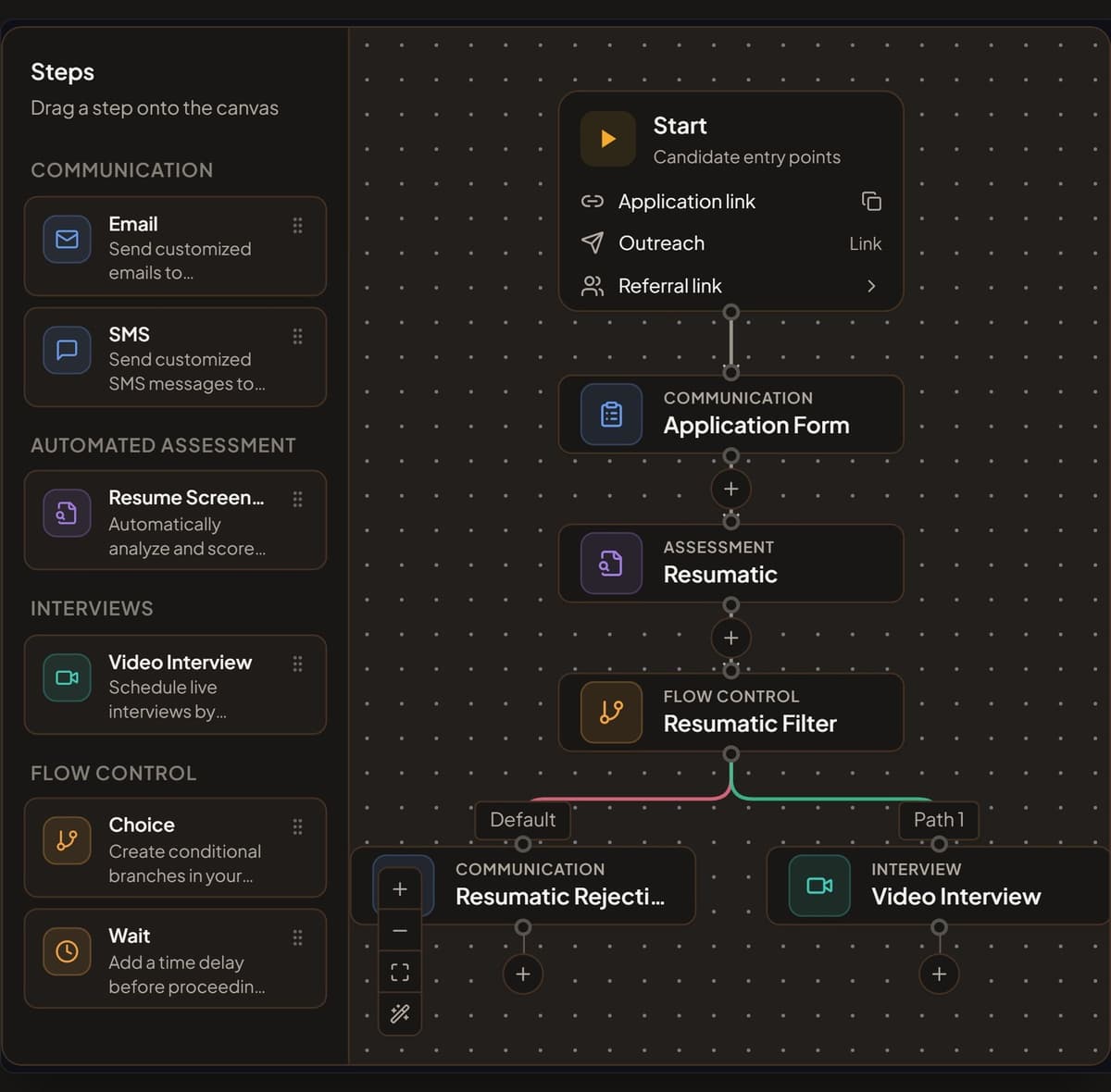
Hivemind is a hiring OS that brings sourcing, screening, interviews, offers and the administration around them into one workflow. A staffing desk can run Hivemind end to end, connect its existing tools, or mix and match both.
Among the modules:
- Resumatic: AI-Powered Resume Filtering System
- Automated Skills Assessments
- Automatic Video Assessment: AI-Powered Video Interview Analysis
- Automated Emails: Smart Email Automation for Recruitment
- SMS Follow-Ups: Automated Candidate Text Messaging
Hivemind has 15 Native Modules and 275 Integrations.
The important distinction is between intake and execution. The recruiter still owns the client conversation, decides whether the requirements make sense and confirms the order. Once that order is agreed, every candidate can be managed from inbound to offer in one unified workflow.
For a staffing desk using this playbook, the workflow can therefore look like this:
Client intake → read-back → confirmed order → candidate pipeline → screening → assessment → interview → offer
The first two steps depend on the recruiter. The steps that follow run in one unified workflow.
Once the order is confirmed, the workflow builder is where a team can build the exact pipeline the desk needs.
Frequently asked questions
What is a job order in staffing?
A job order is a client's request for a staffing firm to fill a role. It gives the recruiter the information needed to find suitable candidates, including the duties, must-haves, dates, hours, location, pay and decision-maker. The recruiter takes this information during the intake call, reads it back to the client and records the confirmed version so everyone works from the same brief.
What questions should a recruiter ask on a job order intake call?
Ask why the role is open, what the person will do in a normal week, what success looks like in the first month, which requirements would cause the client to reject someone before an interview, the start date, duration, hours, location, site risks, pay, benefits and who makes the hiring decision. Ask why previous candidates for similar roles were rejected. Then read the order back and ask whether there is any other reason the client would say no to a candidate who meets the agreed requirements.
Does a staffing agency have to include a pay range in a job posting?
It depends on the state and the circumstances. New York requires employers using temporary help firms to include a pay range in covered postings. Illinois requires an engaged employment agency or recruiter to make pay and benefits information available and can impose liability in some circumstances. Washington's posting rules cover recruitment through third parties, while Colorado requires compensation and benefits information in covered postings. Because these rules differ and change, check the current requirements for the location before posting. For the staffing desk, the practical rule is simple: get the applicable pay information in writing during intake.
Can a staffing firm follow a client's discriminatory request, such as one for a certain age or sex?
No. A staffing firm should not accept or act on a discriminatory client requirement. The EEOC has stated that a staffing firm can be liable for complying with a client's discriminatory assignment request, and the client's request does not protect the staffing firm from liability. Decline the criterion, explain that candidates cannot be selected on that basis and escalate the request to the desk lead or appropriate legal contact.
What counts as a must-have?
A must-have should be something the person genuinely needs to perform an important part of the job. Tie every must-have to a specific duty. A required licence for work that cannot legally be performed without it is a clear example. A degree, number of years of experience or previous job title may instead be a proxy for a skill the client actually needs. Ask what the candidate must be able to do with that qualification or experience before making it a screening requirement.
How many candidates should go in the first submittal?
Agree the number with the client during the intake call and record it on the order. The first round can also include one calibration candidate who meets the actual duties but does not meet one of the client's proxies, such as a degree requirement. Label the candidate clearly and use the client's response to test whether the proxy is genuinely necessary. The goal is not to increase the number of candidates submitted. It is to learn whether the agreed brief produces the right shortlist.
Should a recruiter wait for written confirmation before submitting candidates?
Yes. Prepare the candidate pool while waiting, but do not make the first submittal against an unconfirmed order. If the client changes a must-have during the read-back, update the written order and get confirmation before submitting. This prevents the recruiter from being judged against requirements the client never clearly agreed to.
How do you measure whether intake calls are working?
Start with the first-submittal acceptance rate: divide the number of candidates the client agrees to interview by the number submitted in the first round. Track it by recruiter and client over time. Record a reason for every rejection and link it to the order. If candidates are repeatedly rejected for requirements that were never recorded, the intake process needs attention. If rejections are mainly caused by pay, hours or location, those questions need to be covered earlier. If one client repeatedly changes the brief after confirmation, the issue may sit with the client's hiring process rather than the recruiter.
Sources
- Burning Glass Institute and Harvard Business School: Skills-Based Hiring: The Long Road from Pronouncements to Practice ↩
- Greenhouse: 2024 Candidate Experience Report ↩
- SHRM: 2025 Recruiting Executives Benchmarking ↩
- Ashby: Recruiter Productivity, Talent Trends Report ↩
- ClearlyRated: How NPS Helps Staffing and Recruiting Firms Grow ↩
- UK legislation: Conduct of Employment Agencies and Employment Businesses Regulations 2003, regulation 18 ↩
- GOV.UK, Department for Business and Trade: The Conduct Regulations, regulation 18 guidance ↩
- Electronic Code of Federal Regulations: Uniform Guidelines on Employee Selection Procedures and ADA regulations, definitions ↩
- Indeed Hiring Lab: Where Do College Degrees Still Matter in a Skills-First Job Market? ↩
- LinkedIn Economic Graph Research Institute: Skills-Based Hiring 2025 Report ↩
- O*NET Resource Center: About O*NET ↩
- US Equal Employment Opportunity Commission: Enforcement Guidance on contingent workers placed by staffing firms and Prohibited Employment Policies and Practices ↩
- Colorado Department of Labor and Employment: Job Postings and Hiring ↩
- New York State Department of Labor: Pay Transparency Law, fact sheet for employers ↩
- Illinois Department of Labor: Equal Pay Act salary transparency FAQ ↩
- Washington State Legislature: Revised Code of Washington, wage and benefit disclosure in postings ↩
- Survale: 2025 CandE Benchmark Research, key statistics ↩
- Indeed: Pay Transparency Across High-Earning Sectors
- National Bureau of Economic Research: The Impact of Pay Transparency in Job Postings on the Labor Market
- American Economic Association: Is Pay Transparency Good?, Journal of Economic Perspectives