

California SB 947, signed on 30 September 2026, includes a labor contractor within its definition of an employer but does not define the term.12 From 1 July 2027, employers may not rely solely on software for discipline or termination decisions. Where a decision primarily relies on software, a human must corroborate it, and the employer must give notice after use and, on request, describe the employee's data.
Key takeaways
- From 1 July 2027, SB 947 bars relying solely on software for discipline or termination decisions, and a human must corroborate any decision that primarily relies on it.
- The law includes a labor contractor in its definition of an employer but does not define the term, so how it applies to a staffing agency and its temps is still open.
- Covered decisions can also trigger a post-use notice and, on request, a description of the employee's own data.
- SB 947 does not clearly split duties between the agency and a client that runs the software, so document who reviews an automated recommendation before action is taken.
- Start now: inventory the automated tools your agency and clients use, map the decisions they influence, and put a documented human review around each one.
The law does not clearly explain how these requirements apply to a staffing agency and its temporary workers. It also leaves questions about whether ending a worker's assignment should be treated as a termination. Another open question is how responsibility should be divided between a staffing agency and the client that directs the worker's day-to-day activities. The meaning of "primarily relies" will also need to be established.
This article examines what the chaptered text actually says, including the wording that is particularly important for staffing agencies. It also considers what the committee analyses and other California rules add to the picture. The focus is on the steps an agency may want to take before the law becomes effective, particularly when using automated systems in its own hiring process or when making decisions about worker placements.
The law's application to a specific staffing agency will depend on its circumstances and should be assessed with legal counsel. This article is intended to explain the legislation and identify practical preparation steps. It is not legal advice.
In this article
- What does SB 947 require, and from when?
- Does SB 947 apply to a staffing agency and its temps?
- What counts as an automated decision system?
- How common is software-driven discipline at work?
- When does a person have to check the software's call?
- What goes in the post-use notice?
- What must the agency hand over when a temp asks for their data?
- What SB 947 says about applicants and hiring tools
- How SB 947 sits beside the Civil Rights Council and CPPA rules
- Who enforces SB 947, and what does a violation cost?
- How other states and cities handle the same decisions
- Could federal action stop SB 947 before July 2027?
- What should a California staffing agency do before 1 July 2027?
- Conclusion
- Frequently Asked Questions
What does SB 947 require, and from when?
Governor Gavin Newsom approved SB 947 on 30 September 2026. The Secretary of State chaptered it on the same day as Chapter 859, Statutes of 2026. The bill's author, Senator Jerry McNerney, described it as "the first such law in the nation." The California Federation of Labor Unions sponsored the legislation and announced it on 3 February 2026 as the return of the No Robo Bosses Act.
The law follows an earlier version, SB 7, which Governor Newsom vetoed on 13 October 2025. In his veto message, Newsom argued that SB 7 created "unfocused notification requirements" for businesses using automated tools, including tools that presented little risk. He also pointed to forthcoming California Privacy Protection Agency rules that would address some automated decision-making in disciplinary, termination and deactivation decisions. His position was that those rules should first be given an opportunity to work before introducing additional requirements.
The final version of SB 947 places several specific limits on how employers can use automated decision systems (ADSs) when making disciplinary or termination decisions.
Employers cannot rely solely on an automated system.
An employer may not rely only on an ADS when deciding whether to discipline or terminate an employee. The automated system can therefore form part of the decision-making process, but it cannot be the sole basis for the decision.
A human must corroborate certain decisions.
If an employer primarily relies on an ADS output when making a disciplinary or termination decision, it must have a human corroborate the decision. The human reviewer must be able to assess the output. If the output cannot be corroborated, or the reviewer determines that it is inaccurate, incomplete or misleading, the employer cannot use that output to make the decision.
The employee must receive notice.
When an employer has primarily relied on an ADS for the decision, it must provide the employee with written notice at the time it informs the employee of the disciplinary or termination decision.
Employees can request a description of their own data.
Where an ADS was primarily used to make the decision, the employee can request a "meaningful, objective description" of the employee's own data that was used by the system. The law therefore gives the employee a limited way to understand what information about them contributed to the automated decision.
SB 947 also prohibits two specific uses of automated decision systems. An employer may not:
- Use an ADS to infer an employee's protected status under Government Code section 12940.1
- Use an ADS to predict whether a worker will exercise legal rights and then take adverse action against that worker because of the prediction.
The law provides for a penalty of $500 per violation. Its requirements take effect on 1 July 2027. This gives employers time to review the automated systems they use and determine where human review, employee notices and data-access processes may need to be built into their existing procedures.
The final law is narrower in several respects than the version that initially moved through the Legislature. The Senate floor analysis records that Assembly amendments removed independent contractors from the bill's coverage. They also removed provisions concerning automated decision-making for deactivation decisions. The amendments narrowed the information an employee can obtain through a data request, removed the employee's right to bring a civil action, and moved implementation to 1 July 2027.
For staffing agency owners who followed the bill earlier in 2026, this distinction matters. The version that was discussed during the legislative process is not necessarily the version that became law. The chaptered text is the version that determines the obligations that will apply from July 2027.
Does SB 947 apply to a staffing agency and its temps?
Whether SB 947 applies to a staffing agency and its temporary workers starts with the law's definition of an employer. The statute defines an employer as a person who directly or indirectly, or through an agent or another person, employs someone or exercises control over that person's wages, hours or working conditions. It then adds that an employer includes "a labor contractor of a person defined as an employer under subparagraph (A)."
This could potentially cover both sides of a staffing arrangement. A client that controls a temporary worker's hours may fall within the first part of the definition. An agency that supplies the worker could potentially fall within the reference to a "labor contractor." However, SB 947 does not define that term, so the statute itself does not resolve whether a particular staffing agency is covered.
The Senate floor analysis identifies the American Staffing Association, the California Staffing and Recruiting Association and California Staffing Professionals among the organizations that opposed the bill. Their inclusion in the legislative record shows that the staffing industry raised concerns during the legislative process, but it does not establish how SB 947 applies to a particular agency.
SB 947 does not define "labor contractor"
The closest existing statutory definition appears in Labor Code section 2810.3. It describes a labor contractor as an individual or entity that supplies a client employer with workers to perform labor within the client employer's usual course of business, whether or not there is a contract.
That definition applies specifically to Labor Code section 2810.3. It is not the definition used by SB 947. SB 947 does not expressly incorporate the Labor Code definition, so it would be risky to assume that the two terms have exactly the same meaning.
The law covers employees and disciplinary or termination decisions
SB 947 applies to employees. The Assembly amendments removed independent contractors from the bill, so the worker's employment status matters when assessing whether the law applies.
The law also focuses specifically on disciplinary and termination decisions. This creates an additional question for staffing agencies because a temporary worker's assignment can end without the worker necessarily leaving the agency's employment. A worker may simply be available for another placement.
The law does not say whether ending an assignment is a termination
SB 947 does not explain whether ending a temporary assignment counts as a termination. It refers to "disciplinary or termination" decisions but does not specifically address assignments.
The enforcement provision creates an additional complication. It refers to situations in which "an ADS was used to make a disciplinary or deactivation decision." The employer must then show that it did not primarily rely on the ADS or that it complied with the required review and notice provisions when making the disciplinary or termination decision.
The reference to "deactivation" remains in the enforcement provision even though the separate provision that would have specifically regulated automated deactivation decisions was removed during the legislative process. We did not find guidance explaining how these provisions should be read together.
As a result, an agency may want to take a cautious approach to automated decisions that end or restrict a worker's placement. This could include an early end to an assignment, a "do not return" decision or a system-based deactivation. Whether any of these actions legally constitutes a termination or another covered decision will depend on how the statute is interpreted and the circumstances of the particular employment relationship.
The potential scale is significant. The American Staffing Association reports that nearly 2.2 million temporary and contract employees worked through US staffing companies during an average week in 2024.3 That figure covers the entire United States, and we did not find a comparable California-specific figure in the sources reviewed.
Who carries the duty, the agency or the client?
SB 947 does not clearly allocate its duties between a staffing agency and its client. The definition of employer could potentially describe both parties. A client may exercise control over a worker's hours or working conditions, while the agency may employ the worker and supply them to the client.
The statute does not specify which party must conduct the human corroboration, provide the required notice or respond to an employee's request for a description of their data when the automated decision originates with the client. The legislative analyses reviewed do not resolve this issue either. We found no case law addressing the question either.
SB 947 does not give an agency rulemaking authority to clarify these staffing arrangements. Unless further legislation, regulation or case law provides more detail, the allocation of responsibility may therefore remain uncertain when the law takes effect on 1 July 2027.
For staffing agencies, the practical point is that it may be risky to assume that an automated decision made by a client is solely the client's responsibility. If a client's system flags a temporary worker and the agency acts on that decision, the agency may need to establish with counsel which party is responsible for each SB 947 obligation and how the two parties will handle the process.
What counts as an automated decision system?
SB 947 defines an automated decision system (ADS) as "any computational process derived from machine learning, statistical modeling, data analytics, or artificial intelligence" that produces a simplified output, such as a score, classification or recommendation. That output must be used to assist or replace human decision-making and must materially affect a person.
The law also excludes several types of technology from the definition. These include spam filters, firewalls, antivirus software, identity and access management tools, calculators, databases, datasets and other compilations of data.
This means a staffing agency cannot determine whether a tool is covered simply by asking whether it uses AI. The tool needs to be assessed against each part of the statutory definition. The process behind it matters. So does the type of output it produces, how that output is used and whether it materially affects a person.
For example, a database containing employees' clock-in times is a compilation of data and is expressly excluded. A system that analyses those times and produces an "attendance risk: high" classification is different. The agency would need to consider whether the system uses statistical modelling or data analytics, whether its output assists or replaces human decision-making and whether the resulting decision materially affects the worker.
The UC Berkeley Labor Center describes workplace automated decision tools as systems that can rank workers, predict their future behaviour or characteristics, or direct how they perform their work. These uses can overlap with the types of tools staffing agencies and their clients may already use.
On a staffing desk, agencies may therefore want to review tools such as:
- A no-show or late-arrival score calculated from clock-in data.
- A client rating system that converts supervisor ratings into a "do not redeploy" status.
- A productivity ranking generated by a warehouse client and shared with the agency.
- A rule that automatically marks a temporary worker as inactive after a specified number of missed shifts or unanswered messages.
- A model that recommends which temporary workers should be released first when a client reduces its headcount.
Not every tool on this list will necessarily meet the statutory definition. The important point is to examine what the system actually does and how its output is used, rather than relying on the product label or the fact that the technology is described as AI.
Screening and matching tools used before a worker is placed with a client raise separate questions. Those tools should be assessed against the relevant requirements as part of the agency's broader review of automated decision-making. See also automated candidate screening for a more detailed discussion of those systems.
How common is software-driven discipline at work?
The available research suggests that software-driven management is already common in US workplaces, although the findings need to be read with some caution. The studies use different samples and measure different types of technology, so they do not provide a single figure for how often software is used to discipline or terminate workers.
The UC Berkeley Labor Center notes that employers can use automated decision systems to fully automate decisions such as discipline or firing. It specifically identifies front-line and temporary workers as groups that may be affected. The research also describes automated systems being used to monitor productivity and make consequential decisions about workers.
A 2024 nationally representative survey of 1,273 US workers, conducted through YouGov for the Washington Center for Equitable Growth, found that automated surveillance affected more than two-thirds of workers and automated management of tasks and schedules around a third.4 The survey measured workplace monitoring and automated management more broadly, rather than software-driven discipline specifically. That distinction matters when applying the findings to SB 947.
A separate 2025 survey commissioned by Resume Builder asked 1,342 US managers with direct reports about their use of AI in managing employees. Among managers who used AI, 64% said they used it to help determine terminations. More than 20% said they allowed AI to make decisions without human input either all the time or often.5 The survey was conducted online through Pollfish and was commissioned by Resume Builder, so its results are better treated as an indication of how some managers are using AI rather than as a representative measure of US workplaces as a whole.
The OECD provides a broader employer-side view. Its 2025 study of algorithmic management, the use of software to fully or partially automate tasks traditionally carried out by human managers, surveyed over 6,000 firms across France, Germany, Italy, Japan, Spain and the United States.
These studies do not show how many California staffing agencies use software to discipline, deactivate or terminate temporary workers. We could not find a source that measures that specific population. The evidence therefore supports the broader point that software-assisted management is already established in US workplaces, while the extent of its use by California staffing agencies remains unclear.
When does a person have to check the software's call?
This is one of the provisions most likely to affect an agency's day-to-day processes. The key trigger is the word "primarily."
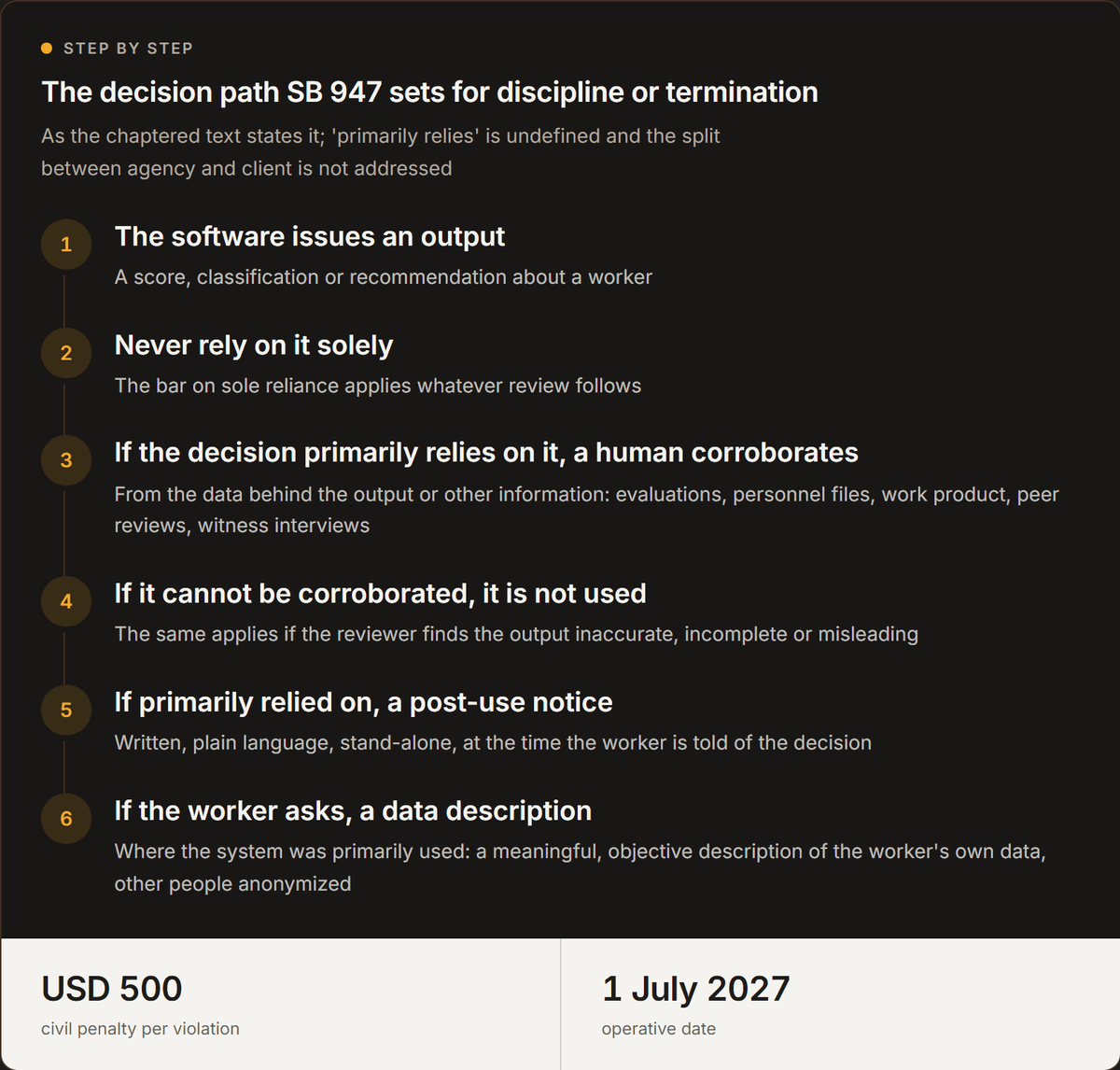
SB 947 prohibits an employer from relying solely on an automated decision system (ADS) when making a disciplinary or termination decision.6 Primary reliance is different. An employer can primarily rely on an ADS output, but it must then direct a human to corroborate the decision.
The human reviewer must use the data that was collected or used to produce the ADS output, or other relevant supporting information. The law gives several examples of information that can be used for corroboration. These include supervisory or managerial evaluations, personnel files, an employee's work product, peer reviews and witness interviews. Witness interviews may include relevant online customer reviews.
If the output cannot be corroborated, it cannot be used for the decision. The same applies if the human reviewer finds that the output is inaccurate, incomplete or misleading. The California Chamber of Commerce's summary of the signed law reaches the same basic conclusion: employers can continue to use automated systems in disciplinary and termination decisions, but a human must independently corroborate the decision when the employer primarily relies on the system's output.7
What "primarily relies" leaves open
SB 947 does not define "primarily relies." The Assembly Judiciary Committee analysis identified the same uncertainty, noting ambiguity over how to determine whether an adverse decision was based "solely" or "primarily" on an ADS, rather than the system being one factor among several.
The law also does not give an agency rulemaking authority to resolve this question. Unless further legislation, regulation or case law provides clarification, agencies will need to work with an undefined standard when the law takes effect on 1 July 2027.
The burden of proof makes this uncertainty important. Once it is established that an ADS was used, the employer must show either that it did not primarily rely on the system or that it complied with the required review and notice provisions.
For a staffing agency, it may therefore not be enough for a coordinator to say that "the software only flags, a person decides." The agency should be able to show what the person actually reviewed and how the final decision was reached. A documented and genuinely independent review could help demonstrate that the employer did not simply adopt the automated output. It can also provide evidence that the required corroboration took place when primary reliance did occur.
The prohibition on sole reliance still applies regardless of how the agency characterizes the decision. The same is true of SB 947's two specific prohibitions concerning protected status and adverse action for exercising legal rights.
A comparator: the CPPA's human involvement test
California's privacy agency has developed its own approach to human involvement for businesses covered by the California Consumer Privacy Act. Its regulations address situations where technology substantially replaces human decision-making. Under that framework, human involvement requires a reviewer who understands how to interpret and use the system's output, considers the output alongside other relevant information, and has the authority to make or change the decision based on their analysis.8
SB 947 does not adopt this test. The two frameworks should therefore not be treated as interchangeable, and there is currently no guidance explaining how they interact.
As a practical recommendation rather than a requirement imposed by SB 947, a staffing agency could use the CPPA approach as a useful model when designing its review process. The reviewer could be trained to understand what the score or classification means. They could review the underlying information and obtain relevant information from the supervisor or client. Most importantly, they should have genuine authority to disagree with the automated output and change the proposed decision.
A structured review form could also make this process easier to document. Recording the output, the evidence reviewed and the reviewer's conclusion creates a clearer record than a general note saying that a person "checked" the system's recommendation. This is similar to how named criteria supported by written evidence can make an interview score card easier to defend.

What goes in the post-use notice?
When an employer primarily relies on an automated decision system for a disciplinary or termination decision, SB 947 requires a written notice when the employee is informed of the decision.1 The notice must be written in plain language and provided as a separate, stand-alone communication. It must be delivered through a simple and easy-to-use method, such as email, a hyperlink or another written format.
This means the notice should not simply be buried inside a termination letter or another document. The employee should be able to identify it as a separate communication explaining the role of the automated system in the decision.
The notice must state that the employer primarily relied on an automated decision system for the decision. It must also explain that a human reviewed the decision and corroborated the system's output.
The notice must provide contact information for a human who can answer questions about the decision. It must also tell the employee about their right to request a description of their own data used by the system. Finally, it must state that the employer may not retaliate against the employee for exercising their rights under the law.
SB 947 only requires this notice after the automated system has been used for the decision. This is different from SB 7, the earlier version of the legislation. SB 7 would have required written notices both before and after the use of an automated decision system. It also would have applied those notices to affected workers and job applicants. The Senate Labor Committee analysis noted that SB 947 removed those pre-use notification requirements and no longer applied the provision to job applicants.
For a staffing agency, the timing could create a practical issue. An agency that normally records warnings or ends assignments by phone or text will need a separate written notice ready when a covered decision is communicated. The notice will also need to identify a person the worker can contact.
The interaction between an agency and its client could make timing more complicated. For example, a client site manager might tell a temporary worker not to return to the site, while the agency coordinator only learns about the decision later that day. SB 947 does not clearly explain which communication starts the notice requirement in that situation.
One way to reduce that uncertainty would be to require clients to send covered decisions to the agency before communicating them to the temporary worker. The agency could then manage the human review, the decision communication and the required notice through one documented process. Whether that allocation is legally sufficient for a particular staffing arrangement should be confirmed with counsel.
What must the agency hand over when a temp asks for their data?
When an employer has primarily used an automated decision system (ADS) for a disciplinary or termination decision, the employee can request a meaningful, objective description of their own data used by the system. The employer must provide that description in a way that anonymizes personal information belonging to customers, other employees, or other individuals. The Assembly narrowed the original proposal, so the right is to a description of the employee's own data rather than a broader disclosure of the system or its underlying records.
Three practical points matter for a staffing agency.
- The agency needs to know what data the system used.
If the scoring or recommendation runs inside the client's system, the agency may not have direct access to the underlying data. The agency's contract with the client can require the client to provide the information needed to respond to a request. That contractual arrangement, however, does not by itself determine which party has the statutory duty.
- Other people's information must be protected.
Client reviews, coworker statements and supervisor notes can contain names or other personal information about people besides the temp. The agency needs a process for removing or anonymizing that information before providing the employee's data description.
- The request route needs to be easy to find.
Where a post-use notice is required, it must identify a human contact who can answer questions and handle the employee's data request. In practice, the agency should have a named contact, a monitored mailbox and a short procedure for receiving and responding to requests.
Record retention is a separate issue. California's Civil Rights Council regulations on automated-decision systems were approved on 27 June 2025 and took effect on 1 October 2025.9 They require covered employers to retain employment records for at least four years, including records relating to automated-decision systems, such as selection criteria and ADS data.9
For an agency, the simplest approach is to keep the relevant material together. The ADS output, the human reviewer's corroboration notes and a copy of the post-use notice can be stored in the same case file. That makes it easier to respond to a later data request and to show how the decision was made.
What SB 947 says about applicants and hiring tools
SB 947 is focused on employees and disciplinary or termination decisions. Its operative text does not create a notification requirement for job applicants. The Assembly Privacy and Consumer Protection Committee analysis specifically notes that, unlike SB 7, SB 947 does not require employers to notify job applicants about their use of an automated decision system (ADS).1 The bill therefore does not create the same applicant-notice requirement that appeared in its predecessor.
That does not mean hiring tools fall outside all California automated-decision rules.
Two other sets of California rules address automated tools used in hiring.
The Civil Rights Council regulations under FEHA define an employment agency to include a person who procures "job applicants, employees or opportunities to work," including through the use of an automated decision system.9 Whether a particular staffing agency's screening or matching software falls within that definition is a question for counsel. These regulations have applied since 1 October 2025.
The CPPA's automated decisionmaking technology (ADMT) regulations cover significant decisions, including decisions that result in "employment or independent contracting opportunities or compensation."8 The CPPA says businesses using ADMT for significant decisions must comply with the applicable requirements from 1 January 2027, six months before SB 947 becomes operative.
For the practical questions around responsible use of automated hiring tools, see AI in recruiting automation.
How SB 947 sits beside the Civil Rights Council and CPPA rules
SB 947 contains its own coordination provision. An employer that complies with its notice requirements is not required to comply with substantially similar notice requirements for employment-related automated decision systems under another state law. At the same time, the provision expressly preserves the CPPA's rules for an employer that is a business subject to the California Consumer Privacy Act of 2018.
For a staffing agency, the rules therefore need to be considered together rather than treated as one set of requirements.
| Rule | What the text asks | Who it names | When |
|---|---|---|---|
| SB 947, review | No sole reliance. A human must corroborate any discipline or termination decision that primarily relies on the output. If the output cannot be corroborated, it cannot be used. | The employer, which includes a labor contractor. The term "labor contractor" is undefined, and the statute does not state how responsibility is divided between the agency and client. | From 1 July 2027 |
| SB 947, notice and data | Where the employer primarily relied on the system, provide a plain-language, stand-alone post-use notice when the decision is communicated. On request, provide a description of the employee's own data used by the system. | The same employer definition applies. | From 1 July 2027 |
| SB 947, prohibitions | Do not use an ADS to infer protected status under Government Code §12940, or to predict and punish the exercise of legal rights. | The same employer definition applies. | From 1 July 2027 |
| Civil Rights Council regulations | Keep employment records, including automated-decision data, for at least four years. | Employers and covered entities. The employment-agency definition includes persons using automated-decision systems for employment-related services. | Since 1 October 2025 |
| CPPA ADMT regulations | Comply with ADMT requirements for significant decisions, including employment opportunities or compensation. An output used without human involvement is treated as substantially replacing human decisionmaking. | Businesses subject to the CCPA. | From 1 January 2027 |
Governor Newsom's 2025 veto message for SB 7 called for the effectiveness of the CPPA's forthcoming rules to be assessed before imposing additional requirements. SB 947 was subsequently signed after those rules had been adopted.
For an agency that is a CCPA business, this creates an important timing point. The CPPA rules can apply from 1 January 2027 to qualifying significant decisions, while SB 947 applies from 1 July 2027 if the agency falls within SB 947's definition of an employer.
The two regimes also use different language for human involvement. The CPPA rules contain a human-involvement test, while SB 947 requires corroboration when an employer primarily relies on an ADS for discipline or termination. We found no guidance explaining exactly how the two tests interact when the same decision is subject to both sets of requirements. An agency should therefore avoid assuming that compliance with one regime automatically satisfies the other.
Who enforces SB 947, and what does a violation cost?
The Labor Commissioner may enforce SB 947, including by investigating alleged violations, issuing citations and bringing civil actions.1 A public prosecutor may also enforce the law. The enforcement provision allows a petitioner to seek temporary or preliminary injunctive relief, punitive damages and reasonable attorney's fees and costs. The civil penalty is USD 500 per violation. The worker's own private right to sue was removed during the legislative process.
SB 947 also preserves stronger local protections. It does not preempt a city, county or city and county ordinance that provides equal or greater protection to employees, so a local rule can impose additional requirements.
The law also contains a collective-bargaining exception. It does not apply where a collective bargaining agreement explicitly waives the relevant provisions in clear and unambiguous terms and provides protection from algorithmic management.
The Assembly Judiciary Committee analysis described enforcement as likely to be modest, stating that the Labor Commissioner and public prosecutors would most likely pursue the most serious cases. The California Chamber of Commerce, which included SB 947 in its 2026 Affordability Agenda, argued that the law imposes impractical requirements on employers of every size.7
The practical risk is not limited to the USD 500 figure. The penalty is calculated per violation, and once an employer's use of the automated system is established, the employer may need to demonstrate that it did not primarily rely on the output or that it followed the required corroboration and notice process. That makes consistent documentation important even where the agency considers enforcement unlikely.
How other states and cities handle the same decisions
Staffing agencies operating across jurisdictions cannot treat California's approach as the only model. Other states and cities have adopted different rules for automated employment decisions, with differences in which decisions are covered, when notice is required and how much human involvement is expected.
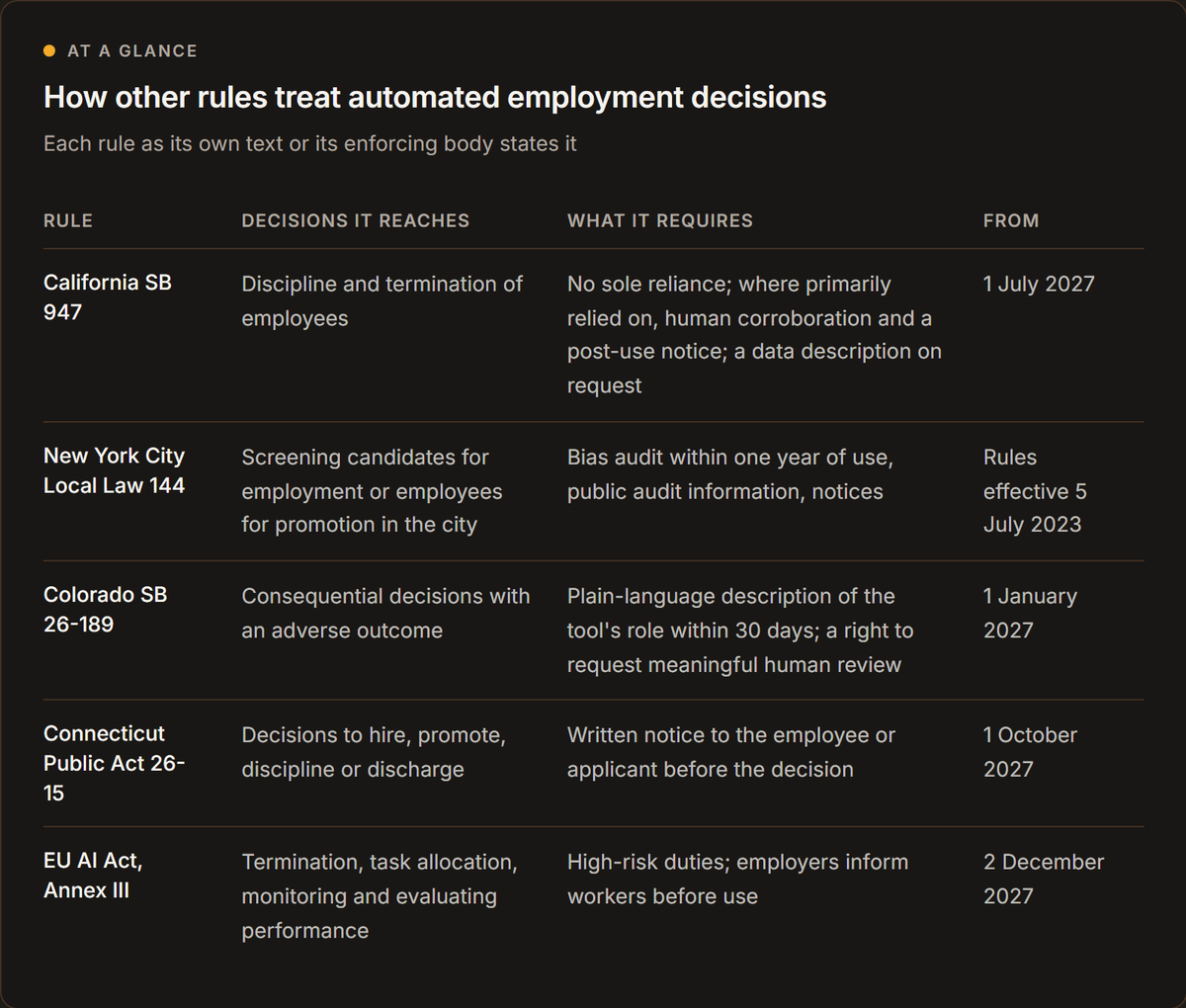
New York City. Local Law 144 restricts employers and employment agencies from using an automated employment decision tool unless it has undergone a bias audit within one year of use, the required audit information is publicly available and the required notices have been provided.10 The law covers tools used to screen candidates for employment or employees for promotion within New York City. Penalties can reach USD 500 for a first violation and USD 500 to USD 1,500 for each subsequent violation.10 The rules took effect on 5 July 2023.
The enforcing department has also clarified that the requirements do not apply when a tool assesses someone who is neither an employee being considered for promotion nor an applicant for a specific position. That distinction can matter to a staffing agency using software to search or rank a wider candidate database. Local Law 144 therefore reaches a different stage of the employment process from SB 947, whose operative provisions focus on employee discipline and termination.1
- Colorado.
SB 26-189 repealed and re-enacted SB 24-205.11 For an adverse consequential decision, a deployer must provide a plain-language description of the automated system's role within 30 days, and an individual can request meaningful human review. Developer obligations begin on 1 January 2027. The Colorado Attorney General has said the law takes effect on that date and that implementing rules must be adopted first.11
The human-review mechanism is different from SB 947. Colorado provides a right to request meaningful human review after a covered decision, while SB 947 requires corroboration when an employer primarily relies on an ADS for discipline or termination.
- Connecticut.
Public Act 26-15, approved on 27 May 2026, covers decisions to hire, promote, discipline or discharge.12 From 1 October 2027, a deployer must provide written notice before making an employment-related decision using the automated system. That is a pre-use requirement, unlike SB 947, which removed the pre-use notification requirement that appeared in SB 7.
- The European Union.
The EU AI Act classifies certain AI systems used to make decisions affecting termination of work-related relationships, allocate tasks based on individual behaviour, or monitor and evaluate performance as high-risk.13 Employers deploying those systems have obligations that include informing workers before the system is used. Regulation (EU) 2026/1744 sets 2 December 2027 as the date on which the relevant Annex III obligations apply.13
The comparison shows why a multi-state staffing agency needs a jurisdiction-by-jurisdiction process. One system might trigger different obligations depending on where the worker is located, what decision is being made and whether the tool is being used for hiring, promotion, discipline or termination.
Could federal action stop SB 947 before July 2027?
Possibly, but an agency should not build its compliance plan around that possibility. Executive Order 14365 of 11 December 2025 directed the Attorney General to establish an AI Litigation Task Force to challenge state AI laws considered inconsistent with the order's policy. The Attorney General established the task force on 9 January 2026.14 On 24 April 2026, the Justice Department moved to intervene in xAI's lawsuit concerning Colorado's algorithmic discrimination law, arguing that the state law violates the Equal Protection Clause.14
We found no federal action specifically challenging SB 947. An executive order does not by itself preempt a state statute, and a legal challenge could occur before or after SB 947 becomes operative on 1 July 2027.
For an agency, several preparation steps are useful regardless of whether SB 947 is ultimately challenged. Keeping automated-decision records, documenting human review and maintaining a clear record of how a reviewer reached or changed a decision are already relevant under other California rules. Building those controls now reduces the need to create a separate process if SB 947 takes effect as written.
What should a California staffing agency do before 1 July 2027?
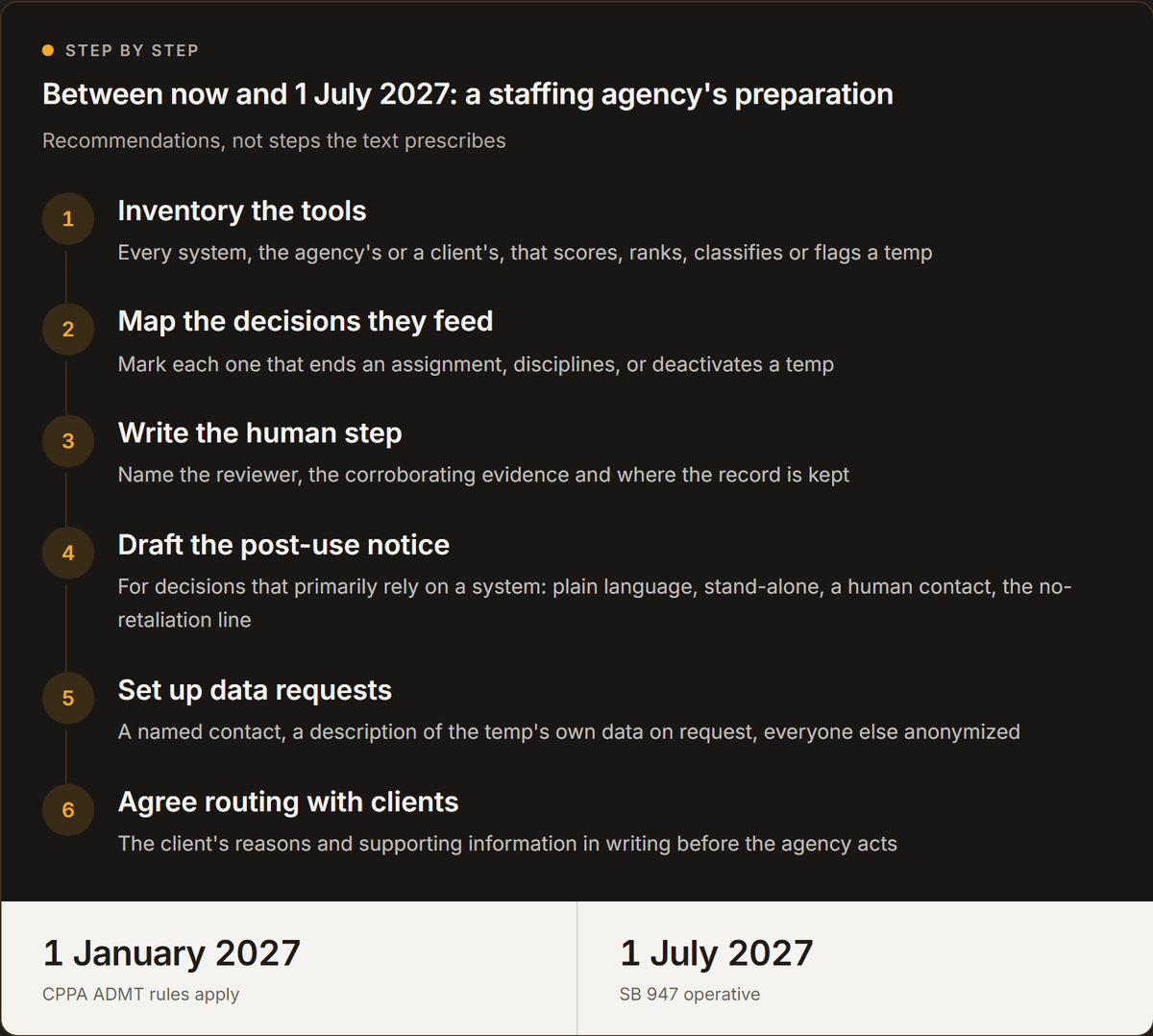
The steps below are recommendations, not requirements stated in SB 947. They follow the decision path created by the law and should be checked against the agency's own systems, contracts and working arrangements with counsel.
- Inventory where software decides
Start by listing every tool that produces a score, ranking, classification or recommendation about a temp after placement. Include systems operated by the agency and systems operated by clients. For each tool, record what it produces, who sees the output and which decisions it influences.
Start with outputs that can end an assignment, trigger a warning, or mark a temp inactive or ineligible. Include simple rules as well as more sophisticated systems, then check each against SB 947's definition of an automated decision system: the process must be derived from machine learning, statistical modelling, data analytics or AI, issue a simplified output, assist or replace human discretionary decisionmaking, and materially impact a natural person.1 Calculators and databases are excluded, so a simple threshold will not automatically qualify. If the position is unclear, it is safer to flag the tool for review rather than assume it falls outside the law.
2. Decide where primary reliance starts
For each decision, ask whether the automated output is the main reason the decision is made. For example, a coordinator who ends an assignment when an attendance score turns red and rarely checks anything else may be primarily relying on the output.
A different case is where the score prompts a coordinator to speak to a supervisor, review the personnel file and consider other evidence before making the decision. That sits closer to the line the Assembly Judiciary analysis identified as ambiguous. Record the reasoning either way. Once the agency's use of the tool is established, that documentation can help show how the output was actually used.
3. Build the corroboration step
For each covered decision, identify who reviews the output, what they check and where the review is recorded. The evidence can include the types of information identified in the statute, such as evaluations, personnel records, work product, peer reviews and witness interviews.
Reviewers should understand what the output means and have authority to reject or change the proposed decision. A short review record should state what information corroborated the output. If the output could not be corroborated, the record should say so because SB 947 does not permit the output to be used in that situation.
4. Draft the notice and the data route
For decisions that primarily rely on an automated system, prepare one plain-language, stand-alone notice template containing the elements required by SB 947. Decide how it will be delivered, using a method that is simple for the worker to access, and make sending the notice part of the decision-communication process.
At the same time, identify the human contact who will handle questions and requests for a description of the employee's own data. Create a short procedure for receiving, reviewing and responding to those requests, including the required anonymization of other people's information. Testing the process against a real or sample file can expose gaps before the law becomes operative.
5. Put it in client contracts
SB 947 does not clearly allocate every duty between a staffing agency and its client. A contract cannot resolve what the statute itself leaves legally open, but it can reduce the information gaps that make compliance difficult.
The agency can ask clients to identify when their systems produce an output that may lead to ending an assignment or taking disciplinary action. Contracts can also require clients to provide the reasons and supporting information in writing, give the agency access to relevant data when a worker exercises a data right, and route covered decisions through the agency before anyone communicates the decision to the temp.
Whether these provisions affect which party ultimately owes a statutory duty is a question for counsel.
6. Keep the records and check the other dates
Keep the automated output, human corroboration record, notice and any data request together in the temp's file. The Civil Rights Council rules already require covered employment records relating to automated decisionmaking to be retained for at least four years.
The CPPA's ADMT requirements create an earlier date for businesses subject to the CCPA. From 1 January 2027, those requirements apply to qualifying significant decisions, including decisions involving employment opportunities. For an agency that is a CCPA business and uses automated decisionmaking in that context, this date arrives before SB 947 becomes operative on 1 July 2027.
The practical goal is therefore not to wait until July 2027 and then build a process from scratch. An agency can use the earlier CPPA date and the existing Civil Rights Council record requirements as checkpoints while preparing for SB 947.
Conclusion
California SB 947 gives staffing agencies a new compliance question to solve before 1 July 2027: when does an automated system influence a decision about a worker, and what does the agency need to do before acting on that output?
The law does not ban automated decision systems. It limits how their outputs can be used for employee discipline and termination. An agency cannot rely on an automated output alone. Where it primarily relies on that output, a human must corroborate it using relevant information. If the output cannot be corroborated, or the reviewer finds it inaccurate, incomplete or misleading, the output cannot be used for the decision. Covered decisions can also trigger post-use notice and employee data-description rights.
For staffing agencies, the more difficult issue may be determining who controls the decision. A client might operate the software, while the agency employs the temp, communicates the decision and maintains the worker's records. SB 947 does not clearly allocate every responsibility between the agency and client. Agencies should therefore identify the systems used by both parties, establish how relevant information will be shared, and document who is responsible for reviewing an automated recommendation before action is taken.
The preparation can start now. Agencies can inventory their automated tools, map the decisions those tools influence, establish a human review process, prepare notice and data-request procedures, and address information-sharing in client agreements. These controls can also support compliance with other California requirements that apply to automated decisionmaking before SB 947 becomes operative.
The broader lesson is that agencies should map their technology to the stage of the employment lifecycle where it is used. Hiring tools, candidate screening systems, workforce-management software and disciplinary decision systems may create different legal questions. Knowing which system is being used, what output it produces and what employment decision it influences is the starting point for managing those risks.
Don't wait until 1 July 2027 to find out where your technology creates exposure. Start by inventorying the automated tools your agency and clients use, identify which decisions they influence, and put a documented human-review process around any system that could affect a worker's employment. Then review those workflows with counsel and make sure your client agreements, records and employee communications support the process.
Where Hivemind fits on a staffing desk
This article focuses on SB 947's rules for automated systems used in employee discipline and termination decisions. The product below works at a different stage of the staffing process. It is hiring software for sourcing, screening, interviews, offers, and the admin around them. Nothing in this section suggests that using it satisfies any duty under SB 947.
Hivemind is the hiring OS: a team can manage every candidate from inbound to offer in one unified workflow. Teams can run Hivemind end to end, connect their existing tools, or mix and match both.
Screening includes Resumatic: AI-Powered Resume Filtering System, Automatic Video Assessment: AI-Powered Video Interview Analysis, and Automated Skills Assessments.
That is separate from the post-placement decisions discussed throughout this article, such as whether to discipline a temp, end an assignment or terminate employment.
The product therefore sits alongside the agency's broader SB 947 process rather than being presented as a solution to it. If an agency later uses automated systems to make decisions about workers after placement, it should assess those systems separately against the applicable California requirements.
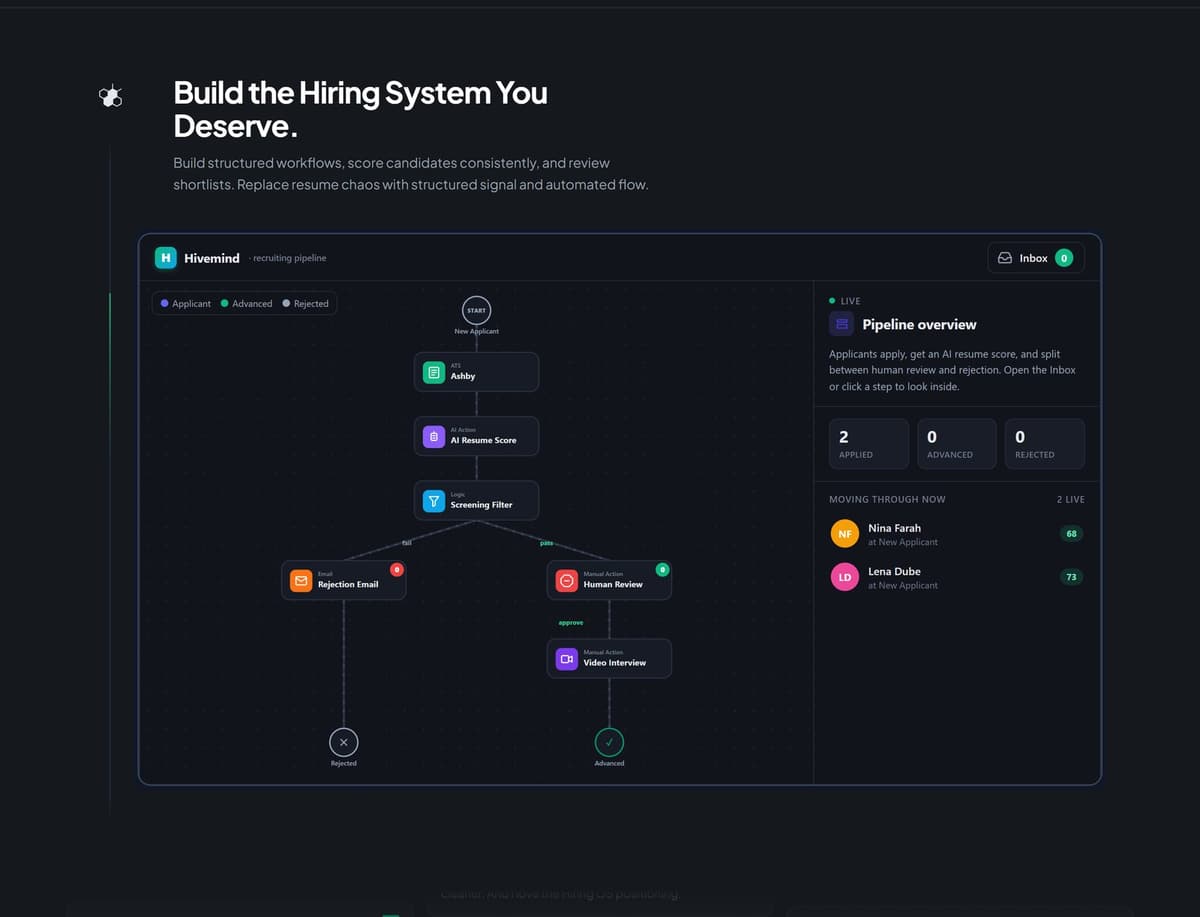
To see how a hiring pipeline is laid out, Book a Guided Demo.
Frequently asked questions
Is a staffing agency an employer under SB 947?
It is not settled. SB 947 defines an employer to include "a labor contractor of a person defined as an employer," but the law does not define "labor contractor." The definition in Labor Code §2810.3 applies specifically to that section and is not expressly incorporated into SB 947. Whether a particular staffing agency falls within SB 947's employer definition is therefore a question for counsel.
Does SB 947 apply to job applicants?
SB 947's operative provisions address employees and disciplinary or termination decisions. The legislative analyses also record that the applicant-notice requirement in the earlier SB 7 was removed. That does not mean automated hiring tools are unregulated in California. The Civil Rights Council regulations address employment agencies that use automated decision systems, while the CPPA's ADMT rules apply to qualifying significant decisions by businesses subject to the CCPA from 1 January 2027.
When does SB 947 take effect?
SB 947 was signed and chaptered on 30 September 2026. It becomes operative on 1 July 2027. Agencies should therefore use the period before that date to identify potentially covered systems and build their review, notice and recordkeeping processes.
Does SB 947 ban software from flagging temps?
No. SB 947 does not prohibit an agency from using an automated system to produce a score, classification or recommendation. It prohibits sole reliance on an ADS for a disciplinary or termination decision. Where the employer primarily relies on the output, a human must corroborate it using the data behind the output or other relevant information. If the output cannot be corroborated, or the reviewer finds it inaccurate, incomplete or misleading, it cannot be used.
Who sends the post-use notice, the agency or the client?
SB 947 does not clearly allocate the notice duty between an agency and client where both may fall within the employer definition. We found no provision that resolves the question. As a practical precaution, an agency can make notice part of its own decision process and agree the information flow and responsibilities with each client in writing. Counsel should confirm the allocation for the agency's particular structure.
What is the penalty under SB 947?
The civil penalty is USD 500 per violation. The Labor Commissioner and public prosecutors can enforce the law and may pursue civil actions and other available remedies, including injunctive relief, punitive damages and reasonable attorney's fees and costs. The worker's private right to sue was removed during the legislative process. Because the penalty applies per violation, agencies should not assess the risk based only on the USD 500 figure; a repeated process failure could create multiple violations.
Sources
- SB 947 chaptered text, bill history, and legislative analyses, California Legislative Information ↩
- Newsom signs McNerney's No Robo Bosses Act, Senator Jerry McNerney ↩
- Staffing industry statistics, American Staffing Association ↩
- Estimating the prevalence of automated management and surveillance technologies at work and their impact on workers' well-being, Washington Center for Equitable Growth ↩
- Half of Managers Use AI To Determine Who Gets Promoted and Fired, ResumeBuilder.com ↩
- California labor unions demand transparency and human oversight of artificial intelligence, California Federation of Labor Unions ↩
- 2026 Affordability Agenda and new 2027 employment laws, California Chamber of Commerce ↩
- CCPA regulations and ADMT regulation text and ADMT announcement, California Privacy Protection Agency ↩
- Automated-decision regulations, final text and Automated Decisions Regulations release, California Civil Rights Council and Civil Rights Department ↩
- AEDT information and FAQ, Local Law 144, and adopted rules, New York City Department of Consumer and Worker Protection and New York City Council ↩
- SB 26-189, Colorado General Assembly, and AI/ADMT information, Colorado Attorney General ↩
- Public Act 26-15, Connecticut General Assembly ↩
- AI Act and Regulation (EU) 2026/1744, European Union ↩
- AI Litigation Task Force memorandum and xAI intervention release, U.S. Department of Justice ↩
- Labor Code section 2810.3, California Legislative Information
- Electronic Monitoring and Automated Decision Systems: Frequently Asked Questions, UC Berkeley Labor Center
- Algorithmic management in the workplace: New evidence from an OECD employer survey, OECD
- Executive Order 14365, Federal Register
- Governor Newsom's 2025 veto message for SB 7, Office of Governor Gavin Newsom