

Possibly. However, we found no public study that shows how often this happens. Staffing agency job board costs typically cover services such as applications, job postings, and InMail credits. These services do not necessarily check whether the candidate is already in your ATS before you pay for the interaction.
Key takeaways
- No public study shows how often staffing firms pay job boards for candidates already in their ATS, so measure it on your own desks.
- Board costs are rising: Recruit Holdings reported Indeed's US revenue per job posting up 35% year over year between April and June 2026.
- Export one month of paid applicants, match them against your ATS, and count how many already had a record with your firm.
- If the database holds relevant candidates, search it before sponsoring the job; if a desk has none for a skill set or region, paying for new reach may be the right call.
- Tag every placement by source so you can see which channels produce hires, not just applications.
There is also evidence that job board costs are increasing. Recruit Holdings reported that Indeed's US revenue per job posting increased by 35% year over year between April and June 2026.
For a staffing firm, the important question is not simply how much you spend on job boards. It is how much of that spend generates genuinely new candidates. If a paid applicant is already in your database, you may be paying to reach someone your firm has already sourced.
The practical way to find out is to compare one month of paid applicants from your job boards against your existing candidate database. Match the applicants against your ATS and calculate how many already had a record with your firm.
This article is written for staffing firm owners who have this month's Indeed, ZipRecruiter, Dice, and LinkedIn invoices in front of them. It looks at the terms and pricing information each platform publicly provides. It then gives you a straightforward way to measure candidate overlap using your own ATS.
That measurement matters because the number you would ideally want to see, the percentage of paid applicants who were already in your database, is not something we found a reliable primary source for. Your own ATS can give you a more useful answer for your firm.
In this article
- What are you actually paying a job board for?
- How do pay per click, pay per started application and a subscription differ?
- What do the public figures say about board revenue and applicant volume?
- What do the large staffing firms disclose?
- Who is already in your database?
- How do you count what the boards bought twice?
- What should the count change on next month's invoice?
- When is the job board still the right spend?
What are you actually paying a job board for?
Every job board invoice is based on a unit. That unit is what the board measures and charges you for. It might be a started application, a job slot, a candidate profile view, or a seat with a set number of InMail credits.
The important point is that none of these units means a candidate your firm did not already have. A candidate who is already in your ATS can still generate a charge. Looking at each board's billing unit makes it easier to see how an existing candidate can end up creating a new cost.
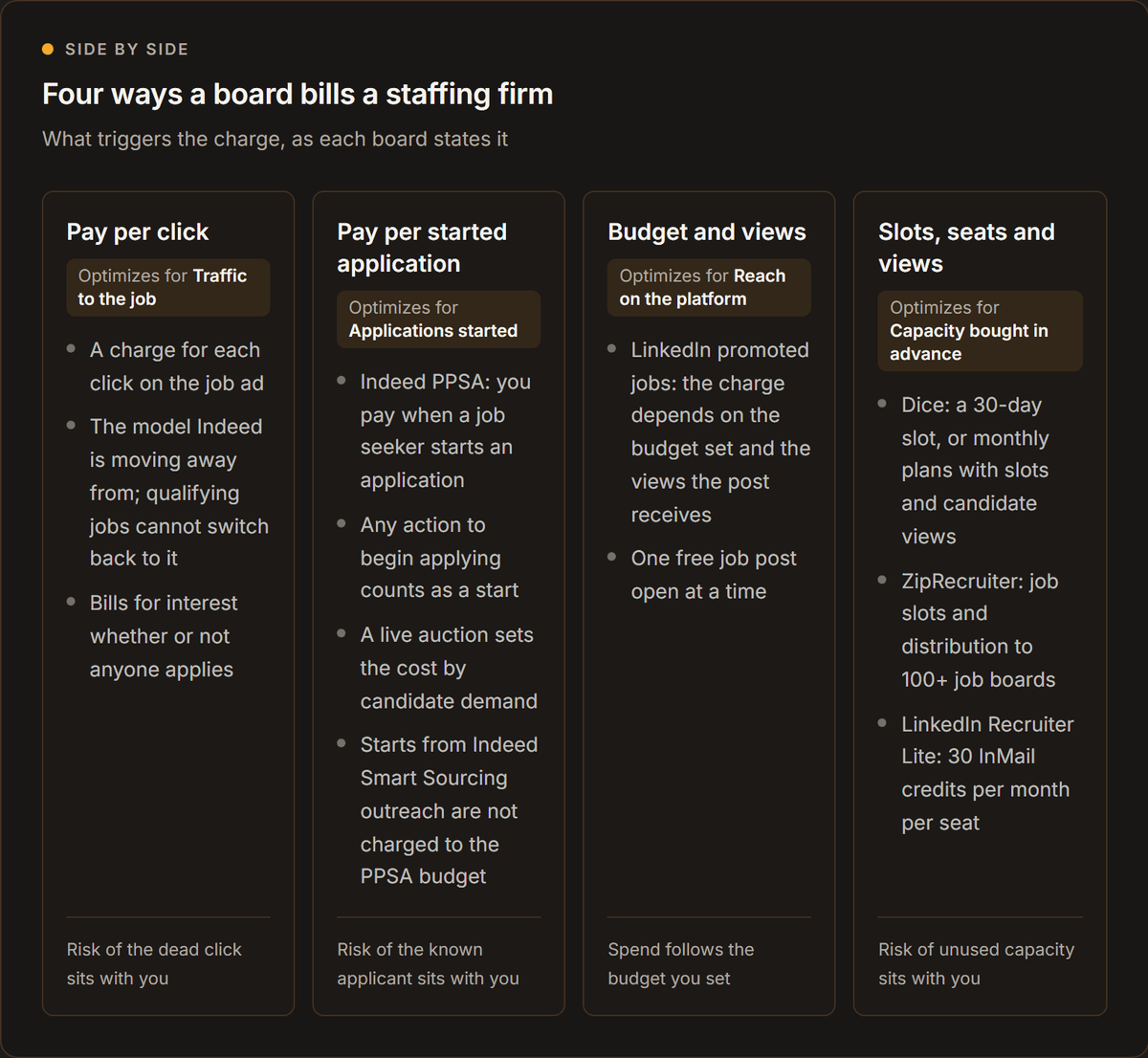
Indeed: you pay when an application starts
Indeed's employer help centre describes Pay Per Started Application (PPSA) as a model where you pay when a job seeker starts an application rather than simply clicking on the job.1 Indeed defines a started application as an action taken by a job seeker to begin the application process.1
This happens before an application is necessarily completed. For example, a candidate could click Apply, open a lengthy application form, and leave without submitting it. The started application can still count as a charge.
Two other points in Indeed's terms matter to staffing firms. Qualifying jobs are automatically enrolled in PPSA, and Indeed says employers cannot switch those jobs back to pay-per-click pricing.1 The cost also varies because PPSA uses a live auction. The amount you pay therefore depends on candidate demand rather than a fixed price per started application.
Indeed also states that applications resulting from Smart Sourcing outreach are not charged against the PPSA sponsorship budget.1 However, the help-centre information reviewed for this article does not explain how Smart Sourcing itself is priced. That means you would need to check your agreement with Indeed to understand that cost.
Recruit Holdings, Indeed's parent company, described the broader change in its results for the April to June 2026 quarter. It said Indeed was moving away from a model centred on search and pay-per-click advertising towards an AI-powered matching platform.2
For employers, the practical point is simpler. On qualifying jobs, the bill is based on started applications. The system does not define the charge according to whether the person is a completely new candidate for your staffing firm.
LinkedIn: budgets, views and seats
LinkedIn sells several products that can generate costs for a staffing firm. The two most relevant here are promoted jobs and Recruiter seats.
For promoted jobs, LinkedIn says the amount charged depends on the budget set for the job and the number of views it receives.3 LinkedIn also allows one free job post to remain open at a time.3 A staffing firm with several active vacancies therefore has to decide which jobs to promote or leave unpromoted.
Recruiter is different. It is a sourcing and messaging licence rather than a job advertisement. Recruiter Lite provides 30 InMail credits per month for each seat.3 The full Recruiter product is designed for higher-volume outreach and provides up to 150 InMails per month per seat.3
The full Recruiter product is sold through LinkedIn's sales team, so there is no public list price to compare. The amount your firm pays is the amount specified in your contract.
The important issue for this article is not the price of an InMail. It is who receives it. A Recruiter search can return someone who is already in your ATS. LinkedIn's published seat terms do not say that the search checks your own database before you use an InMail credit.
Your recruiter could therefore spend an InMail credit contacting someone your firm already knows, even if that person was previously placed by your agency.
ZipRecruiter: slots, distribution and a resume database
ZipRecruiter's plans are built around job slots and distribution. The company says employers can send jobs to more than 100 job boards from one place.4 A filled job can also be closed before 30 days and the slot reused.
The plans page does not publish a standard price for each plan. The amount your firm pays therefore depends on the plan or agreement you have with ZipRecruiter.
ZipRecruiter also says sponsored or paid jobs receive an average of nine times more applicants than organic jobs. This is the company's own claim, and it illustrates what the paid product is intended to provide: more applicants.
Premium and Pro plans also include access to a resume database that ZipRecruiter says contains more than 56 million resumes.4 That gives staffing firms another pool of candidates to search.
The problem is potential overlap. Some of the people in that resume database may already be in your ATS. The published plan information does not state how much overlap there is or whether your ATS is checked before you access a profile.
Dice: prices printed on the page
Dice is the most straightforward board in this group when it comes to published pricing. Its employer pricing page lists a single job slot at USD 399, with the slot active for 30 days.5
The Starter plan costs USD 649 per month when billed month to month, or USD 549 per month when billed annually.5 It includes three job slots per month, one user, and 250 candidate views per month.5
The Standard plan costs USD 899 per month and is billed monthly on an annual contract.5 It includes five job slots per month, two users, and 500 shared candidate views per month.
Candidate views are the key unit to watch on Dice. A recruiter uses a candidate view when opening a profile in the Dice database. If that profile belongs to someone already in your ATS, the view still counts.
The charge is therefore tied to accessing the profile, not to whether the candidate is genuinely new to your firm.
The units side by side
| Board and product | What the board charges for, in its own terms | Price on the board's own page |
|---|---|---|
| Indeed Sponsored Jobs (PPSA) | A started application. Qualifying jobs are enrolled automatically and cannot return to pay-per-click pricing. | None in the help-centre article reviewed. A live auction determines the cost based on candidate demand. |
| ZipRecruiter plans | Job slots, distribution to more than 100 job boards, and resume database access on Premium and Pro plans. | None printed on the plans page. |
| Dice single job slot | One job slot, active for 30 days. | USD 399 |
| Dice Starter | Three job slots a month, one user, and 250 candidate views a month. | USD 649 a month billed month to month, or USD 549 a month billed annually. |
| Dice Standard | Five job slots a month, two users, and 500 shared candidate views a month. | USD 899 a month, billed monthly on an annual contract. |
| LinkedIn promoted job | The budget you set and the views the post receives. One free job post can remain open at a time. | Set by the budget you choose. |
| LinkedIn Recruiter Lite | A seat with 30 InMail credits per month. | Check your invoice; no public price was used for this piece. |
| LinkedIn Recruiter | A seat with up to 150 InMails per month. | Sold through LinkedIn's sales team; no list price. |
Read across the table and one thing is missing from every billing model: your own candidate database.
A started application from someone your firm placed in March is still a started application. A LinkedIn InMail sent to an existing candidate still uses a credit. Opening an existing candidate's Dice profile still uses a candidate view.
The boards are charging for the activity their products measure. They are not charging based on whether the person is new to your firm. That is why the next step is to compare those paid interactions with your own ATS records.
How do pay per click, pay per started application and a subscription differ?
The three pricing models place the risk of a wasted charge in different places. With pay per click, you pay for interest. A click that does not lead to an application still costs you money. With pay per started application, you pay when someone begins an application, so the board takes on the cost of clicks that do not progress that far. With a subscription or prepaid capacity model, you pay for access or capacity in advance. Any unused capacity becomes your cost.
None of these models asks the question this article is focused on: whether the candidate was already in your database. A former placement can generate a billable click. The same person can generate a billable started application. They can also use a candidate view or another unit of purchased capacity.
The move from pay per click to pay per started application changes which activity triggers the charge. Under pay per click, a former placement who sees your job and clicks on it can generate a charge. Under PPSA, that person has to take an action that starts the application before the charge applies.
The important point is that the pricing model does not distinguish between a former placement and someone who has never been in your database. If a former placement starts an application, the charge is treated in the same way as a new candidate's started application.
There is also a benefit to PPSA. You no longer pay for clicks that never progress to an application start. Whether the model ultimately costs your firm more or less depends on your jobs, candidate demand, and the auction price. The Indeed help-centre information reviewed for this article does not provide a fixed price that would allow an owner to calculate the difference in advance.
Your own invoice provides a better answer. Compare the applicants that generated charges with the candidates already in your ATS. That tells you how often the pricing model is charging your firm for people it already knows.
What do the public figures say about board revenue and applicant volume?
The public figures measure different parts of the recruitment market. Recruit reports Indeed's revenue per job posting. Appcast reports trends in recruitment advertising costs. Applicant tracking platforms report how many applications employers receive and how many progress through their hiring funnels.
None of these figures tells you what a staffing firm pays for a particular candidate. They are useful for understanding the wider market, but they cannot replace a comparison between your job board invoices and your own ATS.
Indeed earns more per posting while there are fewer postings
Recruit Holdings reported that Indeed's US average revenue per job posting (ARPJ) increased by 35% in the quarter from April to June 2026.2 Recruit defines ARPJ as US HR Technology revenue divided by the total number of US job postings on Indeed.2
During the same quarter, the number of US job postings on Indeed fell by about 4% year over year. US revenue increased 30.0% to a quarterly record of 1.64 billion US dollars. In other words, Indeed generated more revenue from each posting even as the number of postings declined.
Recruit identified Premium Sponsored Jobs as the main driver of US HR Technology revenue growth in fiscal 2026.2 It also expected US ARPJ to increase by approximately 30% for the full fiscal year.2
These figures need to be read carefully. ARPJ is an average across US employers using Indeed. It is not the price a particular staffing firm pays for a job posting. The employer mix also includes businesses that do not operate staffing agencies.
Job posting volumes have also changed since the quarter covered by Recruit's figures. Indeed Hiring Lab reported that its Job Postings Index was 0.7% higher year over year in September 2026.6 That was its first positive annual reading in almost four years.
The two figures cover different periods. Recruit's results cover April through June, while Hiring Lab's September figure reflects a later point in the year. The useful takeaway is therefore not that postings are permanently declining. It is that, during the quarter Recruit reported, Indeed generated more US revenue per posting while the number of postings was lower.
Advertising benchmarks report rising cost per application
Appcast publishes an annual recruitment advertising benchmark. Its 2026 report states that cost per application and cost per hire increased sharply in 2025. Appcast attributes the increase to changes in job board pricing and programmatic recruitment advertising models.
The underlying dataset is substantial. The report covers more than 302 million clicks and 27 million applications from nearly 1,200 employers.7 It also identifies differences between regions. Fast-growing Sun Belt states recorded lower costs per application, while older and more rural states had higher recruitment advertising costs.7
There are limits to what this tells a staffing firm. Appcast is part of The Stepstone Group and sells recruitment advertising, so the company reporting the increase also operates in the market it is measuring.7
The report's median cost figures are also behind a gated report. We could not find the median cost per application or cost per hire in a publicly readable source, so this article uses only the direction reported by Appcast rather than figures repeated elsewhere.
The regional finding is still useful as a point of comparison. If your desks recruit heavily in rural areas or regions where Appcast reports higher advertising costs, your own invoices can show whether your firm is experiencing the same pattern.
More applications per job, fewer of them worth an interview
Applicant tracking platforms provide another view of the market. Their data generally comes from employers using their software rather than staffing agencies, so the figures should be treated as vendor-specific benchmarks rather than direct measures of staffing-firm performance.
Greenhouse reported that applications per job increased from 116 in 2022 to 189 in 2023.8 The figure reached 223 in 2024 and 244 in 2025. That is a 111% increase over the period. The benchmark covers more than 6,000 companies and more than 640 million applications between 2022 and 2025.8 Greenhouse also reported that time to fill increased by 37% during the same period.
Ashby's data points to a different part of the funnel. It found that around 7 to 8% of applications led to an interview in 2021, compared with between 3.6% and 4.7% more recently, depending on the role.9
Its analysis covered more than 38 million applications and 93,000 jobs from 2021 through 2024. Inbound applications accounted for 93.8% of applications. Sourcing accounted for 4.8%, while referrals accounted for 1%.9
Ashby also found that inbound applications experienced the largest decline in offer rates among the sources it measured. The rate fell by about 70%, from 7 offers per 1,000 applications to 2 per 1,000.9
Gem's benchmark covers June 2021 through May 2025. It includes more than 165 million applicants and 1.2 million hires.10 Gem found that 8% of applicants progressed beyond initial screening and 0.5% received offers.10 That equates to roughly one hire for every 200 applications.
Gem also found that job boards and company marketing channels generated roughly 90% of applications but accounted for about half of hires.10 This shows why application volume alone is a weak measure of recruitment value. A channel can produce a large number of applicants without producing the same proportion of hires.
A research paper by Anais Galdin and Jesse Silbert provides another reason to treat application volume carefully. The researchers studied hiring on Freelancer.com and examined how employers valued customised applications before and after the introduction of large language models.11
In their simulation, removing the value of costly written signals changed hiring outcomes. Workers in the top fifth of ability were hired 19% less often, while workers in the bottom fifth were hired 14% more often.11
That finding comes from one freelance platform and does not establish what happens on staffing job boards. It does, however, illustrate why a larger application count does not automatically mean a better candidate pool.
Taken together, the public data points to more activity at the top of the recruitment funnel without showing a corresponding increase in candidate quality. Indeed reported higher revenue per posting during the quarter it measured. Greenhouse reported more applications per job. Ashby reported lower application-to-interview rates. Gem reported that only 0.5% of applicants received offers in its dataset.
These datasets mostly describe in-house employers using particular recruitment platforms. None measures the percentage of paid job board applicants who were already in a staffing firm's ATS.
That is the number your firm needs to calculate for itself.
What employers report on cost per hire
SHRM's 2026 recruiting benchmark, based on more than 4,600 organisations, found that cost per hire increased for executive positions while remaining relatively stable for nonexecutive positions.12
Cost per hire captures the broader economics of recruitment. It can include advertising as well as recruiter time and other hiring costs. The SHRM data covers in-house employers rather than staffing agencies, so it should not be treated as a direct benchmark for an agency's job board spend.
It does provide useful context. A rise in a job board's revenue per posting does not automatically mean that every employer's total cost per hire is rising by the same amount.
For a staffing firm, the more useful calculation is your own cost per hire or placement. Compare what you spend on each sourcing channel with the candidates, interviews, placements, and repeat candidates that channel produces. The cost per hire guide explains how to calculate that figure for your own desks.
The same principle applies to candidate overlap. Public market figures can show that job board pricing and application volumes are changing. They cannot tell you how many of the people you paid to reach were already in your ATS. Only your own data can answer that question.
What do the large staffing firms disclose?
Private staffing firms generally do not publish their advertising spend. Public staffing companies have to disclose more information, and Robert Half provides one of the clearest US examples.
Robert Half's fiscal 2025 Form 10-K reports its advertising costs for each of the previous three years. The amount fell in 2024 and fell again in 2025.
The filing also explains where that advertising spend goes. Robert Half says it markets its contract talent and permanent placement services to clients and employment candidates through national and local advertising.13 The channels include digital advertising, job boards, alliance partners, radio, and events.
This gives a staffing firm two useful points of comparison. Robert Half spent less on advertising in 2025 than it did in 2023, and its annual filing provides the figures for each year. You can therefore put the public company's trend alongside your own advertising spend.
The same filing identifies another asset that matters for this article: Robert Half's global candidate database. The company lists it as one of its strengths compared with local and regional staffing firms. It places the database alongside factors such as its brand, office network, and technology.
That matters because Robert Half treats its candidate database as a competitive asset. The company's public disclosures therefore show both sides of the equation: it spends money to reach candidates while also considering its existing candidate database valuable.
There is an important limitation. Robert Half's advertising expense is not a job-board budget. It includes marketing to clients as well as candidates, and it covers channels such as radio and events in addition to digital advertising and job boards. The 10-K does not separate those costs.
The filing therefore cannot tell you how much Robert Half spends on Indeed, LinkedIn, or another specific board. It does show that a large staffing firm can have substantial advertising costs while also treating its existing candidate database as an important business asset.
The staffing market is large enough for small efficiencies to matter
The size of the staffing industry puts individual firms' spending into context. The American Staffing Association counted approximately 27,000 staffing and recruiting companies in the US in 2021, operating nearly 54,000 offices.14
The industry also has significant employment reach. Staffing firms provided work for approximately 11 million employees in 2024.14
Staffing Industry Analysts projects the US staffing market will grow by 2.4% in 2026 to USD 183.1 billion.15 It projects another 2.2% increase in 2027.
These figures do not show how much staffing firms waste on repeat candidates. There is no public figure in the data above that answers that question.
They do show why the question is worth measuring. When a staffing firm operates at scale, even a relatively small amount of unnecessary sourcing spend can become material. The most useful benchmark is therefore not what a large public staffing company spends. It is how much of your own paid candidate activity represents people your firm already knows.
Who is already in your database?
A staffing firm's ATS can develop very differently from an in-house employer's database. When a temporary or contract assignment ends, the worker becomes available for another opportunity. If they have worked with your firm before, they may already be in your ATS.
Staffing turnover refills the file
The American Staffing Association reported a 414% turnover rate for temporary and contract employees in 2023.14 Its figures also put average tenure in staffing employment at 10.1 weeks that year.14
The scale of the workforce is substantial. In an average week in 2024, nearly 2.2 million temporary and contract employees worked through US staffing companies.14 During 2023, staffing companies hired 12.7 million temporary and contract employees.14
These figures describe the staffing workforce rather than the contents of any individual firm's database. They also cover different periods, and the hiring figure counts assignments rather than unique people. Even so, the short average tenure explains why staffing firms can repeatedly encounter the same workers.
A worker who completed an assignment with your firm last quarter may be looking for work again today. The ASA data does not measure how often that happens at the individual firm level.
If that worker sees your Indeed advertisement and starts an application, the job board can charge you for that activity. Your firm may already have screened the person, onboarded them, and paid them for previous work.
What staffing firms say works
Surveys of staffing and recruitment firms consistently point to existing candidate databases as an important source of placements. The three sources below are published by, or for, companies that sell recruitment software, so their findings should be read with that context in mind.
StaffingHub's 2026 benchmark, presented by Bullhorn, found that growth-focused staffing firms sourced 23.9% of placements from job boards.16 Direct outreach accounted for 23.4%, while ATS rediscovery accounted for 16.4%. The remaining placements came from sources including referrals, career sites, and AI tools.
The figures show that job boards and ATS rediscovery can both contribute significantly to placements. There is also an important difference between them: rediscovering a candidate already in your ATS does not create a new job-board application charge.
Firefish, a UK recruitment software provider, surveyed 132 recruitment agency leaders in the UK and Ireland in November and December 2025.17 Its 2026 report found that existing candidate databases were the highest-return channel, with 80% of agencies rating them positively.
Bullhorn's GRID 2026 survey also reported that 85% of staffing firms with a redeployment plan had a time to place of less than 20 days.18 The survey reports firms with a plan only, with no comparison group, so it does not show that having a redeployment plan causes faster placements. Firms with a formal plan may also have other processes that make them faster.
What the platforms say about rediscovered candidates
Gem, a recruiting software provider, reports that 46% of sourced hires now come from candidates rediscovered in a company's CRM or ATS.10 Its figure was 26% in 2021.
This is Gem's data from its own customers, who are primarily in-house employers. It measures sourced hires rather than all hires, and it does not specifically measure staffing firms.
It also does not show how many paid job-board applicants were already in a staffing firm's ATS. What it does show is that organisations with tools for searching their existing records are increasingly finding successful candidates there.
What no one has measured
The most useful number for this article would be the percentage of paid job-board applicants who were already in a staffing firm's ATS before they applied.
We found no public primary source that measures this. We found a vendor figure circulating without a published methodology that an owner could independently check, so it is not included here.
You do not need an industry benchmark to find the answer for your firm. Your ATS already contains the relevant history. Compare one month's paid job-board applicants with your existing records, and you can calculate the overlap yourself.

How do you count what the boards bought twice?
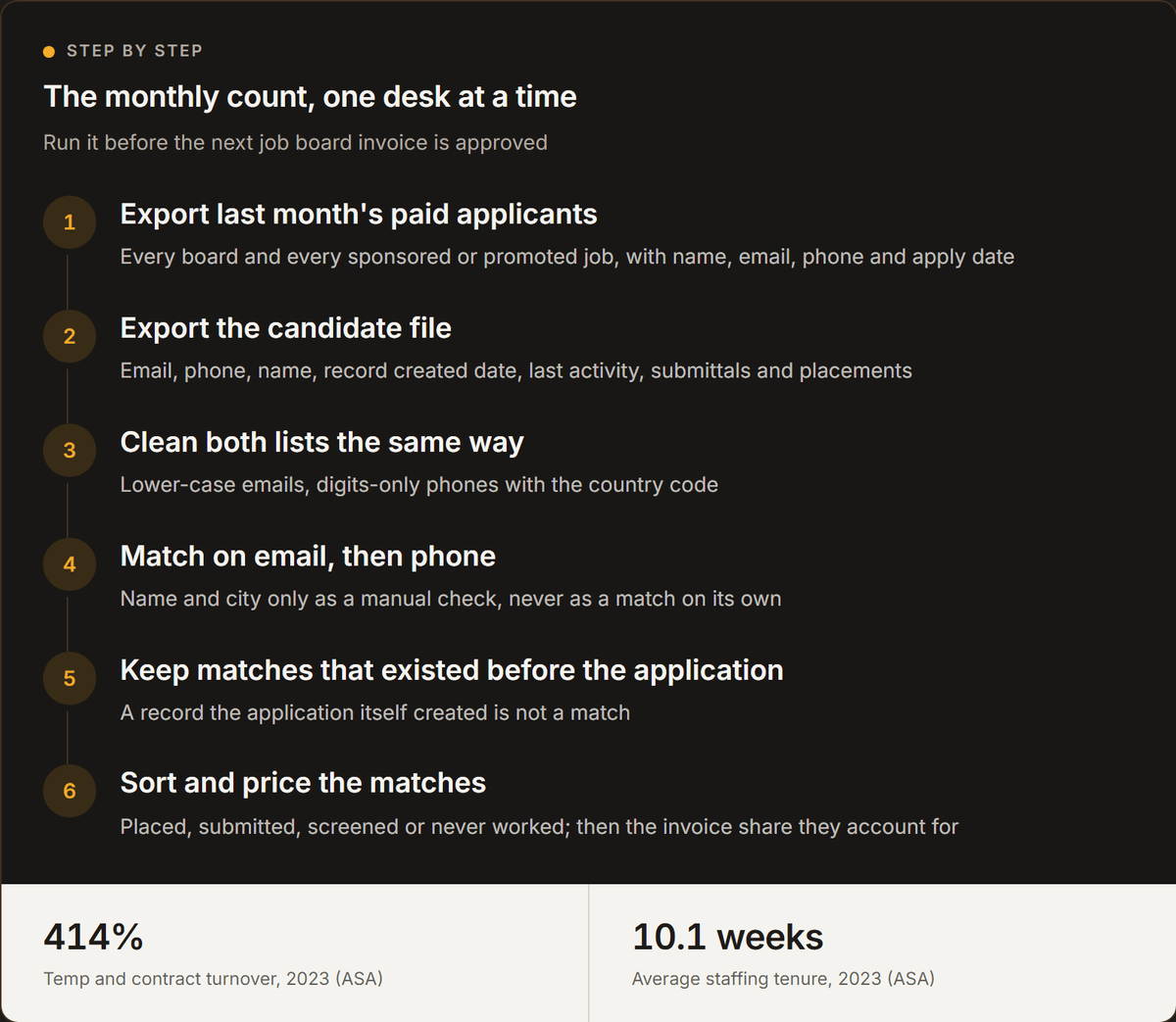
The count is straightforward. Take one month of paid applicants and compare them with your existing candidate file. The question is how many applicants were already in your ATS before the job board brought them back to your attention.
Start with one month and one or two desks. A clean count from a small sample is more useful than a rough calculation across the entire business. Once the process works, you can repeat it every month.
Step one: pull last month's paid applicants
Export every applicant from the previous full month who applied to a sponsored, promoted, or otherwise paid job on each board. Include the applicant's name, email, phone number, job, and application date.
Keep a separate file for each board. The boards use different billing models, so separating them allows you to calculate the cost associated with each source rather than treating all paid applicants as one group.
Also separate activity that was not charged under the relevant model. For example, Indeed says applications from Smart Sourcing outreach are not charged against the PPSA sponsorship budget. Keep those applicants separate from the paid list.
LinkedIn Recruiter activity should also be treated separately. Replies to InMail are part of the seat and messaging model rather than a per-application charge, so they should not be mixed with paid job applicants.
Step two: export the candidate file
Export the relevant candidate records from your ATS. At minimum, include email, phone number, name, record creation date, and last recruiter activity.
You should also include whether the candidate was previously submitted to a client or placed. If your ATS does not provide all of this information in one report, export the relevant reports separately and join them using the candidate's unique identifier or contact information.
Step three: clean both lists the same way
Most matching problems come from inconsistent formatting rather than completely different candidate records.
Convert every email address to lowercase and remove unnecessary spaces. Standardise phone numbers by removing formatting and using the country code consistently. Apply exactly the same process to both lists.
Do not rely on names as the primary matching field. Two people can have the same name, while the same person can appear under slightly different spellings. Use name and location only to review possible matches manually.
Step four: match, and throw out the false matches
Match the paid applicant list against your ATS using email first. For records without an email match, use the phone number.
Then check the dates. This is the step that prevents the most important false result.
Some ATS platforms automatically create a candidate record when someone applies through a job board. If you simply compare last month's applicants with today's ATS, those applications will appear to match because the application itself created the records.
A valid overlap exists only when the candidate's ATS record was created before the application date. That means the firm already held the candidate before the paid job-board interaction.
Step five: sort the matches and price them
Divide the genuine matches into four groups: candidates previously placed by your firm, candidates previously submitted to a client, candidates previously screened or interviewed, and candidates who were simply stored in the database.
The first two groups are particularly important. Your firm has already invested time in those candidates and, in the case of a placement or submission, has already moved them through part of the recruitment process.
Then compare the matched applicants with your invoices.
The letters are simply your firm's own measurements. They are not industry benchmarks.
The final calculation is only an estimate. It assumes that every paid applicant carries the same cost. That is not necessarily true, particularly where a board uses an auction-based model. Label the result as an estimate when presenting it internally.
Three ratios are especially useful.
B ÷ A shows the percentage of paid applicants who were already in your ATS.
C ÷ A shows the percentage of paid applicants who had already been submitted or placed by your firm.
E ÷ D shows how many of the month's hires from paid sources were already in your ATS before the job-board interaction.
If E is close to D, a large proportion of your paid-source hires were already known to the firm. If E is small, the paid source is bringing in more genuinely new candidates among those hires.
What the count costs in recruiter time
The count should take considerably less time than a typical job-board invoice represents in spend. For a small sample, one person can usually handle the exports, standardisation, matching, and manual review in an afternoon.
The US Bureau of Labor Statistics reported a median annual wage of USD 75,940 for human resources specialists in May 2025. Recruiters are included within this occupational category. This is a national figure across employers rather than a staffing-industry benchmark.
Use your own staffing cost when deciding whether the exercise is worthwhile. The initial setup takes time, but once the process is established, the same count can be repeated each month.
There is also a timing benefit to finding existing candidates. SHRM's 2026 benchmarking puts median time to fill at 39 calendar days for nonexecutive positions.12 A former placement who is available again may be faster to submit than a new applicant who still needs to be screened.
Bullhorn's survey also reported that most firms with a redeployment plan place in under 20 days. It reports no comparison with firms that have no plan, so it is not evidence that the plan itself causes faster placements.
The comparison of time to fill and time to hire explains the difference between those measures and why the distinction matters when assessing recruitment speed.
What should the count change on next month's invoice?
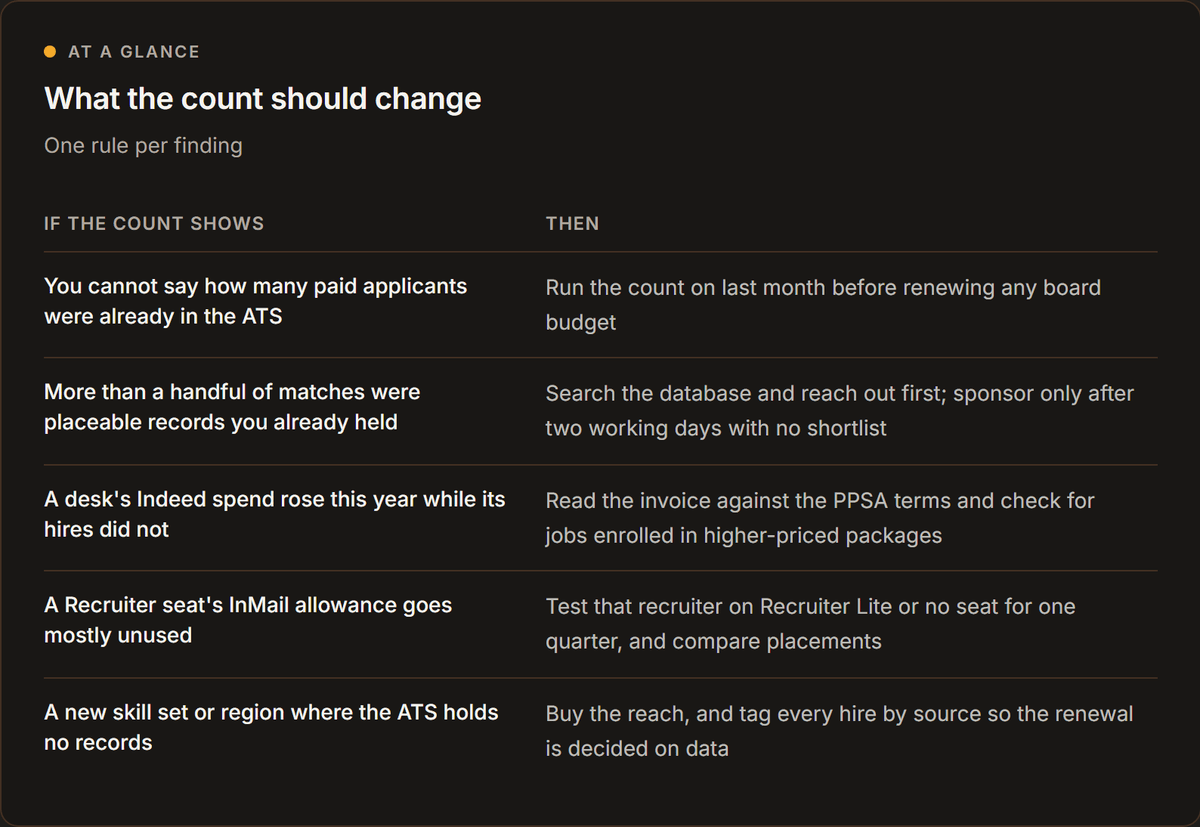
A count only matters if it changes a decision. These five rules turn the results into actions your desks can test. The right rule will depend on what your own ATS and invoice data show.
Buy the additional reach and tag every resulting hire by source. Use those results when the board comes up for renewal
Search the file before you sponsor the job
If the count shows meaningful overlap, change the order of work. When a job order arrives, the recruiter should first search the ATS for candidates with the required skills and location. Recent availability or the end date of their last assignment can help identify people who may be ready for another placement. The recruiter contacts those candidates before sponsoring the job.
If that search does not produce a shortlist within an agreed window, two working days is a reasonable starting point, the job can then be promoted on the relevant board. This does not remove the job board from the process. It moves the paid channel behind the database search.
Whether this saves money depends on the quality and size of your file. Your count provides the evidence. The ASA's figures show how frequently temporary and contract workers move between assignments, with turnover at 414% in 2023. Those figures describe employees rather than the number of repeat candidates held in an individual staffing firm's database.
Read the Indeed invoice against the PPSA terms
If a desk's Indeed spend increased while its placements did not, review the invoice against the terms that determine when a charge is triggered. Check which jobs were billed under PPSA and which were automatically enrolled. Also check whether any jobs were placed in a higher-priced sponsored package.
Recruit Holdings identifies Premium Sponsored Jobs as a major driver of Indeed's US revenue growth. Your firm should therefore know which jobs are using that type of promotion and what the additional spend is producing.
If your firm uses Indeed Smart Sourcing, check how those applications are recorded on your invoice. Indeed's help centre states that Smart Sourcing outreach applications are not charged against the PPSA sponsorship budget, so they should be kept separate from the paid-applicant count.
Match the seat count to how seats are used
LinkedIn Recruiter seats can be purchased for individual recruiters even when their actual usage varies. A full Recruiter seat provides up to 150 InMail credits per month, while Recruiter Lite provides 30. If a recruiter consistently uses only a small portion of the allowance, test whether the full seat is producing enough placements to justify its cost.
Run a controlled test for one quarter using Recruiter Lite or no seat and compare placements with the previous period. Some of the candidates found through recruiter search may already exist in the ATS, which makes the database overlap count useful when interpreting the result. LinkedIn does not publish the full Recruiter seat price, so the comparison needs to use the price in your own contract.
Tag every hire by source
The count becomes much more useful when source information is captured on every placement. Tag each hire with the channel that produced it. This can include a specific job board and job, a Recruiter InMail, an ATS database search, a referral, or a repeat placement.
Once those tags are in place, you can calculate the E over D ratio each month without rebuilding the entire match. You can then see which channels are producing placements and which are mainly generating applicants your firm already knows.
The guide to the best sources for recruitment covers the channels you may want to use as source tags.
When is the job board still the right spend?
The case for job boards is real. An owner who cuts them after seeing overlap in a single month's data could remove a useful source of candidates. Four situations can justify paying for additional reach.
A new skill set or a new region
If your firm takes an order for a skill set it has never placed before, the ATS may have little or no relevant talent. The same applies when a desk opens in a region where the firm has no established candidate network.
In those cases, a job board can provide access to candidates the firm has not previously reached. Buy that reach when the database cannot provide it, then tag every resulting hire by source. The next renewal decision can then be based on what the spend actually produced.
When the board is where the active candidates are
Firefish's 2026 survey found renewed use of job boards, with 60% of agencies reporting that they use them to find candidates showing active intent.17 The same survey reported a 52-percentage-point decline in social sourcing compared with the previous year. Ashby's data also shows that inbound applicants accounted for between 43% and 52% of hires across the four years it analysed.9
LinkedIn's staffing page states that 85% of staffing professionals say they are more successful with Recruiter.3 That is LinkedIn's own product claim, and the page does not provide enough information about the measurement to treat it as an independent benchmark.
The broader point is simpler. Candidates who have never worked with your firm cannot already be in its ATS. For roles where there is a large active applicant pool and the firm's existing database is thin, a job board can provide reach that the database cannot.
When the database is stale for that desk
A database is only useful when its records can still be acted on. Permanent and executive search candidates may remain in a firm's records for longer periods than temporary workers, but older records can become harder to use if contact details, employers or availability have changed.
The overlap count can help identify this problem. If many matches have not been contacted for years and contain outdated phone numbers or employment information, the database may require substantial recruiter time before it produces a shortlist. In that situation, paying for fresh candidate reach may make more sense than relying entirely on an old file.
The answer is not necessarily to abandon the database. It is to compare the time required to refresh it with the cost and results of buying new reach.
When applications come from Indeed's Smart Sourcing outreach
Indeed's published terms make an important distinction for Smart Sourcing. Applications generated through Smart Sourcing outreach are not charged against the PPSA sponsorship budget. That means they should not be treated as equivalent to applications generated by a sponsored job when you calculate board spend.
Indeed's help centre does not establish the full cost of Smart Sourcing itself. Whether it is worthwhile therefore depends on the arrangement and pricing your firm has with Indeed.
None of these situations argues for keeping a job board budget without reviewing it. They show why the answer should differ by desk and by role. A board can be wasteful when it is used to reach candidates already sitting in the ATS. It can also be valuable when the firm needs access to candidates its existing database cannot provide.
The count gives you a way to distinguish between those cases. The next step is to use that evidence when deciding where the board budget belongs.
Conclusion
Job boards are not inherently wasteful. They become expensive when a staffing firm pays to reach candidates it could have reached through its own database.
The first step is therefore not to cancel Indeed, LinkedIn, ZipRecruiter, Dice or another board. It is to measure what the firm is actually buying. Export one month of paid applicants, match them against the ATS, and check whether those records existed before the application arrived. Then separate candidates who were simply stored from people who had already been screened, submitted or placed.
That count gives each desk a more useful number than its total applicant volume. It shows how much of its paid activity is genuinely new and how much overlaps with candidates the firm already knows.
The result should change how recruiters work. If the ATS regularly contains relevant candidates, search the database before sponsoring the job. If a desk has no suitable records for a particular skill set or region, paying for new reach may be exactly the right decision. If a board consistently produces hires from candidates the firm could not otherwise reach, its cost has a clearer justification.
The same principle applies to the rest of the hiring stack. Measure how seats, messaging, sourcing tools and recruiter time are actually being used. Tag placements by source so the firm can see which channels produce hires rather than simply applications.
The objective is not to spend less on every job board. It is to spend where the board adds something the staffing firm does not already have.
The strongest takeaway is simple: before you pay for another candidate, make sure you have not already paid to find that candidate once. Your ATS can tell you. Run the count, change the workflow where the data supports it, and make every job board renewal earn its place in the budget.
Where Hivemind fits on a staffing desk
Everything in this analysis can be done with tools a staffing firm already has: an ATS export, a spreadsheet and an afternoon of recruiter time. That is the right place to start. Run the count before changing your job board budget. It tells you whether your desks are regularly paying to reach candidates who are already in the firm's database.
The more important question is what happens after that count. If the data shows that your recruiters already have relevant candidates in the file, the firm needs a reliable way to find those people, contact them, screen them and move them through the hiring process. Otherwise, the database may contain the right candidates without making them easy for a recruiter to act on.
This is where Hivemind, the hiring OS, fits: sourcing, screening, interviews, offers, and the admin around them, in one workflow. A staffing firm can run Hivemind end to end, connect its existing tools, or mix and match both.
For a staffing desk, that matters because the value of an existing candidate is not simply that their record exists. The candidate has to be discoverable and actionable. A recruiter needs to be able to identify a relevant person, start the conversation, follow up, review the candidate's information and move them through the process without losing the context between systems.
A team can manage every candidate from inbound to offer in one unified workflow and build the exact pipeline the desk needs.
Hivemind has 15 Native Modules and 275 Integrations, with the hiring stack working as one intelligent system.
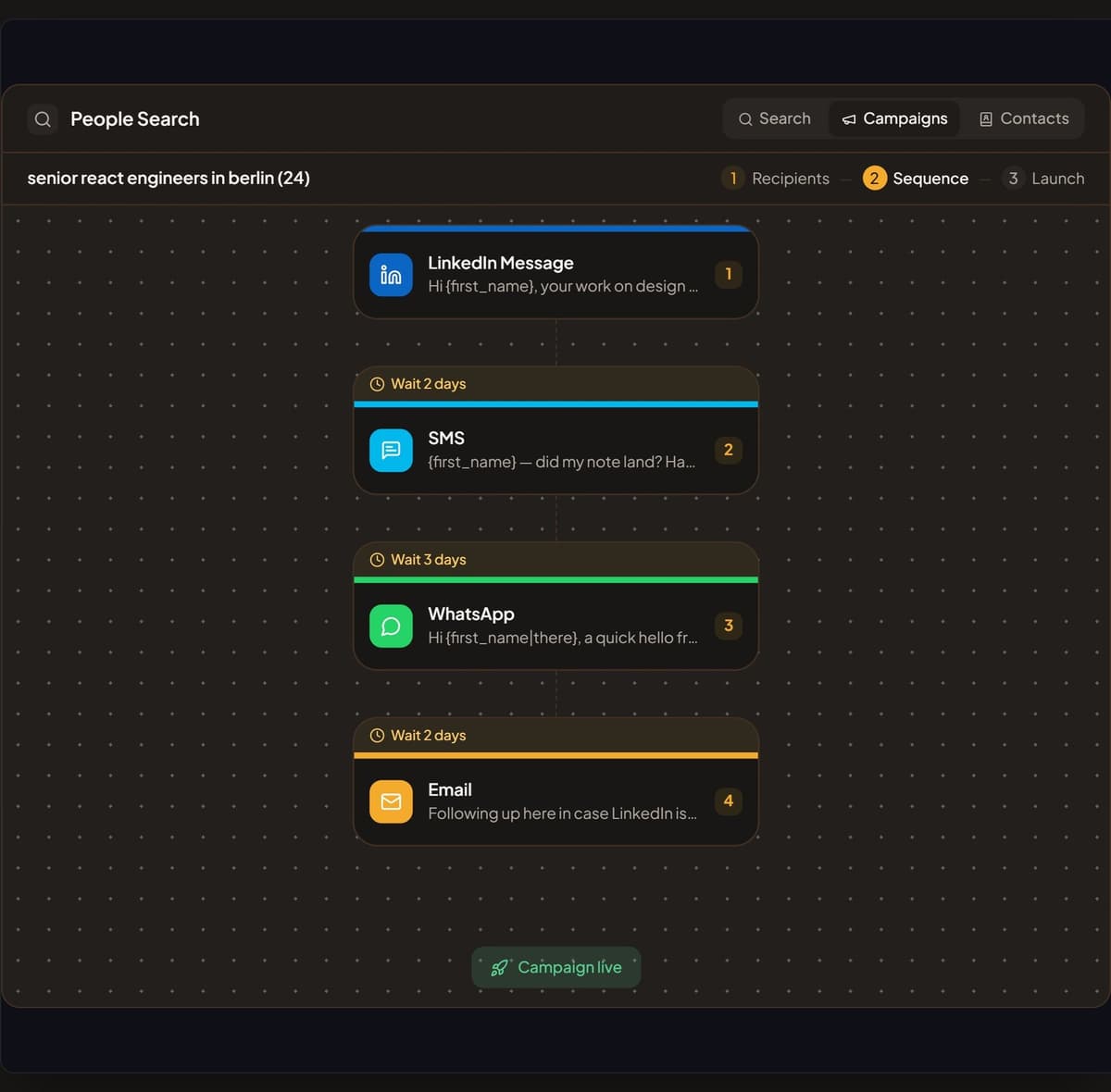
Among the modules are Automated Emails: Smart Email Automation for Recruitment, SMS Follow-Ups: Automated Candidate Text Messaging, and Resumatic: AI-Powered Resume Filtering System.
The connection to the job-board question is straightforward. If your count shows that a meaningful share of paid applicants were already in your ATS, the first response should be to improve how the firm uses the candidates it already has. That means making database searches easier, following up consistently and moving suitable candidates through the pipeline efficiently.
The count should still come first. It gives the firm evidence about where the problem actually exists. Then build the exact pipeline the desk needs around the candidates and processes it is already managing.
The goal is not to eliminate job boards. A board may still be the right source when a desk needs candidates it does not already have. The goal is to make sure the recruiter has a chance to use the firm's existing candidate pool before paying for another source of reach.
If the count says the file is worth working first, book a demo.
Frequently asked questions
What does Indeed charge a staffing agency for?
For a Sponsored Job using Pay Per Started Application, Indeed charges when a job seeker takes an action to begin an application. Qualifying jobs can be enrolled automatically, and Indeed's published terms state that these jobs cannot switch back to pay per click. The cost is determined through a live auction, so there is no single published price per application.
Does Indeed publish a price per started application?
No. Indeed's employer help pages do not publish a standard price per started application. The cost depends on candidate demand and the live auction for the job. Third-party websites may publish estimated price ranges, but those figures should not be treated as Indeed's published pricing.
How much does LinkedIn Recruiter cost a staffing firm?
LinkedIn does not publish a standard list price for a full Recruiter seat. The product is sold through LinkedIn and can provide up to 150 InMail credits per month per seat. Recruiter Lite provides 30 InMail credits per month. The useful comparison for a staffing firm is therefore the price in its own contract against the number of searches, messages and placements the seat produces.
What share of job board applicants are already in a staffing firm's ATS?
There is no reliable public primary source that gives a percentage for staffing firms. The most useful figure is your own. Export one month of paid applicants and match them against ATS records using email first and phone second. Keep only records that existed before the application was submitted.
Why does every applicant match when I run the count?
Your ATS may create a candidate record automatically when someone applies through a job board. That does not mean the candidate was already in your database. Check the record creation date. A match only counts as an existing candidate when the ATS record predates the job-board application.
Is candidate rediscovery worth it for temp and contract desks?
It can be. The ASA reports 414% turnover among temporary and contract employees in 2023, with average staffing employment lasting 10.1 weeks. Those figures describe the workforce rather than the number of repeat candidates in an individual firm's ATS. Your own count will show whether candidates who have previously worked with your firm are returning through paid job-board applications.
Should a staffing firm stop using job boards?
No. Job boards can provide valuable reach when a desk needs candidates it does not already have. This is particularly relevant when entering a new region or recruiting for a skill set that is not represented in the existing database. The count is designed to identify where paid reach is adding something new and where it is mainly reaching candidates the firm already holds.
How should a staffing firm measure job board ROI?
Track the entire path from paid applicant to placement. Tag each hire by its source, then compare the number of hires generated by paid applicants with how many of those candidates were already in the ATS before applying. Review the result alongside board spend. This gives an owner a more useful renewal measure than applicant volume alone.
What should a staffing firm do when the ATS overlap is high?
Change the order of work before immediately cutting the board. Have recruiters search the ATS for suitable candidates before sponsoring the job, then contact those candidates first. Set an agreed window for that search, such as two working days. If no suitable shortlist emerges, use the job board to expand the search. Repeat the measurement to see whether the change reduces paid overlap without reducing placements.
What should a staffing firm do when the ATS overlap is low?
Look at what the paid channel is producing rather than assuming low overlap automatically means high ROI. A board that brings genuinely new candidates can still be expensive without producing placements. Track applications, screening, submissions and hires by source, then compare those results with the invoice. If the board consistently produces candidates and placements the firm's own database cannot, the spend has a stronger case for renewal.
Sources
- Indeed: About Pay Per Started Application (PPSA), Employer Help Centre, Canada edition ↩
- Recruit Holdings: Q1 FY2026 earnings call transcript, 7 August 2026 ↩
- LinkedIn: Billing for promoted job posts, Hiring Pro pricing, Recruiter Lite, Recruiter and Search and staffing ↩
- ZipRecruiter: Plans ↩
- Dice: Pricing for employers ↩
- Indeed Hiring Lab: US Labor Market Snapshot, September 2026 ↩
- Appcast: 2026 Recruitment Marketing Benchmark Report release ↩
- Greenhouse: The Hire Standard benchmark report ↩
- Ashby: Are referred candidates more likely to get hired?, How many hires really come from inbound? and Recruiter Productivity, 2026 ↩
- Gem: Key takeaways from the 2026 Recruiting Benchmarks Report ↩
- Anais Galdin and Jesse Silbert: Making Talk Cheap: Generative AI and Labor Market Signaling ↩
- SHRM: Recruiting Executives Benchmarking ↩
- Robert Half Inc.: Form 10-K for fiscal 2025 ↩
- American Staffing Association: Staffing Industry Statistics and temp turnover and tenure, 2003 to 2023 ↩
- Staffing Industry Analysts: US Staffing Industry Forecast, September 2026 Update ↩
- StaffingHub: Beyond Job Board Dependency, 2026 ↩
- Firefish Software: Annual Recruitment Agency Report 2026 ↩
- Bullhorn: GRID 2026 Industry Trends Report ↩
US Bureau of Labor Statistics: Occupational Outlook Handbook, Human Resources Specialists