
The best interview questions are relevant to the job, consistent across candidates and evaluated against a clear scoring guide. The US Office of Personnel Management recommends assessing four to six competencies in a structured interview. Start by identifying the skills and behaviours the role requires. Then write questions for each competency and define what weak, satisfactory and strong answers look like.
Key takeaways
- Build the bank from the job: OPM says structured interviews typically assess four to six competencies, with one main question and written probes for each.
- Ask every candidate the same questions in the same order and score every answer on the same scale, which is how OPM defines a structured interview.
- Write example answers for each level of one rating scale, and have each interviewer rate alone before the debrief.
- Never ask about protected traits, and keep disability questions until after a conditional offer, as the EEOC states.
- Ask about pay expectations, not pay history: New York City and California bar salary history questions.
This guide to interview questions to ask candidates is for recruiters, talent acquisition teams, hiring managers and staffing agency recruiters. It includes a question bank organised by competency, a practical scoring guide and examples of interview questions that could create legal risks. It is intended as a hiring resource, not legal advice.
In this article
- What makes an interview question worth asking?
- How many competencies and questions belong in the bank?
- Should you ask behavioral or situational questions?
- How do you write a scoring guide two interviewers will apply the same way?
- Which interview questions should a recruiter never ask?
- What does a long or poorly structured interview process cost you with candidates?
- Conclusion
- Frequently asked questions
What makes an interview question worth asking?
A good interview question must relate directly to the job and be asked consistently across all candidates. The US Office of Personnel Management (OPM) defines a structured interview as one in which every candidate receives the same predetermined questions in the same order.1 Their answers are then assessed using the same rating scale and standards.
This consistency makes candidate responses easier to compare. According to the OPM, highly structured interviews demonstrate greater validity, more reliable and consistent ratings, stronger agreement between interviewers and less adverse impact.2 Its research also shows that structured interviews improve agreement on overall candidate evaluations by limiting how much individual discretion interviewers can exercise.2
When one interviewer asks a favourite question and another leaves it out, candidates are effectively being assessed against different standards. A structured process helps prevent this by giving everyone the same opportunity to demonstrate their suitability for the role.
| Element | Unstructured interview | Structured interview |
|---|---|---|
| Questions | Chosen by each interviewer during the interview | Prepared in advance based on the job's required competencies |
| Order | Varies between candidates | The same for every candidate |
| Follow-up probes | Improvised by the interviewer | Prepared alongside each question and used consistently where needed |
| Scoring | Based on the interviewer's overall impression | Each answer is rated against predefined example answers |
| Who rates | Ratings are often agreed during a group discussion | Each interviewer scores independently before comparing evaluations |
How many competencies and questions belong in the bank?
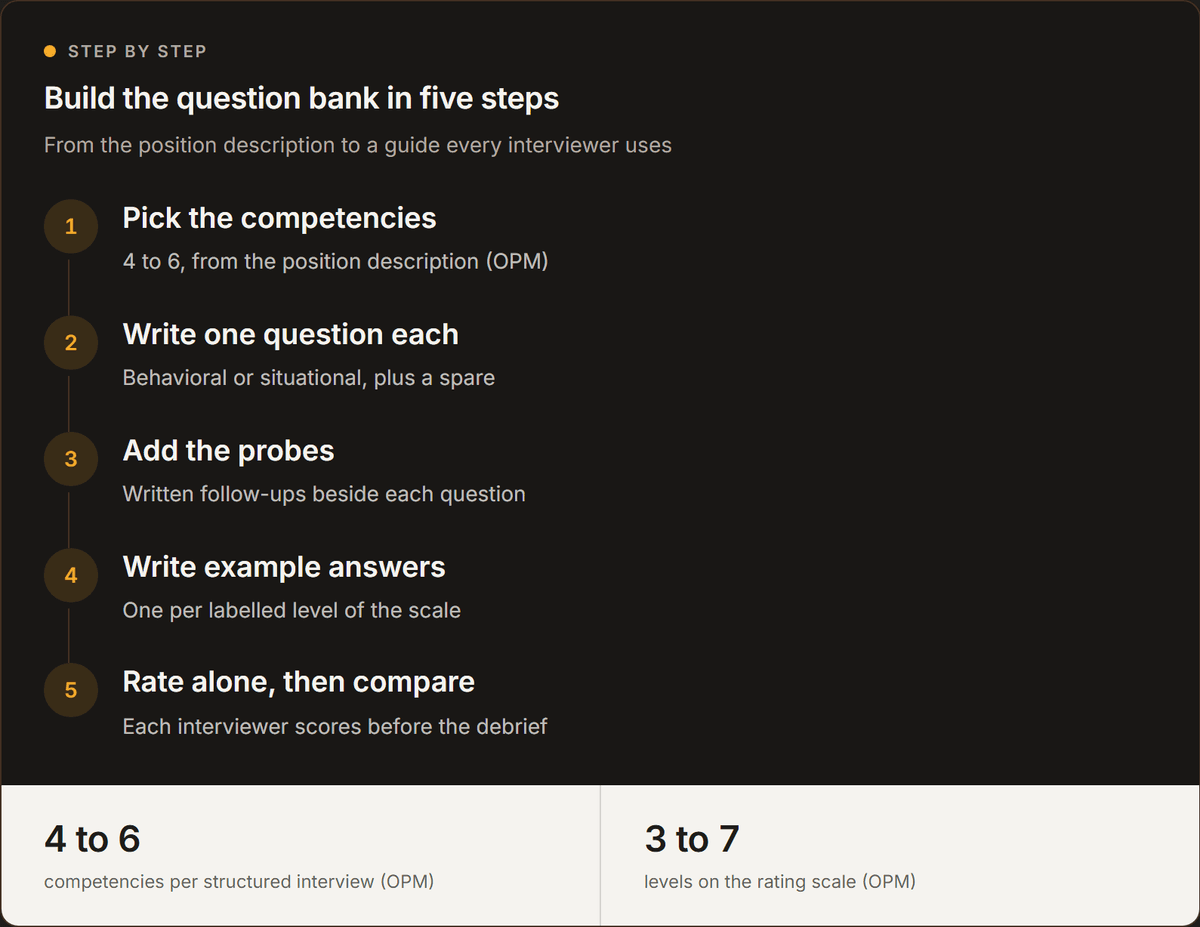
Most hiring teams need fewer questions than they think. The US Office of Personnel Management (OPM) recommends assessing four to six competencies in a structured interview, unless the position is particularly specialised or senior.3 These competencies should come directly from the job description rather than a generic list of desirable qualities.
Write one main question for each competency and prepare a backup question in case a candidate struggles to provide a relevant example. Include follow-up probes beneath each question so interviewers have a consistent way to explore responses. The OPM's interviewer's guide follows this approach, combining questions, rating scales, example responses and suggested probes in one document.3 This prevents interviewers from having to improvise follow-up questions during the interview.
Keep the question bank focused and manageable. Candidates are already facing increasingly lengthy recruitment processes. Gem, a recruiting software provider, reported that its platform data from January 2021 to December 2024 showed hiring teams conducting 42% more interviews per hire than in 2021, increasing from 14 to 20.4 Average time to hire also rose by 24%, from 33 to 41 days. A later Gem report, covering June 2021 to May 2025, found that the average number of interviews per hire had increased by 33% since 2021.5
Should you ask behavioral or situational questions?
Use both formats, with a stronger emphasis on behavioural questions for complex roles. The US Office of Personnel Management (OPM) distinguishes between behavioural questions, which ask candidates to describe how they handled situations in their previous work experience, and situational questions, which present realistic workplace scenarios and ask how they would respond.3
According to the OPM, both formats are effective. However, behavioural description interviews have demonstrated higher validity for complex work, particularly in professional and managerial positions.2 Situational questions can be useful when candidates have limited relevant work experience or have not yet encountered the situations being discussed.
Whichever format you choose, the questions must be assessed against predefined criteria. Even a well-written question becomes part of an unstructured interview if the interviewer relies on personal impressions rather than consistent scoring standards.
The question bank, by competency
Use the questions below as a starting point. Select the competencies relevant to the position and ask every candidate the same questions using the same wording.
Problem solving
- Behavioural: Tell me about a problem at work that had no obvious answer. What did you do first, and what happened?
- Situational: A process you own starts producing errors, and nobody knows why. Walk me through how you would approach the first day of investigating it.
- Probes: What information were you missing? Who else did you involve? What would you do differently next time?
Communication
- Behavioural: Describe a time you had to explain something complicated to someone without your background. How did you know they understood?
- Situational: A client misunderstands your latest update and becomes upset. What would you say during the call?
- Probes: What did you put in writing afterwards? How did the other person respond?
Ownership and reliability
- Behavioural: Tell me about a commitment you were at risk of missing. What did you do, and when did you tell the people involved?
- Situational: You realise on a Friday that a Monday deadline is going to slip. What happens next?
- Probes: Who did you inform, and how early? What did you change about your planning afterwards?
Working with others
- Behavioural: Describe a disagreement with a colleague about how to approach a task. How was it resolved?
- Situational: A teammate regularly hands over work late, causing delays to your own work. How would you handle the situation?
- Probes: What did you say to the colleague directly? What was the outcome for the work?
Job knowledge (write this one per role)
- Behavioural: Tell me about the most challenging [core task of the role] you have completed. What made it difficult?
- Situational: Here is a realistic [core task] from this job. How would you approach it?
- Probes: What tools or methods did you use? How did you check the result?
If you need to discuss compensation, ask candidates about their salary expectations rather than their previous pay history. The legal section below explains why this distinction matters.

How do you write a scoring guide two interviewers will apply the same way?
Create one scoring scale and apply it consistently across all competencies. The US Office of Personnel Management (OPM) recommends using the same range of proficiency levels for every competency, typically between three and seven levels, with at least three clearly defined categories.3 For most hiring teams, a simple three-point scale is sufficient: does not meet, meets and exceeds expectations.
Example answers are what make the scoring guide useful. Rather than leaving interviewers to decide whether a response is good enough, provide examples of what candidates at each proficiency level are likely to say. The OPM recommends developing these examples with subject-matter experts, who discuss possible responses and agree on representative answers for each level. Interviewers then compare candidates' responses against these examples when assigning scores.
The following example shows how to score an answer to the problem-solving question in the question bank.
| Level | What the answer sounds like |
|---|---|
| Does not meet | Describes the problem but cannot explain their own actions, or mainly discusses what other people did. Provides no clear result or cannot explain the outcome. |
| Meets | Identifies the problem, explains the steps taken in the correct order and describes the result. Mentions at least one factor they checked before taking action. |
| Exceeds | Meets all the previous criteria and explains how they tested their assumptions, who they involved and why. Also describes what they changed afterwards to prevent the problem from happening again. |
How to score partial answers
Not every candidate will cover every point in an example answer. Score the evidence they actually provide rather than assuming they would have taken the right steps or penalising them for leaving out minor details. If an answer meets some, but not all, of the criteria for a level, compare it with the next lower level and award the score that best reflects the evidence. Interviewers can use the prepared follow-up probes to clarify incomplete answers, but should give every candidate the same opportunity to provide additional detail. If important evidence is still missing, do not award a higher score based on assumptions or potential.
Keep individual scores separate until the debrief
Interviewers should score candidates independently, assessing each answer against the relevant example responses immediately after the interview. The OPM recommends this question-by-question approach rather than assigning an overall score based on general impressions.
Independent scoring also helps prevent rating errors. One example is leniency or strictness, where an interviewer consistently gives candidates unusually high or low scores regardless of their actual performance. If interviewers discuss their impressions before recording their individual ratings, they can influence one another's assessments.
Have each interviewer complete their scoring first. Once everyone has recorded their evaluations, compare the results and discuss any significant differences. This makes it easier to identify where interviewers interpreted an answer differently and agree on a fair assessment based on the established criteria.
Train interviewers before the process begins
Even a well-designed scoring guide will not produce consistent results if interviewers do not understand how to use it. Provide brief training on the competencies being assessed, how to ask the questions, when to use follow-up probes and how to apply the rating scale.
HumRRO, an industrial-organisational psychology consultancy, emphasises that interviewer preparation and training are essential to the success of structured interviews.6 A short briefing can help ensure that everyone understands the scoring standards and applies them consistently.
Which interview questions should a recruiter never ask?
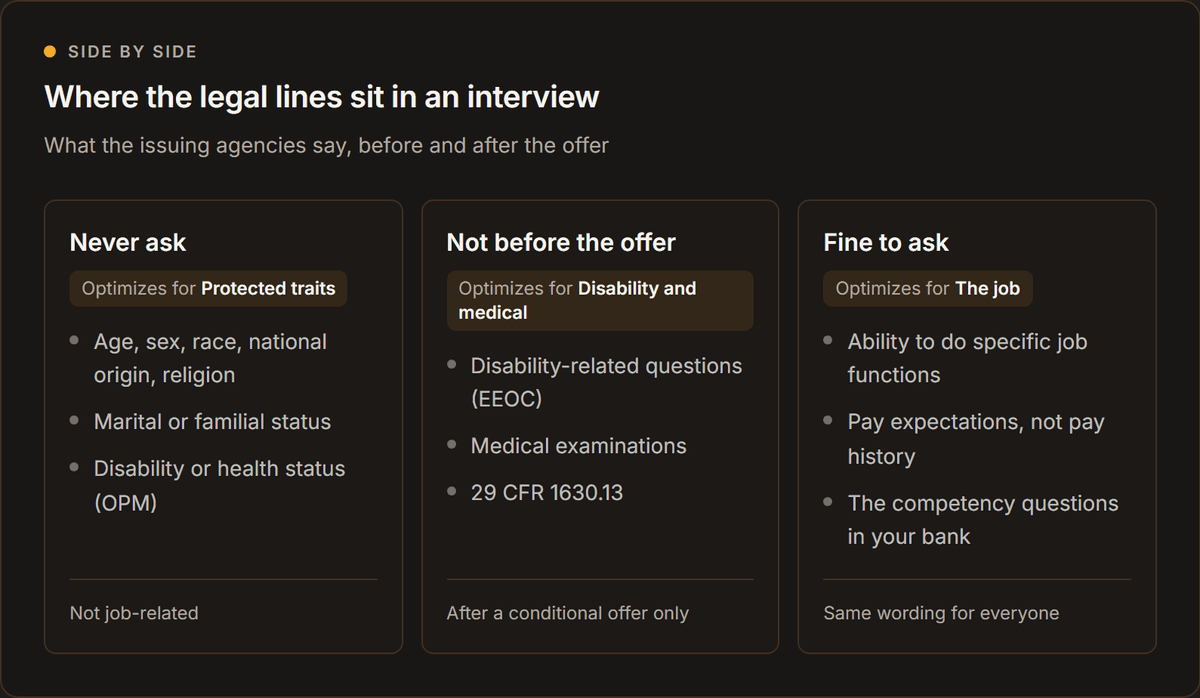
Interview questions should focus on a candidate's ability to perform the job, not their personal circumstances or protected characteristics. The US Office of Personnel Management (OPM) advises interviewers not to ask about or comment on a candidate's age, sex, race, national origin, religion, marital or family status, disability or health.3 The Equal Employment Opportunity Commission (EEOC) similarly recommends limiting pre-employment questions to information that is relevant to determining whether someone is qualified for the position. Characteristics such as race, sex, national origin, age and religion are generally irrelevant to that decision.
Disability and medical questions before a job offer
US law places specific restrictions on questions about disability and medical conditions during recruitment. Under 29 CFR 1630.13(a), covered employers generally cannot conduct medical examinations or ask applicants whether they have a disability, or about its nature or severity, before a conditional job offer.7 The exceptions are set out in 29 CFR 1630.14.
The EEOC confirms that employers generally cannot ask disability-related questions or require medical examinations until they have made a conditional job offer.89 However, recruiters can still ask whether a candidate can perform specific duties required by the position. For example, asking whether someone can meet the role's essential requirements, with or without reasonable accommodation, focuses on their ability to do the work rather than their medical history.
Pay history and salary expectations
Salary history is another area where recruiters need to understand the applicable laws. Some US jurisdictions prohibit employers and recruitment agencies from asking candidates about their previous earnings.
New York City's Local Law 67 of 2017 makes it an unlawful discriminatory practice for employers, employment agencies or their representatives to inquire about an applicant's salary history.10 However, they can discuss the candidate's salary, benefits and compensation expectations without asking about previous earnings.10
California has similar restrictions. According to the California Labor Commissioner's guidance, employers generally cannot seek salary history information from applicants, either directly or through an agent.11 However, they can ask candidates about their salary expectations for the position.
These examples apply to specific US jurisdictions and are not a complete list of salary history restrictions. Recruiters should check the relevant state and local requirements before including compensation questions in their interview process.
Consider the impact of the entire selection process
Legal compliance does not end with avoiding inappropriate questions. Recruiters must also consider whether their hiring practices disadvantage particular protected groups.
The EEOC explains that seemingly neutral recruitment policies can still be discriminatory if they disproportionately disadvantage people in protected groups and are not job-related and necessary for the operation of the business.12
The Uniform Guidelines on Employee Selection Procedures, under 29 CFR 1607.4, use the four-fifths rule as a general indicator of adverse impact.13 If a group's selection rate is less than four-fifths of the rate for the group with the highest rate, this is generally regarded as evidence of adverse impact. The rule is a screening guideline, not an automatic determination that discrimination has occurred.
For recruiters, this means reviewing the entire process, including screening criteria, interview questions, scoring methods and final selection decisions.
What to ask instead
| Avoid asking | Ask instead |
|---|---|
| What is your current salary? | What salary range are you expecting for this position? |
| Do you have any health conditions? | Can you perform the essential functions of this job, with or without reasonable accommodation? |
| Do you have children? | This role requires some travel. Is that something you can accommodate? |
| Where are you originally from? | Are you authorised to work in the US? |
| How old are you? | Do not ask. Age is generally irrelevant to determining whether someone is qualified for the position. |
What does a long or poorly structured interview process cost you with candidates?
A lengthy or disorganised interview process can cause candidates to withdraw before a hiring decision is made. According to Survale, the company behind the Talent Board's Candidate Experience (CandE) research, the leading reason candidates withdrew from recruitment processes in 2025 was feeling that their time had been disrespected during interviews and appointments. This was cited by 32% of candidates who withdrew.14 The 2025 CandE research covered more than 110 companies hiring internationally and collected feedback from over 66,000 job candidates.15
Structured interviews are already widely used among employers participating in the research. Survale reports that 65% of North American employers used structured interview processes in 2025, compared with 71% of CandE award winners.14 However, the research also found that 56% of candidates received no feedback after being rejected during the screening and interview stages.14
A focused question bank can help reduce unnecessary interview rounds and make better use of everyone's time. Written scoring records also give recruiters specific, job-related reasons for their decisions, making it easier to provide meaningful feedback to unsuccessful candidates.
There is no publicly available study establishing the effectiveness of a short interview question bank developed by an individual recruiter. The approach outlined in this guide adapts the OPM's structured interview methodology for smaller hiring teams. Track how well your questions distinguish between candidates and compare interview scores with subsequent job performance. If a question consistently produces similar scores without helping identify stronger candidates, review or replace it.
Conclusion
A successful interview process is not about asking as many questions as possible. It is about asking the right questions, assessing every candidate against the same standards and making decisions based on evidence rather than personal impressions. A structured question bank gives recruiters and hiring managers a consistent way to evaluate the skills, experience and behaviours that matter for each position.
Start with four to six job-related competencies, prepare behavioural and situational questions, and define what weak, satisfactory and strong answers look like. Give interviewers clear scoring guidelines, train them to apply those standards and have them record their assessments independently before discussing the results. Just as importantly, review the questions regularly to establish whether they actually distinguish between candidates who perform well and those who do not.
Consistency also makes the recruitment experience fairer and more respectful. Candidates should understand what they are being assessed on, have an equal opportunity to demonstrate their abilities and receive clear, job-related feedback where possible. Avoiding inappropriate questions and reviewing selection outcomes are equally important parts of building a defensible hiring process.
How Hivemind handles interviews and scoring
The question bank, the example answers and the hiring decision belong to the recruiter and the hiring manager.
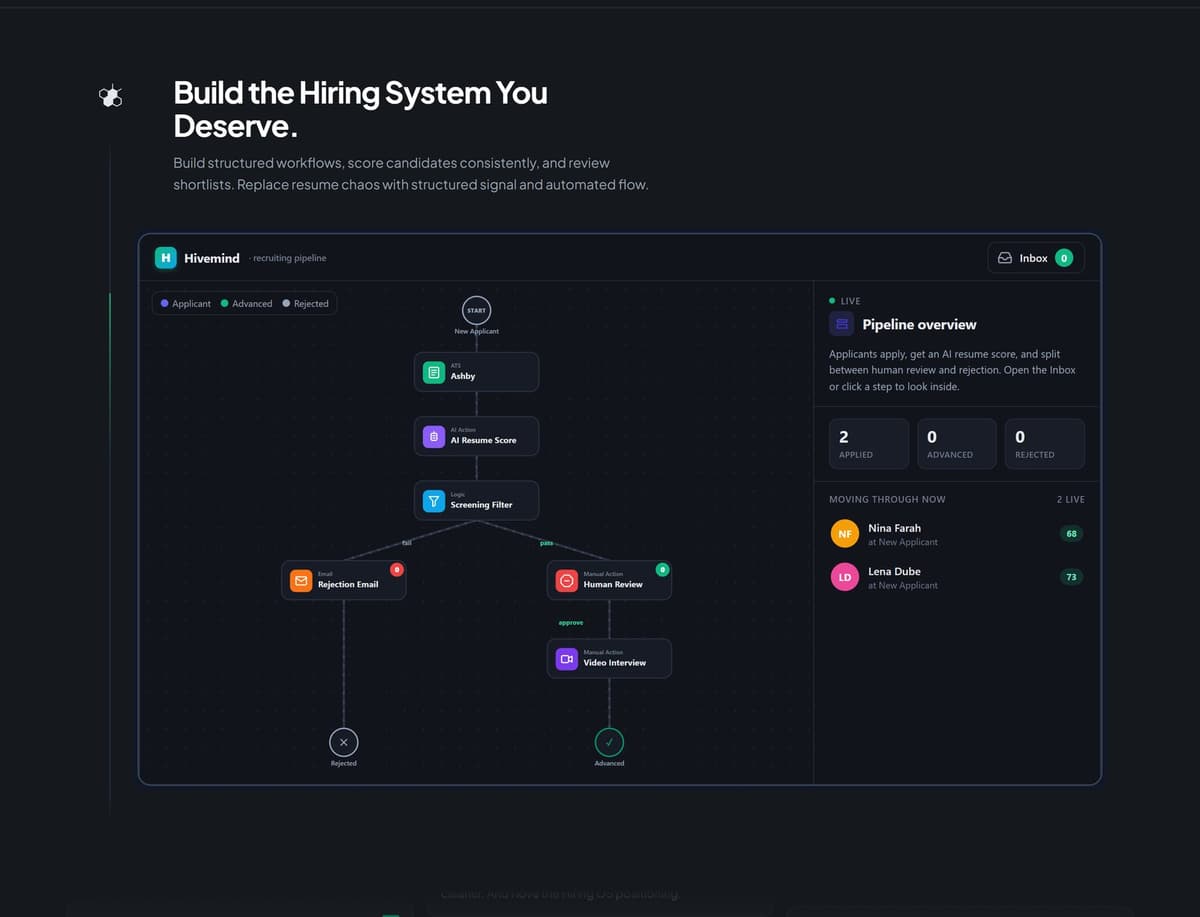
Around the interview sits the rest of the work: sourcing, screening, interviews, offers, and the admin around them. Hivemind is the hiring OS: manage every candidate from inbound to offer in one unified workflow. Its modules include Automatic Video Assessment: AI-Powered Video Interview Analysis, and Automated Skills Assessments.
A team can run Hivemind end to end, connect your existing tools, or mix and match both, and build the exact pipeline your team deserves.
Related: building an interview score card, rubrics for interviews and phone screening questions.
Frequently asked questions
How many interview questions should you ask a candidate?
Ask enough questions to assess the competencies required for the role without making the interview unnecessarily long. The US Office of Personnel Management (OPM) recommends assessing four to six competencies in a structured interview, unless the position is particularly specialised or senior. One main question per competency, supported by prepared follow-up probes, is usually sufficient for a standard interview.
How do you score interview answers fairly?
Use the same scoring scale for every candidate and define what a strong, satisfactory and weak answer looks like. The OPM recommends using a consistent range of three to seven proficiency levels across all competencies, with at least three clearly labelled levels. Interviewers should score each answer independently against the example responses before comparing their assessments during the debrief.
Can a recruiter ask about a candidate's salary history?
In many US jurisdictions, employers and recruitment agencies are prohibited from asking candidates about their previous earnings. For example, New York City's Local Law 67 of 2017 prohibits salary history inquiries during recruitment. Recruiters can generally ask about a candidate's salary expectations instead. However, requirements vary between states and cities, so check the applicable legislation wherever you recruit.
Can you ask a candidate about a disability during an interview?
Generally, no. Under US federal law, employers cannot ask disability-related questions or require medical examinations before making a conditional job offer, subject to specific legal exceptions. Recruiters can ask whether candidates are able to perform the essential functions of the position, with or without reasonable accommodation, without requesting details about their medical history.
Should interviewers ask every candidate the same questions?
Yes. A structured interview requires every candidate to receive the same predetermined questions in the same order and to be evaluated against the same scoring criteria. This makes responses easier to compare, raises agreement between interviewers and helps ensure that hiring decisions are based on job-related evidence rather than personal impressions.
Sources
- US Office of Personnel Management: OPM Assessment and Selection, Structured Interviews page ↩
- US Office of Personnel Management: OPM Assessment and Selection, Other Assessment Methods, Structured Interviews ↩
- US Office of Personnel Management: OPM Structured Interviews training presentation (PDF) ↩
- Gem: Gem blog, 10 takeaways from the 2025 Recruiting Benchmarks Report, 16 January 2025 ↩
- Gem: Gem blog, key takeaways from the 2026 Recruiting Benchmarks Report, 1 December 2025 ↩
- HumRRO: HumRRO blog, 27 January 2025 ↩
- US Equal Employment Opportunity Commission: eCFR, 29 CFR 1630.13(a) ↩
- US Equal Employment Opportunity Commission: EEOC, Pre-Employment Inquiries and Disability ↩
- US Equal Employment Opportunity Commission: EEOC Enforcement Guidance, notice 915.002, 10 October 1995 ↩
- New York City Council: NYC Local Law 67 of 2017, adding Admin. Code 8-107(25) ↩
- California Department of Industrial Relations: California DIR Labor Commissioner FAQ, citing Lab. Code 432.3(b) ↩
- US Equal Employment Opportunity Commission: EEOC, Prohibited Employment Policies/Practices ↩
- Federal enforcement agencies: eCFR, 29 CFR 1607.4(D) ↩
- Survale: Survale CandE 2025 fact sheet, 21 July 2026 ↩
- Survale: Survale CandE 2025 key takeaways, 12 January 2026 ↩