
The best manager interview questions focus on what candidates have actually done. Ask how they have hired employees, coached underperforming team members, resolved conflict, managed budgets and delegated work. These examples reveal far more about their management ability than general statements about leadership style or philosophy.
Key takeaways
- Test the work of managing: hiring, coaching, conflict, the team's numbers, and delegation, with questions about what the candidate actually did.
- OPM's structured interview training deck says structured interviews typically assess between four and six competencies, so pick the ones the role needs and drop the rest.
- Ask every candidate the same questions in the same order and score each answer on one scale with an example answer written for each level.
- Keep age, family, health and disability out of every question and the small talk around them.
- The question bank is a method built on OPM's published rules, not a validated test, so tell the panel that plainly.
Use the same questions for interviewing a manager, in the same order, for every candidate. Score each response against written criteria agreed upon before interviews begin. This creates a consistent hiring process and makes it easier to compare candidates objectively. Avoid questions about management philosophy, which can produce polished answers without demonstrating practical experience.
This guide covers manager interview questions grouped by competency, a written scoring framework and questions that are better left out of the interview.
In this article
- Why does the quality of a manager matter?
- What should an interview for a manager test?
- Which manager interview questions should you ask, by competency?
- How do you score answers to manager questions?
- What can you not ask a manager candidate?
- Conclusion: Hire a manager who can prove they can manage
- Frequently asked questions
Why does the quality of a manager matter?
Hiring a manager affects more than one position. It influences how an entire team operates, how employees develop and how effectively work gets done.
Gallup reports that managers account for 70% of the variance in team engagement.1 Its 2025 study of US frontline supervisors found that 65% had obtained their management roles through strong performance or years of frontline experience. Only 30% said they were selected based on supervisory skills or experience. However, the latter group reported higher engagement, at 42% compared with 31%.1
Gallup's State of the Global Workplace 2025 report also found that only 44% of managers worldwide had ever received management training.1 Gallup also says manager engagement has declined by nine percentage points since 2022, reaching 22% globally in 2025.1
Other research highlights the importance of trust and effective management. DDI's Global Leadership Forecast 2025, based on responses from 2,185 human resource professionals and 10,796 leaders, found that trust in immediate managers had fallen to just 29%.2
SHRM's 2024 research on people managers found that 64% of US workers rated their managers as highly effective. The difference in employee experience was particularly significant: only 35% of workers with managers they did not consider highly effective said they felt valued at their organisation, compared with 80% of those who rated their managers highly.3
The CIPD's Good Work Index 2026, based on a YouGov survey of more than 5,000 working adults in the UK, identified line management, leadership, opportunities for skills development and meaningful work as having the greatest influence on all five business-related outcomes measured in the study.4
These figures should be considered in context. Each of these organisations sells management assessment, development or training services, so their findings are worth reading with that commercial interest in mind.
The demand for management capability is also reflected in employment projections. The US Bureau of Labor Statistics' national employment matrix puts employment in management occupations at 13,683.4 thousand in 2025.5 It projects this figure will increase to 14,527.6 thousand by 2035.
What should an interview for a manager test?
A manager interview should assess someone's ability to get work done through other people. This is a different responsibility from performing the technical or operational work that may have earned them a promotion in the first place.
The US Office of Personnel Management (OPM) makes this distinction in its qualification policy. It states that supervisory positions require both subject-matter knowledge and the managerial abilities needed to plan, assign and review work, as well as evaluate employee performance.6
OPM defines a competency as a measurable combination of knowledge, skills, abilities, behaviours and other characteristics required to perform a particular role or occupational function successfully. Its Executive Core Qualifications are also used by many government departments and agencies when selecting, managing and developing executives and managers.7
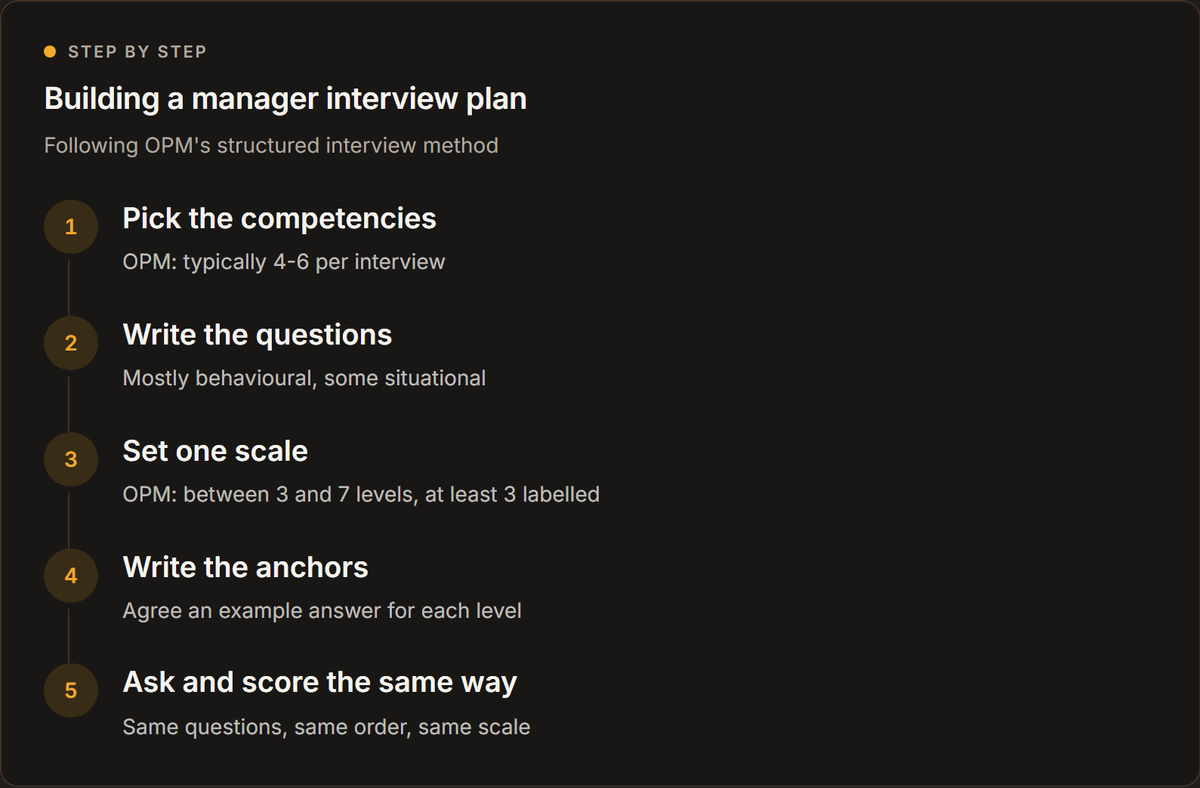
According to OPM's structured interview training material, structured interviews typically assess between four and six competencies.8 More may be appropriate for particularly specialised or senior positions. The question bank in this guide uses five core competencies:
- Hiring and building a team.
- Coaching and feedback.
- Handling conflict.
- Managing team budgets and performance numbers.
- Delegation and accountability.
OPM distinguishes between two types of interview questions. Behavioural questions ask candidates to describe how they handled situations in previous roles. Situational questions present a realistic workplace scenario and ask how they would respond.
Both approaches are effective, but OPM notes that behavioural description interviews have demonstrated stronger validity in highly complex occupations, including professional and managerial positions.9
Gallup also recommends combining structured interviews with validated assessments when selecting managers.1 Its approach focuses on identifying candidates whose natural talents and capabilities match the demands of the role.
The distinction matters because a question about management philosophy primarily tests how well someone can explain their beliefs. A candidate may describe an impressive leadership approach without having demonstrated the ability to put it into practice. Questions about actual decisions, actions and outcomes provide a much stronger basis for evaluating management experience.
Which manager interview questions should you ask, by competency?
Start with behavioural questions that ask candidates to describe their previous experience. Use situational questions when their past roles have not given them an opportunity to demonstrate a particular skill. Follow up with questions such as "What did you do next?" and "How did it end?" to establish what the candidate actually contributed and what resulted from their actions.
Hiring and building a team
OPM's Human Capital Management competency states that effective leaders ensure employees are appropriately recruited, selected, appraised and rewarded.10 It also includes taking action to address performance problems.
The following questions explore whether candidates can identify suitable people, make sound hiring decisions and manage performance when an employee is not meeting expectations.
- Tell me about the last person you hired for your team. What qualities were you looking for, and how did you assess them?
- Describe a hire that did not work out. When did you recognise the problem, and what action did you take?
- Tell me about a time you had to address a performance problem with someone you managed. What happened after your first conversation?
- Suppose you inherit a team with vacant positions and a deadline next month. Which role would you prioritise filling, and how would you approach the recruitment process?
Coaching and feedback
OPM's Developing Others competency focuses on improving employees' ability to perform and contribute. It includes providing ongoing feedback and creating opportunities to learn through both formal and informal development.10
A good manager should be able to identify individual development needs, give constructive feedback and help employees take on greater responsibilities.
- Tell me about someone who became better at their job because of something you did. What specifically did you do?
- Describe the last difficult piece of feedback you gave an employee. How did you prepare for the conversation, and how did the person respond?
- Give an example of a stretch assignment you gave someone. How did you support them while they developed the necessary skills?
- Suppose a strong performer asks for a promotion that you cannot offer this year. How would you handle the conversation?
Handling conflict
OPM's Conflict Management competency covers the ability to manage and resolve disagreements constructively. One of its example behaviours at the Intermediate level is using mediation techniques to manage conflict between team members.10
Managers need to recognise disagreements before they affect productivity, understand the different perspectives involved and find a way forward without allowing workplace tensions to escalate.
- Tell me about a disagreement between people on your team that affected their work. What did you do, and in what order?
- Describe a time you disagreed with your own manager about a decision that affected your team. How did you approach the disagreement, and what was the outcome?
- Tell me about a conflict you allowed to continue for too long. Looking back, what would you do differently?
- Suppose two senior employees both want responsibility for the same project and each threatens to leave if they do not get it. How would you handle the situation over the following week?
Running the team's numbers
OPM's current Executive Core Qualification on fiscal responsibility focuses on managing, allocating and monitoring financial resources strategically.7 It also includes aligning priorities with budget proposals, monitoring expenditure and using cost-benefit analysis to make decisions.
Managers do not necessarily need to be financial specialists, but they should understand the numbers behind their team's performance. They must be able to monitor spending, justify additional resources and make sensible decisions when budgets change.
- Tell me about a budget you were responsible for. How did you track spending against it, and what did you do when expenditure went off plan?
- Describe a time you requested additional employees or budget. What justification did you provide, and what was the outcome?
- Which performance figures did you report for your team each week? Which metric did you act on most frequently, and why?
- Suppose your budget is cut halfway through the financial year. What would your first decisions be, and how would you determine where to reduce spending?
Delegation and accountability
OPM's supervisory qualification policy highlights the importance of planning, assigning and reviewing work, as well as evaluating employee performance. These responsibilities are central to effective delegation and accountability.
A manager must know when to hand work to someone else, how to match responsibilities with individual capabilities and how to maintain oversight without micromanaging. They must also take responsibility when delegated work does not meet expectations.
- Tell me about a responsibility you delegated that you would previously have handled yourself. How did you decide who should take it on?
- Describe a time delegated work was returned late or completed incorrectly. What did you do, and who took responsibility for correcting it?
- Walk me through how you normally plan, assign and review your team's work during a typical week.
- Suppose you take over a team that has repeatedly missed deadlines. What would you investigate first, and how would you address the problem?
These manager interview questions provide a starting point rather than a fixed script. Adapt the wording to reflect the responsibilities, seniority and specific requirements of the position. The aim is to assess the competencies that matter most to the job, not to ask every possible question.

How do you score answers to manager questions?
Score every answer against written criteria established before the first interview. This prevents interviewers from relying on personal impressions or favouring candidates who communicate confidently but cannot demonstrate the required management skills.
The US Office of Personnel Management (OPM) defines a structured interview as one in which every candidate receives the same predetermined questions, in the same order, and all responses are assessed using the same rating scale and standards for acceptable answers.811
OPM's structured interview training material recommends choosing one proficiency-level range for all competencies. The scale typically contains between three and seven levels, with at least three clearly labelled. Its Leadership Competency Proficiency Levels framework describes five levels, ranging from Level 1 (Awareness) to Level 5 (Expert), with example workplace behaviours for each competency.10
OPM also explains how to develop scoring anchors. Subject-matter experts discuss sample responses and agree on examples that best represent each proficiency level. Interviewers then compare candidates' answers against these agreed examples rather than relying on their own interpretation of what constitutes a good response.
The following table uses OPM's example rating labels to demonstrate how a three-level scoring system could work for a coaching question.
| Rating | What the answer shows | Example anchor for a coaching question |
|---|---|---|
| Superior | A specific situation the candidate managed, the steps taken in order, the outcome and what they changed as a result. | Identifies the feedback given, explains the follow-up and describes what the employee now does differently. |
| Satisfactory | A genuine workplace situation and a reasonable response, but with gaps in follow-through or measurable results. | Describes giving the feedback but cannot clearly explain what happened afterwards. |
| Unsatisfactory | A general opinion, hypothetical response or example of someone else's management rather than their own actions. | Talks about believing in open feedback but cannot provide a practical example. |
Develop similar anchors for every question and agree on them with the hiring manager before interviews begin. Each interviewer should score candidates independently before the panel compares results. This helps prevent one interviewer's opinion from influencing everyone else's assessment.
Interviewer preparation also matters. HumRRO, an industrial-organisational psychology consultancy that provides interviewer training, emphasises that the effectiveness of structured interviews depends heavily on how well interviewers are trained and prepared.12
This question bank applies OPM's published structured interview principles, but it is not a validated assessment instrument. We found no publicly available study specifically testing a recruiter-developed question bank for hiring people managers. For more guidance on the wider process, see the guides to how to structure an interview, rubrics for interviews and interview questions to ask candidates.
What can you not ask a manager candidate?
Keep questions about personal circumstances out of the interview, including seemingly harmless small talk. Questions about family responsibilities, age, health and other personal characteristics can introduce discrimination into the hiring process.
OPM's structured interview training material advises interviewers not to ask about or comment on a candidate's age, sex, race, national origin, religion, marital or family status, disability or health status.8
In the United States, the Equal Employment Opportunity Commission (EEOC) enforces several laws governing these areas. The Age Discrimination in Employment Act (ADEA) protects applicants and employees aged 40 and older against age discrimination.13 Under 29 CFR 1625.5, employment application forms requesting a candidate's date of birth or age receive close scrutiny to establish whether the information is being requested for a permissible purpose.14
The EEOC's caregiving enforcement guidance also identifies potentially discriminatory interview practices. For example, asking female applicants about their marital status, young children or childcare responsibilities while not asking male applicants the same questions can be evidence of sex discrimination.15
Disability-related questions are also restricted. Under 29 CFR 1630.13(a), covered employers cannot ask applicants whether they have a disability or inquire about its nature or severity, except where specific provisions under 29 CFR 1630.14 permit it.16
Employers should also examine the outcomes of their selection processes. The Uniform Guidelines on Employee Selection Procedures, under 29 CFR 1607.4, establish the four-fifths rule.17 A selection rate for a particular race, sex or ethnic group that is less than four-fifths of the rate for the group with the highest selection rate is generally regarded as evidence of adverse impact. This is a screening guideline rather than an automatic legal determination of discrimination.
These are US federal employment guidelines, not a complete account of employment law in every country. This information is general guidance, not legal advice.
Conclusion: Hire a manager who can prove they can manage
A strong manager is not simply someone who has been promoted, has years of industry experience or knows how to talk about leadership. They are someone who can build a capable team, develop employees, resolve disagreements, manage resources and take responsibility when things go wrong. Those abilities need to be demonstrated, not assumed.
That is why the quality of your manager interview matters. A structured process gives every candidate the same opportunity to demonstrate their experience and gives hiring teams a consistent way to assess the answers. By choosing the right competencies, asking evidence-based questions and agreeing on scoring criteria before the first interview, you reduce the influence of polished interview performances and gut feelings.
The most important question is not whether someone sounds like a good manager. It is whether they can explain what they have done, why they made particular decisions and what happened as a result. A candidate who can demonstrate those things provides a much stronger basis for a hiring decision than one who simply describes the kind of leader they hope to be.
Ultimately, hiring a manager means hiring someone who will influence the performance, development and working lives of everyone on their team. Take the time to assess that responsibility properly. The right hire can strengthen an entire organisation; the wrong one can undermine a team long after the interview is over.
How Hivemind handles manager interviews
The question bank, the anchors and the hiring decision stay with the recruiter and the hiring manager.
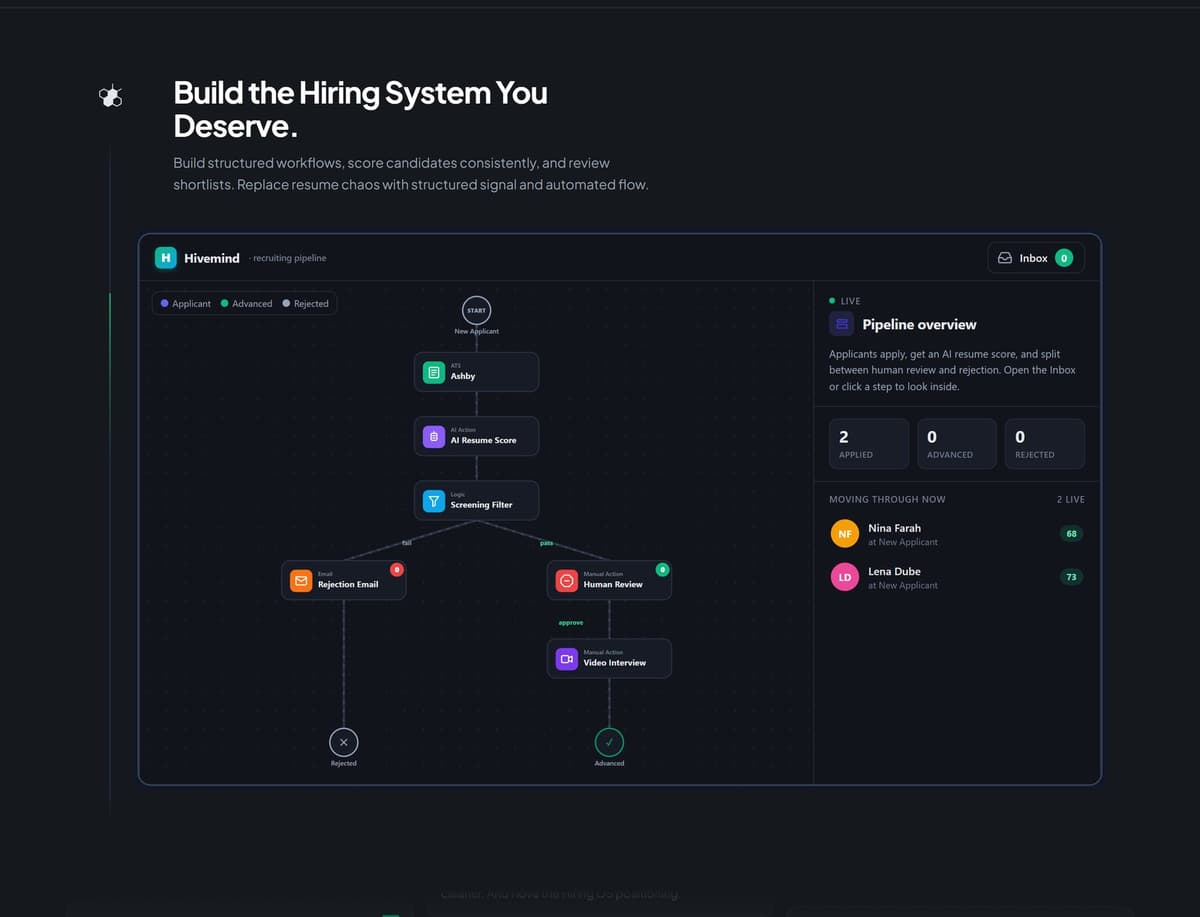
Hivemind is the hiring OS for the work around them: sourcing, screening, interviews, offers, and the admin around them. With Hivemind you manage every candidate from inbound to offer in one unified workflow. Hivemind's modules include Automatic Video Assessment: AI-Powered Video Interview Analysis, and Automated Skills Assessments. A team can run Hivemind end to end, connect your existing tools, or mix and match both.
Frequently asked questions
What are good questions for interviewing a manager?
The best manager interview questions ask candidates to describe specific situations they have handled, such as hiring an employee, resolving a team conflict, coaching an underperformer or managing a budget. Focus on what they personally did, the decisions they made and the outcomes they achieved. Score each response against written criteria to make comparisons fair and consistent.
How many competencies should a manager interview cover?
The US Office of Personnel Management (OPM) recommends assessing between four and six competencies in a typical structured interview, unless the position is particularly specialised or senior. Five competencies provide a practical starting point for most people management roles.
Should I use behavioural or situational questions when interviewing managers?
Use mostly behavioural questions, which ask candidates to explain how they handled situations in previous roles. OPM reports that behavioural description interviews have demonstrated higher validity for complex work, including managerial positions. Situational questions are also effective and can help assess candidates who have limited experience with a particular responsibility.
How should you score answers to manager interview questions?
Develop a consistent rating scale with written scoring anchors before interviewing candidates. OPM recommends using between three and seven proficiency levels, with at least three clearly labelled. Evaluate each response against the same standards, focusing on the candidate's actions, reasoning and results rather than confidence or presentation skills.
Is this manager interview question bank a validated assessment test?
No. This question bank applies OPM's published structured interview principles to common management competencies. It is a practical recruitment resource, not a scientifically validated assessment instrument. Employers should develop and agree on their own scoring criteria based on the specific requirements of the position.
Sources
- Gallup: Gallup, How Managers Impact Team Productivity, 27 July 2026 ↩
- DDI: DDI, Global Leadership Forecast 2025, 22 January 2025 ↩
- SHRM: SHRM, Effective People Managers: The Linchpin of Organizational Success, 13 June 2024 ↩
- CIPD: CIPD, Good Work Index 2026, July 2026 ↩
- US Bureau of Labor Statistics: BLS Employment Projections, National Employment Matrix, management occupations ↩
- US Office of Personnel Management: OPM, General Schedule Qualification Policies ↩
- US Office of Personnel Management: OPM, Executive Core Qualifications, updated 1 October 2025 ↩
- US Office of Personnel Management: OPM, Structured Interviews training presentation ↩
- US Office of Personnel Management: OPM, Other Assessment Methods: Structured Interviews ↩
- US Office of Personnel Management: OPM, Proficiency Levels for Leadership Competencies ↩
- US Office of Personnel Management: OPM, Structured Interviews ↩
- HumRRO: HumRRO, The critical role of interviewer training in effective structured interviews, 27 January 2025 ↩
- US Equal Employment Opportunity Commission: EEOC, Age Discrimination ↩
- US Equal Employment Opportunity Commission: 29 CFR 1625.5, eCFR ↩
- US Equal Employment Opportunity Commission: EEOC, Enforcement Guidance: Unlawful Disparate Treatment of Workers with Caregiving Responsibilities ↩
- US Equal Employment Opportunity Commission: 29 CFR 1630.13, eCFR ↩
- Federal enforcement agencies: Uniform Guidelines on Employee Selection Procedures, 29 CFR 1607.4, eCFR ↩
- US Office of Personnel Management: OPM, Competencies