

Temp to hire is a staffing arrangement in which the agency employs a worker and assigns them to a client. The client can then offer the worker permanent employment, usually by paying a conversion fee. That fee typically decreases over time and may disappear after an agreed assignment period.
Key takeaways
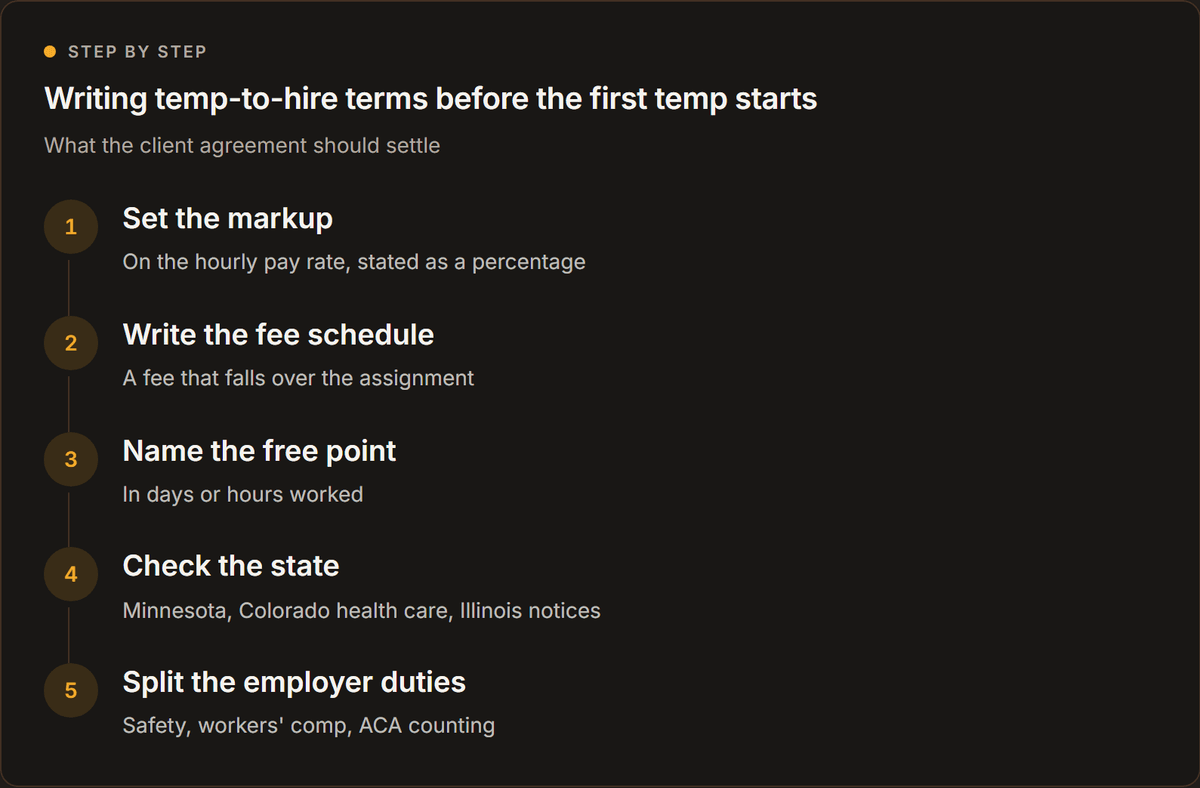
- Write the conversion fee schedule, the free-conversion point and the markup into the client agreement before the first temp starts.
- Published public contracts show the shape: the Massachusetts statewide contract PRF85 lists 15% at 30 days, falling to none over 90 days, with a maximum markup of 36.5%.
- The staffing firm is the employer of record, and OSHA says the firm and its client share responsibility for a safe workplace, so split the duties in the contract.
- Read the state rule where you place: Minnesota bars restricting a client from hiring your employee, and Colorado bars health-care staffing fees on a permanent hire except compensation chargeable for the first 30 calendar days.
- No public source gives an average conversion fee or conversion rate, so price from your own placements.
For staffing firms, the financial terms need to be established before the assignment begins. The client agreement should clearly define the conversion fee, the point at which permanent hiring becomes free, and the markup charged during the temporary assignment. These terms determine how the agency protects its margins while giving the client a path to permanent employment.
This guide is for staffing agency owners and branch managers negotiating temp-to-hire agreements, as well as employers considering temp to hire as an alternative to direct recruitment. It explains who employs the worker during the assignment, how conversion clauses work in published staffing agreements, and which compliance requirements can limit these arrangements. It is not legal advice.
In this article
- What is temp to hire, and how big is the market it runs on?
- Who is the employer while the temp is on assignment?
- What does a long assignment do to benefits and ACA counting?
- What do published client agreements put in the conversion clause?
- Which state laws limit conversion fees?
- When should a client choose temp to hire over a direct hire?
- Conclusion: make every temp-to-hire placement work for your agency
- Frequently asked questions
What is temp to hire, and how big is the market it runs on?
Temp to hire is a common staffing arrangement. The American Staffing Association (ASA) includes temporary-to-hire placements among the services staffing agencies offer, alongside temporary and contract staffing, permanent placements and long-term assignments.1
The temporary staffing market supporting this model is substantial, although employment has declined in recent years. According to the ASA, nearly 2.0 million temporary and contract employees worked for US staffing companies during an average week in 2025.2 These companies hired 9.5 million temporary and contract employees over the course of the year.
The Bureau of Labor Statistics (BLS) Current Employment Statistics series for temporary help services also shows the decline. Counted in thousands and seasonally adjusted, it reads 3161.4 for March 2022 and 2526.0 (preliminary) for October 2026.3
Household survey figures are lower because they measure something different. The BLS Contingent and Alternative Employment Arrangements Survey counted 945,000 workers paid by a temporary help agency in their sole or main job in July 2023.4 This represented 0.6% of total employment, down from 0.9% in May 2017. The distinction matters: the employer-based series counts jobs on staffing company payrolls, while the household survey counts people who identify agency work as their main job.
Worker preferences also help explain the demand for temp-to-hire arrangements. The ASA reports that 64% of staffing employees work in the industry to bridge gaps between jobs or help them find employment.2 Meanwhile, the July 2023 BLS survey found that 44.8% of contingent workers would have preferred permanent employment as their sole or main job, while 40.8% preferred their existing contingent arrangement.4
| Measure | Figure | Source |
|---|---|---|
| Temp and contract employees in an average week, 2025 | Nearly 2.0 million | American Staffing Association |
| Temp and contract employees hired during 2025 | 9.5 million | American Staffing Association |
| Temporary help services employment, March 2022 (thousands) | 3161.4 | BLS CES |
| Temporary help services employment, October 2026 (thousands, preliminary) | 2526.0 | BLS CES |
| Workers paid by a temp agency in their main job, July 2023 | 945,000 | BLS CAEAS |
Who is the employer while the temp is on assignment?
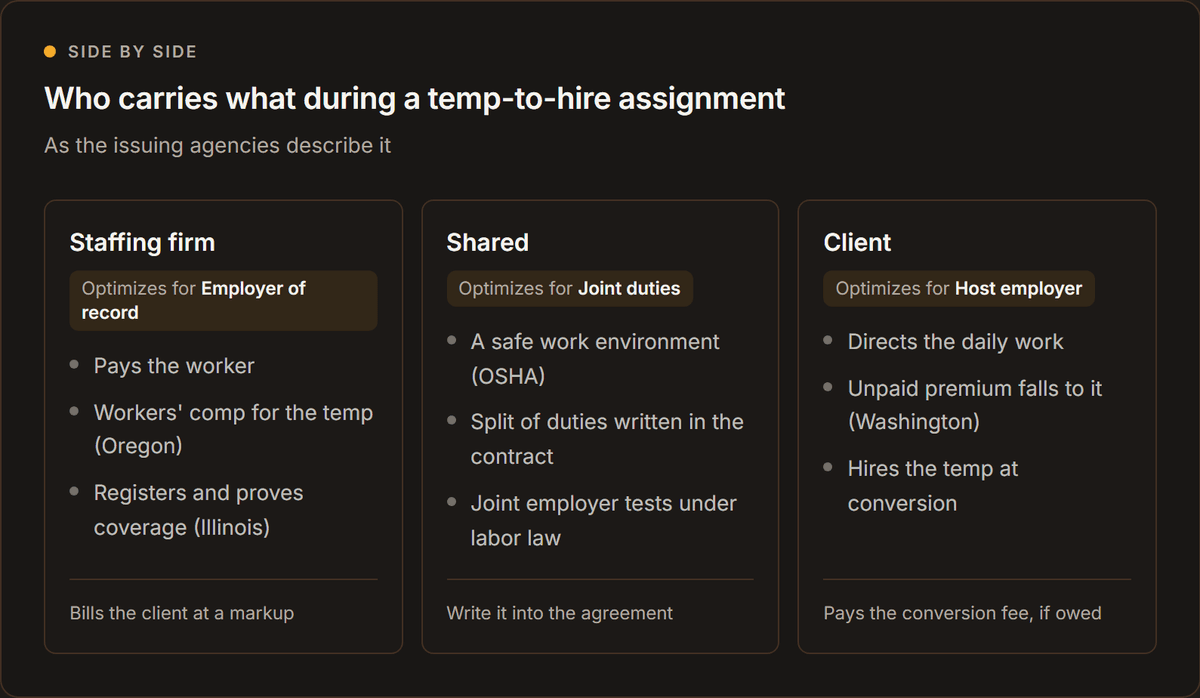
The staffing firm generally employs the worker during the assignment, while the client shares certain workplace responsibilities. OSHA and NIOSH describe staffing agencies and their clients, known as host employers, as joint employers of temporary workers.5 Both have responsibilities for providing and maintaining a safe working environment. OSHA also explains that each party's obligations depend on workplace conditions and should be clearly allocated in the agreement between the staffing agency and the host employer.5
Labor law applies a more specific test. Under 29 CFR 103.40, an entity qualifies as a joint employer only when it possesses and exercises substantial direct and immediate control over at least one essential term or condition of another employer's employees.6 The National Labor Relations Board's final rule of February 27, 2026, confirms that a Texas federal court vacated the 2023 joint employer rule on March 8, 2024, leaving the 2020 rule in effect.7
Wage and hour requirements are a separate consideration. In an April 2026 notice of proposed rulemaking, the Department of Labor stated that it had issued no regulatory guidance on joint employer status under the Fair Labor Standards Act (FLSA) since 2021. The proposal seeks to restore regulations under Part 791.8
Insurance and registration responsibilities also depend on state law. Oregon's Workers' Compensation Division says temporary staffing providers must cover workers' compensation insurance for their temporary employees, while client businesses must maintain separate coverage for their regular workforce.9 Washington takes a different approach to unpaid premiums: if a staffing provider fails to pay the required workers' compensation premium, the client is responsible for the outstanding amount.10 In Illinois, the Day and Temporary Labor Services Act requires staffing agencies to register and provide proof of required unemployment insurance contributions and valid workers' compensation coverage.11
What does a long assignment do to benefits and ACA counting?
A long assignment can cause a temporary worker to qualify as full-time under the Affordable Care Act (ACA), potentially triggering the employer's health coverage obligations. The IRS defines an employee as full-time for a given month if they average at least 30 hours of service per week or complete at least 130 hours of service during that month.12
Employers can use measurement periods to determine whether workers with variable hours qualify. Under Treasury Regulation 26 CFR 54.4980H-3, an applicable large employer can assess a new variable-hour employee over an initial measurement period lasting between three and 12 consecutive months.13 This allows the employer to evaluate working hours over time rather than relying solely on a single month's schedule.
For staffing firms, the key question is which business is responsible for offering coverage. We found no primary source that says which party owes the coverage offer for a given temp; it turns on who is the worker's common-law employer, rather than simply the organisation where the worker performs their duties. The staffing agreement should therefore establish how the agency and client will handle ACA measurement, eligibility determinations and any required coverage offers. Neither party should assume that the other automatically carries this responsibility.
What do published client agreements put in the conversion clause?
Published staffing agreements generally establish three important financial terms: a conversion fee that decreases over time, a point at which permanent hiring becomes free, and the markup charged on the temporary worker's hourly pay rate. The available examples we found come from public-sector contracts, rather than private-sector market data.
Massachusetts' statewide Temporary Help Services contract, PRF85, sets out a declining conversion fee schedule. The fee is 15% at 30 days, 10% at 60 days and 5% at 90 days. No conversion fee applies after 90 days. The contract also limits the hourly rate charged to state buyers to a maximum markup of 36.5% above the temporary worker's hourly pay rate.14 It defines markup as the additional fee charged over the worker's hourly wage. However, the contract page does not specify the amount to which the conversion percentages apply, so agencies should consult the full contract before adopting this schedule.
Other public-sector buyers use hours worked rather than calendar days to determine when conversion becomes free. The North Central Texas Council of Governments (NCTCOG) states that its temporary staffing contract provides for zero conversion fees once a temporary employee has completed at least 520 hours of work.15
The University of Arizona takes a different approach to pricing. Its contracted staffing agencies add a fixed percentage markup to the wage set by the hiring department, with the percentage depending on the position type.16 Conversion fees may also apply. Some agencies charge a fee when a client wants to hire a temporary employee before an agreed assignment period has elapsed.
| Term | Massachusetts PRF85 | NCTCOG contract | University of Arizona |
|---|---|---|---|
| Conversion fee | 15% at 30 days, 10% at 60 days and 5% at 90 days | Zero after 520 hours worked | Some agencies charge before a specified period |
| Free conversion | After 90 days | After 520 hours | After the agency's specified period |
| Markup | Maximum 36.5% of the hourly pay rate | Not specified on the page | Fixed percentage based on position type |
These figures represent individual public-sector contract terms, not industry-wide averages. We found no current public source establishing an average conversion fee or the proportion of temporary workers who eventually convert to permanent employment. Staffing firms should therefore use their own placement data, operating costs and client agreements when setting prices.

Which state laws limit conversion fees?
Some states restrict staffing agencies from charging conversion fees or impose specific disclosure requirements. The rules vary by state and industry, so agencies should check the legislation applicable to every location where they place workers.
Minnesota Statutes 181.9881 prohibits service providers from restricting, restraining or otherwise preventing customers from hiring or soliciting their employees.17 It also makes any contract provision that violates this restriction void. Although the statute does not explicitly mention conversion fees, we found no court decision directly applying it to these charges. Staffing firms should therefore seek Minnesota-specific legal advice before including conversion fees in client agreements.
Colorado has a more specific restriction for health-care staffing. House Bill 23-1030, approved on May 1, 2023, prohibits supplemental health-care staffing agencies from requiring liquidated damages, employment fees or other compensation when a health-care facility permanently hires an assigned worker. The exception allows compensation to be charged for the first 30 calendar days of the placement.
Illinois focuses on disclosure rather than prohibiting placement fees. The Illinois Department of Labor requires day and temporary labor agencies to include the current placement fee and the number of days until that fee can no longer be charged on each laborer's payment notice.11
| State | What the rule does | Who it covers |
|---|---|---|
| Minnesota | Prohibits restrictions on customers hiring or soliciting a service provider's employees and voids conflicting contract provisions | Service providers under Statute 181.9881 |
| Colorado | Prohibits fees for permanent hiring, except compensation chargeable during the first 30 calendar days of placement | Supplemental health-care staffing agencies |
| Illinois | Requires disclosure of the placement fee and the number of days until it expires on each payment notice | Day and temporary labor agencies |
These examples cover three states with different approaches. They are not a comprehensive survey of state conversion-fee laws, so staffing firms should check local requirements before finalising their agreements.
When should a client choose temp to hire over a direct hire?
Temp to hire makes sense when a hiring manager is uncertain about the role, the required staffing levels or whether a particular candidate is the right long-term fit. The arrangement gives both the employer and worker time to assess the working relationship before committing to permanent employment.
Direct hire is better suited to employers who already understand their staffing needs and want the successful candidate on their own payroll from the first day. There is no temporary assignment period before permanent employment begins.
For staffing firms, the two models also generate revenue differently. Temp to hire produces recurring income through the markup charged during the assignment, potentially followed by a conversion fee that decreases over time. Direct hire generates a placement fee when the candidate is successfully placed.
Understanding these differences helps agency owners choose the right placement model for each client. For a closer look at staffing profitability and performance, see the guides to fill rate, days to fill and gross profit. For managing the time between assignments, explore staffing redeployment and the bench.
Conclusion: make every temp-to-hire placement work for your agency
Temp to hire gives staffing firms a way to turn short-term placements into longer-term client relationships and permanent recruitment revenue. It also gives employers time to assess a worker's skills, reliability and suitability before making a permanent commitment. But the model only works commercially when both sides understand the terms before the assignment begins.
For agency owners, that means setting a sustainable hourly markup, establishing a transparent conversion fee schedule, defining when permanent hiring becomes free and checking the employment, insurance and state-specific requirements that apply to each placement. Leaving these details until a client wants to make an offer can put agency revenue and client relationships at risk.
The operational side matters just as much. Agencies need visibility across sourcing, screening, interviews, offers and candidate communication to keep placements moving and identify opportunities for permanent conversion.
Ultimately, successful temp-to-hire staffing is about more than filling a temporary vacancy. It is about creating a structured path from the first assignment to a potential permanent hire, while protecting margins, maintaining compliance and building lasting client relationships.
How Hivemind handles temp-to-hire hiring
The client agreement, the fee schedule and the conversion decision stay with the staffing firm, its client and their counsel.
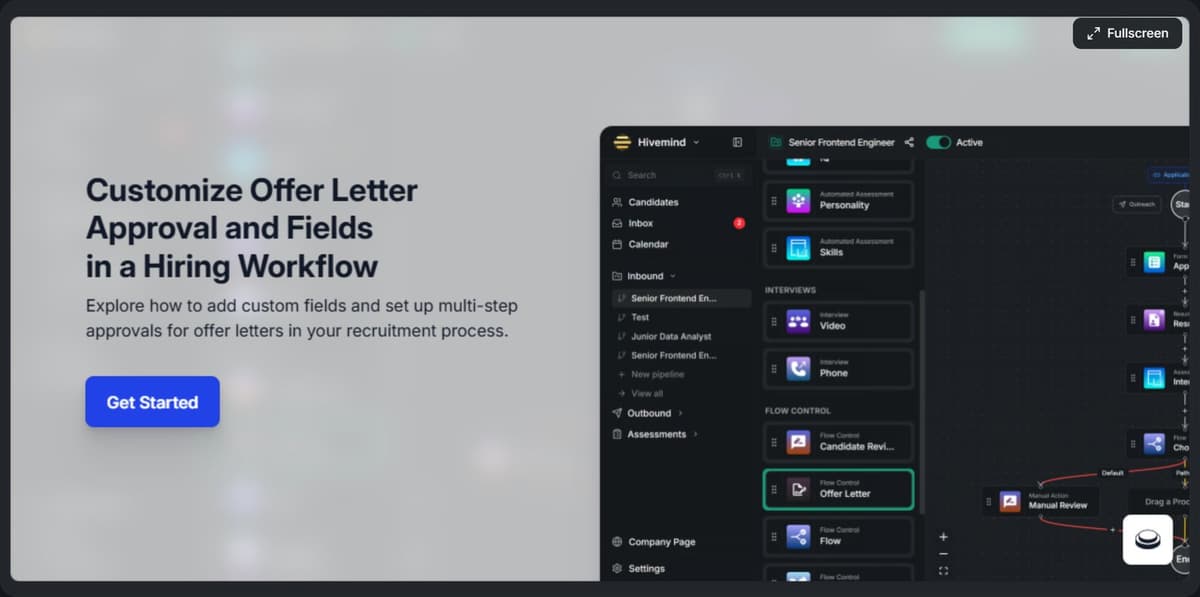
The candidate work around them is what Hivemind runs: sourcing, screening, interviews, offers, and the admin around them. Hivemind is the hiring OS: manage every candidate from inbound to offer in one unified workflow. Its modules include Automated Emails: Smart Email Automation for Recruitment, and SMS Follow-Ups: Automated Candidate Text Messaging.
A firm can run Hivemind end to end, connect your existing tools, or mix and match both.
Frequently asked questions
What does temp to hire mean?
Temp to hire is a staffing arrangement in which a staffing agency employs a worker and assigns them to a client on a temporary basis. The client can then offer the worker permanent employment, usually subject to an agreed conversion fee. The American Staffing Association recognises temporary-to-hire placements as one of the standard services offered by staffing agencies.
How much is a temp-to-hire conversion fee?
Conversion fees vary according to the staffing agreement, and there is no established public market average. For example, Massachusetts' statewide PRF85 contract sets fees at 15% at 30 days, 10% at 60 days and 5% at 90 days, with no fee over 90 days.14
When does a temp-to-hire conversion become free?
The free-conversion point depends on the terms negotiated between the staffing agency and its client. Some agreements use calendar days, while others use hours worked. The North Central Texas Council of Governments, for example, allows clients to hire temporary employees without a conversion fee after they have completed at least 520 hours.
Can a state ban temp-to-hire conversion fees?
Yes. Some states restrict conversion fees or impose conditions on when they can be charged. Colorado HB23-1030, for example, prohibits supplemental health-care staffing agencies from charging a facility a fee for permanently hiring an assigned worker, except for compensation chargeable during the first 30 calendar days of placement.18 Other states, including Minnesota and Illinois, have separate restrictions and disclosure requirements.
Who is the employer during a temp-to-hire assignment?
The staffing firm generally employs the worker during the assignment, while the client shares certain workplace responsibilities. OSHA and NIOSH identify staffing agencies and their clients as joint employers for workplace safety purposes. Both must help provide and maintain a safe working environment, with their respective responsibilities influenced by workplace conditions and contractual arrangements.
Does a temporary worker qualify for benefits under the ACA?
Potentially. Under the Affordable Care Act, an employee generally qualifies as full-time for a month if they average at least 30 hours of service per week or complete at least 130 hours during that month. Applicable large employers can use measurement periods to assess variable-hour employees and determine whether they must offer health coverage.
What should a temp-to-hire agreement include?
A staffing agreement should specify the hourly markup, conversion fee schedule, free-conversion point and payment terms. It should also clarify responsibilities for workplace safety, workers' compensation, insurance and applicable employment requirements. State-specific restrictions should be checked before the agreement is finalised.
Sources
- American Staffing Association: ASA, Staffing and Recruiting Industry Frequently Asked Questions ↩
- American Staffing Association: ASA, Staffing Industry Statistics ↩
- US Bureau of Labor Statistics: BLS CES series CES6056132001, data extracted 10 November 2026 ↩
- US Bureau of Labor Statistics: BLS news release USDL-24-2267, 8 November 2024 ↩
- US Occupational Safety and Health Administration and NIOSH: OSHA and NIOSH, Protecting Temporary Workers, OSHA 3735-2014 ↩
- National Labor Relations Board: 29 CFR 103.40, Joint employers, eCFR ↩
- National Labor Relations Board: NLRB, Standard for Determining Joint-Employer Status, final rule, 91 FR 9707, 27 February 2026 ↩
- US Department of Labor: DOL WHD, Joint Employer Status Under the FLSA, FMLA and MSPA, notice of proposed rulemaking, Federal Register public inspection 2026-07959 ↩
- Oregon Department of Consumer and Business Services: Oregon WCD, Worker leasing vs. temporary staffing ↩
- Washington Department of Labor and Industries: WAC 296-17-31027, Temporary staffing services, WSR 12-11-109, filed 22 May 2012, effective 1 July 2012 ↩
- Illinois Department of Labor: Illinois Department of Labor, Changes to the Day and Temporary Labor Services Act ↩
- US Internal Revenue Service: IRS, Questions and Answers on Employer Shared Responsibility Provisions Under the Affordable Care Act, page last reviewed 20 July 2026 ↩
- US Department of the Treasury and Internal Revenue Service: 26 CFR 54.4980H-3, Determining full-time employees, eCFR ↩
- Commonwealth of Massachusetts: Massachusetts Statewide Contract User Guide, Temporary Help Services PRF85 ↩
- North Central Texas Council of Governments (NTXShare): NTXShare, Temporary Staffing (2021-005) ↩
- University of Arizona Human Resources: University of Arizona HR, Temporary Employment Agencies FAQ ↩
- Minnesota Legislature: Minnesota Statutes 181.9881, Restrictive employment covenants; void in service contracts ↩
- Colorado General Assembly: Colorado General Assembly, HB23-1030 Prohibit Direct-hire Fee Health-care Staff Agency, bill summary as enacted ↩