

Staffing redeployment means placing a temp in their next assignment before their current one ends, rather than finding a new worker to fill the order. When a temp finishes an assignment without another one lined up, they become a worker you need to find work for again. In some states, the paperwork you give them also determines whether a temp who does not contact you about returning to work can be treated as having quit. The key is to plan ahead, using assignment end dates to start finding the next placement several weeks before the current one finishes.
Key takeaways
- When a temp finishes an assignment without another one lined up, they become a worker you need to find work for again.
- The key is to plan ahead, using assignment end dates to start finding the next placement several weeks before the current one finishes.
- In some states, a temp who fails to contact their staffing firm for another assignment after their current one ends can be treated as having quit voluntarily.
- Bullhorn defines redeployment rate as the proportion of workers who finish an assignment and are placed in another assignment by the same staffing firm.
- After three months, your own data should begin to show where workers are being successfully redeployed, how long they spend between assignments and why some offers are declined.
This guide is for owners of light industrial staffing firms whose assignments often end on Fridays, and the operations leads responsible for managing those placements. It covers what the market looks like now, why losing a placement creates costs, how to calculate the cost of keeping workers on the bench, what state unemployment rules mean for temps between assignments, when to start planning their next placement, why workers accept or decline new assignments, and how to measure redeployment using your own staffing firm's data.
There is one important limitation. Two figures staffing firm owners often want to know, the current average assignment length for light industrial temps and the industry-wide redeployment rate, are not available from a reliable public primary source. Figures shared online often come from research available only to members, vendor surveys or individual practitioners' estimates. Rather than present uncertain figures as established industry averages, this guide explains how to calculate the numbers and measure your own results.
In this article
- What does the market look like for light industrial temps right now?
- Why does a temp who rolls off become a candidate you have to find again?
- What does the bench cost a staffing firm?
- What do state unemployment rules say about temps who finish an assignment?
- Why do temps take the next assignment, or not?
- What gets in the way of redeployment?
- How do you measure redeployment?
- Conclusion
- Frequently asked questions
What does the market look like for light industrial temps right now?
The market is showing signs of recovery, particularly in industrial work. For redeployment, that matters because more open orders give staffing firms more opportunities to place temps finishing their current assignments. When suitable jobs are available, leaving workers without another placement becomes harder to justify.
The official figures show a relatively stable market. The US Bureau of Labor Statistics (BLS) reported temporary help services employment of 2,486.8 thousand in September 2026, compared with 2,471.6 thousand in September 2025.1 Both figures were seasonally adjusted, and the September 2026 figure was preliminary. The difference represents modest year-over-year growth rather than a major expansion.
The American Staffing Association (ASA) provides more detail on how the market has moved through 2026. Temporary and contract staffing employment fell 7.5%, or 154,000 jobs, between the fourth quarter of 2025 and the first quarter of 2026, reflecting the usual seasonal slowdown.2 The market then recovered. Weekly staffing employment grew 5.0%, or approximately 94,000 jobs, between the first and second quarters of 2026.2 Second-quarter staffing employment was also up 0.6%, or around 12,000 jobs, compared with the same quarter in 2025.2 According to ASA, this was the first year-over-year quarterly increase in its staffing survey since late 2022.2
Weekly assignment figures suggest that demand has continued to improve, although growth has varied. In August 2026, 49% of staffing companies surveyed by ASA reported an increase in new assignments compared with the previous week, above the 2026 average of 41%.2 In September, 42% reported weekly gains, bringing the figure closer to that average.
Industrial staffing shows particularly strong movement. The Bullhorn and Staffing Industry Analysts (SIA) Staffing Indicator reported that hours worked in industrial occupations were up 17% year over year in the week ending 3 October 2026.3 Across all occupations, workers averaged 35.3 hours that week.3 SIA attributed the increase to renewed demand from manufacturing and logistics clients.3 Bullhorn's indicator tracks hours worked by more than 200,000 workers at hundreds of staffing firms using its platform.3 It is therefore a useful measure of activity among participating firms, rather than a complete count of the US staffing market.
Other reports point to improving conditions in parts of the industry. A staffing contact in Dallas told the Federal Reserve that activity in July was approximately 30% higher than a year earlier, according to the Fed's August Beige Book.4 In the UK, temporary staffing billings also expanded for the fifth consecutive month, according to the KPMG and Recruitment and Employment Confederation (REC) survey.5
Light industrial staffing is also a substantial part of the temporary workforce. BLS data from July 2023 showed that production, transportation and material-moving occupations accounted for one in four US temporary help agency workers.1
For staffing firm owners, the practical takeaway is that improving industrial demand may create more opportunities to move temps directly from one assignment to another. However, stronger market activity does not guarantee that suitable work will be available for every worker. The key is to match upcoming assignment end dates against confirmed orders early enough to give your team time to find the next placement.
Why does a temp who rolls off become a candidate you have to find again?
Because when an assignment ends without another one lined up, the worker is free to take a job elsewhere. Temporary work is designed to be short-term, so workers often expect their assignments to end and may already be looking for their next opportunity.
The wider labour market helps explain why workers move on. In August 2026, the US Bureau of Labor Statistics (BLS) recorded 3.1 million workers quitting their jobs, unchanged from the previous month.1 The quits rate was 1.9%. This does not suggest a particularly frantic labour market, but it shows that workers are still leaving jobs. A temp who finishes an assignment on Friday and has nothing arranged for Monday has a strong reason to accept the first suitable offer, even if it comes from another staffing firm.
Temporary work is also short-term by nature. In July 2023, 945,000 US workers were paid by a temporary help agency in their main or only job, representing 0.6% of total employment, according to BLS.1 Of those workers, 54.8% were classified as contingent, meaning they did not expect their jobs to last.1 For a temp who already knows their assignment is ending, finding the next job is not a distant concern. It is an immediate priority.
Staffing industry figures show how much movement firms must manage. The American Staffing Association (ASA) estimates that nearly 2.2 million temporary and contract employees worked for US staffing companies in an average week in 2024.2 Staffing companies also hired 12.7 million temporary and contract employees during 2023.2 ASA also reported a turnover rate of 414% for temporary and contract staffing employees in 2023, based on its quarterly Staffing Employment and Sales Survey.2 Average tenure in US staffing employment was 10.1 weeks that year.2
These figures describe an industry in which workers frequently enter and leave assignments. The turnover rate measures employee movement over time, rather than the percentage of individual workers who leave permanently, so it should not be read as a simple count of unique people who quit.
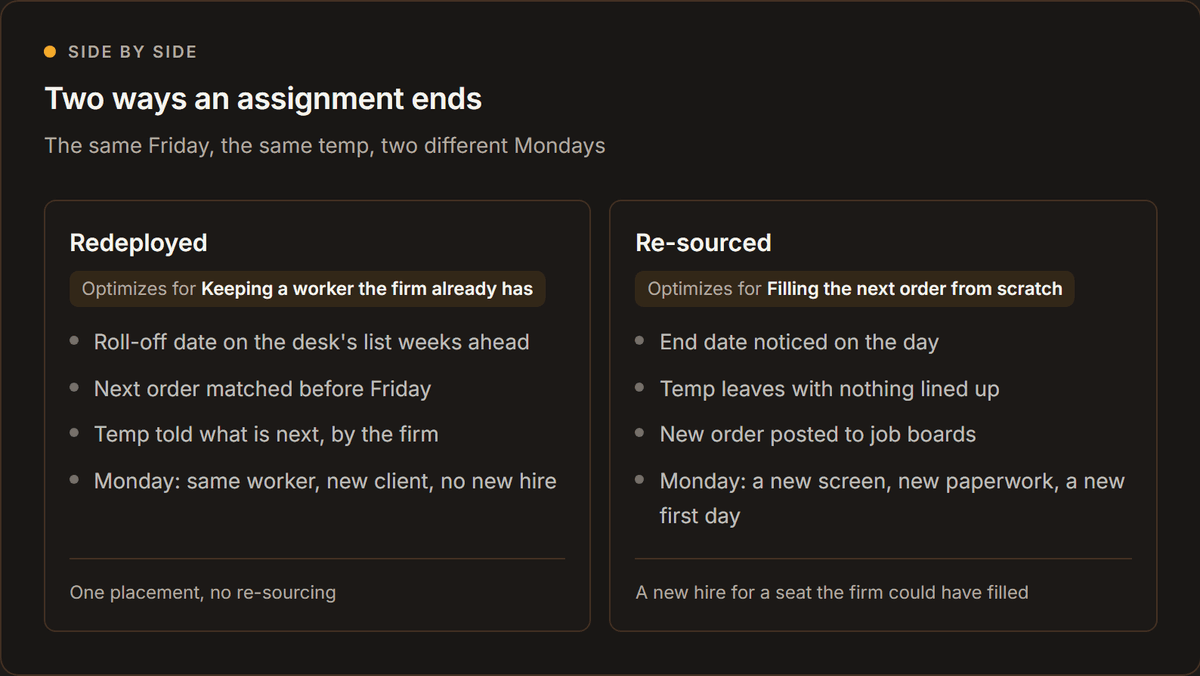
The operational lesson is straightforward: every temp who finishes an assignment without moving into another one creates the possibility of additional recruitment work. Your team may have to advertise another vacancy, screen candidates, complete paperwork and organise a new worker's first day, even when an existing temp could have filled the position.
Redeployment helps break that cycle. Instead of treating the end of an assignment as the end of the relationship, your team treats it as a deadline for finding the worker's next placement. The earlier you identify that deadline, the more time you have to match the worker with another suitable order before they accept work elsewhere.
What does the bench cost a staffing firm?
The bench costs a staffing firm in several ways: recruiter time, sourcing expenses, unemployment taxes, lost gross profit and the administrative work involved in bringing in a new worker. These costs often go unnoticed because they appear in different parts of the business. Adding them together shows what happens financially when a temp finishes an assignment without another one lined up.
- Time to fill.
SHRM's 2026 benchmarking puts the median time to fill a nonexecutive position at 39 calendar days.6 This figure covers employers generally, not staffing firms filling light industrial orders. The important distinction is that redeployment starts with a worker the firm already knows, while recruiting someone new requires time for sourcing, screening and onboarding. The longer the client waits for a replacement, the longer it may take to start billing for the order.
- Sourcing spend.
When a staffing firm recruits a new worker for a position an existing temp could have filled, it may be paying to find someone it already has on its books. Gem's 2026 benchmarks report that 46% of sourced hires came from candidates already in a company's customer relationship management system (CRM) or applicant tracking system (ATS), up from 26% in 2021.7 These figures come from a recruiting software vendor's data, so they should be treated as vendor-specific rather than industry-wide results. They nevertheless illustrate the value of maintaining and reusing an existing candidate database. A temp whose assignment is ending is an immediately available person to consider for another order. The job board spend guide covers the cost of paying to attract candidates a firm may already have on file.
- Unemployment tax.
This is a cost that staffing firm owners can overlook when calculating the value of redeployment. Writing for Staffing Industry Analysts (SIA), Michelle Sims, CEO of YUPRO Placement, explains that successful redeployment can reduce a staffing firm's state unemployment costs.8 In states where unemployment claims affect an employer's future tax rate, claims can have financial consequences beyond the immediate period when a worker is unemployed. Because these rates are typically assessed annually, the effects of a claim may continue into a later tax year.
Minnesota provides a specific example. The state uses unemployment benefits paid to an applicant when calculating the future unemployment tax rate of a taxpaying base-period employer.9 Its rules also generally treat the end of an assignment with a staffing service's client as a discharge by the staffing service, unless the applicable five-day rule is satisfied. The precise requirements matter: staffing firms should check the relevant state rules and documentation rather than assume every worker who finishes an assignment creates the same tax consequence.
- Lost gross profit.
Every day a temp remains unplaced is a day they cannot generate billable hours for the firm. If you know how much gross profit your business earns per hour worked, you can estimate the gross profit lost during an unplaced period. For example, multiply the number of unplaced hours by the gross profit you would normally earn per billable hour. This is an estimate of the opportunity cost, not necessarily a cash expense or a guaranteed loss, because the worker might not have been immediately placeable. The desk numbers guide explains how to calculate gross profit per placement and per recruiter; the same principles can help you measure the cost of an idle bench.
- Onboarding and administration.
Recruiting a replacement also means repeating work that has already been completed for the previous temp. Depending on the role and the client's requirements, this may include reviewing applications, screening candidates, conducting checks, completing employment paperwork and arranging a first day. Your recruiters and administrative staff spend time on these tasks instead of filling orders, supporting existing workers or arranging redeployments.
Cost of not redeploying
| Where the cost appears | What it means | What to count on your own books |
|---|---|---|
| Time to fill the next order | The client waits for a suitable worker to start. | Days from order to start, comparing redeployed temps with new hires. |
| Sourcing spend | The firm pays to attract and find another candidate. | Job board, advertising and sourcing-tool spend associated with orders that an existing temp could have filled. |
| Unemployment tax | Claims may affect the firm's future state unemployment tax rate. | Claims involving temps who finished assignments without another offer, alongside the applicable state tax-rate rules. |
| Lost gross profit | The worker generates no billable hours while unplaced. | Unplaced hours multiplied by the expected gross profit per billable hour. |
| Onboarding | The firm repeats recruitment, checks and administrative work. | Recruiter and administrative hours spent processing each new hire. |
The practical takeaway is that the cost of a worker rolling off is not just the time they spend waiting for another assignment. It can also include the expense of finding a replacement, repeating onboarding work and potentially increasing future unemployment taxes. Tracking these costs separately gives owners a clearer picture of what redeployment saves and where their operations team should focus.
What do state unemployment rules say about temps who finish an assignment?
In some states, a temp who fails to contact their staffing firm for another assignment after their current one ends can be treated as having quit voluntarily. That can affect their eligibility for unemployment benefits. But these rules generally apply only when the staffing firm has first given the worker the required notice and followed the state's procedures.
Four states illustrate how these rules work.
- Texas.
A temporary help firm worker can be treated as having quit without good cause if they fail to contact the firm for reassignment when an assignment ends.10 However, the firm must first have informed the worker that they are required to make contact after assignments and that failing to do so could result in unemployment benefits being denied.10
- Florida.
A temp who fails without good cause to contact their staffing firm for reassignment after an assignment ends can be deemed to have quit, provided the firm explained this requirement when the worker was hired.11 Florida also has a separate rule for labor pools: at the end of an assignment, they must tell day laborers that work is available the next business day and that they must report for reassignment.11
- Minnesota.
A temp can be considered to have quit their staffing service if they fail, without good cause, to request another suitable assignment within five calendar days after an assignment ends.9 The staffing service must have provided a separate document, signed by the worker, that clearly explains this requirement.
- Iowa.
A temp can be deemed to have quit if they fail to notify the temporary employment firm within three working days that an assignment has ended.12 Exceptions apply, including where the worker was not given the required written notice or had good cause. The firm must establish that the worker was informed of the requirement and its consequences through a separate document that the worker reads and signs when hired.
These rules have three important implications for staffing firm owners:
- The paperwork is a legal requirement, not just an administrative formality.
Minnesota and Iowa require specific written documentation, while Texas and Florida require the relevant notice to be given to the worker. If the firm cannot demonstrate that it followed the applicable requirements, it may not be able to rely on the rule. Review your hiring documents and procedures for every state in which you employ temps.
- The worker's duty to make contact does not remove the firm's responsibility to manage redeployment.
A temp who contacts the firm on Monday and is told there is no suitable work available has made contact. The legal rule does not create a new assignment or guarantee that work is available. A proactive redeployment process gives the firm time to identify suitable openings before the worker's current assignment ends.
- These four states are examples, not a complete list of US requirements.
The Wisconsin and Illinois statutes could not be reviewed for this guide, and other states may have different rules. Staffing firms should check the current legislation and applicable procedures in every state where they employ temporary workers, with advice from qualified legal counsel. Never assume that a rule applying in one state automatically applies in another.
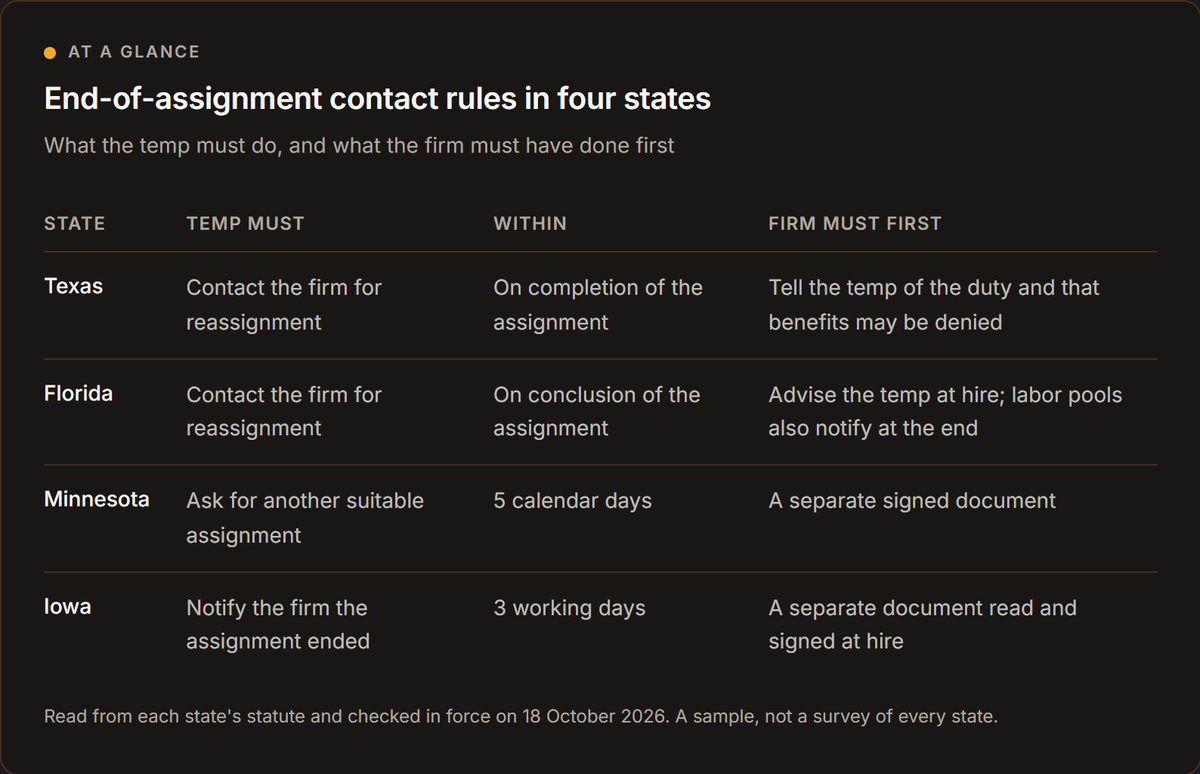
The guide reports these rules as checked against the relevant state statutes and in force on 18 October 2026. This is a sample of four states, not a survey of all state laws. Verify the current requirements with legal counsel before relying on them.
Why do temps take the next assignment, or not?
Temps are more likely to accept another assignment when the work suits their needs and the staffing firm offers it before they find something elsewhere. But temporary workers do not all want the same thing. Some want a steady stream of assignments, others are looking for permanent employment, and many care most about pay, hours, location and predictable work. Redeployment works best when the offer matches what the individual worker wants.
Many temps are happy to continue working temporarily. In July 2023, the US Bureau of Labor Statistics (BLS) found that 48.2% of temporary help agency workers preferred their work arrangement, while 27.7% would have preferred a traditional job.1 A separate article on Staffing Industry Analysts' (SIA) Staffing Stream reported that 61% of temporary workers surveyed were open to another assignment, while 11% ruled one out.8 SIA's 2025 North America Temporary Worker Survey included 4,265 respondents from 55 staffing firms, although the article does not identify which edition produced those particular figures.8 The practical lesson is that many workers are open to continuing, but your firm needs to ask and offer suitable work before another employer does.
Other temps use temporary work as a route into permanent employment. In the American Staffing Association's (ASA) 2014 Staffing Employee Survey, 49% of staffing employees said they chose temporary or contract work as a way to obtain a permanent job.2 The same survey found that 35% had received a permanent job offer from a client, and 66% of those workers accepted.2 These figures are more than a decade old, so they should be treated as background rather than a current measure of worker preferences. For a staffing firm, the implication is still useful: a temp who wants a permanent job may be interested in a temp-to-hire placement, provided the recruiter understands that goal.
Interest in temporary and contract work also extends to people looking for jobs. In a survey of 1,003 US adults conducted by Express Employment Professionals and Harris Poll, 23% of job seekers expressed interest in temporary or seasonal positions, while 24% were interested in contract or freelance work.13 These are different categories of work, but both indicate that some job seekers actively consider alternatives to traditional permanent employment.
Pay is another important factor, and accuracy matters as much as the advertised rate. Among full-time workers, BLS reported median weekly earnings of USD 818 for temporary help agency workers in July 2023, compared with USD 1,132 for workers in traditional employment arrangements.1 These figures cover different employment groups and do not establish what any individual temp should earn. A separate Staffing Stream article by a payroll document vendor cited research suggesting that 42% of workers found their pay stubs confusing.8 Because that survey was not independently reviewed for this guide, the figure should be treated cautiously. The broader point remains: workers need to understand what they are paid and trust that their wages are correct. Pay errors and unclear payslips can undermine that trust.
Repeat assignments can also depend on how a worker first connects with a staffing firm. StaffingHub's 2026 loyalty benchmark analysed 882,004 placements involving 443,182 distinct candidates across agencies using its referral platform during 2024 and 2025.14 Among travel nurses in that dataset, workers sourced through job boards averaged 1.4 assignments, compared with 2.4 assignments for referred nurses.14 These figures come from a vendor's own platform and concern travel nursing, not light industrial staffing. They cannot establish how much a redeployment programme will improve retention in an industrial workforce, but they illustrate that repeat placements can vary across candidate groups and recruitment channels.
Research on temporary agency work provides another important perspective. Economists Elke Jahn and Michael Rosholm studied administrative data from Germany and found that temporary agency employment could have a strong lock-in effect, particularly in tight labour markets.15 In other words, while workers are employed through an agency, it can become harder for them to move into other employment. Their research also found that the positive effect of agency work on later employment was greater during economic downturns, when workers could benefit from the professional networks they developed through agency jobs.15 The findings come from Germany, so they should not be assumed to apply identically to US light industrial staffing. However, they highlight the importance of understanding whether temporary work is helping an individual move towards their longer-term goals.
More broadly, rehiring former employees has become increasingly common, according to ADP Research, which reports rising rehire activity as quitting has declined. For staffing firms, this reinforces the value of maintaining relationships with workers after assignments end. A temp who has already worked successfully for your firm is not simply an old candidate record. They are someone whose experience, skills and preferences your team may already understand.
The practical takeaway is to make redeployment personal and proactive. Ask workers what they want next, record their preferred shifts, pay rates, locations and longer-term goals, and contact them before their current assignment ends. Offer suitable work promptly, explain the pay and conditions clearly, and recognise when a worker is seeking a permanent role rather than another temporary placement. The goal is not to push every temp into another assignment. It is to make your firm the first place they turn when they are ready for their next one.

What gets in the way of redeployment?
Staffing firms often have reasons for not prioritising redeployment. Some workers are easy to replace, assignments change at short notice, and not every temp wants another temporary job. But these objections do not remove the costs of repeatedly recruiting new workers. Each has a practical answer.
- "Temps are a commodity. When an assignment ends, the desk posts the next order and fills it from new applicants."
In a labour market with plenty of available workers, a light industrial branch may be able to fill a basic order quickly. That can make the immediate savings from redeployment seem small. However, the turnover figures discussed earlier show how frequently staffing firms recruit and replace workers. Every temp who leaves without another assignment potentially creates another round of advertising, screening, paperwork and onboarding. If a suitable existing worker could fill the order, recruiting someone new may be unnecessary work and expense.
- "The law already makes temps call the firm back. If they do not, they lose their benefits."
This is only true where the relevant state law applies and the staffing firm has met its own obligations. Texas requires the worker to have received notice of the contact requirement. Minnesota and Iowa require specific signed documentation, while Florida has notice requirements at hire and additional duties for labor pools at the end of an assignment. Without the required notice or paperwork, the firm may not be able to rely on these rules. Even when a temp does contact the branch, the firm still needs a process for identifying suitable work. Legal compliance supports redeployment; it does not replace it.
- "Planning weeks ahead is wasted effort because clients extend or end assignments at short notice."
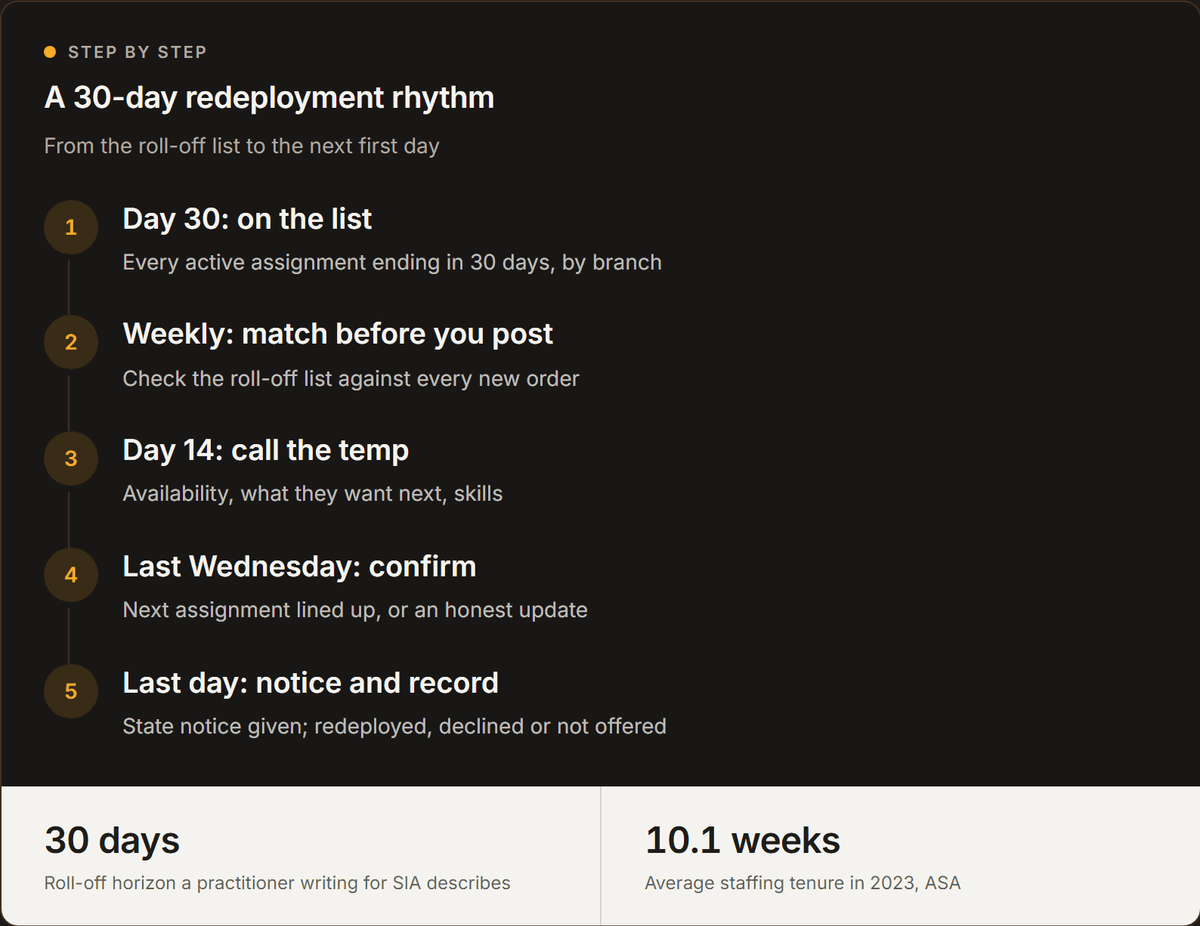
Client requirements do change, so no plan can guarantee that every assignment will end on the expected date. But redeployment planning is about identifying likely roll-offs, reviewing upcoming orders and preparing possible matches. If an assignment ends unexpectedly, having already identified suitable alternatives gives the desk a head start. Very short assignments and day labour may require a different approach, with matching taking place at the end of a shift or as new work becomes available.
- "Temps do not want to be redeployed. They want permanent jobs."
Some workers do want permanent employment, while others prefer temporary work or are open to either option. The survey findings discussed earlier illustrate that workers have different goals. The answer is to ask about those goals before an assignment ends. A temp who wants permanent work may be interested in a temp-to-hire opportunity, while someone who values flexibility may prefer another short assignment. Understanding the worker's preferences helps the desk make relevant offers instead of assuming everyone wants the same thing.
- "Unemployment costs are a rounding error next to gross margin." Whether unemployment taxes make a meaningful difference depends on the state, the firm's claims history and its applicable tax rate. This guide does not calculate the financial effect for an individual staffing firm. However, where a state's tax system uses unemployment benefits paid to former employees when calculating future employer rates, claims can have consequences beyond the immediate assignment. Minnesota is one example. Before dismissing unemployment costs as insignificant, ask your payroll or tax adviser how your rate is calculated and how claims involving workers who roll off may affect it.
What goes in the hire packet
Redeployment begins before the first assignment ends. In states where unemployment rules depend on the notice given to temporary workers, the hire packet is an important part of meeting the firm's legal obligations.
For every state in which you employ temps, check whether your hire packet needs to include:
- A plain-language explanation of the worker's duty to contact the firm when an assignment ends, including the applicable deadline.
- A statement explaining that unemployment benefits may be affected if the worker fails to make contact, where the state requires this notice.
- A separate document that the worker must read and sign, where required by law, as in Minnesota and Iowa.12
- Clear instructions for contacting the branch, including the relevant phone number, text line or person to ask for.
- A copy for the worker to keep and a copy for the firm to retain with the hiring records.
The desk also needs a consistent process for giving and recording any end-of-assignment notice required by the applicable state rules. Train staff to follow that process every time, rather than relying on individual recruiters to remember it.
The important distinction is that having a document in the hire packet is not enough on its own. The firm must follow the applicable legal requirements and be able to demonstrate that it has done so. Review the rules with qualified legal counsel in each state where you operate, because requirements differ and can change.
How do you measure redeployment?
Start by counting how many temps finish an assignment each month and how many your firm places in another assignment. Your redeployment rate is the number redeployed as a share of the total who roll off. Track the result by branch and recruiter to see where redeployment is working and where workers are being lost.
Bullhorn defines redeployment rate as the proportion of workers who finish an assignment and are placed in another assignment by the same staffing firm.3 The calculation compares workers redeployed during the month with all workers who came off assignment that month. It gives staffing owners a straightforward way to measure how effectively their teams retain and reassign existing workers.
There is no verified, publicly available industry benchmark for redeployment rates. The only estimate identified for this guide comes from a guest writer at FormPros publishing on Staffing Industry Analysts' Staffing Stream. The writer suggests that leading light industrial firms achieve rates of 40% to 60%, while firms below 25% spend money replacing workers they already know.8 However, the writer provides no supporting source or methodology, so these figures should be treated as an individual estimate, not an established industry standard. The better starting point is to calculate your own rate and track how it changes over time.
You can also compare redeployment with your firm's weekly placement activity. The American Staffing Association (ASA) defines Staffing Starts as the number of temporary and contract employees who begin new assignments during a reporting week.2 By separating your own starts into redeployed workers and newly recruited workers, you can see how much of your placement activity comes from retaining existing temps rather than sourcing replacements.
A useful redeployment report should give an owner five key measures:
| Measure | How to count it | Why it matters |
|---|---|---|
| Roll-offs | Count the workers whose assignments ended during the month. | Shows how many workers were available for potential redeployment. |
| Redeployed workers | Count the roll-off workers your firm placed in another assignment. | Shows how many workers you successfully retained and placed again. |
| Redeployment rate | Redeployed workers as a share of total roll-offs. | Gives you the headline measure of redeployment performance by branch and recruiter. |
| Days on the bench | Measure the days between one assignment ending and the next starting. | Shows how quickly the desk finds another placement for workers who are redeployed. |
| Offers declined | Count the workers offered another assignment who declined, and record their reasons. | Helps identify problems the desk may be able to address, such as unsuitable shifts, pay rates, locations or assignment conditions. |
Start collecting these figures now, even if your first report is a simple spreadsheet. After three months, your own data should begin to show where workers are being successfully redeployed, how long they spend between assignments and why some offers are declined. That information is more useful for managing your business than relying on an unverified industry estimate.
For a fuller view of how to keep former candidates engaged and available for future work, see the talent pipeline management guide.
Conclusion
Every time a temporary worker finishes an assignment, your staffing firm faces a choice: find that person their next placement, or start the costly process of finding someone else when a client needs filling. The firms that handle redeployment well do not leave that decision until the last shift is over. They know which assignments are ending, understand what their workers want from their next role, and start matching people to confirmed orders before the opportunity passes.
The financial case is straightforward. Better redeployment can reduce repeated sourcing and onboarding, help protect gross profit, and give clients access to workers who already know how the job works. But success depends on more than keeping a list of available candidates. You need reliable assignment data, consistent communication, a clear understanding of state unemployment requirements, and a way to measure how many workers actually move into another assignment.
Start by tracking every roll-off, recording what happens next, and calculating your redeployment rate. Find out why workers decline offers or remain on the bench, then use that information to improve your matching, communication and planning. Do not rely on an unverified industry benchmark when your own desk can show you where the money is being lost.
Technology can help organise the hiring work that supports this process.
The goal is not simply to fill the next order. It is to make better use of the workers you have already recruited, reduce avoidable costs, and give good candidates a reason to keep working with your firm. Treat redeployment as a measurable part of running the desk, not an afterthought when an assignment ends, and every roll-off becomes an opportunity to strengthen both your workforce and your margins.
Where Hivemind fits on a staffing desk
Redeployment is a desk discipline: knowing who rolls off when, matching them to the next order and calling them first. Assignment end dates, timesheets, pay and the state unemployment paperwork stay in the systems the firm already runs for them.
Around that sits the hiring work: sourcing, screening, interviews, offers, and the admin around them. Hivemind is the hiring OS that brings that work together, so a desk can manage every candidate from inbound to offer in one unified workflow. A team can run Hivemind end to end, connect your existing tools, or mix and match both.
The modules closest to working the bench are these:
- Resumatic: AI-Powered Resume Filtering System
- Automated Skills Assessments
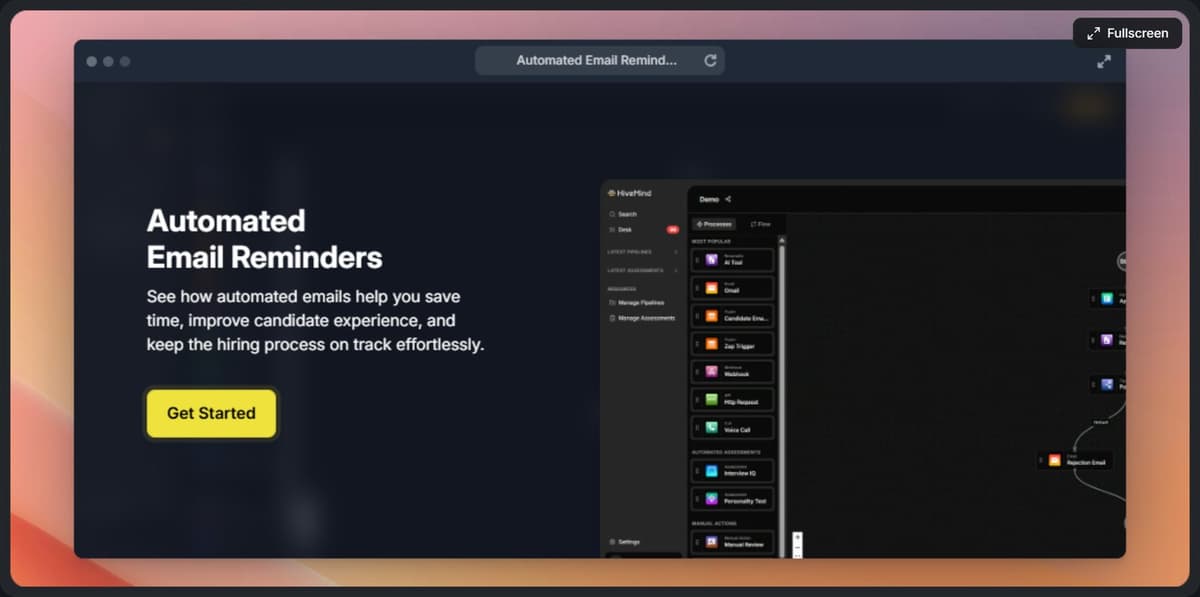
- Automated Emails: Smart Email Automation for Recruitment
- SMS Follow-Ups: Automated Candidate Text Messaging
Hivemind has 15 Native Modules and 275 Integrations, so a desk can build the exact pipeline its team deserves.
Frequently asked questions
What is redeployment in staffing?
Redeployment means placing a temporary worker in a new assignment with the same staffing firm when their current assignment ends. Instead of sourcing and onboarding someone new to fill the next order, the firm reuses a worker it already knows. Bullhorn defines the redeployment rate as the share of workers finishing assignments who are placed in another assignment by the same firm.
How do you calculate a temp redeployment rate?
It is the number of workers redeployed to new assignments as a share of all workers whose assignments ended during the measurement period. Track the rate by branch and recruiter, and record how long workers spend on the bench and why they decline offers.
How far ahead should a staffing firm plan redeployment?
Start planning several weeks before an assignment ends. A practitioner writing for SIA recommends knowing which workers are likely to roll off within the next 30 days and where they could go next.8 Create a list of assignments ending in that period, review upcoming client orders, and identify suitable workers before advertising new vacancies or starting a fresh search.
Does a temp have to contact the staffing agency when an assignment ends?
In some states, failing to contact the staffing firm for reassignment can affect a worker's eligibility for unemployment benefits. Texas, Florida, Minnesota and Iowa have rules that may treat a worker's failure to make the required contact as quitting, provided the firm has given the required notice. Minnesota and Iowa also require specific signed documentation. Requirements differ by state, so staffing firms should check the current rules with legal counsel.
Does redeployment lower a staffing firm's unemployment costs?
It can. Successfully placing a worker in another assignment may reduce unemployment costs associated with workers who leave the firm without another placement. In Minnesota, benefits paid to a former employee can affect an employer's future unemployment tax rate, and the end of an assignment generally counts as a discharge by the staffing service unless the relevant five-day rule applies.9 The exact financial effect depends on the state's rules and the firm's circumstances.
Do temps want to be redeployed?
Many do, but preferences vary. The US Bureau of Labor Statistics found that 48.2% of temporary help agency workers preferred their work arrangement in July 2023. A guest article on SIA's Staffing Stream also reported that 61% of temporary workers surveyed were open to another assignment. However, some workers want permanent employment or need different pay, shifts or locations. Ask workers about their plans and preferences before their assignments end, then offer roles that genuinely suit them.
Sources
- US Bureau of Labor Statistics: Employment Situation, table B-1, Job Openings and Labor Turnover Survey and Contingent and alternative employment arrangements, July 2023 ↩
- American Staffing Association: Staffing industry statistics, Temporary turnover and tenure, 2003 to 2023, Seasonal declines narrow in first quarter of 2026, Staffing industry grows, Staffing index grows in August, Staffing index edges up in September and Staffing industry frequently asked questions ↩
- Bullhorn: GRID 2026 Industry Trends Report, Redeployment rate, Staffing Indicator and Staffing Indicator expanded with light industrial reporting ↩
- Federal Reserve: Beige Book, Dallas district, August 2026 ↩
- KPMG and REC: UK Report on Jobs, September 2026 ↩
- SHRM: Recruiting benchmarking ↩
- Gem: Key takeaways from the 2026 recruiting benchmarks report ↩
- Staffing Industry Analysts: Tenure limits: how necessary are they?, North America Temporary Worker Survey 2025, initial findings, The redeployment lever hiding in your pay stubs and The redeployment mindset ↩
- Minnesota Office of the Revisor of Statutes: Section 268.095 and Section 268.047 ↩
- State of Texas: Labor Code section 207.045 ↩
- Florida Legislature: Section 443.101 ↩
- Iowa Legislature: Iowa Code section 96.5 ↩
- Express Employment Professionals and The Harris Poll: America Employed survey, January 2026 ↩
- StaffingHub: The 2026 staffing industry loyalty and referral benchmark ↩
- Elke J. Jahn and Michael Rosholm, Scandinavian Journal of Economics: Temporary agency work study ↩
- ADP Research: Boomerang hiring makes a comeback