

If your staffing agency sponsors H-1B consultants and has green card cases in progress, do not wait for your company to be named in a government action before checking your files. On 8 October 2026, press reports said the US Department of Labor had suspended processing of permanent labor certifications for certain named employers. No written notice, legal basis or end date had been published at the time of writing. The immediate priority is to check whether your own PERM recruitment records, H-1B pay practices and client placement arrangements meet the applicable requirements.
Key takeaways
- At the time of writing, no published notice had established the legal basis, precise scope or end date of the suspensions.
- Under 20 CFR 656.31(b), the Department of Labor can suspend processing in certain circumstances involving an employer under investigation for possible fraud or wilful misrepresentation.
- Check that PERM vacancies are advertised through appropriate recruitment channels and that US applicants have a fair opportunity to apply.
- Confirm that every H-1B consultant between client projects received the required wage during each employer caused idle period.
- Confirm each person's eligibility with immigration counsel rather than assuming that a pending green card case automatically protects their work status.
This briefing is for owners of US IT staffing agencies that employ H-1B consultants at client sites and have green card applications in progress. It explains what has been reported, what remains unconfirmed, which legal requirements may be relevant, and what your agency should check now. A practical checklist at the end will help you review the recruitment process and sponsorship records behind each case.
This is a compliance briefing, not legal advice. The reported suspensions had not been supported by a published notice when this was written, and important details remained unknown. Allegations are identified as allegations. The announcement alone does not establish that any named employer violated the law.
In this article
- What did the Labor Department announce on 8 October?
- What is known, and what is not?
- What rule lets the Labor Department suspend PERM processing?
- What enforcement came before the suspensions?
- Which PERM steps should an agency check in its own files?
- Which H-1B obligations put green card sponsorship at risk?
- How do the layoff order and the H-1B fee change the picture?
- What should an IT staffing agency do this week?
- Conclusion
- Frequently asked questions
What did the Labor Department announce on 8 October?
On 8 October 2026, Vice President JD Vance said Microsoft was among a handful of companies barred indefinitely from the US Department of Labor's PERM program, CNN reported.1 PERM is the labor certification process employers generally must complete before sponsoring a foreign worker for employment-based permanent residence. CNN also reported that Adobe and several IT outsourcing firms faced indefinite suspensions, meaning their new or pending permanent residency cases would not be processed through the program.
Bloomberg Law reported that the action was announced by Vance and Labor Secretary Keith Sonderling. The companies named included Cognizant, Infosys, Tata, Wipro, HCL Technologies and Capgemini, alongside Microsoft and Adobe. According to reports from Manifest Law and Interesting Engineering, Sonderling said the Department would neither accept new permanent labor certification applications involving the named companies nor process their pending applications.23 The reports described the action as a PERM suspension, not a general ban on H-1B visas.
The administration justified the action by pointing to the scale of the companies' use of employment-based immigration. Interesting Engineering reported the government's claim that the companies had collectively sought nearly 3 million foreign workers since 2009, receiving more than 230,000 H-1B approvals and over 100,000 permanent labor certifications.34 These are figures attributed to the administration, rather than independently established evidence of wrongdoing by each company.
Why should a smaller staffing agency pay attention?
The business model is familiar: recruit technology professionals from abroad, sponsor eligible workers, place them with US clients and, in some cases, support their transition to permanent residence. Bloomberg Law highlighted the role staffing companies play in this market. Its report also cited Department of Labor data showing that Microsoft had filed approximately 1,680 petitions for permanent status through the third quarter of the 2026 federal fiscal year.5
That overlap does not mean smaller agencies are automatically affected by the reported suspensions. It does mean owners should understand their own sponsorship obligations and ensure their records can demonstrate compliance. The reported action is a reason to review existing files, not evidence that every agency using the same business model has breached the rules.
Microsoft disputed the administration's account of its immigration filings. CNN reported that Microsoft said on its website that 80% of the roughly 6,000 H-1B applications it filed in the previous fiscal year were to extend or change the status of existing employees.1 The reports reviewed for this article did not include comments from Adobe or the named IT services firms.
At the time of writing, the reports described the announcement, but a published Department of Labor notice setting out the legal basis, precise scope and duration of the suspensions had not been identified. Those details matter: until the Department's formal position is available, agencies should distinguish confirmed legal requirements from reported allegations and avoid assuming the action automatically changes their own cases.
What is known, and what is not?
For staffing agency owners, the key issue is that the reported suspensions have unanswered questions that could affect how existing green card cases proceed. As of 8 October 2026, officials had referred to ongoing investigations but had not publicly detailed the allegations, specified an end date or published the legal basis for the suspensions, according to Manifest Law.2 We found no Department of Labor press release, written notice or Federal Register document setting out the action.
Immigration advisers have highlighted several unresolved issues. Boundless reported that the Department had not issued detailed written guidance. It remained unclear how long the suspensions would last, whether more employers could be added, and how the action would affect cases that had already received labor certification or had an I-140 petition filed or approved.6 Boundless also reported that the suspensions were linked to active federal investigations involving Microsoft and Adobe, while officials pointed to the volume of applications associated with the six IT services firms.6 The reporting did not indicate that other employers had been affected.
The administration's public statements suggest the suspensions could continue indefinitely. The National News Desk reported that Vice President Vance said they would remain in place for as long as necessary and that the administration had tools to extend them indefinitely.7 When discussing the fraud allegation, Vance referred to employers' obligation to certify that a foreign worker's position could not be filled by an available, qualified US worker. CNN reported that he did not set out specific steps for the companies to regain access to PERM, saying the administration wanted them to change and improve their behaviour.1 Manifest Law reported that Vance also indicated the action could extend to other technology companies.
These statements do not establish that the named companies committed fraud or that an investigation has reached a conclusion. Immigration law firm Wolfsdorf Rosenthal stressed that the allegations should be distinguished from a final finding of wrongdoing.8 It also said the legal authority, scope and duration of the action against each company should be confirmed through written Department of Labor notices.
For an agency reviewing its own sponsorship files, the distinction matters. The announcement is a reason to check compliance and monitor formal guidance, not a basis for assuming that every employer using the same staffing model is affected.
| Question | What has been reported | What remains unknown |
|---|---|---|
| Who is suspended? | Bloomberg Law and Manifest Law reported that named employers include Microsoft, Adobe and six IT services firms. | Whether additional employers will be added. |
| What is stopped? | Sonderling was reported as saying new and pending permanent labor certification applications involving the named companies would not be accepted or processed. | How the action applies to labor certifications already granted and I-140 petitions already filed or approved. |
| What is the legal basis? | Officials referred to investigations involving some companies and cited application volumes for the IT services firms. | The specific legal authority relied on and the formal grounds applying to each employer. |
| How long will it last? | Vance said the suspensions would remain in place as long as necessary. | An end date, review process or defined route to reinstatement. |
| Are H-1B visas banned? | Reports described the action as a PERM suspension, not a general H-1B visa ban. | Whether any separate changes to H-1B processing or other immigration procedures will follow. |
Until formal details are published, agencies should avoid treating reported statements as a complete legal explanation. If your business has pending PERM or I-140 cases, ask your immigration counsel to confirm the current status of each case and whether any official notice applies to your organisation.
What rule lets the Labor Department suspend PERM processing?
Federal regulations already give the US Department of Labor a way to suspend PERM processing when an employer is under investigation for possible fraud or wilful misrepresentation. Immigration law firm Wolfsdorf Rosenthal has identified 20 CFR 656.31(b) as a possible source of authority for the reported suspensions. However, the Department has not publicly confirmed that it relied on this provision.
Under 20 CFR 656.31(b), the Department may suspend processing of applications involving an employer if it learns that the employer is being investigated by the Department of Justice, the Department of Homeland Security or another government agency for possible fraud or wilful misrepresentation connected with the PERM program.9 The suspension can remain in place until the investigation or any related judicial proceedings conclude.
The regulation also addresses notice and duration. It generally requires written notice to the employer, unless the investigating agency requests otherwise in writing, and provides for an initial suspension of up to 180 days. Whether the named companies received written notices, and what those notices might say, has not been established in the reporting reviewed for this article.
Suspension is not the same as debarment.
The same regulation allows the Department to debar an employer from the PERM program for up to three years on specified grounds. These include wilfully providing false or inaccurate information in an application or engaging in a pattern or practice of failing to comply with audit requirements. Separately, knowingly and wilfully providing false information in a PERM application can constitute a federal offence punishable by up to five years in prison. These are potential consequences under the law, not findings that any named employer has committed an offence.
The reason the recruitment records matter becomes clearer when you look at what a PERM application certifies. The Department of Labor must determine that there are not enough US workers who are able, willing, qualified and available for the role in the intended area of employment, and that hiring the foreign worker will not adversely affect the wages and working conditions of similarly employed US workers.10 Employers must also obtain a prevailing wage determination before filing.
For a staffing agency, that means every PERM case depends on more than completing forms. The employer needs a defensible recruitment record and evidence that the job, wage and hiring process meet the applicable requirements. Review those records now, and ask immigration counsel to confirm the regulation's current application to your cases rather than assuming the reported suspensions establish a new rule for every sponsor.
What enforcement came before the suspensions?
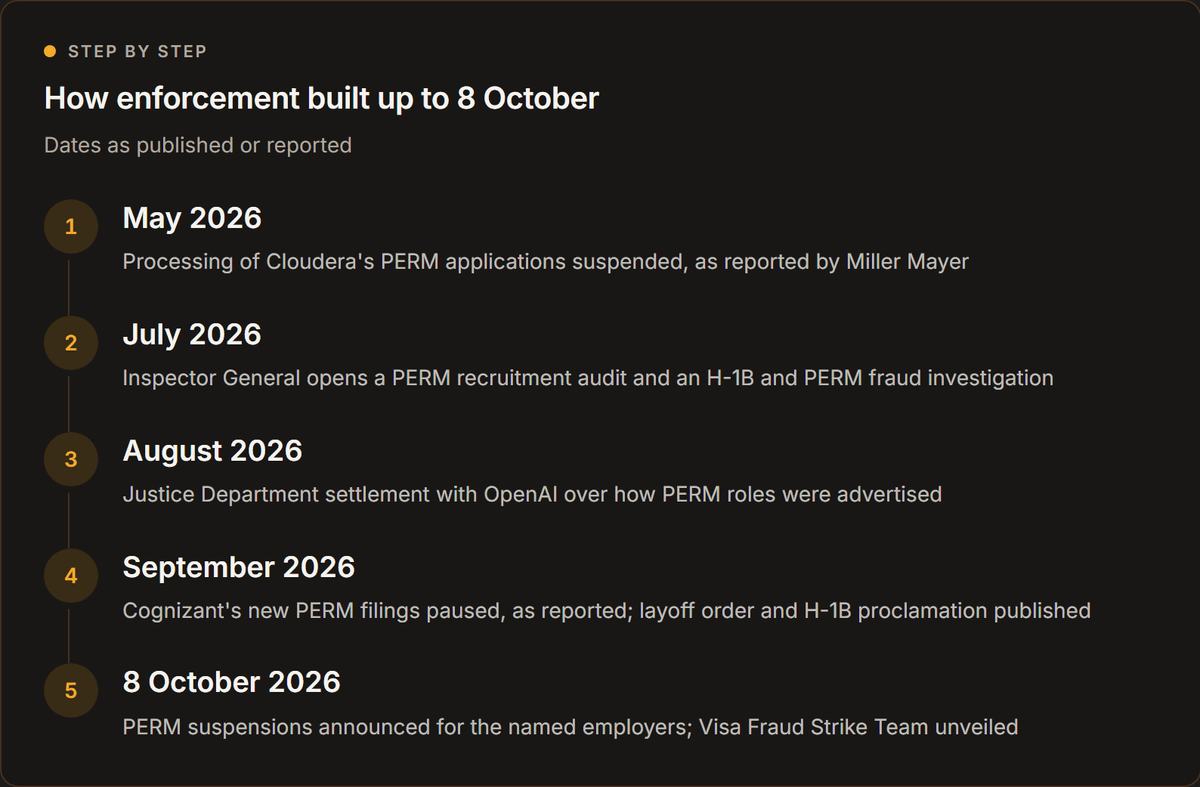
The 8 October announcement followed months of enforcement activity involving PERM recruitment and employment-based visa programs. For staffing agency owners, the earlier cases matter because they show the kinds of recruitment practices and records that authorities may examine.
On 14 July 2026, the Department of Labor's Office of Inspector General announced an audit of the PERM program.11 It said the audit would examine the extent to which US workers were recruited for PERM vacancies in line with employers' recruitment obligations. In July, the Inspector General also opened an investigation into suspected fraud and human trafficking in the H-1B and PERM systems, inviting foreign workers who had experienced coercion, benching or fraudulent recruitment to report it.11
On 8 October, the Inspector General announced a multi-agency Visa Fraud Strike Team focused on the H-1B and J-1 programs.11 The team included personnel from the Departments of Labor, Justice, Homeland Security and State, alongside US Citizenship and Immigration Services and Homeland Security Investigations.
Earlier cases provide more specific examples of the practices under scrutiny. Miller Mayer, an immigration law firm, reported that on 12 May 2026 the Labor Department suspended processing of PERM applications filed by or for Cloudera for 180 days, with an extension possible while the Justice Department investigated alleged discrimination against US workers.12 Masuda Funai reported the government's allegation that Cloudera required applicants for PERM roles to send résumés to an email address that could not receive external messages, while other jobs were advertised through the company's careers portal.13 These are reports of government allegations, not proof of wrongdoing established here.
Manifest Law also reported that Cognizant's new PERM filings were paused in September as part of a federal investigation. Separately, a proposed Labor Department rule to overhaul PERM recruitment had reportedly been under White House review since 14 September 2026, although its text had not been made public at the time of writing.2
A separate case illustrates why the recruitment method matters. In August 2026, the Justice Department's Immigrant and Employee Rights Section announced a settlement with OpenAI concerning how PERM-related jobs were advertised.14 According to the Department, its investigation found that applicants for those roles had to apply by mail, while applicants for other jobs could apply electronically. OpenAI denied the findings and did not admit wrongdoing. The settlement required a USD 1.2 million payment to the Treasury, set aside USD 2 million for potential back pay to US workers, and required PERM-related positions to be advertised on the company's careers website with electronic applications available in the same way as for other jobs.
The common thread is the recruitment process behind the PERM application. Where a sponsored role is advertised differently from comparable jobs, or the recruitment records cannot show that the required process was followed, the employer may face scrutiny. Staffing agencies should therefore check whether their PERM recruitment is genuine, accessible to US applicants and properly documented, and have immigration counsel review any unusual arrangements.
Which PERM steps should an agency check in its own files?
Start with the recruitment records for every PERM case in progress, including cases that have not yet been filed. The rules set specific requirements for advertising jobs, considering US applicants and keeping evidence of the recruitment process. If the Department of Labor audits a case, the agency needs records showing what it did and when.
Under 20 CFR 656.17(e), recruitment for a professional occupation generally requires a 30-day job order with the state workforce agency serving the area where the job will be performed, advertisements on two different Sundays in a newspaper of general circulation, and three additional recruitment steps.9 The mandatory steps, the job order and the two Sunday advertisements, must take place between 30 and 180 days before the PERM application is filed. Advertisements must not offer wages below the prevailing wage or include job requirements or duties beyond those stated on ETA Form 9089.
The employer must also prepare and sign a recruitment report. It must record the recruitment steps taken, their results, any hires, and the number of US workers rejected, with a lawful, job-related reason for each rejection. The report should be supported by records showing how applicants were assessed.
Two other rules cover notices and recordkeeping. Under 20 CFR 656.10, an employer without a bargaining representative must post a notice of the filing for at least 10 consecutive business days.9 The employer must retain the application and supporting documents for five years from the filing date. Under 20 CFR 656.20, an audit letter generally gives the employer 30 days to submit the requested documents.9 A substantial failure to provide the required evidence can result in supervised recruitment for future applications for up to two years.
Staffing agencies should pay particular attention to how they recruit for sponsored roles. Under 20 CFR 655.739, an H-1B-dependent employer or a willful violator that places workers at other employers' sites must follow the recruitment standards of the industry that primarily employs those workers.9 This is an H-1B rule, not a general PERM recruitment requirement, so agencies should ask immigration counsel how it applies to their circumstances rather than treating it as a direct substitute for the PERM rules.
Newland Chase, an immigration consultancy, has identified several situations that may warrant closer scrutiny following the reported suspensions. These include laying off workers in occupations for which the employer sponsors foreign workers, recruiting for PERM roles differently from other vacancies, tailoring job requirements to a sponsored employee, paying sponsored employees less than comparable US workers, and relying on vendors with large sponsorship programmes. For a staffing agency, vendor relationships matter in both directions: you may supply consultants to clients or subcontract consultants from another company.
For each open case, ask:
- Was the role advertised through the agency's usual recruitment channels, and could US applicants apply in the same way as other candidates?
- Do the advertisements match ETA Form 9089, without additional requirements or a wage below the prevailing wage?
- Were the job order and the two Sunday advertisements completed within the 30-to-180-day window before filing?
- Does the signed recruitment report record a lawful, job-related reason for rejecting each US applicant?
- Is the notice of filing on record, with evidence of the posting dates?
- Could the agency retrieve the complete file and submit the required documents within 30 days if an audit letter arrived?
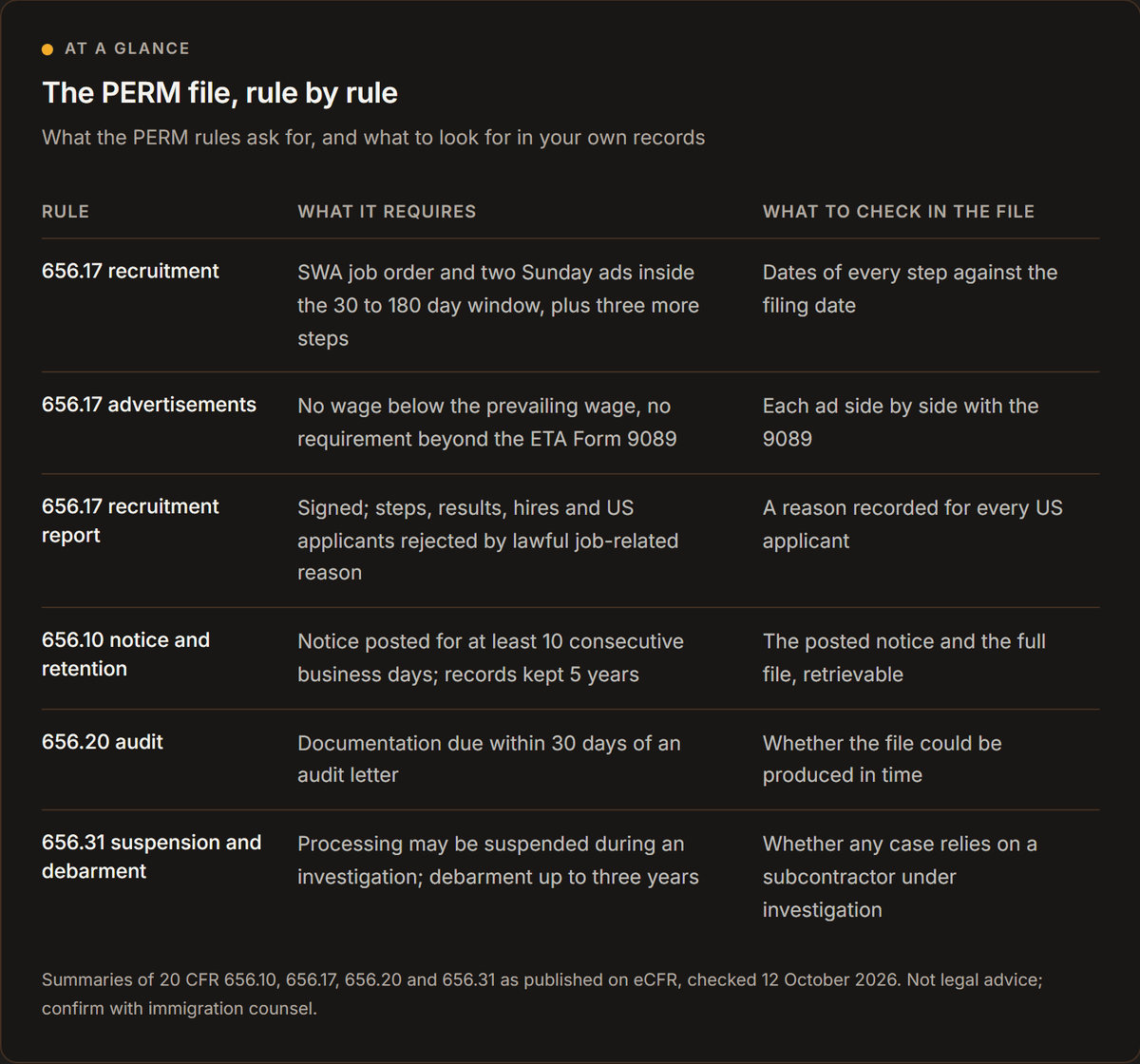
The aim is to establish that each case is supported by a genuine, documented recruitment process. If records are missing, requirements differ between advertisements and the application, or the reasons for rejecting US applicants are unclear, flag the issue for immigration counsel before proceeding.
Which H-1B obligations put green card sponsorship at risk?
PERM recruitment is only one part of an agency's compliance obligations. Problems with its H-1B programme can also affect its ability to sponsor workers for permanent residence. For staffing agencies, pay during gaps between client assignments, working conditions and the nature of the roles consultants fill all deserve close attention.
USCIS warns that violating the attestations in a labour condition application (LCA) can lead to fines, restrictions on future immigration petitions and other sanctions.15 Under 20 CFR 655.810, a wilful failure to comply with H-1B wage or working-condition requirements can result in a civil penalty of up to USD 9,624 per violation, as well as disqualification for at least two years from approval of certain employment-based immigrant petitions and H-1B-related petitions.9 The exact consequences depend on the violation and the applicable provisions. In other words, a serious H-1B compliance failure can affect more than a consultant's current assignment.
Pay does not automatically stop when a client assignment ends.
Under 20 CFR 655.731, an employer generally must pay an H-1B worker at least the required wage, which is the higher of the actual wage paid to comparable employees or the prevailing wage for the occupation and location.9 The obligation applies throughout the period of authorised employment, subject to the rule's terms.
The rule that staffing agencies need to understand particularly well is 20 CFR 655.731(c)(7), which addresses nonproductive time, commonly called benching. When an H-1B worker is not working because of an employer decision, such as having no client assignment available, the employer generally must continue paying the required wage. For salaried workers, this means paying the required salary on the applicable basis; for hourly workers, the regulation generally requires payment for a full-time workweek. An agency cannot simply stop paying a consultant because a project has ended or the next placement has not started. The Labor Department Inspector General's July investigation specifically invited reports from workers who had experienced benching.
Other H-1B requirements are especially relevant to agencies that employ many sponsored workers or place consultants at client sites.
- Public access file: Under 20 CFR 655.760, the employer must make the required LCA and supporting documentation available for public examination at its principal place of business or the place of employment within one working day after filing the LCA.9
- H-1B dependency: Under 20 CFR 655.736, an employer is generally considered H-1B-dependent if it has 25 or fewer full-time-equivalent employees and more than seven H-1B workers; 26 to 50 employees and more than 12 H-1B workers; or at least 51 employees and H-1B workers representing at least 15% of its full-time-equivalent workforce.9 This classification can trigger additional obligations.
- Secondary displacement: Under 20 CFR 655.738(d), certain H-1B-dependent employers and willful violators must make specified inquiries before placing covered H-1B workers with another employer where the relevant employment relationship indicators exist.9 The rules address situations in which the placement could displace a US worker. The precise requirements depend on the circumstances, and an initial inquiry does not automatically eliminate liability.
- Specialty occupation: USCIS requires a specialty occupation to involve the application of highly specialised knowledge and a minimum requirement of a bachelor's degree or higher in a directly related specific specialty, or its equivalent.15 The actual client role and its duties must support the classification. Giving a consultant a suitable-sounding internal job title is not enough.
Two deadlines also matter when an agency has green card cases underway. First, an approved PERM labor certification generally must be submitted with Form I-140 within 180 calendar days of certification, or it expires.9 Second, under the H-1B rules, some workers may qualify for extensions beyond the usual six-year limit when at least 365 days have passed since a qualifying PERM application or immigrant petition was filed.9 Eligibility depends on the relevant statutory and regulatory conditions.
A delayed, expired or restarted PERM case can therefore affect a consultant's immigration planning, particularly when the worker is approaching the H-1B six-year limit. Review each case's filing dates and status with immigration counsel, rather than assuming that a pending green card process automatically protects the worker's ability to remain employed. For a broader introduction to employment authorisation, see the guide to work permits for recruiters.
For agency owners, the practical check is straightforward:
Compare payroll records with every consultant's assignment history, verify that required wages continued during employer-caused gaps, check that each client role supports its H-1B classification, and confirm that LCA records and green card deadlines are properly documented.

How do the layoff order and the H-1B fee change the picture?
The reported PERM suspensions came on top of two September 2026 actions that could also affect staffing agencies: an executive order addressing layoffs by H-1B sponsors and a proclamation extending restrictions on H-1B entry.
Executive Order 14431, dated 18 September 2026, directs the Secretaries of State, Labor and Homeland Security to consider whether an H-1B sponsor has carried out layoffs in the previous year or plans layoffs that negatively affect similarly situated US workers.16 This consideration applies to decisions involving Labor Condition Applications (LCAs), H-1B petitions, visas and entry. The order also directs the Labor Secretary, through the Wage and Hour Administrator, to begin reviewing data from previously submitted LCAs within 30 days to determine whether further action against sponsoring employers is warranted.16
The order does not automatically prohibit an employer from filing an H-1B petition after layoffs. Employment law firm Littler notes, however, that workforce reductions could receive greater scrutiny during petition decisions, including extensions, visa issuance and entry.17
A separate proclamation dated 18 September extends the 2025 restrictions on H-1B entry until 21 September 2027.16 Under the restriction, covered entry requires the relevant petition to be accompanied by a USD 100,000 payment. The proclamation cites a fall in combined H-1B registrations by large IT staffing and outsourcing firms, from 24,946 to 2,055, a 92 percent decrease.16 These are figures cited by the administration to explain its policy.
The fee is currently blocked, but its status could change.
On 7 October 2026, the University of Colorado Boulder's international office reported that the fee was not then required because a court order prevented its collection. The government had appealed, leaving open the possibility of a change in the legal position. Fragomen also reported that a federal court in the Northern District of California had issued a preliminary injunction blocking implementation, with two separate court orders preventing collection. The proclamation remains in place, so employers should not assume either that the fee is payable now or that the current position will remain unchanged.
Wage rules are also changing. Under the weighted H-1B cap selection system, USCIS weights selection according to the highest OEWS wage level that the beneficiary's offered wage meets or exceeds.15 Separately, in March 2026, the Department of Labor proposed changes to its PERM and LCA regulations that would alter how the four prevailing-wage levels are calculated using the Bureau of Labor Statistics' Occupational Employment and Wage Statistics (OEWS) survey.16 The proposal is not a final rule, so employers should distinguish the requirements currently in force from potential future changes.
For staffing agency owners, the practical issue is the combined effect on workforce planning, sponsorship eligibility and cost. Review recent and planned layoffs, check the wage level and job duties recorded for each sponsored worker, and confirm the applicable requirements before filing or extending a petition. Immigration counsel should assess how the current court orders, entry restrictions and any proposed wage changes apply to each case.
What should an IT staffing agency do this week?
Do not assume the reported suspensions will widen, but do not wait for your agency to be named before checking your records. A clean file is useful even if nothing changes, and it puts you in a better position to respond if regulators ask questions.
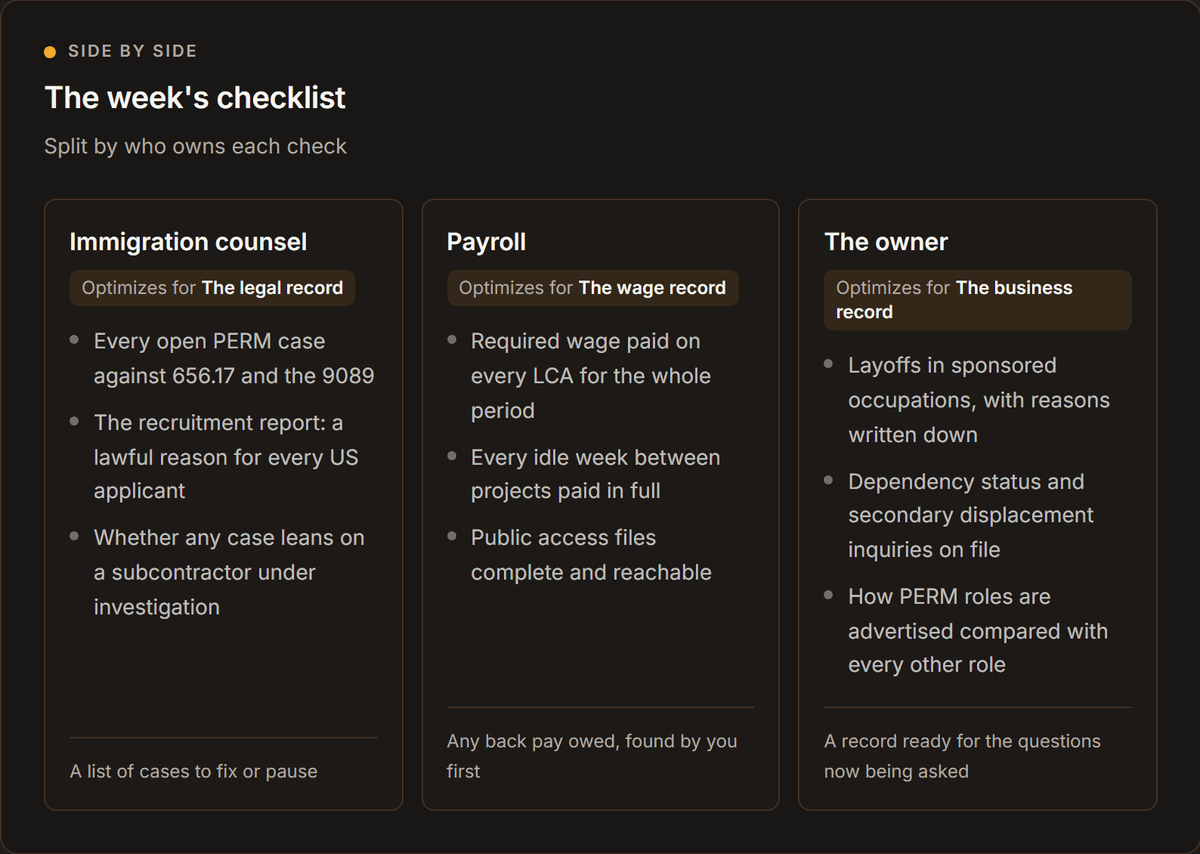
The week's checklist
Split the work by who owns each check.
In order of urgency
- Benching. Confirm that every H-1B consultant between client projects received the required wage during each employer caused idle period. If you find a gap, work with immigration counsel to establish what is owed and how to correct it.
- How PERM roles are advertised. Check that PERM vacancies are advertised through appropriate recruitment channels and that US applicants have a fair opportunity to apply. The OpenAI settlement addressed differences between application methods for PERM related roles and other vacancies. The Cloudera matter involved an allegation about an application email address that could not receive external messages. These are distinct cases, but both highlight the importance of reviewing how applicants can respond to job advertisements.
- The open PERM files. Check every case against 20 CFR 656.17, the ETA Form 9089 and the applicable recruitment timing requirements, including the 30 to 180 day window where it applies.9 Make sure the complete supporting file can be produced within the applicable audit deadline, which is generally 30 days.
- Dependency and placements. If your agency is H-1B dependent or otherwise subject to the relevant additional requirements, confirm that required secondary displacement inquiries were completed and documented for covered client placements.
- Layoffs. If your agency laid off US workers in occupations for which it sponsors foreign workers during the previous year, document the circumstances and reasons. The September order directs agencies to consider relevant layoffs in decisions involving LCAs, H-1B petitions, visas and entry. It does not automatically prohibit sponsorship after a layoff.
- Subcontractors. If your agency places consultants employed by another firm, ask that firm in writing about any relevant PERM or H-1B compliance concerns. Check the contractual responsibilities and records that your own agency may need to produce. A subcontractor's compliance issues can raise questions for other parties in the placement chain, depending on the facts.
- Consultants with cases in progress. Map each consultant's PERM and I-140 dates against the applicable 180 day PERM certification validity period and any potentially available H-1B extension provisions, including the rule that may apply when at least 365 days have passed since a qualifying PERM application or immigrant petition was filed. Confirm each person's eligibility with immigration counsel rather than assuming that a pending green card case automatically protects their work status.
What should you tell your consultants?
Be clear about what is known and what remains uncertain. Consultants may hear about the reported suspensions in the news and worry about their own cases. Explain that the reported action concerns named employers, that your agency is reviewing its records, and that you will communicate any case specific developments once they have been verified. Do not promise that an individual case is safe until its status and circumstances have been checked.
If your agency also places workers in California, the SB 947 article covers a separate set of requirements concerning automated decisions about temporary workers. Treat that as a separate compliance review.
Conclusion
The legal position surrounding the 8 October PERM suspensions remains uncertain. At the time of writing, no published notice had established the legal basis, precise scope or end date of the suspensions. The announcement named specific large employers, but it did not establish that those companies had violated the law or that staffing agencies were subject to the same restrictions. Agencies should not assume that the suspensions will expand, but they should not assume their own sponsorship cases are unaffected either.
What is clear is that IT staffing agencies already have legal obligations governing PERM recruitment and H-1B employment. The reported suspensions come amid increased scrutiny of how permanent vacancies are advertised, how US applicants are considered and how sponsored workers are paid. Separate measures concerning layoffs, H-1B entry and prevailing wages add further uncertainty for businesses that depend on international talent. Although the consequences of the latest actions remain unclear, agencies can review their existing compliance now.
What your agency should do now
- Check benching and wages. Compare payroll records with client assignment histories. Confirm that H-1B consultants between assignments received the wages required by the applicable rules, and seek legal advice if you identify a potential shortfall.
- Review PERM recruitment. Check advertisements, recruitment dates, applicant records and documented reasons for rejecting US applicants. Make sure the recruitment process meets the applicable requirements and that supporting documents are complete.
- Audit open cases and deadlines. Review each pending PERM case, its ETA Form 9089 and supporting records. Confirm that you can produce the file within the applicable audit deadline and that PERM certification and immigration filing deadlines have been tracked.
- Check client placements and subcontractors. Establish whether additional H-1B dependency or secondary displacement requirements apply. Clarify subcontractors' responsibilities and identify any compliance concerns that could affect your arrangements.
- Review layoffs and sponsorship changes. Document relevant workforce reductions and ask immigration counsel how the September measures apply to your agency's circumstances. Verify current requirements before making decisions about new filings, extensions or immigration costs.
- Communicate with consultants. Explain what is known about the suspensions, what remains uncertain and how the agency is checking individual cases. Do not guarantee that a case is unaffected until its status has been verified.
Prepare for scrutiny without assuming the outcome
The purpose of these checks is not to predict whether the government will extend the suspensions, but to establish whether the agency can demonstrate compliance with the rules already in force. If the review identifies gaps, obtain legal advice, take appropriate corrective action and document what has been done. Keep a record of the review so the business can explain its findings and response if questions arise from regulators, clients or employees.
The suspensions may remain limited to the employers named, or further action may follow. Until the legal position becomes clearer, the practical response is to start with benching and PERM recruitment, then work through payroll, placements and case deadlines. Accurate records and a documented compliance review will leave the agency better prepared to respond to developments without treating an uncertain announcement as a settled legal outcome.
Where Hivemind fits on a staffing desk
Nothing in this article is a software problem. The PERM file, the LCA and the wage record belong to the agency, its immigration counsel and its payroll. No system decides whether a recruitment report is lawful.
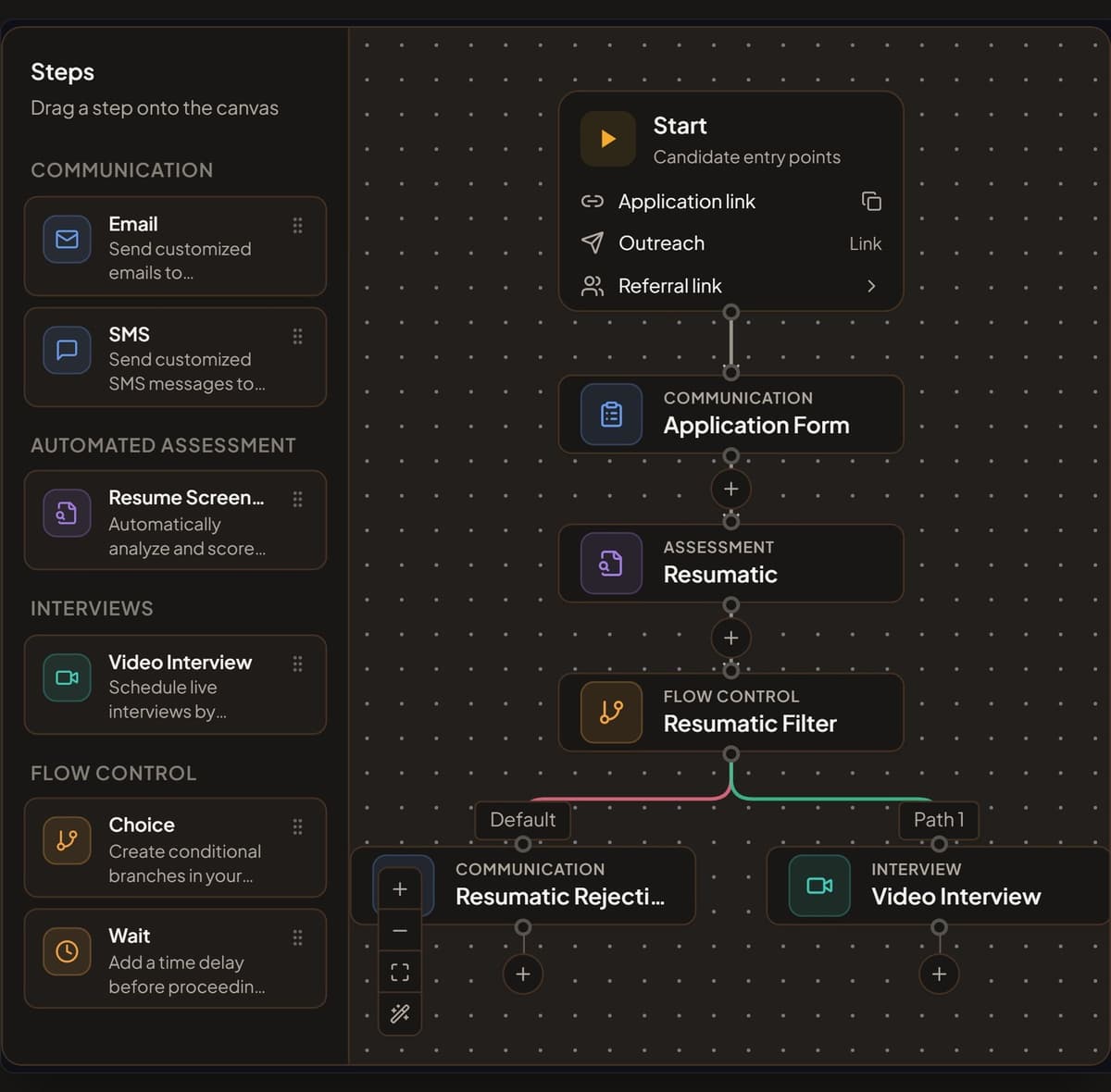
What a desk can control is how consistently it recruits. A role that is advertised and screened the same way as every other role leaves a cleaner record behind it. Hivemind is the hiring OS that covers sourcing, screening, interviews, offers, and the admin around them, so a desk can manage every candidate from inbound to offer in one unified workflow. A team can run Hivemind end to end, connect your existing tools, or mix and match both.
The modules closest to the recruitment record are these:
- Resumatic: AI-Powered Resume Filtering System
- Automated Skills Assessments
- Automated Emails: Smart Email Automation for Recruitment
Hivemind has 15 Native Modules and 275 Integrations.
Frequently asked questions
What is the PERM suspension announced on 8 October 2026?
On 8 October 2026, Labor Secretary Keith Sonderling announced that the Department of Labor would stop processing new and pending permanent labor certification applications involving certain named employers, according to reports by Manifest Law and Bloomberg Law. At the time of writing, no published notice had clarified the legal basis, precise scope or end date of the suspensions.
Which companies were affected by the PERM suspensions?
Bloomberg Law and Manifest Law reported that the suspensions covered Microsoft, Adobe, Cognizant, Infosys, Tata, Wipro, HCL Technologies and Capgemini.5 The reporting did not establish that staffing agencies outside this list were subject to the same action. The absence of a published notice left questions about the suspensions' precise scope unanswered.
Does the PERM suspension stop H-1B visas?
No general H-1B visa ban was announced as part of the reported PERM suspensions. The action concerned permanent labor certification applications for the named employers. H-1B sponsors must still comply with applicable wage and employment rules, and certain wilful violations can result in penalties or restrictions on future immigration-related petitions.
Can the Department of Labor suspend PERM processing for an employer?
Under 20 CFR 656.31(b), the Department of Labor can suspend processing in certain circumstances involving an employer under investigation for possible fraud or wilful misrepresentation. The regulation provides for written notice, subject to an exception where the investigating agency requests otherwise in writing, and an initial suspension of up to 180 days. However, no official source had confirmed that this provision was the legal basis for the suspensions announced on 8 October.
What are the PERM recruitment requirements for a professional role?
Under 20 CFR 656.17(e), professional occupations generally require a 30-day job order with the state workforce agency, advertisements on two different Sundays in a newspaper of general circulation, and three additional recruitment steps selected from the permitted options. The recruitment must fall within the applicable 30-to-180-day period before filing, subject to the rules for the individual recruitment steps. Advertisements must comply with the regulations, and the recruitment process must be consistent with the position described in the ETA Form 9089. The employer must also document the recruitment results and lawful, job-related reasons for rejecting US applicants.
What are the H-1B benching rules for a staffing agency?
Under 20 CFR 655.731(c)(7), an employer generally must continue paying the required wage when an H-1B worker is not working because of an employer-related reason, such as a lack of assigned work.9 The applicable payment requirements depend on the worker's circumstances and pay arrangement. A consultant between client assignments may therefore still be entitled to wages even when the agency has no billable work for that person.
When is a staffing agency considered an H-1B-dependent employer?
Under 20 CFR 655.736, H-1B dependency is determined by the number of full-time-equivalent US employees and the proportion of H-1B workers. The thresholds are 25 or fewer US full-time-equivalent employees with more than seven H-1B workers; 26 to 50 employees with more than 12 H-1B workers; or at least 51 employees with H-1B workers making up at least 15 percent of the workforce. Covered dependent employers may have additional recruitment and non-displacement obligations. Specific secondary displacement inquiries apply to certain placements with other employers, depending on the employer's status and the circumstances.
Sources
- CNN: Trump admin bars Microsoft and other tech companies from seeking permanent residency for foreign workers ↩
- Manifest Law: DOL halts PERM for 8 tech companies ↩
- Interesting Engineering: US suspends Microsoft, Adobe from green card program ↩
- University of Colorado Boulder, ISSS: USD 100,000 H-1B fee, current status ↩
- Bloomberg Law: US suspends visa program for tech firms including Microsoft ↩
- Boundless: DOL suspends employers from PERM labor certification ↩
- The National News Desk, via FOX 11: Vance unveils H-1B and J-1 abuse findings ↩
- Wolfsdorf Rosenthal: DOL announces PERM suspensions ↩
- Electronic Code of Federal Regulations: 20 CFR 656.31, 656.17, 656.10, 656.20, 656.30, 655.731, 655.736, 655.738, 655.739, 655.760, 655.810 and 8 CFR 214.2 ↩
- US Department of Labor, Office of Foreign Labor Certification: Permanent labor certification (PERM) ↩
- US Department of Labor, Office of Inspector General: PERM recruitment audit, H-1B and PERM investigation, July 2026 and Visa Fraud Strike Team ↩
- Miller Mayer: DOL suspends PERM processing for Cloudera ↩
- Masuda Funai: Business immigration monthly, May 2026 ↩
- US Department of Justice, Immigrant and Employee Rights Section: OpenAI settlement agreement ↩
- US Citizenship and Immigration Services: H-1B specialty occupations and H-1B electronic registration process ↩
- Federal Register: Executive Order 14431, Restriction on entry of certain nonimmigrant workers and Improving wage protections, proposed rule ↩
- Littler: Executive order directs agencies to consider layoffs in H-1B adjudication ↩
- Newland Chase: US federal government suspends major employers from PERM
- Fragomen: California federal court issues preliminary injunction against the H-1B fee