

The staffing industry outlook for Q4 2026 points to a recovery in some segments, not a broad boom. Robert Half's results, released on 22 October, show US contract and permanent placement revenue growing again. Staffing hours on Bullhorn's platform are also up year over year. However, US payroll growth was weak in September, and the number of temporary help jobs fell. Agency owners should therefore set recruiter headcount and sales targets using their own leading indicators, rather than relying on industry headlines.
Key takeaways
- Robert Half's chief executive said its talent business returned to adjusted year-over-year revenue growth for the first time since 2022, with revenues increasing 2 percent.
- The SIA and Bullhorn Staffing Indicator showed industrial staffing hours up 17 percent year over year in the week ending 10 October 2026, while office and clerical hours were down 7 percent.
- BLS Table B-1 shows US temporary help services employment at 2,486.8 thousand in September 2026, a one-month change of -10.9, and above the 2,471.6 thousand of a year earlier.
- Total US nonfarm payroll employment rose by only 29,000 in September 2026, so the turn at the staffing firms sits inside a flat labor market.
- Decide capacity per desk on your own job orders, and move a recruiter to a turning desk before you hire a new one.
This article is for US staffing agency owners setting fourth-quarter hiring plans and sales targets as public staffing firms report their results. It reviews third-quarter earnings available by 25 October, compares them with federal labor data and weekly staffing indicators, and explains what to monitor on individual desks before adding recruiters.
One distinction matters throughout: public staffing firms serve different clients and skill markets, so their results do not represent the entire industry. Statements from company executives reflect their own businesses and should be treated accordingly.
In this article
- What did Robert Half report on 22 October?
- Which segments turned, and which did not?
- What did the other public staffing firms say?
- What do the weekly staffing numbers say?
- What does the federal data say?
- What are the Fed's staffing contacts saying?
- What this means for your fourth quarter
- Is one good quarter enough to hire recruiters on?
- Conclusion: Let your desks lead the recovery
- Frequently Asked Questions
What did Robert Half report on 22 October?
Robert Half reported third-quarter 2026 revenue of USD 1.359 billion, compared with USD 1.354 billion in the same quarter of 2025.1 Net income rose to USD 50 million from USD 43 million. At group level, revenue was nearly flat, while profit increased.
The more important development was within its staffing business. Robert Half's chief executive said the talent business returned to adjusted year-over-year revenue growth in the third quarter for the first time since 2022, with revenue increasing by 2 percent.1 However, the company's overall results were held back by Protiviti, its consulting arm. Protiviti's year-over-year revenue growth rate was -2.9 as reported and -3.3 as adjusted.1
The chief executive also said hiring activity was improving as market conditions gradually strengthened.12 This is an encouraging sign, but it reflects Robert Half's own business and client mix. It does not establish that every staffing agency or skill market is recovering.
The wider results call for caution. For the nine months ended 30 September 2026, Robert Half generated USD 3.996 billion in revenue, down from USD 4.076 billion in the same period of 2025.1 Its year-to-date revenue therefore remained below the previous year's level.
Robert Half also warns that past performance cannot reliably predict future results, partly because long-term contracts do not make up a significant part of its business.1 Staffing agencies face a similar challenge: client demand can change quickly, and a stronger quarter does not guarantee that growth will continue. Agency owners should treat Robert Half's results as a useful signal, not as a reason to increase recruiter headcount without checking their own sales pipeline and placement trends.
Which segments turned, and which did not?
Robert Half breaks down revenue growth by geography, staffing type and job function. Its third-quarter results offer a useful view of where demand is recovering, but the figures also show why agency owners should look at their own markets before changing hiring plans.
| Segment, Q3 2026 | Growth as reported | Growth as adjusted | Q3 2025 growth as reported |
|---|---|---|---|
| US contract talent | 2.5 | 1.9 | -10.3 |
| US permanent placement | 8.1 | 7.5 | -11.3 |
| International contract talent | -1.1 | -1.1 | Not used here |
| International permanent placement | 1.3 | 1.6 | Not used here |
| Global finance and accounting | 2.2 | 1.5 | Not used here |
| Global technology | 4.6 | 3.9 | Not used here |
| Global administrative and customer support | -2.7 | -3.1 | Not used here |
Source: Robert Half, Form 8-K, Exhibit 99.1, revenue growth rates table, 22 October 2026. Figures are percentages.
The US staffing business showed the clearest improvement. US contract talent revenue grew at 2.5 as reported and 1.9 as adjusted, against -10.3 as reported a year earlier.1 International contract talent revenue was still at -1.1 as reported and as adjusted, while international permanent placement grew modestly, at 1.3 as reported and 1.6 as adjusted.1 For US agency owners, the message is that the recovery is uneven across regions, even within the same company.
Permanent placement showed the strongest growth. US permanent placement revenue grew at 8.1 as reported and 7.5 as adjusted, against -11.3 as reported a year earlier. Across the business globally, contract talent revenue grew at 1.7 as reported and 1.0 as adjusted, while permanent placement grew at 6.2 as reported and 5.6 as adjusted.1
That improvement is worth watching because permanent placement revenue depends on successful hires. However, a small number of completed placements can move quarterly results significantly, so one strong quarter does not necessarily mean demand will keep rising.
Job function matters just as much as placement type. Global technology revenue grew at 4.6 as reported and 3.9 as adjusted.1 Finance and accounting also returned to growth, at 2.2 as reported and 1.5 as adjusted. Administrative and customer support remained in decline, at -2.7 as reported and -3.1 as adjusted.1
An agency focused on technology or finance roles may therefore see different conditions from one that mainly places administrative and front-office staff. Robert Half's recovery is not a signal that every desk should expand.
Before adding recruiters, agency owners should compare these industry trends with their own gross profit per placement, gross profit per recruiter and fill rates. The guide to the numbers that run a staffing desk explains how to assess whether additional placement volume is translating into profitable growth.
What did the other public staffing firms say?
Robert Half was not the only major staffing company reporting signs of improvement. Other public firms also described stronger performance, although their results reflect different clients, markets and staffing specialities.
ManpowerGroup. ManpowerGroup's segment table, printed in percent, shows US revenues from services growing 5.5 in the third quarter of 2026, both as reported and in constant currency.3 Across the group, revenue reached USD 4.8 billion, up 4 percent as reported, 5 percent in constant currency and 6 percent on an organic constant-currency basis.3
ManpowerGroup attributed growth to its Manpower brand, particularly in the US, and said its US Experis business returned to growth during the quarter.3 Its chief executive said the company's performance reinforced confidence that 2026 was an inflection point for the business.3 The chief executive also reported that the Manpower brand continued to lead, with notable market share gains in the US.3 These are management's assessments of its own performance, rather than independent measures of the wider staffing market.
Randstad. Randstad reported organic revenue growth of 3.9 percent in the third quarter of 2026, alongside double-digit profit growth.4 Its chief executive also pointed to improving trends in October.4 The 3.9 percent figure covers Randstad globally; a North American revenue figure for the quarter was not available in the source material used for this article.
Kforce. Kforce had not released its third-quarter results by 25 October. In July, the company said revenue had begun recovering in the first quarter of 2026 and expanded more strongly in the second. Its third-quarter guidance anticipated further improvement from the previous quarter. These comments describe Kforce's expectations before its third-quarter results were available, not a confirmed outcome.
Taken together, these companies provide more evidence of improving conditions than Robert Half's results alone. However, they serve different markets and customer groups, and each company's statements describe its own business. Several other US public staffing firms had not reported by 25 October, so agency owners will have more results to compare as they set their fourth-quarter plans.
What do the weekly staffing numbers say?
Quarterly earnings show what happened over the previous three months. Weekly staffing indicators offer a more immediate view of changes in demand.
The SIA and Bullhorn Staffing Indicator. The SIA and Bullhorn Staffing Indicator showed US staffing hours up 11 percent year over year in the week ending 10 October 2026, and up 0.6 percent from the previous week.5 Industrial staffing hours increased by 17 percent year over year, while IT staffing hours rose by 6 percent. Office and clerical staffing hours, however, fell by 7 percent.5
The indicator measures hours worked by staffing professionals recorded on Bullhorn's platform. It therefore reflects activity among participating customers, rather than the entire US staffing industry. Even with that limitation, its results show a pattern similar to Robert Half's: technology and industrial staffing are improving, while administrative and clerical work remains weaker.
The ASA Staffing Index. The American Staffing Association describes staffing employment as a coincident indicator of economic activity and a leading indicator of total US nonfarm employment.6 Its weekly Staffing Index tracks changes in temporary and contract employment, with results generally published nine days after the end of the work week.6
The ASA's September 2026 monthly report showed staffing employment up 0.5 percent from August and 3.3 percent compared with the same week of 2025.6 The October report was not yet available when this article was written.
The broader forecast also points to gradual rather than rapid growth. Staffing Industry Analysts' September 2026 forecast projected that the US staffing market would grow by 2.4 percent in 2026 to USD 183.1 billion, followed by 2.2 percent growth in 2027.5 That suggests a market recovering slowly, not one returning to a widespread hiring boom.
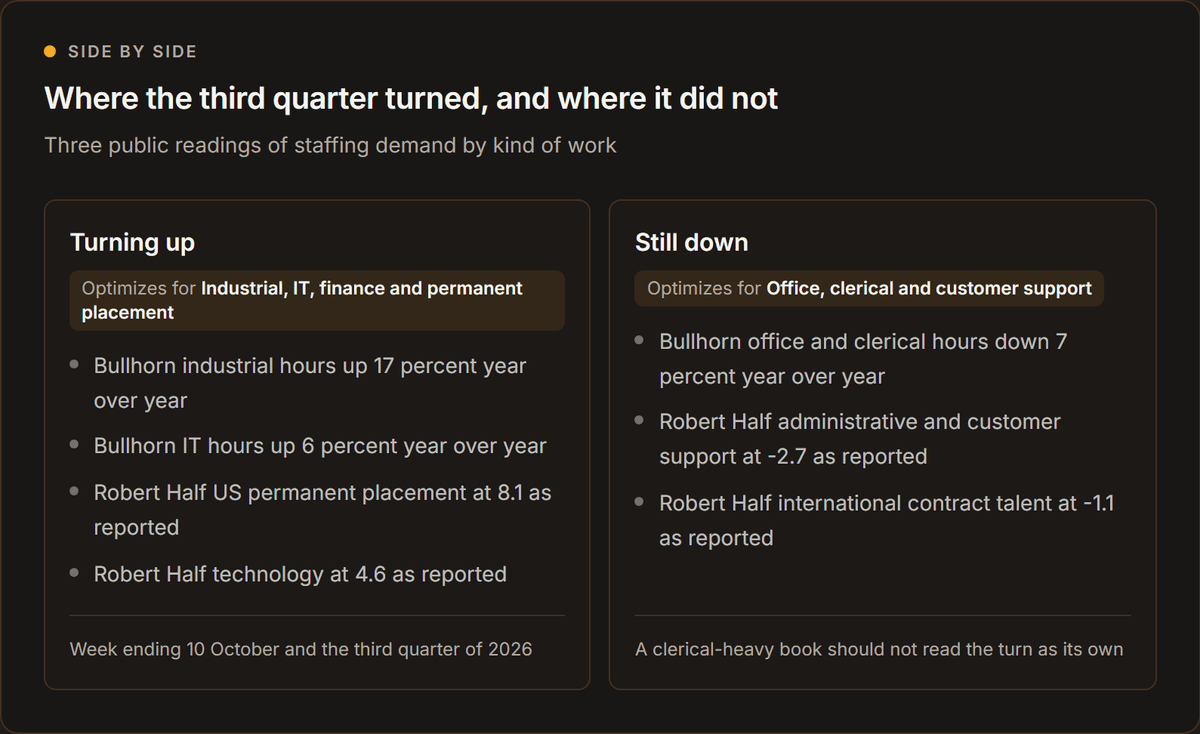
For agency owners, the key lesson is that the recovery depends on the type of work being filled. Industry-wide growth figures can provide useful context, but they cannot replace tracking demand, placements and profitability across your own desks.
What does the federal data say?
US government labor data paints a more subdued picture than the staffing companies' results. For agency owners, both matter: staffing firms may be seeing early improvements in certain markets, while the wider labor market remains slow.
Payroll growth remains weak. Total US nonfarm payroll employment increased by just 29,000 in September 2026, following average monthly growth of 45,000 over the previous 12 months.7 The Bureau of Labor Statistics (BLS) also revised July's payroll figure down from a gain of 21,000 to a loss of 10,000.7 Meanwhile, the unemployment rate has remained between 4.1 percent and 4.3 percent since March 2026.7 These figures point to a labor market growing slowly rather than one experiencing a broad hiring surge.
Temporary help employment fell in September but remains above last year's level. Seasonally adjusted, preliminary employment in US temporary help services stood at 2,486.8 thousand in September 2026, compared with 2,471.6 thousand in September 2025. However, BLS Table B-1 shows a one-month change of -10.9. Both trends matter: temporary employment is slightly higher than a year ago, but it weakened during September. Because preliminary figures can be revised, agency owners should look at several months of data rather than treating one month's decline as a turning point.
Hiring and quitting remain subdued. The BLS reported 5.2 million US hires in August 2026, equivalent to a hiring rate of 3.3 percent.7 Quits remained at 3.1 million, or a rate of 1.9 percent.7 For staffing agencies, fewer people voluntarily leaving jobs can mean fewer candidates actively seeking new opportunities. However, candidates who are looking may be more likely to remain in a suitable role once placed.
Wage growth is moderating. Average hourly earnings for private nonfarm employees rose by 0.1 percent to USD 37.81 in September 2026, an increase of 3.0 percent over 12 months.7 The Atlanta Fed's Wage Growth Tracker also eased, falling from 4.1 percent in August to 3.9 percent in September.8 Wage growth was 3.4 percent for people who stayed in their jobs and 4.7 percent for those who changed jobs. That difference helps explain why changing jobs can be attractive to candidates, and why agencies may need to offer competitive opportunities to persuade them to move.
Layoff indicators are not pointing to a surge. Initial US unemployment insurance claims fell by 6,000 to a seasonally adjusted 194,000 in the week ending 17 October 2026.9 Challenger, Gray and Christmas reported 43,281 announced US job cuts in September, down 18 percent from August's 52,881.10 Employer hiring plans rose sharply from 12,325 in August to 90,787 in September, but remained 23 percent below September 2025 and at their lowest September level since 2011.10 Announced hiring plans are not the same as completed hires, so this increase should be treated as an indication of intentions rather than confirmed demand.
Leading indicators send mixed signals. The Conference Board's Employment Trends Index fell 0.5 percent to 107.56 in September 2026.11 The Board said the index remained 1.0 percent above its level a year earlier, suggesting moderate payroll employment growth ahead.11
Indeed's Job Postings Index reached 103.8 on 16 October 2026, almost 4 percent above its February 2020 level, while its new-postings index remained broadly flat at 99.2.2 Indeed Hiring Lab reported that postings on its platform were 2.8 percent higher year over year in October and expected annual growth to remain positive through the autumn.2 However, it cautioned that the labor market could not yet be described as stronger because new postings had not improved.
Taken together, these figures describe a labor market that is neither growing quickly nor showing clear signs of breaking down. Some staffing segments are improving, but payroll growth is weak and hiring intentions remain uneven. Agency owners should use this backdrop to inform their forecasts, then check whether their own client demand, open roles and completed placements support adding recruiter capacity.

What are the Fed's staffing contacts saying?
The Federal Reserve's Beige Book collects reports from businesses and other contacts across its 12 districts.12 It is not a statistical survey, but it offers a useful view of what employers and staffing firms are experiencing on the ground.
The October 2026 Beige Book reported little or no overall employment change in most districts. Three districts reported modest increases, five reported slight increases and four reported no significant change.13 Five districts also said businesses had reduced staffing through attrition, delayed hiring or expected to create fewer jobs after investing in AI.13
The district reports include direct observations from staffing industry contacts.
Boston: Staffing contacts said workers were motivated to look for new jobs because wage increases were lagging behind inflation.13
Chicago: A temporary employment agency reported uneven demand across manufacturing subsectors.13 Contacts in administrative and professional services also said hiring had become easier.
Cleveland: Banking and staffing contacts reported that fewer outside job opportunities had reduced employee turnover and eased wage pressure.14
Minneapolis: A staffing firm operating across several offices reported strong job orders, and many contacts said they were finding workers relatively successfully.12 IT staffing contacts said AI was not causing layoffs but was reducing the creation of new jobs.
These reports point to two important trends. First, workers may be easier to find, helping agencies fill roles more quickly, but clients may also feel less need to rely on recruiters. Second, AI appears to be limiting the creation of some new roles, particularly in IT, rather than causing widespread layoffs.
For agency owners, the practical lesson is to distinguish between clients struggling to find workers and clients that simply have fewer roles to fill. Those situations require different sales and recruiting strategies.
What this means for your fourth quarter
The public results suggest that demand is improving in some US staffing segments, although growth is coming from a low base. They do not guarantee that your agency is experiencing the same recovery. Your fourth-quarter decisions should depend on what is happening across your own desks.
Start with your own leading indicators. Public company results describe activity that has already happened. Your new job orders, submittal-to-interview ratio and client response times can give you earlier clues about future revenue. Compare new orders with the same weeks last year, desk by desk. If industrial orders are rising, the broader industrial staffing trend may be relevant to your business. If clerical orders remain flat, industry-wide growth elsewhere should not influence that desk's forecast.
Add recruiter capacity where demand is growing. Hiring a recruiter for a desk with declining orders adds cost before there is enough work to generate revenue. Before recruiting externally, consider moving a recruiter from a weaker desk to one with stronger demand. Because the recovery varies by segment, staffing capacity should be allocated accordingly.
Protect your rates on renewals. If orders are returning and candidates are easier to find, avoid automatically cutting bill rates or spreads to win more volume. Review renewal terms carefully and protect margins where client demand supports them. More placements are not necessarily better if each one generates less gross profit.
Use your existing candidate database first. Federal Reserve contacts reported that finding workers had become easier in some markets. This is an opportunity to reconnect with candidates already in your records before spending more on job boards or other sourcing channels. Existing candidate relationships may help you fill roles at a lower cost. The article on job board spend at staffing firms explores how agencies can assess that investment.
Redeploy temporary workers before assignments end. When demand starts recovering gradually, placing an existing temporary worker into a new assignment can be quicker than finding and onboarding someone new. Track assignment end dates and contact clients early about upcoming vacancies. The guide to redeploying temps before the assignment ends covers how to approach this process.
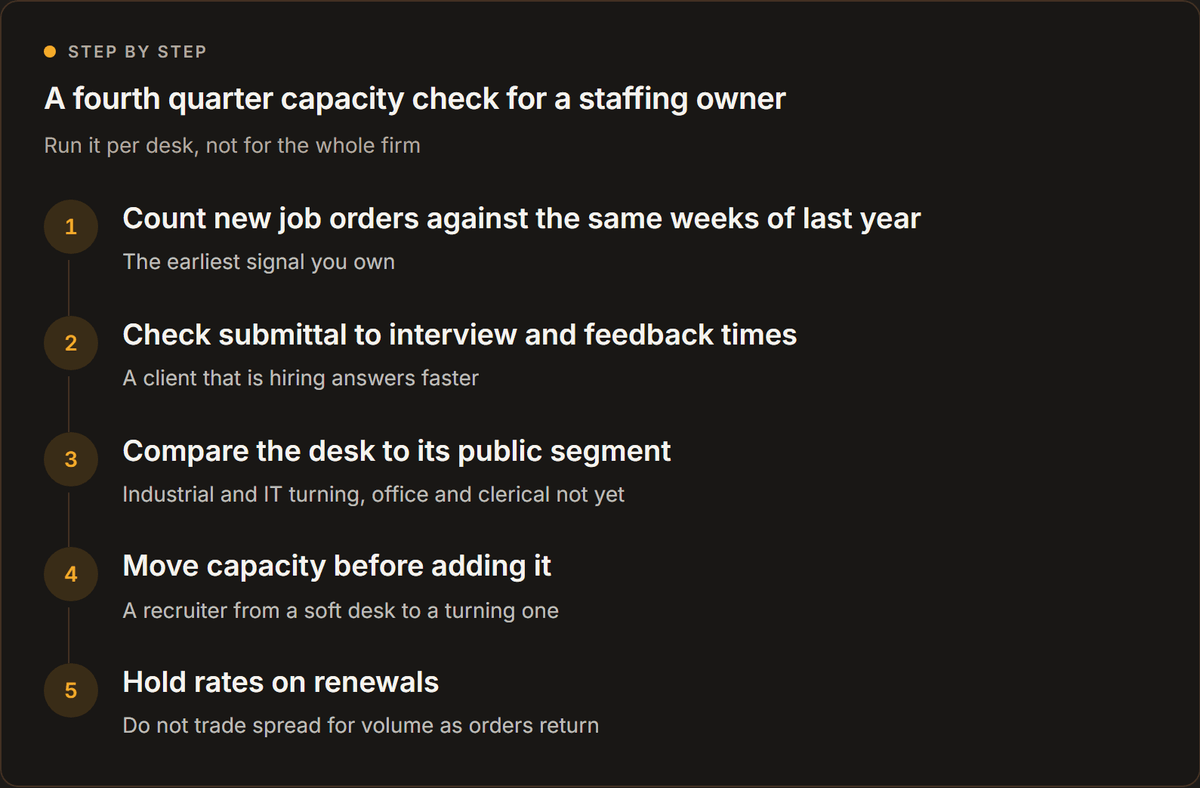
The goal is not to predict the entire staffing market correctly. It is to make better decisions about your own agency. Review each desk's demand, placement performance and gross profit before adding people, increasing spending or changing rates.
Is one good quarter enough to hire recruiters on?
No. One strong quarter is a reason to investigate whether demand is returning, not proof that it will continue. Robert Half's own release warns that future results cannot reliably be predicted from past trends, and its revenue for the first nine months of 2026 remained below the same period in 2025. The BLS temporary help count fell in September, and payroll figures for July were revised down. An agency that hires three recruiters based on one public company's results is assuming that the same recovery is happening across its own clients and job markets.
There is a cost to waiting, too. Recruiters need time to build client relationships, source candidates and fill roles. An owner who waits for certainty may add capacity only after orders have returned, missing placements while competitors move faster. Robert Half and ManpowerGroup reported improvements in parts of their US businesses, while Bullhorn's staffing hours and Indeed's job postings also provided signs of recovery. If your own job orders and client conversations confirm that demand is improving, delaying every hiring decision carries its own risk.
The practical approach is to make the decision desk by desk and use your own data. Consider moving a recruiter from a weaker desk before hiring someone new. If demand continues to grow, add one recruiter and review the results before expanding further. Set a date to reassess job orders, placement activity and gross profit during the quarter. Let evidence from your own business determine the next step, rather than the timing of public earnings announcements.
Conclusion: Let your desks lead the recovery
The staffing industry is showing signs of recovery, but Q4 2026 is not a quarter for hiring on headlines alone. Robert Half's return to growth, ManpowerGroup's stronger US results and Bullhorn's rising staffing hours suggest that demand is returning in parts of the market. Yet federal payroll growth remains weak, temporary help employment fell in September, and office and clerical staffing continues to lag. The opportunity is real, but it is not evenly distributed.
For agency owners, the advantage will go to those who can tell the difference between a market improving and a desk ready to grow. Track new job orders against last year, monitor how quickly clients respond and candidates progress, and measure gross profit rather than placements alone. Move recruiters towards stronger desks before adding headcount, protect your rates as demand returns, and set a review date before committing to further expansion.
The founder takeaway is simple: make the next hire earn its place in your plan. One good quarter can justify a closer look. Sustained orders, healthy margins and a credible pipeline justify the investment. If those signals are there, move before the opportunity passes. If they are not, keep your capacity flexible and your costs under control.
You do not need to predict the entire staffing market to make a smart Q4 decision. You need to know which desks are gaining traction, which are still struggling, and what your own numbers say to do next. That is how you turn an industry recovery into profitable growth for your agency.
Where Hivemind fits on a staffing desk
The capacity decision in this piece is the owner's: which desks to staff, which clients to price, and when to add a recruiter. No system makes that call, and nothing here says one does.
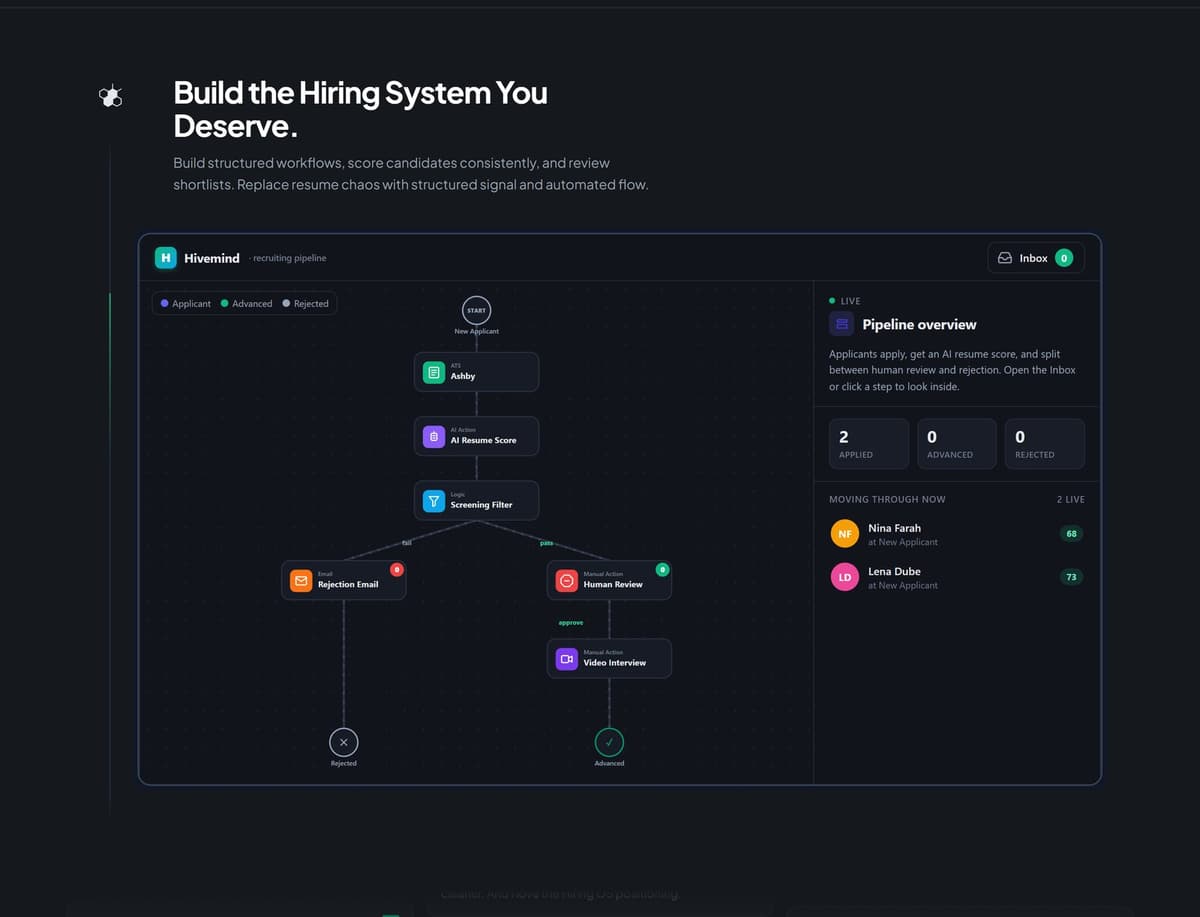
When orders come back, the work on each desk is the same: sourcing, screening, interviews, offers, and the admin around them. Hivemind is the hiring OS: manage every candidate from inbound to offer in one unified workflow. A team can run Hivemind end to end, connect your existing tools, or mix and match both, with 15 Native Modules and 275 Integrations to build the exact pipeline its team deserves.
Frequently asked questions
What is the outlook for the US staffing industry in Q4 2026?
The US staffing market is showing signs of a gradual recovery, although growth varies by sector. Robert Half and ManpowerGroup reported growth in the third quarter, while the SIA and Bullhorn indicator showed staffing hours among Bullhorn's customers rising by 11 percent year over year in the week ending 10 October. Industrial and IT staffing improved, but office and clerical work continued to decline. With national payrolls adding just 29,000 jobs in September, the broader employment market remains sluggish.
Did temporary help employment increase or decrease in September 2026?
Temporary help employment fell compared with August but increased year over year. BLS Table B-1 shows US temporary help services employment at 2,486.8 thousand in September 2026, a one-month change of -10.9, and above the 2,471.6 thousand of September 2025.7 These figures are seasonally adjusted and preliminary.
How did Robert Half perform in the third quarter of 2026?
Robert Half reported revenue of USD 1.359 billion, compared with USD 1.354 billion a year earlier. Net income increased from USD 43 million to USD 50 million. Its chief executive also reported that the talent business returned to adjusted year-over-year growth for the first time since 2022, with revenue up 2 percent. In its growth rates table, US permanent placement was at 8.1 as reported, and US contract talent at 2.5.
Which staffing sectors are experiencing growth?
Industrial staffing, IT staffing and permanent placement are showing signs of improvement. In the week ending 10 October, industrial staffing hours increased by 17 percent year over year, while IT staffing hours rose by 6 percent.5 Office and clerical hours declined by 7 percent, and Robert Half's administrative and customer support function was at -2.7 as reported.
Is now a good time for staffing agencies to hire more recruiters?
Only if confirmed client orders justify the additional cost. Robert Half cautioned that past performance cannot reliably predict future results, and its revenue for the first nine months of 2026 remained below the previous year's level. Agencies should first shift existing recruiters towards sectors with rising demand, monitor incoming orders and reassess hiring needs before expanding their teams.
What is the projected growth rate for the US staffing market?
Staffing Industry Analysts' September 2026 forecast projects that the US staffing market will grow by 2.4 percent in 2026, reaching USD 183.1 billion. A further 2.2 percent increase is expected in 2027, suggesting a gradual recovery rather than rapid industry-wide growth.
Sources
- Robert Half Inc.: Form 8-K Exhibit 99.1, third-quarter 2026 results, 22 October 2026 ↩
- Indeed Hiring Lab: US Labor Market Snapshot, October 2026 ↩
- ManpowerGroup Inc.: Form 8-K Exhibit 99.1, third-quarter 2026 results, 15 October 2026 ↩
- Randstad: Q3 2026 results, 21 October 2026 ↩
- Staffing Industry Analysts: SIA and Bullhorn Staffing Indicator, 20 October 2026 and US Staffing Industry Forecast, September 2026 update ↩
- American Staffing Association: ASA Staffing Index ↩
- US Bureau of Labor Statistics: The Employment Situation, September 2026, Table B-1 and Job Openings and Labor Turnover, August 2026 ↩
- Federal Reserve Bank of Atlanta: Wage Growth Tracker ↩
- US Department of Labor: Unemployment Insurance Weekly Claims, 22 October 2026 ↩
- Challenger, Gray and Christmas: Challenger Report, September 2026 ↩
- The Conference Board: Employment Trends Index ↩
- Federal Reserve Bank of Minneapolis: Beige Book, October 2026 ↩
- Federal Reserve: Beige Book, October 2026, national summary and Chicago District ↩
- Federal Reserve Bank of Cleveland: Beige Book, 14 October 2026 ↩
- Kforce Inc.: Form 8-K Exhibit 99.1, second-quarter 2026 results