

Staffing agency text messaging compliance comes down to four habits: understand what each message is for, keep records of candidate consent, stop texting a number as soon as the recipient opts out, and send messages only during permitted hours in the strictest state you operate in. Federal law, state laws, and carrier registration requirements all need to be considered before a campaign goes out.
Key takeaways
- Label every candidate text template as informational or promotional, and send promotional templates only to candidates who gave signed written consent.
- Under 47 CFR 64.1200(a)(10) a candidate may revoke consent by any reasonable method, and the request must be honored within a reasonable time not to exceed ten business days from receipt.
- The TCPA lets a person recover actual loss or $500 for each violation, and a court may raise the award to not more than three times that amount for a willful or knowing violation.
- Sending between 8 a.m. and 8 p.m. in the candidate's own time zone stays inside the federal window, the Oklahoma window and the Oregon window Goodwin reports.
- CTIA's principles say senders should not use opt-in lists that have been rented, sold, or shared, so a bulk send list is built only from the agency's own consent records.
This guide is for staffing desk leads preparing to text hundreds of candidates about a new job order and agency owners responsible for ensuring those messages comply with the law. It covers federal requirements, FCC consent and opt-out rules, state laws governing text messages, and carrier registration requirements. It also includes a checklist staffing teams can use before launching each campaign.
Two important limitations apply. First, this guide is not legal advice. The rules are based on the relevant legal instruments or attributed to the law firms and industry bodies reporting them, with information checked as of 25 October 2026. Consult legal counsel to confirm how the requirements apply to your agency, message templates, and operating states. Second, no public study meeting this guide's source requirements was found to support claims about candidate response rates or preferences for recruiter texts. Accordingly, this guide focuses on compliant messaging practices rather than making unsupported claims about candidate behaviour.
In this article
- Why does a staffing desk need consent rules for texts?
- Which federal law covers a text to a candidate?
- Is a texting tool an autodialer after Facebook v. Duguid?
- Is a job text telemarketing?
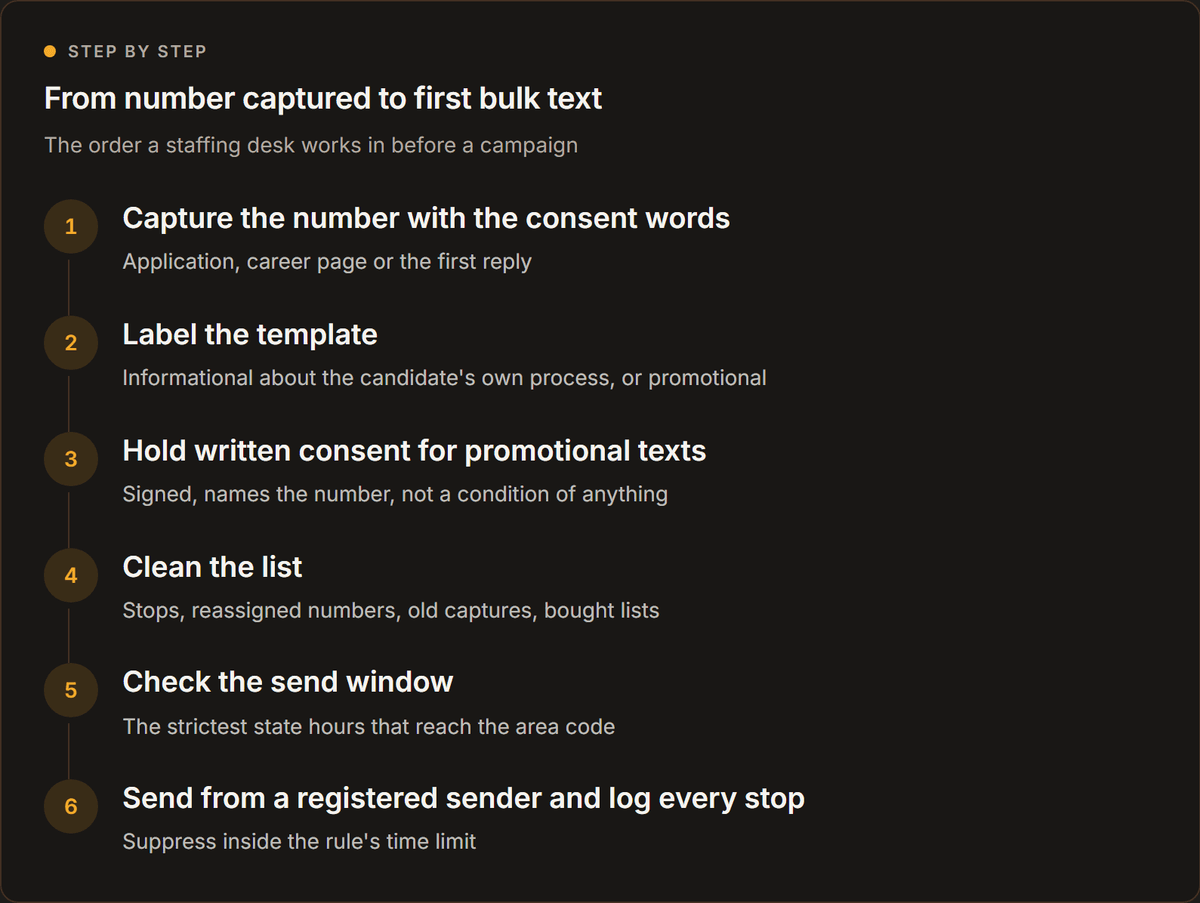
- What consent should be on file before the first text?
- What happens when a candidate texts STOP?
- What changed in the FCC's revocation rules this year?
- Which state laws reach a staffing agency's texts?
- What do carriers and 10DLC registration require?
- How do you build the send list?
- What is the exposure if a desk gets it wrong?
- The send checklist
- Conclusion: Make every candidate text defensible
- Frequently asked questions
Why does a staffing desk need consent rules for texts?
Staffing recruiters use text messages to reach candidates quickly. They might confirm a shift, share a new job order on a Friday afternoon, or remind someone about an upcoming start date. Texting can save recruiters from repeatedly chasing candidates by phone. However, when agencies send these messages at scale, they can fall within the scope of laws designed to restrict unwanted communications. Good intentions do not automatically protect an agency from liability.
The main legal framework includes the Telephone Consumer Protection Act (TCPA), the Federal Communications Commission's (FCC) rules under that law, and an expanding range of state laws with similar requirements. Although these laws were largely developed to address sales calls and unwanted marketing, some provisions extend beyond sales communications. Those broader requirements are particularly relevant to staffing agencies that regularly text candidates.
Following the rules also helps agencies maintain reliable candidate contact lists. Each section below ends with a practical action recruiters can take to keep their texting practices compliant.
Which federal law covers a text to a candidate?
The starting point is 47 U.S.C. § 227, which establishes the TCPA. The law restricts calls to cellular telephone numbers using an automatic telephone dialing system or an artificial or prerecorded voice without the recipient's prior express consent, subject to specified exceptions, including emergency purposes.1 These restrictions are not limited to sales calls. They can apply to any communication that meets the relevant legal requirements.
Text messages can also qualify as calls under the TCPA. The FCC's rules explicitly include text messages, including short message service (SMS) messages, within the definition of a call in its rules governing package delivery notifications.2 The FCC's consent and revocation rules likewise address calls and text messages together.
The law also defines the equipment covered by these restrictions. Under 47 U.S.C. § 227(a)(1), an automatic telephone dialing system (ATDS) is equipment with the capacity to store or produce telephone numbers to be called using a random or sequential number generator and to dial those numbers. Whether a staffing agency's texting platform meets this definition is an important legal question. The Supreme Court's interpretation of the definition is relevant to determining how the rules apply.
The potential financial consequences make compliance particularly important. The TCPA allows individuals to sue in state court for actual monetary losses or statutory damages of $500 per violation of the relevant autodialer and prerecorded-voice provisions, whichever is greater.1 If a court finds that a violation was willful or knowing, it may increase the award to up to three times the amount otherwise available.
Each message that constitutes a separate violation can create additional exposure. A campaign sent to hundreds of candidates could therefore create hundreds of potential claims, depending on the circumstances and the applicable legal requirements.
What the desk does: Treat every text template as a communication that requires TCPA review. Document how each texting platform obtains candidate numbers, how messages are initiated, and whether the system's features could bring it within the law's restrictions.
Is a texting tool an autodialer after Facebook v. Duguid?
Many staffing agencies were told that a 2021 Supreme Court decision removed texting tools from the TCPA's scope. That is only partly true, and misunderstanding the distinction can expose an agency to liability.
In Facebook v. Duguid, the Supreme Court held that an automatic telephone dialing system must have the capacity to use a random or sequential number generator to either store or produce the telephone numbers it calls.13 A platform that sends messages only to a saved list of candidates may fall outside this definition. The decision significantly narrowed the scope of the federal autodialer restrictions.
However, Duguid did not eliminate other consent requirements:
- The TCPA still restricts calls to cellular numbers using an artificial or prerecorded voice without the required consent, regardless of the dialing equipment.
- Florida law covers certain unsolicited telephonic sales calls involving automated systems for selecting and dialing telephone numbers or recorded messages. It does not simply adopt the federal random or sequential number generator test.
- Oklahoma defines written consent for commercial telephone sales calls, and Maryland sets a written-consent requirement for calls placed using automated systems.
- Carriers impose separate consent, registration, and opt-out requirements on business texting. These operate independently of how a court interprets the TCPA's autodialer definition.
A second Supreme Court decision also affects how agencies should approach FCC interpretations. In McLaughlin Chiropractic v. McKesson, decided on 20 June 2025, the Supreme Court held that the Hobbs Act does not require district courts in civil enforcement proceedings to accept an agency's interpretation of a statute.3 In practice, a court hearing a TCPA lawsuit can interpret the statute independently. A favourable FCC interpretation may support an agency's position, but it is not an absolute defence.
Whether a particular texting platform can generate random or sequential telephone numbers is a technical question about its capabilities. Agencies should not rely on a blog post, or this guide alone, to determine the answer.
What the desk does: Ask the texting provider in writing whether the platform can store or produce telephone numbers using a random or sequential number generator. Keep the provider's response on file, and continue following the rest of this guide regardless of the answer. State laws and carrier requirements may apply even when a platform falls outside the federal autodialer definition.
Is a job text telemarketing?
This is often the first question staffing agency owners ask. The available legal definitions suggest that a straightforward message about a job opening is unlikely to qualify as telemarketing. However, no regulator or court is identified here as having specifically confirmed that interpretation for staffing agencies.
Under 47 CFR § 64.1200(f)(13), the FCC defines telemarketing as initiating a telephone call or message to encourage the purchase, rental, or investment in property, goods, or services.2 A message informing a candidate about a job opening does not, on its face, encourage the candidate to purchase anything.
The same rule defines telephone solicitation in similar commercial terms. It also excludes certain calls or messages to people who have given prior express invitation or permission, as well as those to people with whom the caller has an established business relationship.
Several state laws follow a similar approach:
Florida: Section 501.059 defines a telephonic sales call to include a telephone call, text message, or voicemail transmission to a consumer to solicit the sale of consumer goods or services.4
Washington: RCW 19.190.010 defines a commercial electronic text message as an electronic text message sent to promote real property, goods, or services for sale or lease.5
Texas: Senate Bill 140 defines telephone solicitation to include a call or other transmission, including text, graphic, or image messages, initiated by a seller or salesperson to induce someone to purchase, rent, claim, or receive an item.6
Three factors can make a staffing message more likely to cross the line into promotional messaging.
The content of the template matters. A message advertising the agency's services, promoting a referral bonus, selling a paid training course, or featuring a third-party product is more promotional than a message about a candidate's own application or placement.
The wording of state laws differs. Texas, for example, includes language about inducing someone to claim or receive an item, which is broader than language limited to purchases.
Not every relevant requirement is limited to telemarketing. Federal restrictions on certain autodialed or prerecorded calls to cellular numbers can apply beyond marketing. The FCC's revocation rule under 47 CFR § 64.1200(a)(10), discussed later in this guide, also is not limited to telemarketing on its face.
The practical solution is to classify each template according to its content and purpose rather than relying on a single label for all recruitment messages.
| Template | What it is about | How to treat it |
|---|---|---|
| Shift or start confirmation | The candidate's own placement | Informational; honour every stop request. |
| New order that fits the candidate | A job the candidate applied for or expressed interest in | Generally informational under this interpretation; retain consent records and honour opt-outs. |
| Interview time or feedback | The candidate's own recruitment process | Informational; honour opt-outs. |
| Referral bonus, paid course, or partner offer | The agency's services or a third party's products or services | Treat as telemarketing where applicable; obtain the required signed written consent before sending. |
| Re-engagement message to old records | A broad campaign to candidates who may no longer remember the agency or have an active relationship with it | High risk; verify consent records, their relevance to the proposed message, and whether numbers have been reassigned before sending. |
What the desk does: Classify every saved template as informational or promotional. Keep promotional templates subject to the required written-consent controls, and do not insert promotional content into an otherwise informational message. When classification is uncertain, seek legal advice before sending.
What consent should be on file before the first text?
A telephone number on a job application proves that a candidate provided their number. It does not establish what messages they agreed to receive, who could send them, or which communication methods they authorised. Consent is evidence of that agreement, and the staffing desk should be able to produce the record.
For promotional texts sent with an autodialer or a prerecorded voice, federal law sets a written-consent standard. Under 47 CFR § 64.1200(a)(2), autodialed or prerecorded telemarketing calls to cellular numbers generally require the recipient's prior express written consent, subject to specified exceptions, including certain calls by tax-exempt nonprofit organisations and certain health care messages.2
Section 64.1200(f)(9) defines prior express written consent as a signed agreement that clearly authorises the seller to deliver advertisements or telemarketing messages using an autodialer or prerecorded voice to the specified telephone number.2 The agreement must also state that signing is not a condition of purchasing property, goods, or services.2
Several states use a similar approach. Oklahoma's Telephone Solicitation Act of 2022 defines prior express written consent as a signed written agreement authorising commercial telephonic sales calls by telephone, text message, or voicemail.7 Maryland's Stop the Spam Calls Act defines prior express written consent as a signed written agreement authorising telephone solicitations through calls, texts, or voicemail using specified automated systems, recorded or artificial voices, or prerecorded voicemail.8
One proposed federal change that many staffing agencies heard about never took effect. The FCC's 2023 order included a so-called one-to-one consent rule that would have required consent to identify one seller at a time. On 24 January 2025, the Eleventh Circuit granted the petition for review in Insurance Marketing Coalition v.9 FCC, vacated Part III.D of the FCC's 2023 order containing the rule, and remanded the matter for further proceedings.
Applying its own precedent, the court emphasised that consent must be voluntary and interpreted the TCPA's reference to prior express consent according to its common-law meaning. The court's mandate issued on 30 April 2025, and the FCC subsequently conformed its written-consent definition to the decision, with the revised rule taking effect on 29 August 2025.10
Industry guidance nevertheless recommends careful control over who can use a candidate's consent. In its May 2023 Messaging Principles and Best Practices, the Cellular Telecommunications Industry Association (CTIA) recommends obtaining an opt-in before sending messages.11 Its guidance also states that consent should apply to the specific campaign and sender for which it was obtained, rather than being transferable or assignable.
CTIA's principles are industry guidance, not legislation. However, carriers apply their messaging policies through their own rules and enforcement practices, which can affect whether an agency is permitted to continue sending messages.
A usable consent record should contain the following:
The candidate's telephone number: Record it exactly as provided.
The consent wording: Keep a copy of what the candidate saw, including the types of messages they agreed to receive.
The source and timestamp: Record where and when consent was given, such as on an application form, career page, or in a reply to a recruiter's initial message.
Written consent for promotional texts: Retain the required signature, which may be electronic, along with the statement that signing is not a condition of purchasing goods or services.
The authorised sender: Identify the agency covered by the consent. Do not assume that permission given to one business automatically extends to a partner or sister brand.
What the desk does: Add clear, specific texting-consent wording wherever candidates provide their numbers. Store the exact wording and timestamp with each candidate's record. Do not include a number in a bulk campaign if the agency cannot establish the consent required for that message.
What happens when a candidate texts STOP?
Opt-out handling is a significant source of risk for staffing agencies because candidates do not always use the word STOP when asking to be removed from a messaging list.
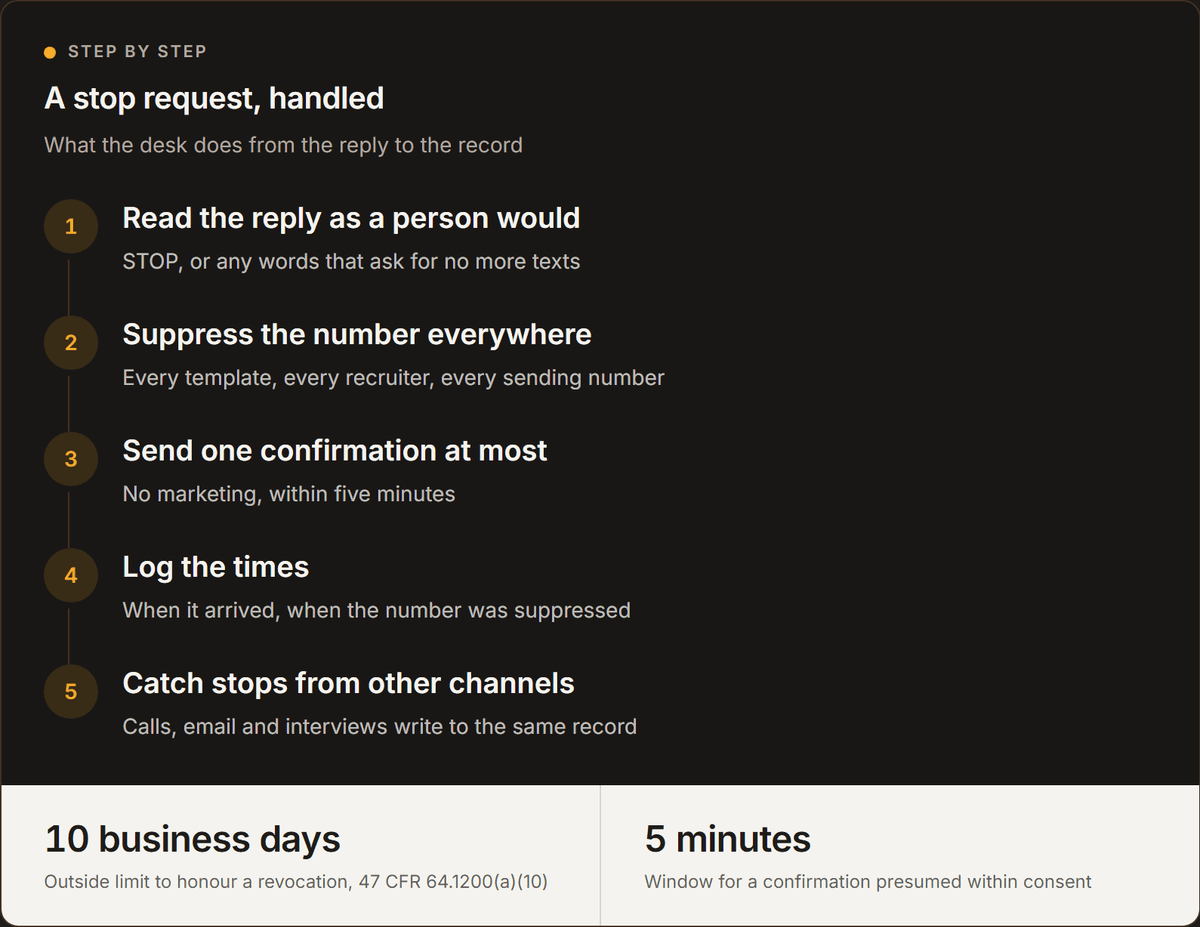
The relevant federal rule is 47 CFR § 64.1200(a)(10). It allows a recipient to revoke prior express consent to calls or text messages through any reasonable method that clearly communicates a desire to receive no further messages from the sender.2 Requests made through reasonable means must be honoured within a reasonable time, not exceeding ten business days after receipt. A sender cannot require recipients to use one exclusive method to revoke consent.
The FCC explained the timing requirement in its February 2024 order. It requires callers to honour do-not-call and consent-revocation requests within a reasonable period, capped at ten business days, rather than the 24-hour period initially proposed.12 The FCC noted that consumers become frustrated when robocalls and robotexts continue for days or weeks after they have asked for the messages to stop.12
A sender may also send one message confirming the revocation, provided the confirmation contains no marketing and is the only additional message sent. A confirmation sent within five minutes is presumed to fall within the recipient's prior express consent.
CTIA's guidance supports the same general approach. It recommends offering multiple opt-out methods, including telephone calls, email, and text messages. It also states that no further messages should be sent after the final confirmation.
The difficult cases often involve replies that do not use a standard keyword. Examples include:
- "Please stop texting me."
- "Take me off this."
- "I found a job, leave me alone."
A keyword filter may recognise STOP but miss these requests. The relevant question is whether the message clearly communicates that the candidate does not want to receive further texts. Each example above would ordinarily communicate that intention.
Requests can also arrive through other channels. A candidate might ask a recruiter to stop texting during a phone call, email the branch, or make the request during an interview. CTIA's guidance supports providing opt-out methods beyond text messages. If the request remains in one recruiter's notes or memory rather than being entered into a shared system, another recruiter may inadvertently text the candidate again.
What the desk does: Maintain one central record for all opt-out requests, regardless of how they arrive. Route messages that appear to request an opt-out to a responsible team member promptly, and suppress the number across every template, recruiter, and sending number. Send no more than one confirmation, with no marketing, and record when the request arrived and when suppression occurred. Aim to send the confirmation within five minutes where practicable, and ensure the overall revocation process complies with the applicable legal deadline.
What changed in the FCC's revocation rules this year?
One part of the FCC's revocation rules has been delayed twice and is now being revised. Staffing agencies need to understand which requirement is affected so they do not stop following rules that remain in force.
The disputed provision is the revoke-all requirement. Under this approach, a candidate who withdraws consent in response to one type of message also withdraws consent for every other type of message from the same sender. In April 2025, an FCC bureau order granted a limited waiver delaying this requirement until 11 April 2026. On 6 January 2026, the FCC's Consumer and Governmental Affairs Bureau extended the waiver of the relevant part of 47 CFR § 64.1200(a)(10) until 31 January 2027.12 The provision would otherwise require a revocation made in response to one type of informational message to apply to all future robocalls and robotexts from that caller.
The FCC has also considered whether to change how recipients can withdraw consent. In a further notice published in the Federal Register in December 2025, the Commission asked whether callers should be allowed to designate an exclusive method for revoking consent instead of having to honour requests made through any reasonable method.10
A revised rule then moved forward. A draft FCC Report and Order circulated on 9 September 2026 ahead of the Commission's 30 September open meeting.12 It proposed allowing callers to treat a revocation as applying only to the informational category of messages to which it was directed. The draft stated that the changes would take effect 30 days after publication in the Federal Register, while also making clear that the draft itself was not official Commission action.
Law firm Manatt reported that the FCC released its revocation Report and Order on 1 October 2026 and that the new rules would take effect 30 days after Federal Register publication.13 At the time of Manatt's alert, the Order had not yet been published. Law firm Troutman Pepper Locke similarly reported that the revised rules would allow callers to limit a revocation to the specific category of informational robocall involved.14 A single revocation of telemarketing consent, however, would still end all future telemarketing robocalls from that caller.
For staffing agencies, the practical position as of this guide's research date is as follows:
The reasonable-method rule remains important. Recipients must be able to revoke consent through reasonable methods, and the ten-business-day limit remains the stated outside deadline for handling revocations.
The revoke-all requirement has been waived until 31 January 2027. Legal reporting indicates that the new order is intended to replace it with a category-based approach once the order is published and effective.
Some practical questions remain unresolved in the material reviewed. The available sources do not establish precisely how a staffing agency should classify different job alerts into informational categories or explain any exclusive revocation method permitted by the revised order.
Until the published order and applicable effective dates are confirmed, the safest approach is to apply the stricter standard. If a candidate asks the agency to stop texting, suppress the number across all message types and record the request. Any later change to this approach should be made only after legal counsel confirms the requirements in the published rule.
Which state laws reach a staffing agency's texts?
Federal law establishes a baseline, but several states impose additional requirements on business texting. These can include stricter sending hours, written-consent requirements, limits on message frequency, and private rights of action that allow recipients to sue.
Florida: The Florida Telephone Solicitation Act, § 501.059, includes text messages within its definition of a telephonic sales call. Florida restricts certain unsolicited telephonic sales calls involving automated systems for selecting and dialing telephone numbers or recorded messages unless the recipient has given prior express written consent.4
A recipient may recover actual damages or $500, whichever is greater. A court may increase the award to no more than three times that amount for a willful or knowing violation. Florida also provides a specific opt-out procedure for text message solicitations: before bringing a lawsuit over such messages, the recipient must reply STOP. The solicitor must then stop sending text message solicitations within 15 days of receiving the notice, except for one message confirming receipt.4 Because the federal revocation rule generally sets a shorter outside deadline of ten business days, agencies should apply whichever applicable deadline comes first.
Oklahoma: The Telephone Solicitation Act of 2022 establishes a written-consent standard for commercial telephonic sales calls by text message. It also prohibits commercial telephone sellers or salespeople from making covered solicitation calls before 8 a.m. or after 8 p.m. in the recipient's local time zone, and from making more than three such calls to the same person within 24 hours about the same subject or issue.
An affected recipient may recover actual damages or $500, whichever is greater. A court may increase the award to no more than three times that amount for a willful or knowing violation.
Maryland: The Stop the Spam Calls Act establishes a written-consent requirement for covered telephone solicitations sent by text message using specified automated systems, recorded or artificial voices, or prerecorded voicemail. Agencies should assess whether their messaging methods and templates fall within the law's scope before sending promotional texts to Maryland candidates.
Texas: Senate Bill 140 took effect on 1 September 2025 and brought text messages into the state's definition of telephone solicitation. Law firm Goodwin reports that the law broadened the definition to include texts and images and introduced a private right of action with statutory damages of up to $5,000 per violation.
Washington: RCW 19.190.060 prohibits a person conducting business in Washington from initiating or assisting in the transmission of an electronic commercial text message to a telephone number assigned to a Washington resident for cellular telephone or pager service.5 The definition focuses on messages promoting goods or services for sale or lease. A straightforward job message therefore appears to fall outside the definition, while a promotional message sent to a Washington number may be covered.
Oregon: Law firm Goodwin reports that Oregon House Bill 3865, effective 1 January 2026, restricts contact hours to 8 a.m. through 8 p.m., limits daily calls to three per consumer, and expressly covers text messages.15
Federal rules also restrict telephone solicitations to residential subscribers before 8 a.m. or after 9 p.m. in the recipient's local time zone.2 Scheduling messages between 8 a.m. and 8 p.m. in the recipient's time zone provides a common window that fits within the federal hours and the Oklahoma and Oregon hours described above. Agencies must still check any other applicable restrictions.
Two cautions are important. First, these are the state laws covered by the sources reviewed for this guide, not an exhaustive survey of every state's requirements. Second, a telephone area code does not necessarily identify a candidate's current location. Someone who moved from Tampa to Dallas may still have a Florida number.
The practical response is to maintain the candidate's current location where available and apply the strictest relevant sending window while checking the laws that may apply to the number, recipient, and campaign.
What the desk does: Maintain a concise compliance reference for every state in which candidates receive texts. Record the applicable sending hours, frequency limits, and consent requirements. Schedule bulk messages between 8 a.m. and 8 p.m. in the recipient's local time zone as a conservative baseline, and do not exceed three messages about the same subject to a candidate in one day where that limit applies. Check the relevant state law before each campaign rather than assuming one national rule covers every recipient.

What do carriers and 10DLC registration require?
Even a staffing agency that complies with the law can have its messages blocked by wireless carriers. US carriers operate a separate registration system for business texting from standard ten-digit telephone numbers, known as 10DLC. These requirements apply independently of how a court interprets the TCPA.
The Campaign Registry, which operates the registration system, describes registered 10DLC as an application-to-person messaging channel in which brands and campaign service providers are verified before they can send messages.16 A company that uses SMS to communicate with customers qualifies as a brand under the system. Brands cannot register directly with The Campaign Registry and must instead work through a registered messaging service provider.16
Messaging provider Twilio explains in its documentation that US application-to-person (A2P) 10DLC was introduced by carriers to verify business messaging traffic sent to US telephone numbers and support consent-based messaging. Twilio also states that senders using its 10DLC numbers without registration may incur additional carrier fees for unregistered traffic.17 Requirements and charges vary by provider, so staffing agencies should check the terms that apply to their own messaging platform.
CTIA's Messaging Principles and Best Practices also set expectations for consent and list management. The guidance recommends that senders create and verify their own opt-in lists rather than use lists that have been rented, sold, or shared. It also recommends retaining records of opt-in and opt-out requests and regularly checking telephone deactivation files.11 For example, senders can review these files daily and remove disconnected numbers from their consent lists.
Personal mobile phones create a particular risk for staffing agencies. When recruiters send business messages from their own devices, opt-out requests may not reach a central suppression list, and the agency may lack a complete record of its communications. If a recruiter leaves, the agency could lose access to important consent and opt-out records.
What the desk does: Send candidate messages through a provider-registered sender associated with the agency's brand. Confirm which opt-out keywords the provider recognises and whether the agency can export a complete opt-out log. Keep candidate texting on approved business systems rather than personal phones.
How do you build the send list?
Consent records can easily be overlooked when a staffing desk builds a campaign list in a hurry. A database may contain hundreds of candidate numbers without showing whether those candidates agreed to receive the messages being sent.
Start with records that contain the relevant consent wording and the date it was obtained. Remove every number associated with an opt-out, regardless of which channel the request came through. Then review older records, because a telephone number captured several years ago may no longer belong to the same person.
The FCC's Reassigned Numbers Database helps callers identify numbers that have been permanently disconnected and potentially reassigned to new subscribers. Callers can check the database before making calls to reduce the risk of contacting someone who previously held the number.12 US carriers must report the most recent permanent disconnection date for their numbers to the database administrator by the 15th of each month.2
Checking older numbers before a re-engagement campaign can therefore help prevent messages from reaching people who never gave consent to the agency.
Do-not-call requirements are also relevant to promotional messaging. Registrations on the National Do Not Call Registry generally remain in place unless the consumer cancels the registration or the number is removed by the database administrator.2 Federal rules also require covered telemarketers to maintain procedures for recording and honouring requests from people who do not want to receive further calls made by or on behalf of the business.
Staffing agencies sending promotional texts should maintain an internal suppression list and assess whether the National Do Not Call Registry requirements apply to their campaigns. A candidate's request to stop must be recorded and respected according to the applicable rules.
Purchased and shared lists introduce additional risks. CTIA's guidance recommends against renting, selling, or sharing opt-in lists for messaging. A list obtained from a job board, partner agency, or sister brand does not automatically establish that candidates consented to receive messages from your agency.
The staffing database is often the best source for building a campaign list, but its records may be outdated. The guide to redeploying temps before the assignment ends explains how staffing firms can work their existing databases to prepare for new job orders. Before using those records for text campaigns, the agency must also verify that the necessary consent is in place.
What the desk does: Build bulk lists only from records with documented consent appropriate to the proposed messages. Remove opted-out numbers, check older numbers against the Reassigned Numbers Database where appropriate, and screen promotional campaigns against applicable do-not-call requirements and internal suppression lists. Never assume that a list supplied by another organisation carries consent for your agency to send texts.
What is the exposure if a desk gets it wrong?
The potential cost is calculated per violation. That is why a mistake becomes more expensive when a staffing agency sends texts at scale.
Under the TCPA's autodialer and prerecorded-voice provisions, a person can recover actual damages or $500 per violation, whichever is greater. A court can increase the amount to up to three times that figure if the violation was willful or knowing. Florida and Oklahoma also provide for actual damages or $500, whichever is greater, with potential tripling for willful or knowing violations.47 Goodwin reports that Texas Senate Bill 140 introduced statutory damages of up to $5,000 per violation.15
These lawsuits are not unusual. Goodwin's 2025 year-in-review reports that 2,588 TCPA lawsuits were filed between 1 January and 30 November 2025, a 0.4% decrease from 2024.15 The firm expects litigation under state-level TCPA-style laws to increase in 2026. These figures do not show how many cases involve staffing agencies, and no public count of staffing-specific cases could be found. They do, however, show that this type of litigation is an established risk.
For an agency owner, the key question is what one poorly managed bulk send could cost. The potential exposure depends on how many messages violate applicable autodialer, prerecorded-voice or state sales-call rules. At $500 per violation, the total can grow quickly, before any increase for willful or knowing conduct. Whether those rules apply depends on the circumstances, but the practical lesson is clear: maintaining a reliable consent record is cheaper than defending a lawsuit.
A client contract may also require the agency to warrant that its candidate communications comply with the law. The records described in this guide provide evidence to support that commitment, just as documented reference checks help support a placement (see reference checks that hold up when a client asks).
The send checklist
Run this checklist before every bulk text campaign and retain the completed version with the campaign records.
| Check | Rule behind it | Pass when |
|---|---|---|
| Template labelled | 47 CFR 64.1200(f)(13) | Every template is classified as informational or promotional. |
| Consent on file | 47 CFR 64.1200(a)(2) and (f)(9) | Promotional templates are sent only to records with signed written consent. |
| Stops removed | 47 CFR 64.1200(a)(10) | Every number that has requested no further texts, through any channel, is suppressed. |
| Old numbers checked | FCC Reassigned Numbers Database | Numbers collected some time ago are checked before a re-engagement campaign. |
| Do-not-call checked | 47 CFR 64.1200(c)(2) and (d) | Promotional messages exclude numbers on applicable national and internal do-not-call lists. |
| Send window set | 47 CFR 64.1200(c)(1), Oklahoma and Oregon rules | Messages are scheduled between 8 a.m. and 8 p.m. in the recipient's local time zone. |
| Frequency capped | Oklahoma's act; Oregon rules as reported | No more than three texts on the same subject are sent to one candidate in a day, where the relevant limit applies. |
| Registered sender | The Campaign Registry and provider requirements | The sending number is registered under the agency's brand. |
| Stop handling tested | 47 CFR 64.1200(a)(10) and (a)(12) | A reply asking for texts to stop reaches the appropriate person or system, and no more than one confirmation message is sent. |
Two points matter for owners. First, each row describes a process, not a product. A desk can pass this checklist using a spreadsheet and a disciplined team lead, while an agency with expensive software can still fail if its procedures are poor.
Second, every check should leave an evidence trail. If a candidate challenges a message, the agency needs to show what was sent, why the number was included, and how any stop request was handled. The same discipline that produces a submittal that gets interviews also helps a text campaign stand up to scrutiny: be specific, document the process, and contact the right person.
Conclusion: Make every candidate text defensible
Text messaging gives staffing agencies a direct way to reach candidates, confirm shifts, fill urgent vacancies, and keep placements moving. But the faster a desk sends messages, the easier it becomes for one weak consent record, ignored stop request, or poorly timed campaign to turn into a costly compliance problem.
The solution is not to stop texting. It is to build a process that makes every message accountable. Classify templates before sending, collect and retain the right consent, screen lists before every campaign, respect local sending hours, register the sending number, and make sure opt-out requests reach every recruiter and system that could contact the candidate again. Most importantly, keep records that show what the agency did and when it did it.
These safeguards should not depend on a recruiter's memory or a last-minute check. They need to be part of the staffing desk's everyday workflow, with clear ownership and a checklist that is completed before each bulk send. Technology can help organise candidate communications and records, but the agency must still establish the rules, configure its processes appropriately, and confirm its legal obligations with counsel.
The strongest staffing desks do more than send the right message. They can demonstrate why they were entitled to send it, who received it, and what happened when the candidate replied. That is how an agency protects its candidates, its client relationships, and its reputation while continuing to recruit at speed.
Where Hivemind fits on a staffing desk
The consent decisions in this guide stay with the agency and its counsel: which templates are promotional, what consent each needs, which states the desk texts into, and how a stop is honoured. No system makes those calls for the desk, and nothing here says one does.
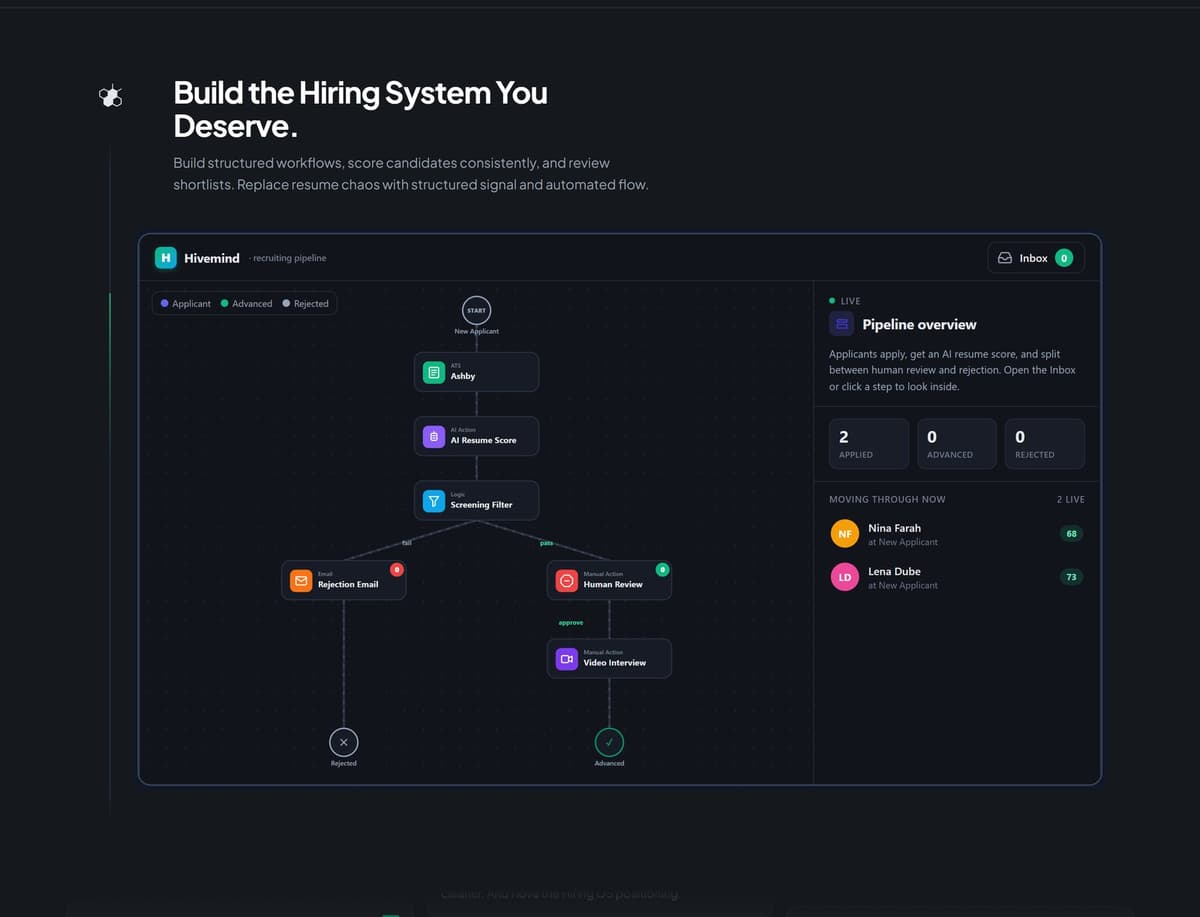
Around those decisions sits the rest of the hiring work: sourcing, screening, interviews, offers, and the admin around them. Hivemind is the hiring OS: manage every candidate from inbound to offer in one unified workflow. Among its modules are SMS Follow-Ups: Automated Candidate Text Messaging, and Automated Emails: Smart Email Automation for Recruitment, which sit in the same workflow as the rest of the candidate record.
A team can run Hivemind end to end, connect your existing tools, or mix and match both. Hivemind has 15 Native Modules and 275 Integrations, so a desk can build the exact pipeline its team deserves.
Frequently asked questions
Does the TCPA apply to a staffing agency texting candidates?
Yes, in some circumstances. Under federal rules, text messages can count as calls, and the TCPA's consent requirements can apply to texts sent to mobile numbers using an autodialer or an artificial or prerecorded voice. Additional written consent requirements apply to autodialed or prerecorded telemarketing messages, and restrictions on sending hours apply to telephone solicitations to residential subscribers.
A text about a candidate's own application or placement is less likely to qualify as telemarketing because it does not necessarily encourage the purchase of goods or services. However, no regulator or court decision identified for this guide specifically confirms that all staffing-related texts fall outside telemarketing rules. Agencies should classify their templates carefully, treat promotional messages as telemarketing where applicable, and honour opt-out requests across all message types.
Do I need written consent to text a candidate about a job?
It depends on the message and how it is sent. Promotional texts sent using an autodialer or an artificial or prerecorded voice require prior express written consent under the applicable federal rule. Florida, Oklahoma and Maryland also have written-consent requirements for certain sales or solicitation messages.
A message about a candidate's own application, interview or placement is less likely to trigger the federal written-consent requirement for telemarketing. Even so, staffing agencies should retain a record of what the candidate agreed to receive, when consent was obtained, and which agency or sender it covered. The agency should confirm its obligations under the laws that apply to each campaign.
How quickly must a staffing agency honour a STOP reply?
Under 47 CFR 64.1200(a)(10), a sender must honour a revocation request within a reasonable time, not exceeding ten business days after receiving it.2 Candidates can withdraw consent through reasonable means, so agencies should not rely exclusively on the word "STOP" or require candidates to use only one opt-out method.
A single confirmation text is permitted, provided it contains no marketing. A confirmation sent within five minutes is presumed to fall within the scope of the candidate's consent. The agency should record when the request arrived and when the number was suppressed, and ensure the suppression applies across recruiters, templates and sending numbers.
What hours can a recruiter text candidates?
The federal rule restricts telephone solicitations to a residential subscriber to between 8 a.m. and 9 p.m. in the recipient's local time. Oklahoma restricts commercial telephone solicitations to between 8 a.m. and 8 p.m., and Goodwin reports that Oregon also limits contact hours to 8 a.m. through 8 p.m.
A practical approach is to schedule messages between 8 a.m. and 8 p.m. in the candidate's local time zone. This is a conservative operating window, but agencies should still check any additional state requirements that apply. An area code may not reflect where a candidate currently lives, so the desk should use the best available information about the recipient's location.
Is a texting platform an autodialer under the TCPA?
Not necessarily. Following Facebook v. Duguid, the federal autodialer definition generally requires equipment with the capacity to use a random or sequential number generator to store or produce telephone numbers. A platform that sends messages to a saved list may fall outside that specific definition, depending on its functionality and the circumstances.
That does not mean the platform is automatically exempt from all messaging rules. Other federal provisions, state laws and carrier registration requirements may still apply. Staffing agencies should assess how their tools work and should not treat the autodialer question as a substitute for obtaining appropriate consent, managing opt-outs or following applicable sending restrictions.
What is 10DLC registration, and does a staffing agency need it?
10DLC stands for 10-digit long code. It is the carrier framework used for business texting from standard ten-digit phone numbers. The Campaign Registry supports the registration process by verifying brands and registering messaging campaigns through messaging service providers.
For staffing agencies that send business texts at scale, registration is an important part of setting up a reliable messaging operation. The agency should ask its provider which registration steps apply, confirm that its sending number is registered under the correct business brand, and understand the provider's requirements and fees. Twilio's documentation, for example, states that unregistered senders using its 10DLC numbers may incur additional carrier fees. Registration does not, by itself, establish that the agency has the consent required to send a particular message.
Can a staffing agency text candidates from a purchased list?
A purchased list should not be treated as proof that candidates have consented to receive the agency's messages. CTIA's messaging principles advise against using opt-in lists that have been rented, sold or shared, and consent should be tied to the sender and campaign for which it was obtained.11
The safer approach is to build campaign lists from the agency's own records, keeping the consent wording, date and source for each number. Before sending, remove anyone who has opted out, check older numbers where appropriate, and confirm that the planned messages match the scope of the candidate's consent. If the agency cannot establish why a person should receive the message, that number should not simply be included because it appears on a list.
Sources
- US Government Publishing Office, United States Code: 47 U.S.C. 227 ↩
- Electronic Code of Federal Regulations: 47 CFR 64.1200 ↩
- Supreme Court of the United States: Facebook, Inc. v. Duguid (2021) and McLaughlin Chiropractic Associates v. McKesson Corp. (2025) ↩
- Florida Legislature: Section 501.059, Florida Statutes ↩
- Washington State Legislature: RCW 19.190.010 and RCW 19.190.060 ↩
- Texas Legislature: S.B. 140, enrolled ↩
- Oklahoma Legislature: H.B. 3168, Telephone Solicitation Act of 2022 ↩
- Maryland General Assembly: Commercial Law section 14-4501 ↩
- US Court of Appeals for the Eleventh Circuit: Insurance Marketing Coalition Ltd. v. FCC (2025) ↩
- Federal Register: Ninth Further Notice of Proposed Rulemaking, 5 December 2025 and final rule conforming the prior express written consent requirements, 29 August 2025 ↩
- CTIA: Messaging Principles and Best Practices, May 2023 ↩
- Federal Communications Commission: Reassigned Numbers Database, FCC 24-24, Report and Order, February 2024, DA 25-312, Order, April 2025, DA 26-12, Order, January 2026 and draft Report and Order circulated September 2026 ↩
- Manatt, Phelps and Phillips: FCC replaces revoke all rule ↩
- Troutman Pepper Locke: FCC revises TCPA revocation of consent rules ↩
- Goodwin Procter LLP: Consumer Financial Services: 2025 Year in Review, TCPA ↩
- The Campaign Registry: home page ↩
- Twilio Docs: Programmable Messaging and A2P 10DLC ↩