

A staffing agency reference check is defensible when it uses consistent, job-related questions, asks about work the referee has directly observed, and records the answers at the time of the call. Before making contact, decide who will conduct the check. If you use a screening company, the Fair Credit Reporting Act (FCRA) may require specific disclosures, the candidate's consent, and adverse action procedures. Keep criminal history and salary history out of the reference call.
Key takeaways
- A staffing agency reference check is defensible when it uses consistent, job-related questions, asks about work the referee has directly observed, and records the answers at the time of the call.
- If a vendor's consumer report may lead you to reject a candidate, you must follow the FCRA's pre-adverse-action process.
- The US Office of Personnel Management (OPM) recommends structured telephone reference checks and a minimum of three contacts.
- California and New York restrict employers from seeking a candidate's salary history, including through other people acting on their behalf.
- Federal EEOC regulations generally require employers to retain personnel and employment records, including hiring records, for one year from the date the record was made or the relevant personnel action, whichever is later.
This guide is for recruiters checking a candidate's references before placement and the desk leads responsible for approving those checks. It explains the purpose of a reference check, when it becomes a consumer report, what consent is required, how to conduct the call, which questions to avoid, what former employers can disclose, how to handle negative feedback, how to document the conversation, and when information can be shared with a client.
There are two important limitations. First, this is not legal advice. The legal requirements discussed here are based on statutes, regulations and guidance from the bodies that issued them, checked as in force on 18 October 2026. State laws vary, and the five state reference statutes discussed are examples, not a comprehensive survey. Consult legal counsel about the rules that apply where your candidate, referee and client are located.
Second, no current public survey was found showing how often staffing firms conduct reference checks or what those checks reveal. Older survey figures did not meet this guide's source-age requirements, so they have been excluded. Rather than speculate about how common reference checks are, this guide focuses on how to conduct and document them so the process can withstand later scrutiny.
In this article
- What is a reference check for?
- Why does a staffing firm own its reference checks?
- When does a reference check become a consumer report?
- What consent do you need before the calls?
- When in the process do you check references?
- How do you run the call?
- How do you keep every reference check the same?
- What can you never ask a reference?
- How much will a former employer tell you?
- How do you read what a referee tells you?
- What do you do when a reference says something negative?
- How do you write it down so it holds up?
- Can you send the reference to the client?
- Reference check decision guide
- Conclusion
- Frequently asked questions
What is a reference check for?
A reference check helps a staffing agency verify a candidate's past work performance by speaking to people who have worked with them. The US Office of Personnel Management (OPM) defines reference checking as an objective evaluation of an applicant's previous job performance based on information from people who know and have worked with them, including supervisors, colleagues and employees they managed.1
For a staffing recruiter, this definition has two important implications. First, the focus is on job performance, not personality. A reference check should establish how the candidate did the work, not simply whether someone liked them. Second, the person providing the reference should have direct knowledge of that work. A former supervisor, colleague or team member can describe what they observed. A friend or relative usually cannot provide the same evidence.
OPM also explains that reference checks can verify information candidates provide during other stages of recruitment, including their CVs and interviews. This is particularly useful in staffing. For example, a candidate might tell you during a screening call that they operated a forklift on the second shift for two years, trained new employees and left when their contract ended. You can ask a former supervisor to confirm those details rather than relying on the candidate's account alone.
Reference checks are useful, but they are not conclusive proof that someone will perform well in a new role. OPM notes that they predict job performance better than years of education or work experience, but less effectively than cognitive ability tests.1 Staffing agencies should therefore treat references as one part of the assessment process, alongside structured interviews and relevant skills tests.
The most useful reference checks confirm or challenge specific claims about a candidate's experience and performance. That gives the recruiter evidence to consider before recommending the candidate to a client.
Why does a staffing firm own its reference checks?
A staffing firm is responsible for the candidates it recommends to clients. When you put someone forward for a role, the client relies on your judgement as well as the information on the candidate's resume.
The American Staffing Association (ASA) addresses this responsibility in its code for members. Its search and placement code expects members to assess candidates' experience and qualifications and communicate that information honestly to clients.2 Reference checks help recruiters verify a candidate's experience before making a recommendation. If a client later asks why you believed a candidate was qualified, your reference records provide evidence of how you reached that decision.
Staffing firms also have legal responsibilities when clients make discriminatory requests. The US Equal Employment Opportunity Commission (EEOC) explains that a staffing firm can be liable for complying with a client's discriminatory assignment request.3 The client's request does not excuse the agency's conduct. The same principle applies to reference checks: if a client asks you to reject candidates for a reason the law prohibits, you cannot avoid responsibility by saying you were following the client's instructions.
Some clients and managed service provider (MSP) programmes conduct their own checks, and some may not want to receive the agency's reference notes. That does not remove the agency's responsibility for its own screening decisions. The checks still help determine which candidates you recommend in the first place.
When does a reference check become a consumer report?
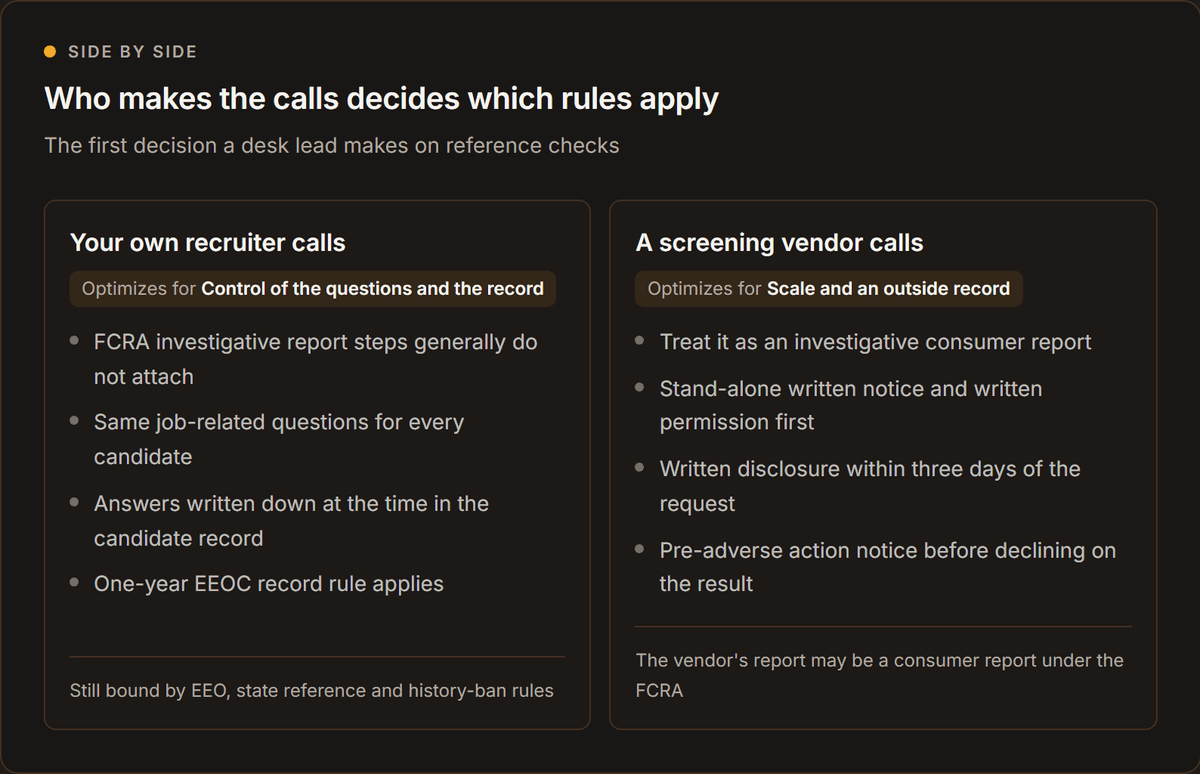
The first decision a desk lead needs to make is who will conduct the reference calls. Using your own recruiter or hiring a third-party screening vendor can lead to different legal requirements.
Under the Fair Credit Reporting Act (FCRA), an investigative consumer report is a type of consumer report that gathers information about a person's character, general reputation, personal characteristics or lifestyle through personal interviews with people who know them.4 These people may include neighbours, friends, associates or others familiar with the individual. A screening company that interviews a candidate's former supervisors and prepares a report about the candidate may fall within this definition.
The Federal Trade Commission (FTC) explains that employers using investigative consumer reports must provide written notice and inform the individual of their right to request further information about the investigation.5 Under 15 U.S.C. § 1681d, the person requesting an investigative consumer report must provide written disclosure no later than three days after first requesting the report.4 The disclosure must explain the individual's right to request additional information about the investigation. If the individual makes that request in writing, the person who procured the report must provide a written description of the nature and scope of the investigation within five days.4
However, the FCRA also excludes certain information from the definition of a consumer report. This includes information based solely on transactions or experiences between the individual and the person making the report.4 For example, a former employer describing its own experience of employing a candidate may fall within this exclusion.
When a staffing agency's own recruiter makes the calls, the agency is not automatically acting as a consumer reporting agency. Whether the FCRA applies depends on the specific facts, including how the information is collected, used and provided to others. Staffing firms should confirm their position with legal counsel rather than assume every reference check is exempt.
For day-to-day decisions, use the following approach:
- Your own recruiter conducts the calls:
The FCRA's investigative consumer report requirements generally may not apply, depending on the circumstances. The agency must still comply with applicable employment, discrimination, recordkeeping and state-law requirements.
- A screening vendor conducts the calls:
Assess the arrangement as a potential investigative consumer report. Where the FCRA applies, complete the required disclosures, obtain the necessary written permission and follow the relevant procedures before taking adverse action based on the report.
- The agency packages reference findings and sells or supplies them to clients:
Seek legal advice before proceeding. The legal position can depend on the agency's role and the way the information is collected and distributed.
The distinction matters because using a third party does not automatically settle every legal question, and using an internal recruiter does not exempt the agency from all other rules.
There is also an important change in the regulatory background. On 12 May 2025, the Consumer Financial Protection Bureau (CFPB) withdrew guidance documents that included its January 2024 advisory opinion on background screening and Circular 2024-06 on background dossiers and algorithmic scores in hiring. Older articles may still rely on those documents. For this issue, start with the statute and the FTC's employer guidance, and have counsel confirm how the current requirements apply to your process.
What consent do you need before the calls?
Get the candidate's written permission before contacting their referees. If a third-party screening company will conduct the checks, follow the Fair Credit Reporting Act (FCRA) requirements where they apply. Even when your own recruiter makes the calls and the FCRA does not apply, written consent provides a clear record of what the candidate agreed to.
When the FCRA applies to an employment consumer report, the employer must provide a clear, conspicuous written disclosure in a document that contains only that disclosure and obtain the candidate's written authorization before requesting the report.4 The Federal Trade Commission (FTC) explains that the disclosure must be separate from the employment application. The authorization can appear in the same document as the disclosure.
For a staffing desk, this means keeping reference consent separate from general registration paperwork. Do not hide it inside the candidate's job application, registration form or talent pool terms. Give the candidate a clear explanation of the checks and record which referees they have agreed you may contact.
That last point matters. If a candidate provides three referees, that does not automatically give you permission to contact their current manager. An unexpected call to a current employer could put their existing job at risk. Confirm who you can contact before making any calls.
Store the consent in the candidate record alongside the right to represent. The right to represent confirms that the agency has permission to submit the candidate for a specific opportunity; reference consent records permission to contact the agreed referees. Keeping both on file lets the desk lead check that the necessary permissions are in place before the candidate is submitted or placed.
When in the process do you check references?
In general, check references after the initial screening and before making the placement decision. However, fair chance laws in some jurisdictions restrict when an employer can ask about criminal history. Your process must keep reference checks separate from those questions and follow the applicable timing rules.
New York City provides a clear example. Guidance on its Fair Chance Act explains that employers can verify a candidate's qualifications by reviewing resumes and contacting references, but generally cannot seek information about conviction history before making a conditional offer.6 Employers must first assess other relevant qualifications, including references and academic records, before making that offer.
The guidance also addresses temporary help firms. For these firms, the conditional offer is generally the offer to place an applicant in the firm's labour pool. A staffing agency in New York City should therefore complete its reference checks before making that offer and avoid asking about conviction history during those calls.
California also restricts early criminal-history questions. Under the California Fair Chance Act, employers with five or more employees generally cannot ask about a candidate's conviction history before a job offer.7 New York City's guidance makes the point for references outright: employers may contact them to verify qualifications, but cannot try to discover conviction history.
The safest approach is to treat references as a way to verify job-related experience and performance, not as a way to investigate criminal history. Check the rules for the location and type of role before deciding exactly when each step should happen.
| Step in the process | Reference work at that step | Rule to keep in view |
|---|---|---|
| Phone screen | Ask the candidate for referees who supervised or worked with them, and establish what each person directly observed | Record which referees the candidate agrees you may contact |
| Before the reference calls | Obtain written consent. If a screening vendor will conduct the calls, provide the required stand-alone FCRA disclosure and obtain written authorization where applicable | FCRA § 1681b and the FTC's employer guidance |
| Reference calls | Ask consistent, job-related questions about work the referee directly observed | EEOC guidance and OPM's reference-checking approach |
| Before a conditional offer or pool placement | Complete the checks of qualifications that must precede the offer, keeping criminal-history and medical inquiries separate as required by law | New York City Fair Chance Act |
| After a conditional offer | Conduct any permitted criminal-history check separately, following the applicable legal requirements | New York City and California fair chance rules |
| Placement decision | Make and document the decision using relevant information. If a consumer report from a screening company contributes to an adverse decision, complete the required pre-adverse-action steps first | FCRA § 1681b and the FTC's employer guidance |
How do you run the call?
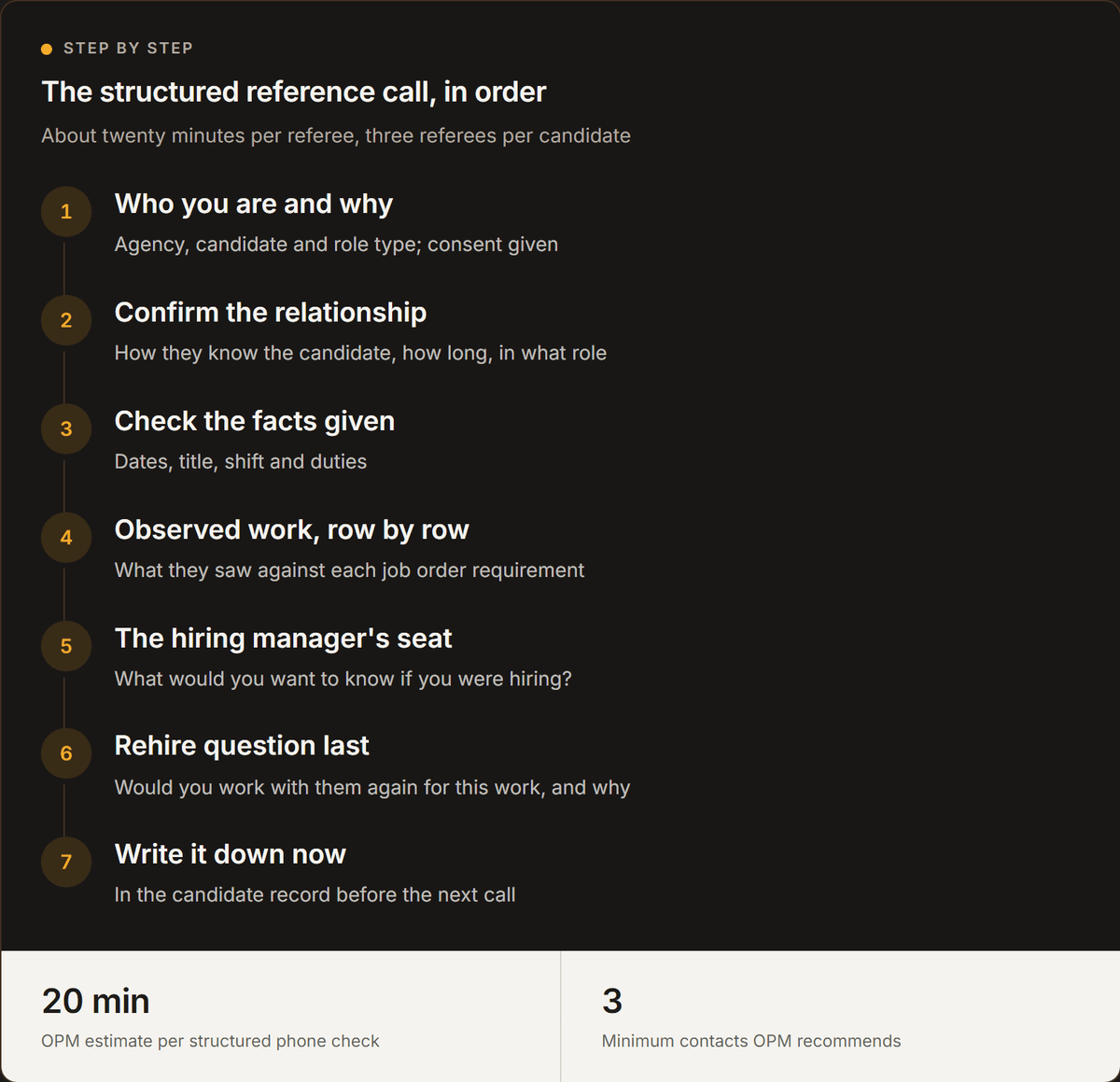
Use a structured phone interview, follow the same order for every candidate and allow about 20 minutes per referee. The US Office of Personnel Management (OPM) recommends structured telephone reference checks and a minimum of three contacts. It also notes that written requests for work histories tend to receive fewer responses and provide less useful information.1
A 20-minute call gives you time to ask about specific work without making the process too demanding for a busy supervisor. Speaking to three referees also helps you identify consistent patterns instead of relying on one person's opinion. If a candidate can provide only one referee, ask why and record the explanation rather than automatically treating it as a problem.
A structured reference call should follow seven steps.
- Explain who you are and why you are calling.
Introduce your agency, identify the candidate and explain the type of role you are considering them for. Confirm that the candidate has agreed to the call. Do not identify the client unless the candidate has agreed that you may share that information.
- Confirm the relationship.
Ask how the referee knows the candidate, how long they worked together and what role the referee held. You need to establish whether they have direct knowledge of the candidate's work.
- Verify the candidate's employment details.
Confirm dates, job title, shift and responsibilities. This is an opportunity to check information the candidate provided during screening.
- Ask about the work the referee observed.
Use the job order to identify the role's requirements, then ask about each one separately. Find out what the candidate did, how they performed and what the referee personally observed.
- Ask the referee to think like the hiring manager.
Instead of asking for a general opinion, ask: "If you were hiring someone for this role, what would you want to know about how this person works?" This encourages the referee to focus on information relevant to the job.
- Ask whether they would work with the candidate again.
Leave this question until the end. Ask whether they would rehire or work with the candidate again in a similar role, and why. Record the explanation rather than relying on a yes or no answer alone.
- Record the answers immediately.
Complete the candidate record before moving to the next call. Capture the referee's answers accurately, using their own words where the exact wording matters.
The fourth and fifth steps are particularly important. A question such as "How was she as an employee?" usually produces a broad answer that tells you little about whether the candidate can do the job. A more useful question links the referee's observations to a specific requirement.
For example, if a warehouse client needs someone who can pick orders to a target rate using a scanner and train two new starters each week, ask what the referee actually saw the candidate do in both areas. Build your questions from the job order agreed during the intake call. That way, the reference check and the candidate submission address the same requirements.
How do you keep every reference check the same?
Use one set of questions for each role and the same rating system for every candidate being considered for that role. A consistent process helps recruiters gather comparable information and gives the staffing firm a clear record of how it assessed each candidate.
The US Office of Personnel Management (OPM) explains that structure can improve reference checks. Its recommendations include basing questions on a job analysis, asking applicants the same questions and using standardized procedures to record and rate answers.1 For a staffing agency, the job order provides the starting point: every candidate submitted for the same role should be assessed against the same requirements using the same core questions and recording template.
Consistency also helps reduce discrimination risk. The Equal Employment Opportunity Commission (EEOC) says employers must not use background information to discriminate and should apply the same standards to candidates regardless of protected characteristics. If one recruiter follows the approved script while another asks different questions, candidates may be assessed by different standards. A shared template helps the agency maintain a fairer, more defensible process.
Keep the rating system simple. For each job requirement, record what the referee actually observed and classify the evidence as:
- Seen and confirmed
- Partly seen
- Not seen
Do not ask referees to give candidates a score out of ten. A numerical rating can imply more precision than the evidence supports and make it harder to understand what the referee actually observed. Specific examples of the candidate's work are more useful than a general score.
If your agency already uses an interview scorecard, build the reference template around the same job requirements. The screening call, interview, reference check and candidate submission can then describe the person against a consistent set of criteria. Anyone reviewing the record later can see how the agency reached its decision.
What can you never ask a reference?
Avoid questions that are unrelated to the job, seek information about protected characteristics, or request information restricted by applicable laws. Pay history and criminal history require particular care because some jurisdictions restrict when or how employers can obtain that information.
The EEOC's general guidance is that pre-employment questions should focus on information relevant to determining whether a candidate is qualified. Race, sex, national origin, age and religion are not appropriate factors for assessing job qualifications. OPM similarly advises employers to avoid reference questions that are not directly related to the work.
For a staffing recruiter, this means asking what the candidate did, how they performed and whether their experience matches the role. Do not ask about family plans, pregnancy, medical history, age, religion or the origin of a candidate's accent. These questions do not establish whether the person can perform the job and may create discrimination risks.
Using a screening vendor does not make an inappropriate question acceptable. Under the Fair Credit Reporting Act (FCRA), a consumer reporting agency cannot provide an employment investigative report based on an inquiry that would violate applicable federal or state equal employment opportunity law.4 The agency remains responsible for ensuring its screening process follows the rules.
Pay history is another area where state law matters. California prohibits employers and their agents from seeking an applicant's salary history information. New York State also restricts employers from seeking salary history, including from other sources. A former employer is another source, so recruiters should not ask for a candidate's previous pay where these prohibitions apply. Instead, discuss the candidate's pay expectations for the role.
Criminal history should be handled separately from reference checking and only at the stage permitted by the applicable law. For example, New York City and California have fair chance rules that restrict when employers can ask about conviction history. Keep criminal-history questions out of reference calls where the relevant rules prohibit them.
| Ask about | Never ask about |
|---|---|
| What the referee observed against each job requirement | Race, colour, national origin, religion, sex, age, disability or genetic information |
| Employment dates, job title, shift and duties | Family plans, pregnancy, health or medical history |
| How the candidate learned, trained others or handled a work problem | Current or past pay where salary history restrictions apply, including in California and New York |
| Attendance and reliability, based on the referee's observations | Arrests, convictions or pending cases before the legally permitted stage |
| Whether the referee would work with the candidate again in a similar role, and why | Any screening criterion a client requests that the law prohibits |
How much will a former employer tell you?
A former employer may be able to share more than employment dates, depending on its policies and the law that applies. Some employers give dates and job titles only as a company policy, not because the law requires them to limit their answers. Understanding the relevant state law can help a recruiter ask for useful information about a candidate's actual work performance.
Five state statutes illustrate how the rules differ:
- Florida:
An employer that shares information about a current or former employee with a prospective employer is generally protected from civil liability unless clear and convincing evidence shows that the information was knowingly false or violated a civil right.
- Kansas:
Employers have absolute immunity from civil liability for disclosing specified information to a prospective employer, including employment dates, pay level, job description and duties, and wage history.8 The statute also provides protection for certain written responses that include previous written evaluations and explain whether the employee left voluntarily or involuntarily and why.
- Arizona:
An employer that responds in good faith to a prospective employer's questions about a former employee's reason for termination, job performance, professional conduct or evaluation is generally protected from civil liability.89 The presumption of good faith can be rebutted by evidence of actual malice or intent to mislead. The statute also requires a copy of written employment-related communications to be sent to the former employee's last known address.
- Minnesota:
The law limits liability for certain disclosures by private employers made in response to a request. The protected information includes employment dates, compensation and wage history, job description and duties, and training and education provided by the employer.10
- Virginia:
An employer that provides information about a person's professional conduct, reason for separation or job performance in response to a request is generally protected from civil liability unless it acts in bad faith.11 The law presumes good faith.
The practical lesson is that a former employer's willingness to discuss performance depends partly on the legal protections available in its state. Arizona and Virginia emphasise good faith, Florida protects a disclosure unless it was knowingly false, and each sets out the circumstances in which protection can be lost. Kansas and Minnesota specify categories of information covered by their laws.
There is an important distinction concerning pay history. Some state laws protect employers that disclose certain pay information to prospective employers, while California and New York restrict prospective employers from seeking salary history. A recruiter must follow the rules that apply to the hiring process and the people involved, rather than assume that a former employer's legal protection gives the staffing agency permission to ask any question. Check the relevant jurisdictions with counsel.
The Equal Employment Opportunity Commission (EEOC) also sets limits on employment references. Employers cannot give negative or false references, or refuse to provide references, because of a person's protected characteristics. EEOC retaliation guidance identifies an unjustified, untruthful negative reference or refusal to provide a reference as potential forms of post-employment retaliation.3
If a referee's comments seem driven by resentment over a complaint the candidate previously made, do not treat the statements as automatically reliable. Record what was said, distinguish direct observations from personal opinions, and assess the information against the job requirements and other available evidence.
How do you read what a referee tells you?
Treat general ratings cautiously and give more weight to specific examples of the candidate's work. A glowing reference may be sincere, but it does not necessarily provide strong evidence that the candidate can do the job.
Research published in the International Journal of Selection and Assessment in 2026 by Ryan Jacobson and Carl-Johan Holmberg examined eight experiments involving UK and US managers. The researchers found that managers rated their direct reports more leniently in structured online reference checks than in private assessments.12 They also found that asking referees to consider the hiring manager's perspective reduced this leniency.12
The studies examined online rating forms, not telephone calls between recruiters and former supervisors. Their results should therefore be treated as a useful indication of how references can be biased, rather than as a precise measure of how your own calls will turn out.
The finding supports two practices in this guide: asking the referee to consider what a hiring manager needs to know, and recording specific observations rather than relying only on an overall rating.
Three habits can help you interpret references more accurately.
- Listen for specifics.
A referee who describes a particular shift, a problem and how the candidate handled it is providing evidence of observed work. A response such as "great worker, very reliable" is positive, but tells you little without examples.
- Compare the referees' answers.
If three people independently describe the same strength, that consistency can support the assessment. If one gives a glowing reference while the other two are lukewarm, investigate the difference instead of automatically accepting the most positive account.
- Notice unanswered questions.
If you ask whether the candidate trained new starters and the referee talks only about attendance, follow up politely. The referee may not have observed the training, may have misunderstood the question or may be avoiding it. Record what you can establish rather than assuming why they did not answer.
The aim is not to catch referees out. It is to separate what they directly observed from what they think, and to make a placement decision based on evidence relevant to the role.

What do you do when a reference says something negative?
Ask what the referee saw and when, check the claim with a second person who also witnessed it, and keep information about protected characteristics out of your notes and decisions.
The Fair Credit Reporting Act (FCRA) sets a standard for screening vendors that is also useful for your own reference calls. A consumer reporting agency generally cannot report negative information gathered by interviewing an associate unless it confirms the information with another source who has independent, direct knowledge, or the person interviewed is the best possible source.4 Apply the same principle to your own checks: one person's account is a lead to investigate, not automatically a proven fact.
If a vendor's consumer report may lead you to reject a candidate, you must follow the FCRA's pre-adverse-action process. Before making the decision, provide the candidate with a copy of the report and a copy of A Summary of Your Rights Under the Fair Credit Reporting Act. Give them a reasonable opportunity to review the information and respond before you decide. A former supervisor can be mistaken, and the candidate deserves a chance to challenge inaccurate information.
When the negative comment comes from your own recruiter's call, fairness still matters. Ask the candidate about the specific concern. For example: "One of your references mentioned that attendance was a problem in the last few months. Can you explain what happened?" The answer may reveal a shift change, a family emergency, a disagreement about working hours or another detail that changes how you assess the information. Consider the explanation alongside the evidence, then record the reason for your decision.
Never pass on or rely on a referee's comments about a protected characteristic. If someone volunteers that a candidate "had a lot of medical appointments" or "was planning a family", do not record that information, repeat it to the client or allow it to influence the hiring decision. Bring the conversation back to relevant job requirements.
How do you write it down so it holds up?
Record the details promptly in the candidate's file, use the referee's own words where they matter, and retain the record for at least the applicable legal period.
Federal EEOC regulations generally require employers to retain personnel and employment records, including hiring records, for one year from the date the record was made or the relevant personnel action, whichever is later.313 Joint EEOC and FTC guidance confirms that this requirement covers application forms and other hiring records. A reference-check note is part of that record.
Consumer reports have an additional disposal requirement. When an employer no longer needs a consumer report, the FTC says it must securely dispose of the report and information gathered from it.5 Keep records for the required retention period, then dispose of them securely in line with the applicable rules.
A useful reference-check note should include the same details every time:
- The candidate, role type and job order against which the reference was checked.
- The referee's name, relationship to the candidate, how long they worked together and the roles they held.
- The date and time of the call and the recruiter's name.
- Confirmation that the candidate consented to contacting that referee.
- Each job requirement discussed, what the referee said they directly observed and the recruiter's assessment.
- The answer to the rehire question and any reason the referee gave.
- Any negative claim, the follow-up questions asked and whether a second source confirmed it.
- The recruiter's conclusion in one or two sentences.
Some recruiters worry that written notes could become evidence against their firm. But the record exists whether or not it is written down properly. Clear, timely notes help show that the agency applied consistent, job-related standards to each candidate, as EEOC guidance expects. Careless notes create avoidable risk. Comments about a candidate's age, health or family can be especially damaging, which is why the template should keep recruiters focused on relevant work evidence.
Can you send the reference to the client?
Sometimes, but check the candidate's consent, your client contract and the applicable state law before sharing anything. Collecting a reference does not automatically give your agency permission to forward it.
The American Staffing Association's code encourages members to consider how candidate information is kept confidential and when it may be shared with clients.2 Set the rules in your candidate terms and processes before a client requests the information, rather than deciding under pressure.
State law may impose a specific restriction. Minnesota, for example, restricts a prospective employer or employment agency from disclosing certain written reference information received under the state's reference statute without the employee's written authorization.10 If your agency receives a written reference covered by that rule, do not forward it to a client without first checking the legal requirements and obtaining the required permission.
A safer default is to share your conclusion rather than your raw notes. You might tell the client that you checked three references against the role's requirements and summarise what they confirmed. Keep the referees' exact words in your agency's records. If the client needs more detail, obtain the candidate's written agreement before sharing it where required. This also helps protect the confidentiality of your sources and encourages referees to take your calls in future.
Reference check decision guide
| Situation | What to do |
|---|---|
| A screening vendor or another third party will contact the references | Check whether the FCRA applies. Where it does, provide the required stand-alone written disclosure and obtain written permission before requesting the report. The written disclosure of rights is due within three days after the report is first requested. Follow the pre-adverse-action process before rejecting a candidate based on the report. |
| Your own recruiter makes the calls | Use the same job-related questions for every candidate, ask about work the referee directly observed and record the answers promptly in the candidate's file. |
| The candidate is applying for work in New York City | Follow the applicable Fair Chance Act rules. Do not ask references about arrests, convictions or pending cases before the conditional offer. For a temporary help firm, the conditional offer generally means an offer to place the applicant in its labour pool. |
| The referee or candidate is in New York State or California | Check the relevant salary-history restrictions before asking about the candidate's current or past pay. Do not ask for salary history where prohibited. |
| A former employer sends a written reference that you want to forward to the client | Check the state rule first. Minnesota, for example, restricts an employment agency from disclosing certain covered written reference information without the employee's written authorization. |
| A referee volunteers negative information | Ask what they saw and when, check the claim with a second source who also witnessed it, and keep information about protected characteristics out of the record and decision. |
Conclusion
A reference check should do more than confirm that a candidate once held a job. It should give your staffing agency reliable, job-related evidence that the person you recommend can do the work your client needs. That means asking consistent questions, checking negative claims before acting on them, recording what referees actually observed and protecting information that has no place in a hiring decision.
The difference between a useful reference and a costly mistake often comes down to what your desk does with the answer. A vague warning is not proof. A glowing recommendation is not a guarantee. Recruiters need to look for specific examples, give candidates a fair opportunity to respond to concerns and keep a clear record of why they reached their conclusions. When a client questions a placement, that record can help demonstrate that the agency followed a fair, consistent process.
Build reference checking into your standard workflow, train recruiters to follow the same steps and make consent, confidentiality and recordkeeping part of the process from the start. Where consumer reporting or state-specific employment laws apply, get the right legal advice before you act. A defensible process protects candidates from unfair decisions, gives clients greater confidence in your recommendations and helps your agency reduce avoidable hiring risk.
The goal is not to collect the most references. It is to make better placement decisions, backed by evidence your team can explain.
Where Hivemind fits on a staffing desk
The reference call itself is the recruiter's work: choosing who to call, asking the right questions about observed work and judging what the answers mean. No system makes that judgement for you, and the legal calls in this guide stay with the agency and its counsel.
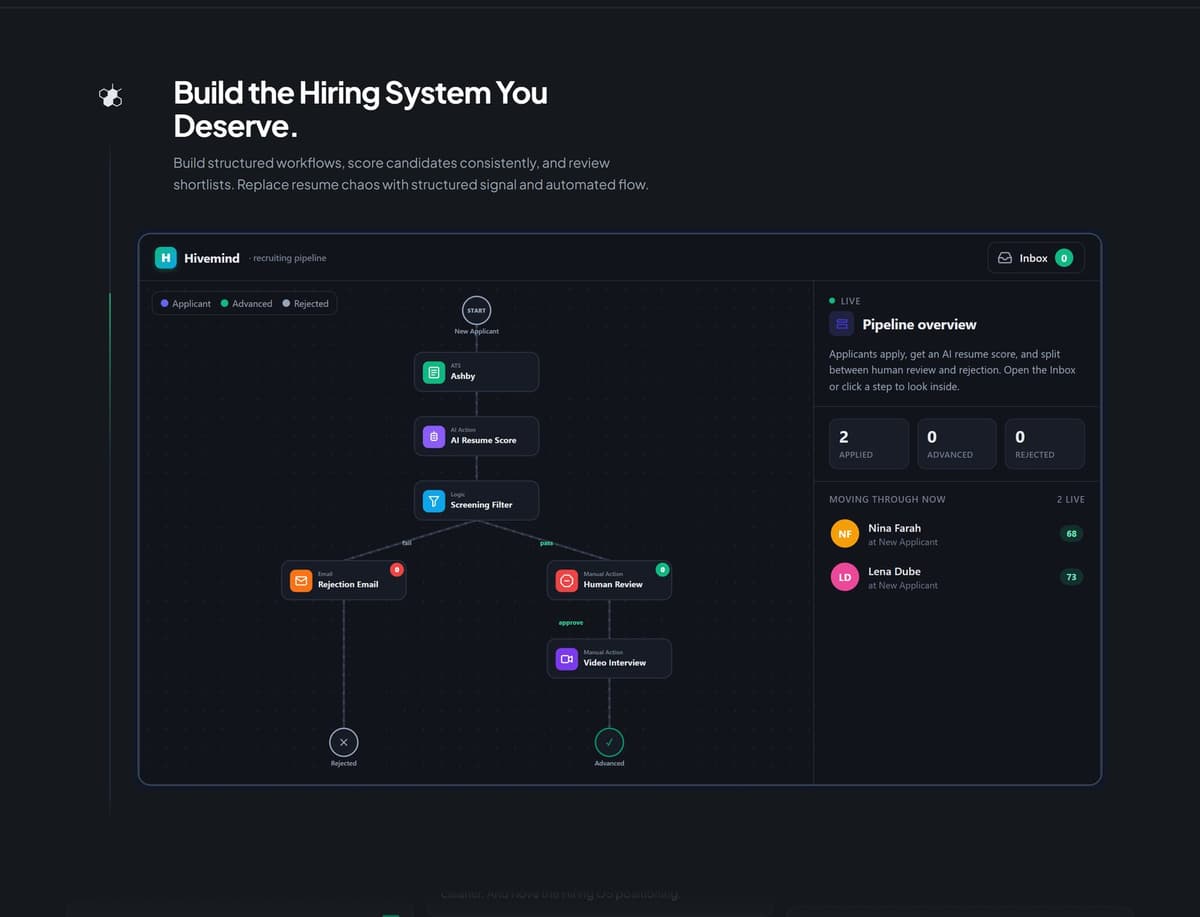
Around the reference check sits the rest of the hiring work: sourcing, screening, interviews, offers, and the admin around them. Hivemind is the hiring OS that brings that work together, so a desk can manage every candidate from inbound to offer in one unified workflow. A team can run Hivemind end to end, connect your existing tools, or mix and match both.
The modules that sit closest to the steps around a reference check are these:
- Resumatic: AI-Powered Resume Filtering System
- Automated Skills Assessments
- Automatic Video Assessment: AI-Powered Video Interview Analysis
- Automated Emails: Smart Email Automation for Recruitment
Hivemind has 15 Native Modules and 275 Integrations, so a desk can build the exact pipeline its team deserves.
Frequently asked questions
Does the FCRA apply to a staffing agency's reference checks?
It depends on who conducts the checks and how the information is collected. When a screening vendor or another third party interviews referees about a candidate's character, reputation or personal characteristics, the findings may qualify as an investigative consumer report under the Fair Credit Reporting Act (FCRA). If the FCRA applies, the agency must follow the relevant disclosure, written authorization and adverse-action requirements. Reference calls conducted directly by the agency's own recruiters generally do not trigger those same reporting requirements, but employment discrimination laws and state-specific rules still apply.
What questions should a recruiter ask during a reference check?
Ask consistent, job-related questions of every candidate. Confirm how the referee knows the candidate, verify relevant employment details and ask what the referee directly observed about the candidate's ability to meet each requirement in the job order. You can also ask what the referee would want to know if they were hiring the candidate and whether they would work with them again. The US Office of Personnel Management (OPM) recommends structured telephone reference checks lasting around 20 minutes, with at least three reference contacts.1
How many references should a staffing agency check?
Aim for at least three references. OPM recommends a minimum of three contacts for structured telephone reference checks. Speaking to multiple people helps recruiters identify patterns across different perspectives rather than basing a placement decision on one person's opinion. Choose referees who have directly observed the candidate's work wherever possible.
Can a staffing agency ask a reference about a candidate's salary history?
California and New York restrict employers from seeking a candidate's salary history, including through other people acting on their behalf. Staffing agencies should check the applicable law before asking a former employer or another referee about previous pay. Where salary-history questions are prohibited, ask the candidate about their current compensation expectations instead.
Can a former employer legally give a negative reference?
In some states, former employers have legal protections when they provide certain employment information in good faith. Florida, Arizona and Virginia have protections for specified disclosures, while Kansas and Minnesota protect particular categories of employment information under their respective laws. These protections have limits and differ by state. The EEOC also makes clear that employment references cannot be used to discriminate based on protected characteristics, and an unjustified, untruthful negative reference may constitute unlawful retaliation in some circumstances.
How long should a staffing agency keep reference-check notes?
Generally, at least one year under the applicable federal EEOC recordkeeping rules. The required retention period runs from the date the record was made or the relevant personnel action, whichever is later. Other legal requirements may call for a longer period, so agencies should check the rules that apply to their circumstances. If a consumer report was used, the agency must also follow the relevant secure-disposal requirements when the report is no longer needed and the retention period has ended.
Can a staffing agency share a reference with its client?
Only after checking the candidate's consent, the client contract and the applicable state law. Minnesota, for example, restricts employment agencies from disclosing certain written reference information without the employee's written authorization. A safer default is to give the client a summary of what the agency verified against the job requirements rather than forwarding the original reference or raw notes. Obtain any additional permission required before sharing more detail.
Sources
- US Office of Personnel Management: Reference checking ↩
- American Staffing Association: Search and placement code of ethics ↩
- US Equal Employment Opportunity Commission: Background checks: what employers need to know, Prohibited employment policies and practices, Enforcement guidance on retaliation and Enforcement guidance on contingent workers placed by staffing firms ↩
- US Government Publishing Office, United States Code: 15 U.S.C. 1681a, 15 U.S.C. 1681b and 15 U.S.C. 1681d ↩
- Federal Trade Commission: Using consumer reports: what employers need to know ↩
- New York City Commission on Human Rights: Fair Chance Act ↩
- California Civil Rights Department: Fair Chance Act ↩
- Kansas Legislature: K.S.A. 44-119a ↩
- Arizona Legislature: A.R.S. 23-1361 ↩
- Minnesota Office of the Revisor of Statutes: Section 181.967 ↩
- Virginia General Assembly: Code section 8.01-46.1 ↩
- Ryan P. Jacobson and Carl-Johan Holmberg, International Journal of Selection and Assessment: Leniency in structured online reference checks ↩
- Electronic Code of Federal Regulations: 29 CFR 1602.14 ↩
- Consumer Financial Protection Bureau, Federal Register: Interpretive rules, policy statements and advisory opinions; withdrawal, 12 May 2025
- Florida Legislature: Section 768.095
- California Labor Commissioner's Office: California Equal Pay Act FAQ
- New York State Department of Labor: Salary history and pay equity