

The automatic extension of certain Employment Authorization Documents (EADs) no longer applies to renewal applications filed on or after 30 October 2025, following a final rule that took effect on 14 October 2026. For a US staffing agency, this makes expiry dates on temporary workers' employment authorization documents especially important. If a worker has no other valid basis for employment authorization, the agency must reverify their eligibility by the applicable deadline and stop assigning them work if they are no longer authorized to work.
Key takeaways
- The automatic extension of certain Employment Authorization Documents (EADs) no longer applies to renewal applications filed on or after 30 October 2025, following a final rule that took effect on 14 October 2026.
- Under 8 CFR 274a.2(b)(1)(vii), an employer must reverify an employee's employment authorization no later than the date the existing authorization expires.
- USCIS recommends giving employees at least 90 days' advance notice before their current employment authorization expires.
- The US Department of Justice's Immigrant and Employee Rights Section (IER) warns employers that rejecting valid documents because they are approaching their expiration date could be unlawful.
- As of 18 October 2026, the public record indicates that the court challenge has not blocked the rule for most affected workers.
This guide is for US staffing agency owners who place temporary workers and the people responsible for maintaining Form I-9 records. It explains what changed under the rule, which workers are affected, what agencies must do before employment authorization expires, how to comply without violating anti-discrimination rules, the potential consequences of missing a deadline, and the status of relevant court cases.
This is a compliance guide, not legal advice. The analysis draws on the rule, applicable regulations and guidance from the agencies responsible for issuing them, with the position checked as of 18 October 2026. Because eligibility can depend on a worker's immigration category and renewal filing date, agencies should consult immigration counsel before taking action in cases where either detail is uncertain.
In this article
- What changed on 14 October?
- Which temps are affected, and which still have an extension?
- What does a staffing agency have to do now?
- What does the gap look like on a real timeline?
- When should a temp file to renew?
- How do you reverify without discriminating?
- What does a missed reverification cost?
- Is the rule being blocked in court?
- Why does this land on staffing agencies?
- Conclusion
- Frequently asked questions
What changed on 14 October?
On 14 October 2026, the Department of Homeland Security (DHS) published a final rule adopting its October 2025 interim final rule without changes.1 The rule took effect immediately and makes the end of automatic EAD extensions permanent for most new renewal applications.
The main change is straightforward: unless an exception applies under the law, existing regulations or a Federal Register notice covering Temporary Protected Status (TPS), filing an EAD renewal application on or after 30 October 2025 no longer automatically extends the worker's employment authorization.12 Under 8 CFR 274a.13(e), an expiring EAD and, where applicable, the associated employment authorization are not automatically extended simply because the worker has requested a renewal.
US Citizenship and Immigration Services (USCIS) has incorporated the change into its Handbook for Employers (M-274).1 The handbook confirms that, effective 30 October 2025, a timely Form I-765 renewal generally no longer provides an automatic extension of an expiring EAD unless the law or a Federal Register notice provides otherwise.3 DHS has also updated its employer guidance to help businesses complete Form I-9 under the new requirements.
The change happened in two stages. The interim final rule took effect on 30 October 2025, left automatic extensions already in effect before that date untouched, and remained open for public comment until 1 December 2025.1 The final rule published on 14 October 2026 adopted the interim rule without changes, making the policy permanent.
This ends a protection that had expanded over nearly a decade. According to the College and University Professional Association for Human Resources (CUPA-HR), automatic extensions began in January 2017 with a limit of 180 days.4 Temporary changes in May 2022 and April 2024 increased the maximum to 540 days, and a December 2024 rule incorporated the longer extension into the regulations. For most new renewal applications, that additional time is now gone.
What has not changed is equally important. DHS confirms that employers must continue to hire only workers authorized to work in the United States, verify employment eligibility and reverify authorization when required.1 Staffing agencies therefore retain their existing compliance responsibilities. The change is that, for affected renewals, filing an application no longer automatically provides extra time to work beyond the EAD's expiration date.
Which temps are affected, and which still have an extension?
The rule primarily affects workers who rely on an Employment Authorization Document (EAD) to establish their right to work and whose renewal applications no longer qualify for an automatic extension. Husch Blackwell identifies affected groups including asylees, asylum applicants, adjustment-of-status applicants and certain H-4 spouses of H-1B workers. For workers who have no other valid basis for employment authorization, the end of an applicable extension means they cannot continue working beyond the date their authorization expires.
The key dividing line is the date the worker filed their renewal application. Under the USCIS Handbook for Employers (M-274), certain workers who filed Form I-765 before 30 October 2025 may remain eligible for an automatic extension of up to 540 days, provided they meet the requirements of 8 CFR 274a.13(d).3 This means two temporary workers with the same type of EAD may have different deadlines. A worker who filed in September 2025 may still qualify for an extension, while one who filed in November 2025 generally will not.
Other workers fall outside this EAD rule because their employment authorization follows a different process. Ashurst Perkins Coie indicates that workers in certain employer-sponsored categories, including H-1B, L-1 and O-1, are not affected in the same way. However, the rules governing continued employment while an extension petition is pending depend on the worker's immigration classification and circumstances. Agencies should confirm the applicable requirements with immigration counsel rather than assume that every worker in these categories receives the same extension.
Some employees must not be reverified at all. USCIS instructs employers not to reverify US citizens or noncitizen nationals, lawful permanent residents who presented a Permanent Resident Card (Form I-551), or List B documents.3 A Permanent Resident Card may have an expiration date, but that date does not mean the employee's underlying authorization to work has expired.
The following table summarises how a staffing agency should approach each situation.
| Temp's situation | Does the automatic extension apply? | What the agency should do |
|---|---|---|
| EAD renewal filed on or after 30 October 2025 | Generally, no. Exceptions may apply under the law or an applicable Federal Register notice. | Check the worker's authorization and reverify by the applicable deadline. Do not continue assigning work if authorization has expired and no other valid basis for employment exists. |
| EAD renewal filed before 30 October 2025, with an eligible category code | Potentially, for up to 540 days, if the regulatory requirements are met. | Check the category code, filing date and receipt notice against section 5 of the M-274. |
| H-1B, L-1 or O-1 worker with an extension pending | Governed by the rules for that immigration category, not automatically by the EAD renewal rule. | Confirm the worker's status, petition and applicable continued-employment rules with immigration counsel. |
| US citizen or noncitizen national | Not applicable. These employees must not be reverified. | Do not reverify based on an expiring document. |
| Lawful permanent resident who presented a Permanent Resident Card, or a List B document | Not applicable to these documents. | Do not reverify solely because the document has expired. |
What does a staffing agency have to do now?
Staffing agencies need to reverify affected temporary workers' employment authorization on time and manage the process through a central calendar rather than relying on memory. Reverification should be part of the agency's regular hiring and compliance operations, just like screening candidates or managing placements.
Under 8 CFR 274a.2(b)(1)(vii), an employer must reverify an employee's employment authorization no later than the date the existing authorization expires.2 The regulation also addresses recruiters and referrers for a fee. If the required verification is not completed and the worker has no other valid authorization, the worker can no longer lawfully continue in the relevant employment arrangement.
For a staffing agency, the practical question is who holds the legal responsibility for completing Form I-9. An agency that employs a temporary worker and pays them will generally have its own verification obligations. Having the worker report to a client's premises does not, by itself, transfer those obligations to the client. Where contracts or working arrangements make the responsible employer unclear, the agency should confirm its position with immigration counsel.
Reverification requires the employee to present an acceptable document establishing continuing employment authorization or a new grant of authorization.5 The employer examines the document and records the required information on Form I-9. USCIS recommends giving employees at least 90 days' advance notice before their current employment authorization expires.3 The agency should check the relevant dates recorded in Section 1 and Section 2 and follow the applicable reverification deadline.
A renewal receipt is no longer a reliable bridge between an expired EAD and renewed work authorization. Littler explains that employers generally cannot rely on an expired EAD and a renewal receipt for applications that no longer qualify for automatic extensions.6 Faegre Drinker similarly reports that USCIS receipt notices will explain that the notice is not evidence of employment authorization and cannot be used with an expired EAD to establish continued authorization where no extension applies.
For a staffing desk, the process can be organised into five steps:
- Identify every relevant Form I-9.
Record the EAD expiration date in Section 2 and the employment authorization expiration date in Section 1, where applicable. Determine the actual reverification deadline under the relevant rules rather than assuming that one date always controls.
- Check the renewal receipt.
If the application was filed on or after 30 October 2025, do not assume an automatic extension applies. For earlier applications, check the worker's eligibility category and supporting documents against section 5 of the M-274.
- Give written notice 90 days in advance where possible.
Explain that the worker may present an acceptable List A or List C document establishing continued authorization. Do not specify which document the worker must provide.
- Complete reverification by the applicable deadline.
Examine the acceptable documentation and record the required information on Form I-9.
- Stop assigning work if authorization expires.
If the worker has not established continuing authorization by the deadline and has no other valid basis for employment, stop the assignment, document the action and notify the client as appropriate. The agency can complete reverification when the worker establishes authorization again.
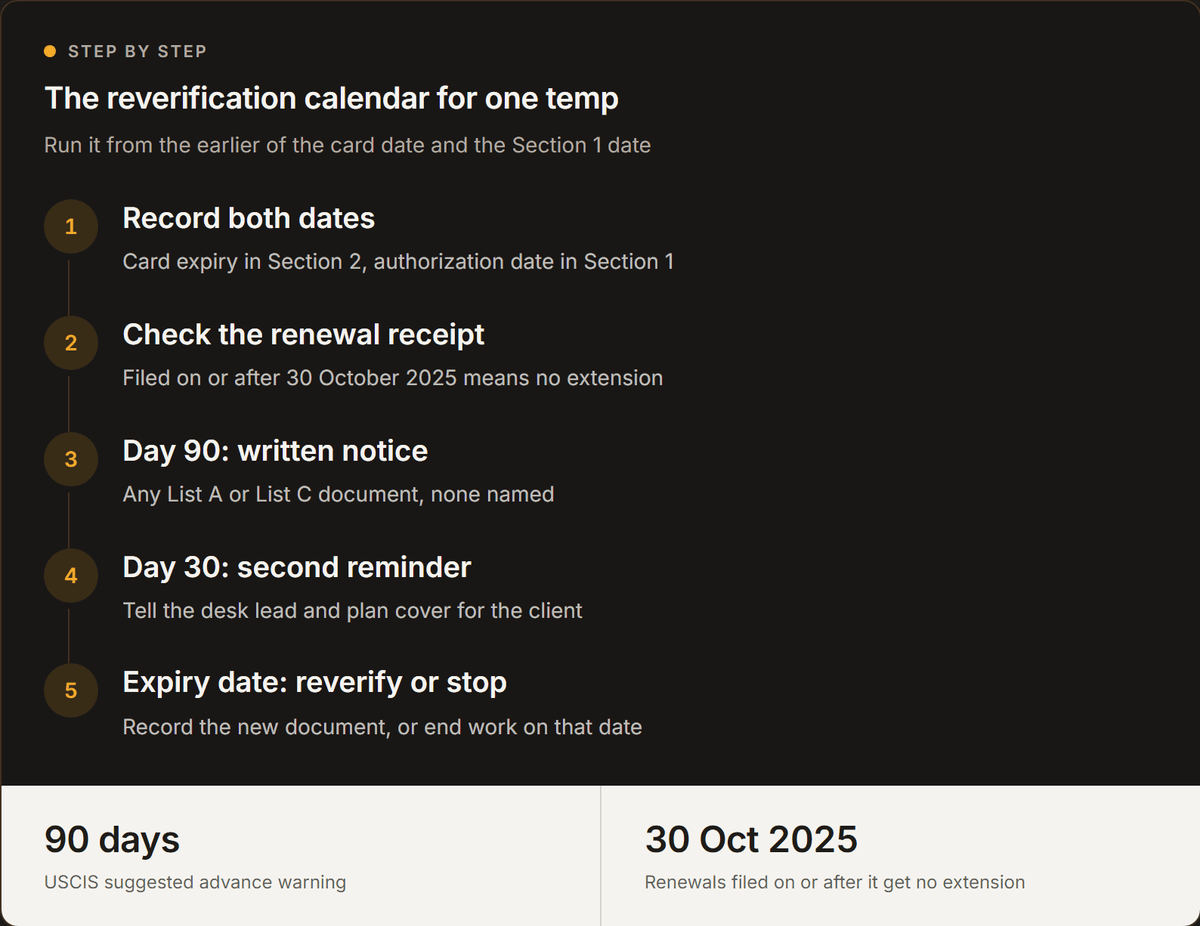
The 30-day reminder is an internal workflow recommendation, not a separate statutory deadline. The agency should also confirm the applicable reverification date for each worker, since the relevant documents and immigration category can affect the analysis.
Decisions for the staffing desk
| If | Then |
|---|---|
| A temp's Form I-9 relies on an EAD | Record the relevant expiration dates and establish the correct reverification deadline. |
| The renewal receipt shows a filing date on or after 30 October 2025 | Do not assume the filing extends employment authorization. Check for an applicable exception and act by the relevant deadline. |
| The renewal was filed before 30 October 2025 | Check the eligibility category and receipt against M-274 section 5 before relying on an extension of up to 540 days. |
| An EAD expires within 90 days | Give advance written notice that the worker may present any acceptable List A or List C document establishing continued authorization. |
| The deadline arrives without acceptable evidence of continued authorization | Stop assigning work if the worker has no other valid basis for employment, document the action and complete reverification when appropriate evidence becomes available. |
What does the gap look like on a real timeline?
Department of Homeland Security (DHS) provides a worked example in its rule that shows how the change can interrupt a worker's employment. An adjustment-of-status applicant has an EAD that expires on 30 May 2026 and files a renewal application on 4 February 2026. If the application is still pending on 31 May 2026, the worker cannot continue working on the basis of that expired EAD unless another valid basis for employment authorization applies.1
The worker filed almost four months before the card expired, giving USCIS time to process the application. Under the previous rules, a qualifying, timely renewal could have provided an automatic extension of up to 540 days. Under the new rule, filing the application alone does not provide that protection. The worker can continue working beyond the printed expiry date only if the renewal has been approved in time or another valid basis for employment authorization applies.
For a staffing agency, the consequences extend beyond the worker. The client loses an assigned temp on a date that can be identified months in advance, while the agency may need to arrange replacement cover and manage the disruption. DHS acknowledges that delayed renewal decisions can create temporary staffing gaps for employers, resulting in lost productivity, overtime costs, recruitment and training expenses, and additional compliance work.1 Staffing agencies may be called upon to fill these gaps for clients while facing the same employment authorization deadlines for workers on their own payroll.
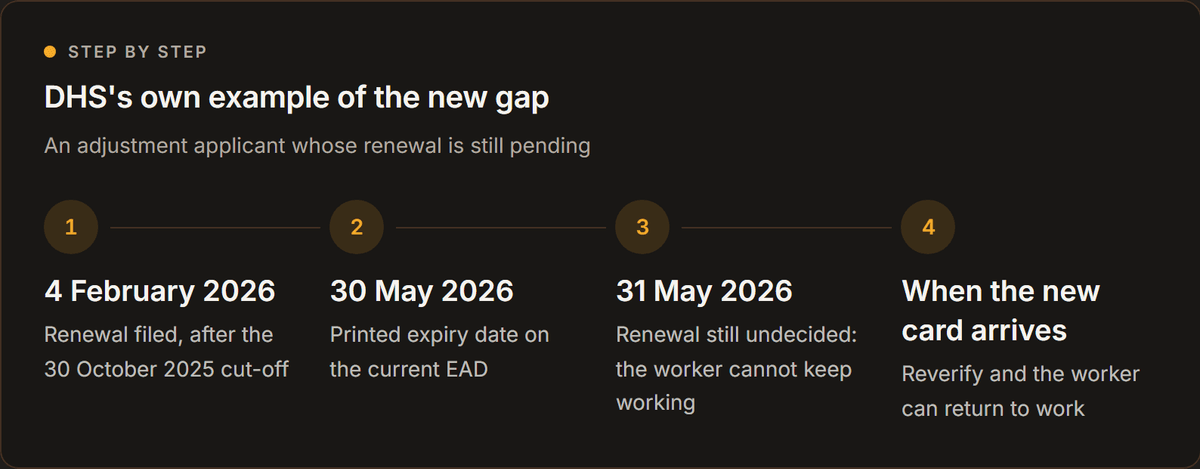
The practical response is to plan for potential gaps before they occur. If a temp's EAD is due to expire within 90 days and the renewal remains pending, the agency should alert the client that the assignment may be interrupted and agree on a contingency plan. Advance notice gives the client time to arrange cover, adjust schedules or discuss alternatives. Waiting until the worker becomes unauthorized to work leaves both the client and the staffing agency with fewer options.
Staffing firms already manage assignments around planned end dates. The same discipline applies here, except that the deadline comes from the worker's employment authorization rather than the client's staffing requirements.
When should a temp file to renew?
Temporary workers should file their EAD renewal applications as early as the rules allow, because USCIS processing time is now the main risk to continued employment. USCIS generally recommends filing no more than 180 days before the current EAD expires.1 DHS notes in its rule, however, that nothing prohibits filing earlier where the applicable rules permit it.
The difficulty is that nobody can guarantee how long a renewal will take. USCIS publishes processing times based on how long it took to complete 80% of adjudicated cases over the preceding six months.1 As DHS explains, these figures can lag behind current conditions. Ashurst Perkins Coie reported in November 2025 that EAD renewals generally took six to 12 months, increasing the risk that a worker's existing authorization will expire before a decision is made.7
The reported backlog highlights the problem. Erickson Immigration Group reported that, as of 30 June 2026, USCIS had more than 432,000 EAD renewal applications pending for at least six months, including more than 91,000 pending for over 18 months.8 These figures are the firm's account of a USCIS report we could not find, so they should be treated as reported figures rather than independently verified totals.
Filing volumes have also changed. According to receipt data cited by DHS in the rule, USCIS received 240,060 EAD applications under category C08, which covers certain applicants with pending asylum cases, in January 2025, compared with 32,472 in June 2026.1 For category C09, covering certain applicants with pending adjustment-of-status applications, receipts fell from 64,106 to 36,455 over the same period. Lower filing volumes could ease the backlog over time, but they offer no immediate protection to a temp whose EAD expires next month.
For staffing agencies, two practical points follow:
- The worker is responsible for filing their own renewal application.
The agency cannot file it on their behalf simply because it employs them. However, the agency can notify the worker in writing well in advance of the expiration date and encourage them to check the applicable filing window and submit their renewal promptly.
- A renewal receipt is evidence that an application has been filed, not proof that employment authorization continues beyond the current expiry date.
Unless the worker qualifies for an applicable extension or has another valid basis for employment authorization, the agency must not treat the receipt alone as permission to keep working after authorization expires.

How do you reverify without discriminating?
Staffing agencies must reverify only the workers covered by the rules, accept any documentation the law allows and avoid taking action before the applicable deadline. Handling the process incorrectly can create discrimination risks even when the agency is trying to comply with immigration law.
The US Department of Justice's Immigrant and Employee Rights Section (IER) warns employers that rejecting valid documents because they are approaching their expiration date could be unlawful.5 Employers must not reverify US citizens, noncitizen nationals or lawful permanent residents who presented a Permanent Resident Card, and they must not reverify List B identity documents. Employees undergoing reverification can present any acceptable List A or List C document establishing employment authorization. For example, a worker may present an unrestricted Social Security card alongside the required documentation rather than obtain a new EAD, provided the document satisfies the applicable Form I-9 requirements.
These protections are grounded in 8 U.S.C. § 1324b(a)(6), which addresses unfair immigration-related employment practices involving requests for more or different documents than required, or rejection of documents that reasonably appear genuine and relate to the employee, when the conduct is undertaken with discriminatory intent.9 Honigman's employer guidance highlights the risks on both sides: failing to reverify employment authorization on time can expose an employer to penalties, while demanding particular documents or rejecting acceptable ones can amount to unlawful document abuse.10
Staffing agencies have faced complaints over these practices. In March 2024, IER dismissed a charge against a staffing agency accused of rejecting an EAD that had been extended and failing to refer the worker for a job. The agency reached a private agreement with the worker that included one month's lost wages, and IER identified concerns about the agency's practices. The charge was dismissed, so the allegations should not be treated as proven. Nevertheless, the case illustrates how a decision about one worker's documents can lead to federal scrutiny.
The distinction is particularly important under the new rule. Agencies may be tempted to stop placing workers who hold EADs or remove temps from assignments well before their authorization expires to avoid the risk of a lapse. Neither approach is an appropriate substitute for applying the rules correctly. A worker whose authorization remains valid is still authorized to work, and IER warns that rejecting valid documentation because of an approaching expiration date could be unlawful.
A consistent process helps agencies meet their obligations without demanding more than the law permits:
- Send the same standard 90-day notice to affected workers. State the relevant date and explain that they may present any acceptable List A or List C document. Do not specify which document they must provide.
- Complete reverification by the applicable deadline, without acting earlier than the rules permit or missing the deadline.
- Do not reverify US citizens, noncitizen nationals or lawful permanent residents who presented a Permanent Resident Card. Do not reverify List B identity documents.
- Record the required information about the documentation presented and the reverification on Form I-9.
- Apply the same process consistently, regardless of a worker's nationality or the client to whom they are assigned.
What does a missed reverification cost?
A missed reverification can mean fines, a disrupted assignment and, in serious cases, penalties for knowingly employing someone who is not authorised to work. The applicable civil penalty ranges are set out in the US Department of Justice's adjustment table at 28 CFR 85.5.
For civil penalties assessed after 3 July 2025, Form I-9 paperwork violations carry penalties of 288 to 2,861 US dollars per relevant individual. First-order penalties for unlawful employment range from 716 to 5,724 US dollars per unauthorised worker.2 On 15 July 2026, the Justice Department confirmed that these civil penalty amounts would remain at their 2025 levels for 2026.11
| Violation | Minimum penalty | Maximum penalty | Counted per |
|---|---|---|---|
| Form I-9 paperwork violation | 288 | 2,861 | Relevant individual |
| Unlawful employment of aliens, first order | 716 | 5,724 | Unauthorised worker |
Amounts are in US dollars and apply to civil penalties assessed after 3 July 2025. The Justice Department retained these penalty levels for 2026.
The greater risk goes beyond paperwork. Under 8 U.S.C. § 1324a(a)(2), it is unlawful to continue employing someone when the employer knows that the person is, or has become, unauthorised to work.9 If a worker's employment authorisation expires and no valid extension or other basis for continued employment applies, allowing them to remain on an assignment can expose the agency to more serious penalties.
An expired Employment Authorization Document (EAD) does not automatically mean that a worker has lost employment authorisation. Certain workers qualify for automatic extensions, and other rules may apply. Staffing agencies must therefore check the worker's actual authorisation status rather than relying on the card's expiry date alone.
The penalty table sets out the possible fines, not the amount an agency will necessarily pay. The final penalty depends on the circumstances, the number of violations and the factors considered by the enforcing agency. For staffing firms managing large numbers of temporary workers with EADs, even a small number of missed deadlines can create significant exposure.
The practical solution is to manage reverification through a central tracking system, with advance reminders, clear responsibility for follow-up and accurate records. A proactive process helps agencies identify approaching deadlines, verify continued work authorisation and reduce the risk of costly compliance failures.
Is the rule being blocked in court?
As of 18 October 2026, the public record indicates that the court challenge has not blocked the rule for most affected workers. Staffing agencies should not assume the rule will be overturned or plan their compliance around that possibility.
In Doe v. DHS (No. 8:26-cv-00060), H-4 visa holders challenged the Department of Homeland Security's (DHS) interim rule in the US District Court for the Central District of California.1213 According to the Immigration Policy Tracking Project, the plaintiffs argued that DHS had unlawfully skipped the usual public notice-and-comment process and that the rule was arbitrary and capricious. The complaint was brought by seven pseudonymous plaintiffs, Jane Doe 1 to 5, John Doe 6 and Jane Doe 7.14
Bloomberg Law reported that, in an order dated 11 September 2026, Judge David O. Carter found that DHS had failed to justify bypassing notice and comment for the interim rule. However, the ruling's protection applied only to the plaintiffs who brought the case, rather than to all affected workers. Bloomberg Law also reported that the White House regulatory office had approved DHS's final rule on 9 September 2026.
Erickson Immigration Group similarly described the September order as a limited injunction preventing enforcement of the interim rule against the plaintiffs. The firm reported that the final rule was scheduled to take effect upon publication on 14 October 2026, while the litigation continued.8
The distinction between the interim and final rules matters. The final rule followed a public comment period, addressing the procedural issue raised in the challenge to the interim version. However, the September court order does not, by itself, establish whether the final rule will withstand any subsequent legal challenge. The underlying order was not available for independent review for this guide, so its precise scope should be confirmed before relying on it.
For staffing agencies, the practical approach is to follow the final rule unless a subsequent court order or other applicable legal authority provides otherwise. If a temporary worker claims to be covered by the lawsuit or a court order, request the relevant documentation and consult immigration counsel before deciding how the rule applies to that individual.
Why does this land on staffing agencies?
Staffing agencies face a particular compliance challenge because they hire continuously, manage high volumes of temporary workers and maintain Form I-9 records for their employees. Every worker whose employment authorisation requires reverification adds another deadline to track.
The American Staffing Association reports that nearly 2.2 million temporary and contract employees worked for US staffing companies in an average week in 2024.15 Staffing companies also hired 12.7 million temporary and contract employees during 2023. These figures illustrate the scale and turnover of the industry, although they do not indicate how many workers hold Employment Authorization Documents (EADs).
The US Bureau of Labor Statistics (BLS) estimated temporary help services employment at 2,486.8 thousand in September 2026, based on its preliminary, seasonally adjusted figures.16 The BLS also reported that foreign-born workers accounted for 19.1% of the US civilian labour force in 2025.16 Together, these figures provide context for the workforce staffing agencies manage, but they do not establish how many agency workers require reverification.
No public source identified for this guide provides a reliable count of staffing agency workers who hold EADs. The figures should therefore be treated as indicators of the industry's scale, not combined to estimate the number of workers at risk. The practical point is that agencies managing large workforces and frequent placements have more employment records and authorisation dates to monitor.
The Department of Homeland Security (DHS) has also estimated the potential impact of EAD expirations across the wider US economy. Its projections suggest that between 20,000 and 33,000 EADs could lapse during an 18-month period beginning in May 2027.1 DHS estimates that the resulting labour turnover could cost US employers $312.1 million and affect approximately 1,700 to 2,800 employers.1 These are national projections based on DHS's assumptions, not measured outcomes or estimates for staffing agencies specifically.
An individual agency's exposure depends on the workers it employs, their authorisation status and the effectiveness of its reverification process. For recruiters who need a broader understanding of employment authorisation documents, the guide to work permits for recruiters explains the main document type
Conclusion
A missed EAD reverification can cost a staffing agency far more than a paperwork fine. It can disrupt a client assignment, force an urgent replacement search and expose the business to penalties if it continues employing someone it knows is unauthorised to work. With thousands of workers moving through staffing firms each year, relying on individual recruiters to remember expiry dates is an avoidable risk.
The answer is a process that works before a deadline is missed: track relevant authorisation dates, assign clear responsibility for follow-up, verify whether a worker remains authorised to work and keep accurate records. If a worker's status is uncertain, involve HR or immigration counsel rather than guessing. Compliance decisions must remain with the agency.
Get the compliance process right first. Then make the recruitment workflow fast enough to respond when a placement changes. That is how staffing agencies protect their clients, their workers and their business without letting an avoidable administrative failure become a costly legal problem.
Where Hivemind fits on a staffing desk
Form I-9 completion, reverification and the decision to take a temp off assignment stay with the agency's own employment and HR process. No hiring system makes that legal judgement for you.
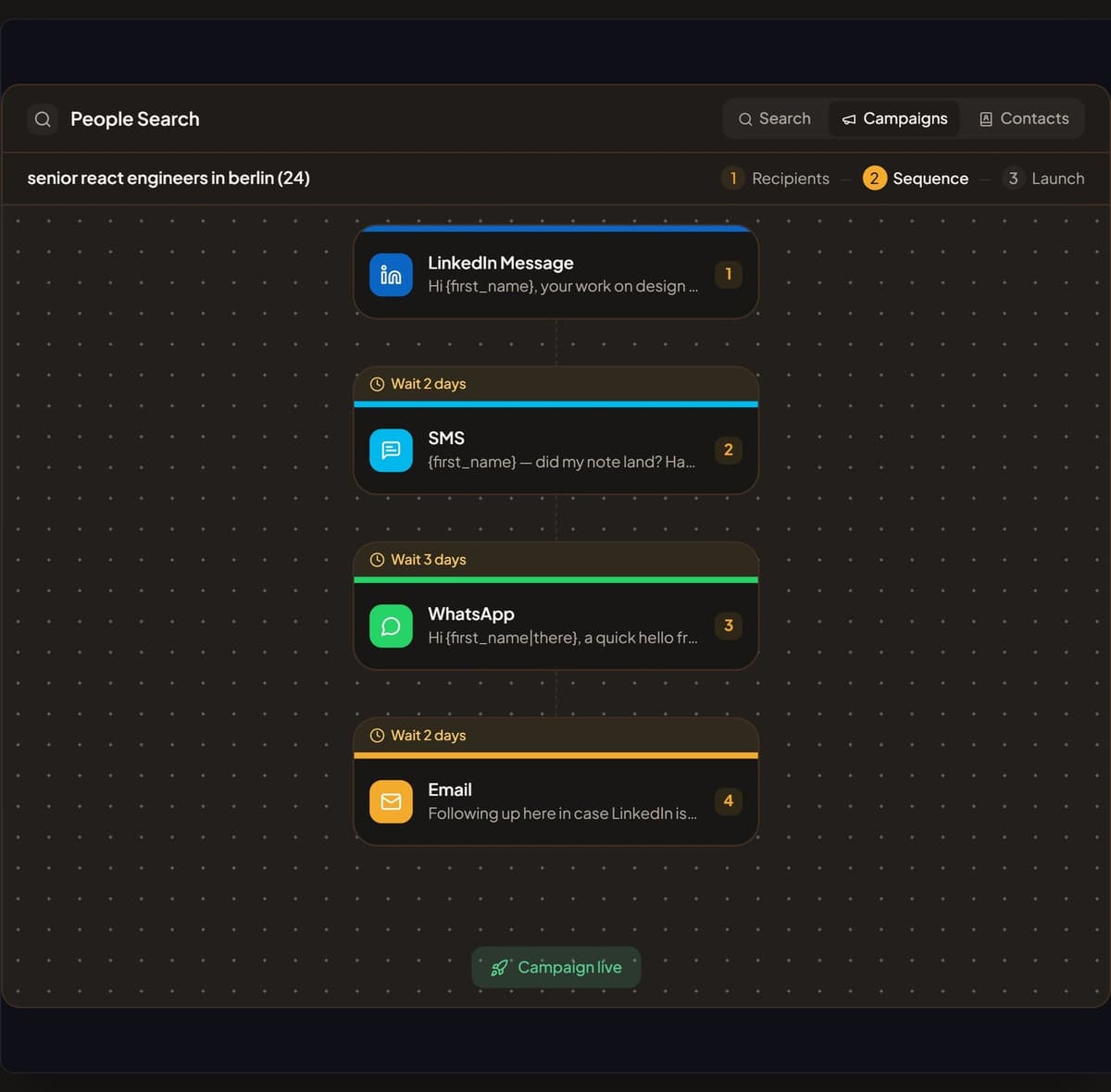
What sits around it is the hiring work itself: sourcing, screening, interviews, offers, and the admin around them. Hivemind is the hiring OS that brings that work together, so a desk can manage every candidate from inbound to offer in one unified workflow. A team can run Hivemind end to end, connect your existing tools, or mix and match both.
When a temp has to come off an assignment, the desk's next job is often finding cover. The modules closest to that work are these:
- Resumatic: AI-Powered Resume Filtering System
- Automated Skills Assessments
- Automated Emails: Smart Email Automation for Recruitment
- SMS Follow-Ups: Automated Candidate Text Messaging
Hivemind has 15 Native Modules and 275 Integrations, so a desk can build the exact pipeline its team deserves.
Frequently asked questions
Does a timely EAD renewal still extend a temp's work authorisation?
Not automatically. For renewal applications filed on or after 30 October 2025, filing a renewal generally does not extend an expiring EAD under the applicable rule. Certain renewals filed before that date may still qualify for an automatic extension of up to 540 days, provided they meet the relevant requirements under 8 CFR 274a.13(d).
When must a staffing agency reverify a temp's Form I-9?
Reverification must be completed no later than the date the employee's employment authorisation expires, where reverification is required. Under 8 CFR 274a.2(b)(1)(vii), employers must update Form I-9 to reflect continued employment authorisation. Staffing agencies should track relevant expiry dates in advance and give workers sufficient notice to obtain acceptable documentation. An expired document does not always mean employment authorisation has ended, so the agency must check whether an extension or other applicable provision applies.
Can a staffing agency accept an expired EAD with a renewal receipt?
Generally, no, for renewal applications filed on or after 30 October 2025. A renewal receipt notice alone does not extend employment authorisation under the new rule. Employers must establish continued authorisation using documentation permitted by the applicable rules, including any valid extension or alternative documentation that applies to the worker's circumstances.
Which documents can a temp present for reverification?
Employees may choose an acceptable, unexpired document from List A or List C of Form I-9's Lists of Acceptable Documents. For example, an employee may present an unrestricted Social Security card if it meets the applicable requirements. Employers must not insist on a particular document, demand additional documents unnecessarily or discriminate based on citizenship or immigration status.
Which workers should a staffing agency never reverify?
Employers must not reverify US citizens or noncitizen nationals. They also generally must not reverify lawful permanent residents who presented a Permanent Resident Card, even when that card expires, or employees who presented a List B identity document. Agencies should follow USCIS guidance to determine which employees require reverification and avoid unnecessary document requests.
What are the penalties for missed reverification?
For civil penalties assessed after 3 July 2025, 28 CFR 85.5 sets Form I-9 paperwork violation penalties at 288 to 2,861 US dollars per relevant individual.2 First-order penalties for unlawful employment range from 716 to 5,724 US dollars per unauthorised worker. These are penalty ranges, not guaranteed fines. Under 8 U.S.C. § 1324a(a)(2), knowingly continuing to employ someone who is unauthorised to work is unlawful.
Has a court blocked the end of automatic EAD extensions?
The September 2026 ruling in Doe v. DHS provided limited relief to the plaintiffs challenging the interim rule, according to Bloomberg Law's reporting. It did not block the rule for all affected workers. The final rule took effect on 14 October 2026, and litigation may continue. Staffing agencies should follow the applicable final rule unless a subsequent court order or other legal authority changes how it applies to their workers.
Sources
- US Department of Homeland Security, Federal Register: Removal of Automatic Extensions for Certain Employment Authorization Documents, final rule, 14 October 2026 and interim final rule, 30 October 2025 ↩
- Electronic Code of Federal Regulations: 8 CFR 274a.13, 8 CFR 274a.2 and 28 CFR 85.5 ↩
- US Citizenship and Immigration Services: Completing Section 3, reverification and rehires and Handbook for Employers M-274, section 5.0 ↩
- CUPA-HR: USCIS ends automatic extensions of employment authorization ↩
- US Department of Justice, Immigrant and Employee Rights Section: Guidance on reverification and Letters of resolution, fiscal year 2024 ↩
- Littler: DHS ends automatic extensions of EAD renewals ↩
- Ashurst Perkins Coie: DHS ends automatic work authorization extensions ↩
- Erickson Immigration Group: DHS finalizes end of automatic EAD extensions for renewal applicants ↩
- United States Code, GovInfo: 8 U.S.C. 1324b and 8 U.S.C. 1324a ↩
- Honigman: Employer alert on reverification ↩
- US Department of Justice, Federal Register: Civil monetary penalties inflation adjustment, 15 July 2026 ↩
- Bloomberg Law: H-1B spouses get limited win on rule axing work permit renewals ↩
- Immigration Policy Tracking Project: DHS ends automatic extension of Employment Authorization Documents ↩
- National Foundation for American Policy: Complaint, Jane Doe 1 et al. v. DHS ↩
- American Staffing Association: Staffing industry statistics ↩
- US Bureau of Labor Statistics: Foreign-born workers, 2025 and Employment Situation, table B-1 ↩
- Husch Blackwell: DHS ends automatic extensions of H-4 EADs and other work authorization categories
- Faegre Drinker: DHS issues interim final rule on removal of the automatic extension of EADs