

A staffing candidate submittal earns an interview when it answers the client's own requirements first. Open with a short table that sets each required and desired skill beside the candidate's evidence, using the client's words. Attach the resume after that. Send the package only once you hold the candidate's written right to represent them for this role, and strip out anything the law keeps from the client before an offer.
Key takeaways
- Put the client's requirements at the top, in the client's words, with the candidate's evidence against each one.
- Use the same rows for every candidate you send against one order, and use the same words to describe how strongly each candidate meets each row.
- Send the package only once you hold the candidate's written right to represent them for this role, and strip out anything the law keeps from the client before an offer.
- Strip the client copy of contact details, the photo and anything the law keeps out before an offer, including pay history and criminal history where those rules apply.
- For every submittal, record whether it led to an interview.
This playbook is for the recruiter about to send candidates to a client and for the desk lead who reviews those submittals before they go. It covers what belongs at the top, how to show evidence for each requirement, what must never travel with the submittal, how to handle consent and candidate data, and how fast to send. It closes with a way for the desk lead to measure whether submittals are working.
One limit up front. We found no current public study of how long a hiring manager spends on a staffing submittal, and no public submittal-to-interview ratio for staffing desks. This guide therefore offers no benchmark to hit. It offers a format that public supplier rules already ask for, plus a way to measure your own desk.
In this article
- What does a hiring manager actually read?
- What goes at the top of the submittal?
- How do you show the evidence against each requirement?
- Do you have the right to represent the candidate?
- What must never go in a submittal?
- How do you keep candidate data safe when you send it?
- How fast should the submittal go?
- How does a desk lead know submittals are working?
- Conclusion
- Frequently asked questions
- Sources
What does a hiring manager actually read?
A hiring manager reads a submittal against two things: the job order you gave them and the other candidates on their desk. They rarely measure it against an abstract picture of the job. A report from the Burning Glass Institute and Harvard Business School found that a hiring manager compares a candidate with others from the available pool, not with an abstract concept of what the job requires.1
The same report found that much of hiring is left to the individual hiring manager, who applies criteria that are both stated and unstated, both objective and impressionistic. For a recruiter, this has a practical consequence. The client will judge your candidate partly on what they told you at intake and partly on what they never said. A submittal that lines the candidate up against each stated requirement gives the manager something firm to react to. When they push back, you learn which unstated criterion you missed.
How long do managers spend reading? Nobody has measured it well in public recently. The often-quoted eye-tracking figures are more than a decade old for the first study and past the age limit used for this guide's sources for the second, so they are left out. The surveys that have replaced them come from resume and testing vendors, and they disagree. In ResumeGo's survey of 418 recruiters and hiring managers, 47% said they spend between 30 seconds and 1 minute on a resume in the initial screen.2 Resume Genius reports that 57% of the 625 US managers it surveyed spend 1 to 3 minutes on a resume, while 22% spend less than a minute.3 Kickresume reports that 76% of recruiters in its survey spend at least 30 seconds on a CV, and that 62% of HR professionals said they have rejected a candidate without fully reading the CV.4
All of these are vendor surveys, with their own panels and their own interest in how resumes get read. Read them as a reason to put what matters first, not as a measure of how long a reader spends.
There is also doubt about the resume as a reading tool. In TestGorilla's 2025 survey, only 48% of US employers said resumes are an effective way to determine candidates' capabilities.5 The same vendor reports that 86% of the US employers it surveyed had problems with resumes. It also lists 45% finding it hard to rank candidates using resumes and 34% unable to tell from a resume whether the candidate had the right skills.5
Put these findings together and the job of the submittal becomes clear. The resume is long, inconsistent from one candidate to the next and hard to rank. The hiring manager is comparing your candidate with others and with criteria you only partly know. The first screen of your submittal should therefore do the comparison for them, on the client's own terms, before they open the resume.
Clients also judge the staffing firm on how well it does this. ClearlyRated, which runs a client satisfaction programme for staffing companies, reports that the client Net Promoter Score for rated staffing companies averaged 36%.6 That figure is ClearlyRated's own aggregate and the page does not print its method, so treat it as one company's measure. It is still a reminder that every submittal is a small piece of evidence about whether your desk understood the order.
What goes at the top of the submittal?
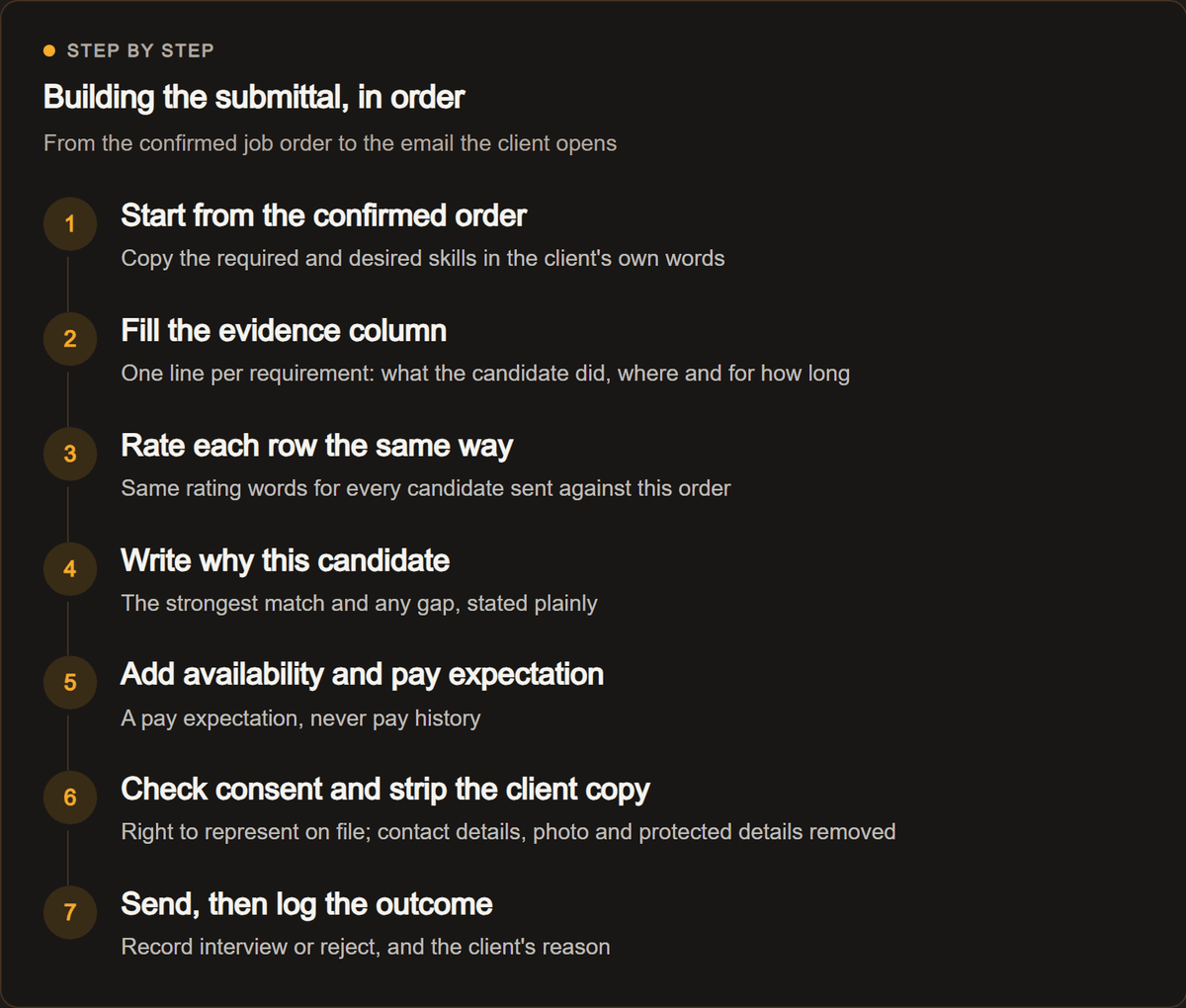
Put the client's requirements at the top, in the client's words, with the candidate's evidence against each one. Follow that with a short line on why this candidate, plus availability and pay expectation. The resume comes after.
You do not have to invent this format, because public managed service provider (MSP) programs already ask suppliers for it. CAI, the MSP for the State of New Jersey's IT contract, tells suppliers in its supplier rules to list the candidate's experience with each of the required and desired skills on the resume template.7 Its Utah IT MSP guidelines, effective June 2026, go further and ask suppliers to fill in every required and desired skill with the candidate's actual years of experience.7
These are public-sector IT programs run by one MSP, so they are not an industry standard, and a commercial client with no template may never ask for a table. They remain a useful public benchmark. An MSP is a professional reader of submittals, and when it writes rules for suppliers it writes down what it needs to see first. In both programs, that is the requirements, one row at a time.
The submittal summary has five parts, and each should stay short.
| Part | What to write | Why it is there |
|---|---|---|
| The role line | The client's job title, the requisition or order reference, and the location and hours as the client stated them | Lets the reader confirm in seconds that this is the right order |
| The requirements table | Every required skill, then every desired skill, in the client's words, each with the candidate's evidence | Does the comparison the hiring manager would otherwise do from the resume |
| Why this candidate | A few sentences on the strongest match and any gap, stated plainly | Gives the reader the recruiter's judgement, not a sales pitch |
| Logistics | Availability, notice period or start date, and the candidate's pay expectation | Removes the questions that stop an interview being booked |
| Consent | A line confirming the candidate has given a written right to represent for this role | Tells the client the candidate knows about this submission |
The requirements table is the heart of the submittal. Use the same rows for every candidate you send against one order, and use the same words to describe how strongly each candidate meets each row. That consistency lets the client compare like with like, and it is the part most submittals skip.
How do you show the evidence against each requirement?
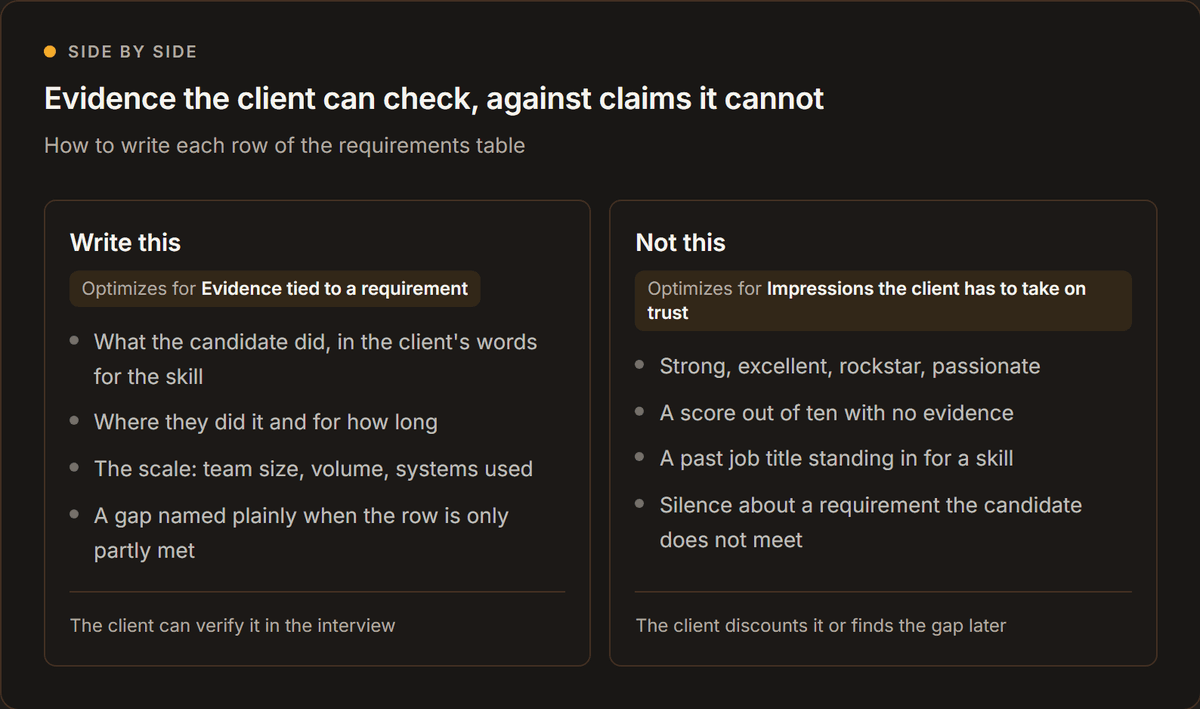
Write evidence, not adjectives. For every requirement row, say what the candidate did, where, for how long and at what scale. "Strong Java skills" tells the client nothing they can check, whereas "Built and maintained payment services in Java for four years at a regional bank" is evidence. The Utah guideline's request for actual years of experience against every skill applies the same principle in a stricter form.
This is also what the American Staffing Association (ASA) asks of its members. Its search and placement code of ethics asks members to determine the experience and qualifications of candidates and to communicate them honestly to clients.8 Honest communication includes the gaps. If the client asked for a certification the candidate does not hold, say so in the row. A gap the client finds in the interview costs you more than a gap you named in the submittal.
Rate each row with the same small set of words for every candidate. Federal hiring practice offers a useful model. The US Office of Personnel Management describes a structured interview as one where all candidates are asked the same predetermined questions in the same order, and all responses are evaluated using the same rating scale and standards for acceptable answers.9 It says this ensures candidates have equal opportunities to provide information and are assessed accurately and consistently.9 A submittal is not an interview, but the logic carries over. If the rows and the rating words are the same for every candidate, the client is comparing candidates and not the recruiter's enthusiasm for each one.
A simple scale works well: mark each requirement as met with evidence, partly met or not met, and add one line of evidence. Avoid scores out of ten, because they look precise, invite argument about the number and hide the evidence the client actually needs. If your desk uses an interview score card for its own screens, use the same requirement rows in the submittal so that the two documents agree.
Write the rows from skills, not job titles. LinkedIn's Economic Graph estimates that a skills-based approach could expand talent pools by 6.1 times globally compared with searching on prior job title.10 A submittal that says the candidate "has held the title Senior Analyst" leaves the client to guess what they can do. One that maps the candidate's work to each required skill lets a strong candidate with an unusual title get through. TestGorilla reports that 53% of the employers it surveyed had dropped degree requirements, up from 30% the year before.5 That is the vendor's survey, but it points the same way: when a requirement is a proxy, show the skill behind it. The guide to skills-based hiring covers the wider case.
There is a legal edge to this as well. The federal Uniform Guidelines on Employee Selection Procedures say that an employment agency that agrees to an employer's request to devise and use a selection procedure should follow the guidelines' standards.11 Those standards treat a selection rate for any race, sex, or ethnic group that is less than four-fifths, or 80%, of the rate for the group with the highest rate as generally regarded as evidence of adverse impact. A desk that screens candidates out on rows that have nothing to do with the work is building exactly the kind of record those guidelines examine. Tie every row to a duty, as the job order intake call playbook explains, and keep the rating evidence with the order.
Do you have the right to represent the candidate?
Never send a submittal without the candidate's written permission to present them for this specific role. This is the rule most likely to cost a desk a placement it had already won.
MSP programs enforce it. CAI's New Jersey supplier rules say CAI reserves the right to reject candidates who have not submitted the electronic right to represent at the time of screening.7 The same rules say CAI's account managers screen candidates by requiring each one to verbally validate the submitting firm.7 In other words, the MSP calls the candidate and asks who sent them. If the candidate does not know, or names a different firm, your submission is in trouble.
The ASA code makes the same point from the ethics side. It asks members to consider the extent to which candidate information shall remain confidential and the circumstances under which it may be shared with clients.8 It also asks members to inform candidates and clients of all information relevant to the hiring process.8 A candidate who learns from a client that their resume arrived from an agency they never authorised for that role has been told nothing relevant at all.
The right to represent should be specific. A good one names the client, or the end client behind an MSP, and the role with its order or requisition reference. It also records the pay or rate you discussed with the candidate, the date the candidate gave permission and how they gave it, whether in writing or by a recorded reply.
A blanket consent signed at registration ("you may send my resume to any client") does not name this client or this role. It also leaves you exposed when two firms submit the same person. Ask every time. It takes one message, and it doubles as a final check that the candidate still wants the role at the pay discussed. The desk huddle line for this is short: no right to represent, no submittal.
What must never go in a submittal?
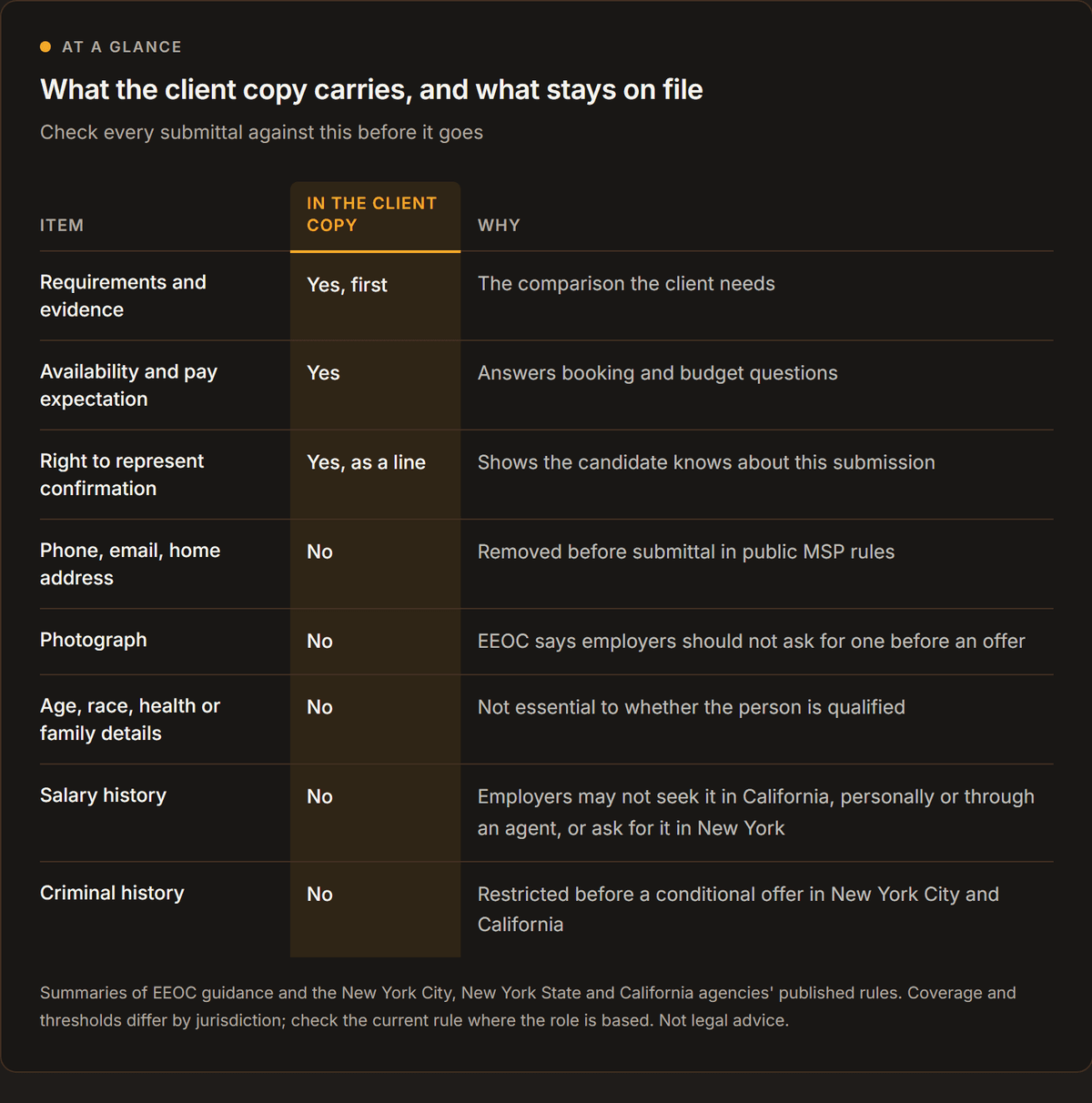
Leave out anything that would let the client decide on a protected characteristic, and anything the law says the client should not see before an offer. A staffing firm cannot pass this responsibility to the client.
The Equal Employment Opportunity Commission (EEOC) is direct about where liability sits. Its enforcement guidance on staffing firms says that the fact that a discriminatory assignment practice is based on a client's requirement is no defence, and that a staffing firm is liable if it honours a client's discriminatory assignment request.12 The EEOC also says it is illegal for an employment agency to take into account a person's race, colour, religion or sex when making decisions about job referrals.12 A submittal is a referral.
The EEOC's general guidance on pre-employment inquiries sets the rule for what the package should carry. As a general rule, the information requested through the pre-employment process should be limited to what is essential for determining whether a person is qualified for the job, and information about race, sex, national origin, age and religion is irrelevant to that.12 Several specific items follow from this rule.
On photographs, the EEOC says employers should not ask for a photograph of an applicant. If one is needed for identification, it may be obtained after an offer of employment is made and accepted.12 Remove the photo from the client copy of the resume, even if the candidate put it there. On race, the EEOC says employers should not request information that discloses or tends to disclose an applicant's race unless there is a legitimate business need, so keep any equal opportunity data you collect out of the submittal.12
On disability and health, employers generally cannot ask disability-related questions or require medical examinations until after a conditional job offer.12 Nothing about the candidate's health belongs in the submittal. The same goes for date of birth, graduation years that reveal age, home address and family details, none of which is essential to whether the person can do the job. The ASA's general code of ethics asks members to provide equal employment opportunities based on bona fide job qualifications, without regard to race, colour, religion, national origin, sex, age or disability.8 The submittal is where that commitment is either kept or quietly broken.
Two pieces of research show why this matters even when nobody intends to discriminate. A 2024 research brief from the Becker Friedman Institute at the University of Chicago, on the work of Patrick Kline, Evan K. Rose and Christopher R. Walters, reports that firms in the grade showing the most discrimination were 24% less likely, on average, to call back a Black applicant than a white one.13 For the least discriminatory firms the gap was 3%. The underlying experiment measured callback rates from over 83,000 fictitious job applications sent to entry-level openings at more than 100 Fortune 500 firms.13
Software is not immune either. University of Washington researchers tested how three large language models ranked resumes when only the names were changed, across more than three million comparisons between resumes and job descriptions.14 The systems preferred white-associated names 85% of the time against Black-associated names 9% of the time.14 They preferred male-associated names 52% of the time against female-associated names 11% of the time. The study tested open-source models, not commercial hiring products, so it does not tell you how any particular tool behaves. It does show that a submittal process that lets names and personal details do the work is risky whether a person or a model reads it first.
Criminal and pay history
Two more categories need care, because several jurisdictions restrict them before an offer and they often come up when a client asks for "everything you have".
On criminal history, New York City's Fair Chance Act makes it an unlawful discriminatory practice for most employers and employment agencies to inquire about or consider the criminal history of job applicants before a conditional offer.15 For temporary help firms, the city's guidance treats the conditional offer as the offer to place an applicant in the firm's labour pool, meaning the group of people from which the firm selects candidates to send for job opportunities.15 California's Fair Chance Act generally prohibits employers with five or more employees from asking a job candidate about conviction history before making a job offer.16
On pay history, California's Labor Commissioner says an employer cannot, orally or in writing, personally or through an agent, seek salary history information about an applicant.17 Treat a client's request for current salary as one that rule may reach, and check with counsel. New York's Department of Labor says employers there cannot ask job applicants for their wage or salary history as a condition of employment, under a ban that took effect on January 6, 2020.18 Send the candidate's pay expectation for this role instead, because it answers the client's real question.
Background checks have their own procedure. Guidance from the EEOC and the Federal Trade Commission says that before an employer gets a background report from a reporting company, it must tell the applicant in writing, in a stand-alone notice that cannot be part of an employment application.19 It must also get the applicant's written permission to run the check. None of that happens in a submittal. If the client wants a background check, it follows its own process after the interview stage.
How do you keep candidate data safe when you send it?
Send the client what it needs to decide on an interview and nothing that lets it go around you or misuse the data. Remove the candidate's phone number, personal email and home address from the client copy. CAI's New Jersey supplier rules say the same in plain terms: submit the resume on the MSP's template and remove any candidate contact information before submittal.7
There are two reasons for this. The commercial reason is obvious: a resume with contact details invites a client, or a competing supplier who sees it, to reach the candidate directly. The second reason is data protection. In California, the Attorney General says the California Consumer Privacy Act (CCPA) exemptions for employment-related personal information expired on December 31, 2022.20 The CCPA requires a business to give a notice at collection that lists the categories of personal information it collects and the purposes it uses them for.20 Whether the CCPA reaches your firm depends on its size and how it handles data, so check with counsel. The habit it points to is sound everywhere: tell candidates what you collect and why, and send clients only what the purpose needs.
In practice, keep one master resume on file and generate a fresh client copy for each submission, removing contact details, the photo and personal details every time. Where the client allows it, send through the MSP's portal or a link you control, because an email attachment can be forwarded without trace. Record what was sent, to whom and when, against the order.

How fast should the submittal go?
Fast enough to make the shortlist, but not so fast that the fit is wrong. In programs with a submission cap, fit beats speed.
The public MSP rules show why. Under the New Jersey program, CAI itself must submit 3 to 5 fully qualified candidates within 4 business days of releasing the requirement.7 The program's vendor management system will only allow two candidate submissions per supplier by default, and suppliers are told to make sure their best candidates are being submitted.7 Under the Utah guidelines, a supplier has 7 calendar days from posting to submit at its best rate.7 When a supplier only gets two slots, sending the first two people who look close is a good way to lose both to a better-matched rival.
On the client side, hiring still takes weeks. SHRM's 2026 benchmarking, drawing on data from over 4,600 organisations, puts the median time to fill a nonexecutive position at 39 calendar days.21 That is an employer measure and not a staffing desk measure, but it shows the scale of the clock. A day spent writing a clean requirements table rarely decides whether the client fills the seat, whereas a submittal that misses the brief can cost you the order. The guide to time to fill and time to hire explains how the two clocks differ.
For a commercial desk with no submission cap, the trade-off is sharper, because a slower but better submittal can still lose to a fast one. A workable rule is to send the first candidate as soon as one clearly meets every required row and has given a right to represent. Send the rest together once you have them, against the same rows. Never send a candidate who fails a required row just to hold a place in the queue. Say in your note that more candidates are coming.
How does a desk lead know submittals are working?
Measure your own desk. We found no public submittal-to-interview ratio for staffing firms, so there is nothing reliable to benchmark against, and your own numbers will tell you more.
For every submittal, record whether it led to an interview. If it did not, record the client's reason in the client's own words and note which requirement row the reason maps to, or "not on the order" if it maps to none. Review those reasons weekly, by recruiter and by client. Rejections that map to a requirement row mean the evidence in that row was weak or wrong. Rejections marked "not on the order" mean the intake call missed something, and the fix sits on the intake side. A client whose reasons are mostly "not on the order" is revealing the unstated criteria that the Burning Glass Institute and Harvard Business School report found hiring managers apply.1
Use these reviews to coach, not to rank. Each week, read three submittals per recruiter against the checklist in this guide: requirements first, evidence and not adjectives, the same rating words for every candidate, consent confirmed and the client copy stripped. Most problems show up in the first screen of the document.
Also watch for patterns in who gets through. If candidates with certain kinds of names, schools or career breaks are being rejected at a different rate, look at the rows and the evidence before you look at the client. The Uniform Guidelines' four-fifths rule is a federal enforcement test and not a desk target, but the habit of comparing selection rates across groups is a good one. The guide to measuring quality of hire covers what to track once a placement starts.
Conclusion
A submittal is the client's first look at your judgement. Lead it with the client's own requirements and the candidate's evidence against each, rated the same way for every candidate, and send it only with a specific right to represent. Strip the client copy of contact details, the photo and anything the law keeps out before an offer, including pay history and criminal history where those rules apply. Then measure what happens to every submittal and fix the rows, or the intake call, that the rejections point to.
Where Hivemind fits on a staffing desk
The submittal itself is the recruiter's judgement: which candidates to send, how honestly to state the gaps, and when to push back on the client. No system writes that for you.
Around it sits the work that feeds it: sourcing, screening, interviews, offers, and the admin around them. Hivemind is the hiring OS that brings that work together, so a desk can manage every candidate from inbound to offer in one unified workflow. A team can run Hivemind end to end, connect your existing tools, or mix and match both.
The modules that sit closest to a submittal are these:
- Resumatic: AI-Powered Resume Filtering System
- Automated Skills Assessments
- Automatic Video Assessment: AI-Powered Video Interview Analysis
- Automated Emails: Smart Email Automation for Recruitment
Hivemind has 15 Native Modules and 275 Integrations, so a desk can build the exact pipeline its team deserves.
Frequently asked questions
What is a candidate submittal in staffing? A candidate submittal is the package a staffing firm sends a client to put a candidate forward for a specific job order. It usually carries a short summary, the candidate's evidence against the client's requirements, availability, pay expectation and the resume. A good one opens with the requirements and the evidence, because the client is comparing candidates against the order and against each other.
What should a candidate submittal template include? A template should include the role line and a requirements table listing every required and desired skill in the client's words, with the candidate's evidence against each. It should also carry a short note on why this candidate, availability and pay expectation, and a line confirming the candidate's right to represent. Public MSP programs such as CAI's New Jersey and Utah IT programs ask suppliers to list experience against each required and desired skill.
What is a right to represent in staffing? A right to represent is the candidate's written permission for a staffing firm to present them for a specific role. CAI's New Jersey MSP rules reserve the right to reject candidates without one at screening, and its account managers ask each candidate to confirm which firm submitted them. Get one for every role, naming the client, the role, the pay discussed and the date.
Should a submittal include the candidate's photo or date of birth? No. The EEOC says employers should not ask for a photograph of an applicant and that pre-employment information should be limited to what is essential to judge qualification. Age, race, national origin, religion and health details are not essential. Remove the photo and personal details from the client copy, even if the candidate included them.
Can a staffing agency tell the client a candidate's current salary? In some states the client may not ask for it. California's Labor Commissioner says an employer cannot seek salary history personally or through an agent, and New York employers cannot ask applicants for wage or salary history as a condition of employment. Send the candidate's pay expectation for this role instead, which answers the client's real question.
How should a recruiter submittal email be written? Keep it short. Put the role and order reference in the subject line, then add one line on why this candidate, the requirements table in the body, availability and pay expectation, and the right to represent confirmation. Attach the client copy of the resume with contact details and the photo removed, and use the same table rows for every candidate you send against the order.
How many candidates should a staffing firm submit for one job? Send as many as clearly meet every required skill, and no more. Where an MSP caps submissions, as CAI's New Jersey program does at two per supplier by default, send your best two. A candidate who fails a required row should not be sent to hold a place.
Sources
- Burning Glass Institute and Harvard Business School: Skills-Based Hiring: The Long Road from Pronouncements to Practice ↩
- ResumeGo: How much time do employers spend on a resume ↩
- Resume Genius: Hiring trends survey ↩
- Kickresume: Resume trends survey on CV screening ↩
- TestGorilla: The state of skills-based hiring 2025 ↩
- ClearlyRated: How NPS helps staffing and recruiting firms grow ↩
- CAI: New Jersey IT MSP supplier fact sheet and Utah guidelines for successful submissions, June 2026 ↩
- American Staffing Association: Search and placement code of ethics and ASA code of ethics ↩
- US Office of Personnel Management: Structured interviews ↩
- LinkedIn Economic Graph: Skills-based hiring, March 2025 ↩
- Electronic Code of Federal Regulations: Uniform Guidelines on Employee Selection Procedures ↩
- US Equal Employment Opportunity Commission: Enforcement guidance on contingent workers placed by staffing firms, Prohibited employment policies and practices, Pre-employment inquiries and race and Pre-employment inquiries and disability ↩
- Becker Friedman Institute, University of Chicago: A Discrimination Report Card ↩
- University of Washington: AI tools show biases in ranking job applicants' names according to perceived race and gender ↩
- New York City Commission on Human Rights: Fair Chance Act ↩
- California Civil Rights Department: Fair Chance Act ↩
- California Labor Commissioner's Office: California Equal Pay Act FAQ ↩
- New York State Department of Labor: Salary history and pay equity ↩
- EEOC and Federal Trade Commission: Background checks: what employers need to know ↩
- California Department of Justice: California Consumer Privacy Act ↩
- SHRM: Recruiting benchmarking ↩