
Most candidates who drop out before their start date do so in a quiet window. The offer is accepted, the recruiter moves on to the next role, and a counteroffer, a better offer or plain silence fills the gap. A desk keeps the placement by treating acceptance as the start of a short, scheduled process. That means dated contact, a counteroffer conversation before the candidate resigns, and every legal pre-start step on a calendar.
Key takeaways
- Treat an accepted offer as work in progress with a named owner until the candidate has worked the first shift, because a placement that does not start pays nothing.
- Gartner reported that 33% of candidates in its July to September 2024 survey backed out after accepting an offer, and no public source gives a falloff rate for staffing placements.
- Hold the counteroffer conversation before the candidate resigns, and call on the day they resign.
- Put every legal step on the placement calendar at acceptance: I-9 Section 1 by the first day, Section 2 and the E-Verify case by the third business day, and the FCRA disclosure before any check.
- Count accepted offers against starts for the last six months and record where each drop happened, so the desk fixes the step that loses placements.
This playbook is for owners of staffing agencies with around ten recruiters who still work a desk and have lost starts recently. The window covered here comes after sourcing, screening and interviews are done. At this point, the client's hiring manager judges your agency on whether the person shows up, not on whether they said yes.
The playbook covers four things:
- What public evidence says about candidates who back out after accepting
- Why the pull to leave persists even in a cooling market
- Which legal steps fall inside the window, and in what order
- A day-by-day plan your desk can run from acceptance to the first shift
Two limits first. First, this is not legal advice. The rules below come from the issuing bodies' own pages, checked on 1 November 2026, and you should confirm with counsel how they apply in your states. Second, we found no public source that gives a falloff, renege or first-day no-show rate for staffing placements. Every rate in this article comes from a general-workforce survey, named in the sentence where it appears. The playbook ends by asking your desk to count its own numbers.
In this article
- What does a dropout between offer and start cost a staffing desk?
- How often do candidates back out after accepting an offer?
- Why do accepted candidates still leave in a cooling market?
- What has to happen legally between the offer and the first day?
- How do you plan contact from acceptance to the first shift?
- How do you handle a counteroffer before it lands?
- What should you do in the last two days before the start?
- How do you count your own falloff rate?
- The window checklist
- Conclusion: keep the placement until the first shift
- Frequently asked questions
What does a dropout between offer and start cost a staffing desk?
A placement that does not start pays nothing. Your recruiters have already spent the time on the intake call, sourcing, screens, submittal, interview chasing and offer conversation. The client is left with an empty seat on a date it planned around.
The guarantee does not cover this. Frontline Source Group, a staffing firm, says a placement warranty typically gives a free replacement candidate or a partial refund if a placed hire leaves within the warranty period, usually 90 days.1 It also says a full cash refund is typically available only in a shorter initial window, often the first 30 to 90 days from the start date.1
It ties the refund window to the start date. A candidate who never starts falls outside it: there is no placement for the warranty to protect, and nothing has been billed. This is one firm's marketing page, not an industry standard, so your own contract terms decide what applies to you.
Hiring volume raises the stakes. The American Staffing Association reports that America's staffing companies hired 9.5 million temporary and contract employees in 2025.2 It also reports that six in 10 staffing employees (64%) work in the industry to fill the gap between jobs or to help them land a job.2
That second figure matters for this window. Many of the people your desk places are, by their own account, between jobs and looking for the next one. They are open to the next call, including one from someone else.
What the desk does: Treat an accepted offer as work in progress, not a closed placement. Keep it on the recruiter's active list, with a named owner, until the candidate has worked the first shift.
How often do candidates back out after accepting an offer?
There is no public rate for staffing placements. What exists are general-workforce surveys that ask different people different questions, so read each one as a sign of direction, not as a benchmark for your desk.
Gartner is the most careful of the sources. Its survey of nearly 3,500 candidates, fielded July through September 2024, found that 63% had received a job offer in their most recent hiring process, down from 73% in October 2023.3 In the same survey, 33% of candidates said they backed out after accepting an offer, compared with 49% in October 2023. So the share fell as the market cooled, but it stayed at about a third.
Vendor surveys point the same way, with different wording. Click Boarding surveyed 2,000 US adults who had changed jobs in the past two years.4 It reports that 45% were ghosted between receiving a job offer and their first day.4 It also found that 53% of respondents admitted to ghosting a new employer, and 42% had done so more than once.4 Click Boarding sells onboarding software, so it has an interest in the problem looking large. Treat its figures as attributed claims, not benchmarks.
Hiring managers see the same window. A Resume.org survey of 1,115 US hiring managers found that 54% had been ghosted by a Gen Z candidate after extending an offer.5 Managers also reported candidates who accept but never complete paperwork (27%), fail to show up on day one (26%), or quit without notice shortly after starting (29%).5 These are shares of managers who had seen each behaviour at least once, not rates across candidates.
The first day is its own risk point. The CIPD and Omni RMS report that 27% of UK employers who tried to fill vacancies in the past 12 months had new starters fail to turn up on their first day.6 They also report that 41% of UK employers who recruited in the past year had a new employee resign within the first 12 weeks.6 These are UK employers, not US staffing firms, but the pattern is familiar: the start date is not the finish line, and the first weeks carry their own losses.
HR leaders name ghosting as a cause of unfilled roles. SHRM's 2025 Talent Trends report lists too few applicants, competition from other employers and applicant ghosting (applicants who suddenly stop all communication without explanation) as reasons critical roles stay vacant.7 The survey ran from 3 to 12 February 2025 and drew 2,040 HR professionals.7
| Source | Who was asked | What it measured | Figure |
|---|---|---|---|
| Gartner, 2024 | Nearly 3,500 candidates | Backed out after accepting an offer | 33% (49% in October 2023) |
| Click Boarding, 2026 | 2,000 US job changers | Ghosted between offer and first day | 45% |
| Resume.org, 2025 | 1,115 US hiring managers | Ghosted by a Gen Z candidate after an offer | 54% of managers |
| CIPD and Omni RMS, 2024 | UK employers who recruited | New starters failed to turn up on day one | 27% of employers |
| Staffing placements, US | Not published | Falloff between offer and start | Not published |
The last row is the honest one. If a client or vendor quotes you a staffing falloff rate, ask for the survey, the sample and the question.
Why do accepted candidates still leave in a cooling market?
The cooling market cuts both ways for your desk. Gartner found that among 2024 respondents who accepted a new position, only 29% thought they could find a better job by continuing to look, down from 43% a year earlier.3 Gartner reports this alongside a lower back-out share, but it does not say one caused the other.
People are still moving, though. The Bureau of Labor Statistics (BLS) reported that quits were unchanged in August 2026 at 3.1 million, a rate of 1.9 percent (preliminary).8 In professional and business services, the quits rate was 2.1 in August 2026, against 2.5 in August 2025.8 BLS also reported 5.2 million hires (a rate of 3.3 percent) and job openings little changed at 7.1 million.8 Note that BLS has no separate line for employment services, so professional and business services is the closest published industry, and the August figures are preliminary.
The pay gap is the pull. The Atlanta Fed's Wage Growth Tracker for September 2026, a three-month measure, was 3.4 percent for people not changing jobs and 4.7 percent for people changing jobs.9 The Atlanta Fed counts someone as a job switcher if they are in a different occupation or industry than a year ago, or have changed employers or job duties in the past three months.9 The tracker is the median percent change in hourly wages for individuals observed 12 months apart, built from the Current Population Survey.9 A candidate who has accepted your offer is about to become a switcher, and every other recruiter who calls them knows the switcher premium exists.
The current employer pulls too. Robert Half Australia reports that 85% of Australian businesses made a counteroffer to an employee in the past twelve months.10 Of those counteroffers, 46% kept the employee, 7% were declined immediately, and 32% were accepted with the employee leaving within 12 months.10 This is an Australian sample from a staffing firm's own survey, so read it as counteroffer outcomes among Australian employers, not as a rate for your desk.
Employers ghost too, which teaches candidates that silence is normal. In the same Click Boarding survey, 59% of respondents said a new employer had ghosted them.4 Greenhouse's 2024 Candidate Experience Report found that 52% of candidates had been ghosted by an employer, a 22% decrease from the year before.11 It also found that one in five candidates (20%) had rejected an offer because of a poor interview experience.11 If your desk goes quiet after the offer, it is doing what candidates already expect employers to do.
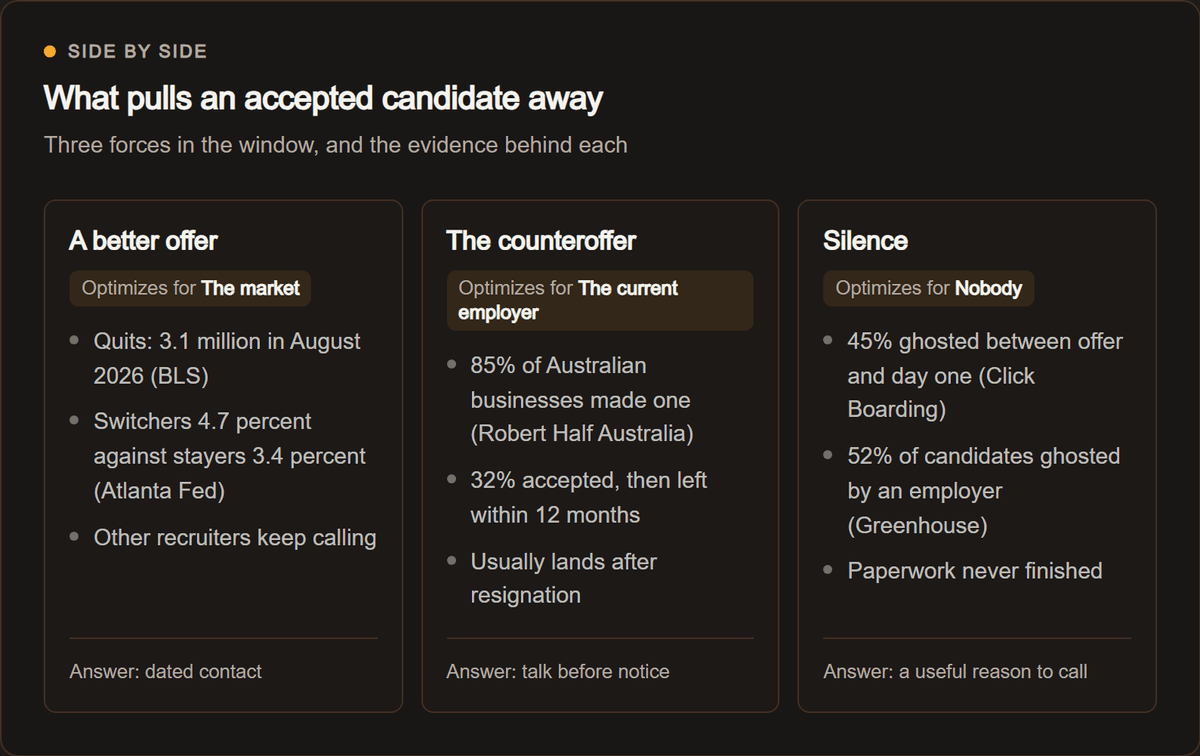
What the desk does: Assume the candidate is still on the market until the first shift is worked. Plan for three forces, a better offer, a counteroffer and silence, and give each one a scheduled answer.
What has to happen legally between the offer and the first day?
The window is also when the paperwork happens, and the paperwork works in your favor: every legal step is a legitimate reason to contact the candidate. The order matters, because several rules only allow a step after the offer is accepted, and some only after a conditional offer.
Form I-9 and E-Verify
The I-9 clock runs from acceptance to three business days after the start. USCIS's Handbook for Employers says the employee must complete Section 1 of Form I-9 no later than their first day of employment.12 An employer may not ask someone who has not accepted a job offer to complete Section 1.
Section 2 can be completed at any time between acceptance and three business days after employment begins. An employee who starts on Monday must have their documents reviewed on or before Thursday of that week. An employer may terminate an employee who fails to present acceptable documentation, or an acceptable receipt, within those three business days.12 The E-Verify User Manual says cases must be created no later than the third business day after the employee starts work for pay.13
For the desk, this means the I-9 request goes out on acceptance: not before, and not on the first morning. Where the agency is the employer of record for a temp, the agency owns these steps. Document rules change, as the EAD extension change covered earlier showed, so check the current handbook pages before each new hire cycle.
Background checks under the FCRA
A consumer report used for hiring has its own sequence. Under 15 U.S.C. 1681b(b)(2)(A), an employer cannot obtain a consumer report for employment purposes unless it has given a clear written disclosure, in a document that contains only the disclosure, and the candidate has authorized the check in writing.14 The FTC adds that this notice cannot sit inside an employment application.
Problems do turn up. HireRight's 2025 Global Benchmark Report says more than three-quarters of businesses found candidate discrepancies during screening in the last 12 months.15 HireRight sells screening, so treat that as a vendor's figure.
If a report comes back with a problem, a second sequence applies before the offer can be pulled. Under 15 U.S.C. 1681b(b)(3)(A), the employer must give the candidate a copy of the report and a written description of their rights before taking any adverse action based even partly on it.14 The FTC says this notice must include a copy of A Summary of Your Rights Under the Fair Credit Reporting Act. It must also explain the candidate's right to dispute the report's accuracy or completeness, and to get an additional free report if they ask within 60 days.16
Fair chance laws in New York City and California
In some places the criminal history check has to wait for the conditional offer, and the candidate gets time to respond.
New York City. The Commission on Human Rights says the Fair Chance Act does not change what criminal history information employers may consider.17 It changes when they may consider it. Under the Commission's adopted rule text, an employer that wants to revoke a conditional offer over criminal history must tell the applicant they have a reasonable time of at least five business days to respond.17 The rules also extend the time the employer must hold the position open from three to five business days from the applicant's receipt of both the inquiry and the analysis.17 The certified rule text does not print an effective date, so confirm when the revised rules apply before relying on them.
California. The Civil Rights Department's Fair Chance Act FAQ says an employer that decides to withdraw a job offer over criminal history must say so in writing, provide the conviction history report it relied on, and allow at least five business days to respond.18 The Act covers public and private employers with five or more employees, including union hiring halls, labor contractors, temporary employment agencies and client employers.18 Because temporary employment agencies are named, a staffing desk placing in California is inside the rule.
Medical questions and drug tests
The ADA also places some steps after the offer. The EEOC says that once an offer is made, an employer may ask disability-related questions and require medical examinations, and may condition the offer on the results.19 The ADA specifically states that tests for current illegal use of controlled substances are not considered medical examinations.19
For regulated driving roles there is a hard stop. Under 49 CFR 382.301, an employer cannot let a driver it intends to hire perform safety-sensitive functions until it has received a verified negative controlled substances test result.20 If the result is not back, the driver does not drive on day one, whatever the start date says.
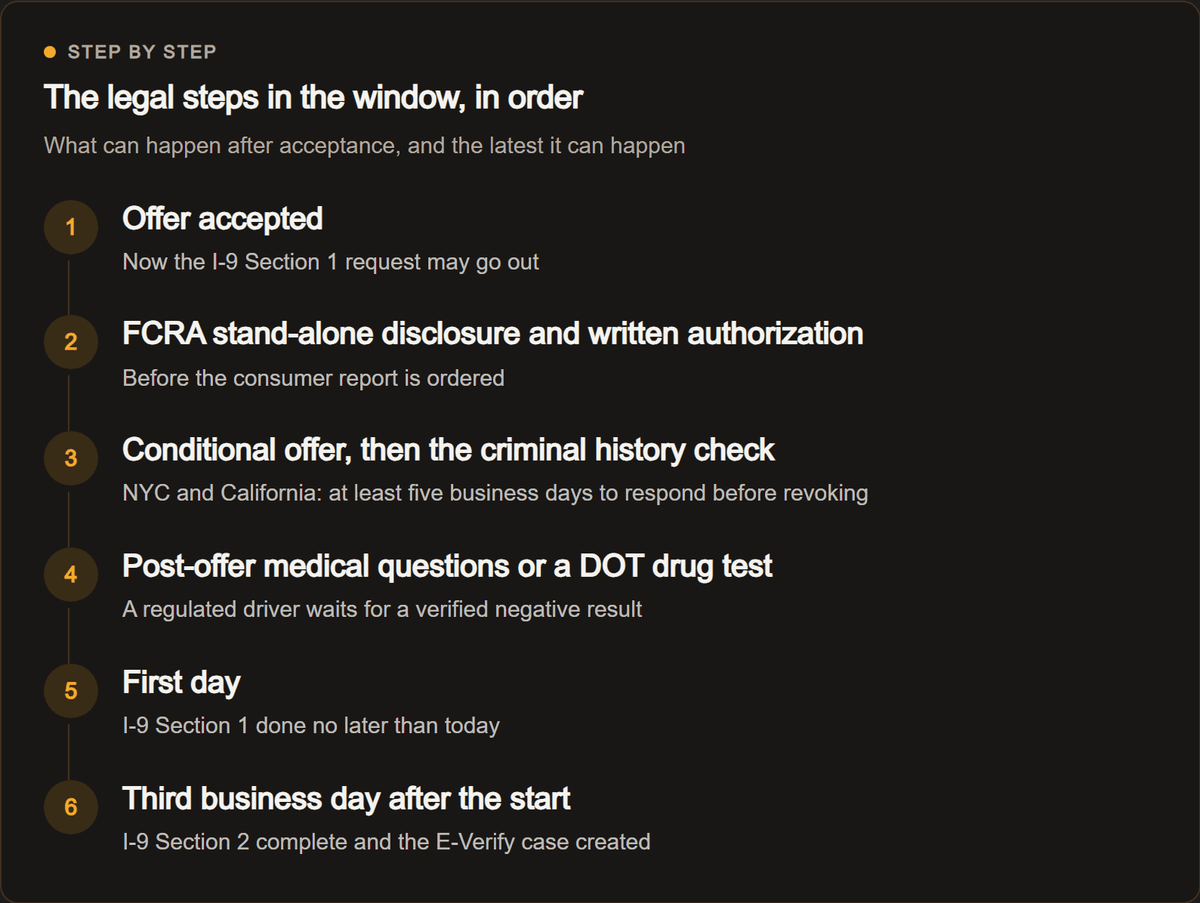
What the desk does: Put every one of these steps on the placement calendar the day the offer is accepted, with a date and an owner. Each step is a scheduled, useful reason to call the candidate.
How do you plan contact from acceptance to the first shift?
Contact in the window works best when it has a purpose. A call that only asks "are we still good?" invites a polite yes and tells you nothing. A call that books the drug test, confirms parking instructions or walks through the I-9 documents gets the candidate doing something for the new job. A candidate who is wavering tends to show it when asked to act.
None of the sources behind this article tested how often to call a placed candidate or what that does to dropout. The schedule below is a planning frame, not a measured rule. Adjust it to the length of the window and the role.
| When | What the recruiter does | What it confirms |
|---|---|---|
| Day of acceptance | Send the written offer recap, the I-9 Section 1 request and the FCRA disclosure | Start date and pay are agreed, and the paperwork has begun |
| Within two days | Call to talk through resignation and a possible counteroffer | There is a plan if the current employer responds |
| After resignation | Call the same day they resign | Whether a counteroffer came, and what the candidate said |
| Midway | Book any test, check or site induction | Logistics are moving and the candidate is acting on them |
| Three days before | Send the first-day details in writing | Address, time, contact name, dress code and documents to bring |
| Day before | Make a short call | The candidate is still coming, and how they are getting there |
| First morning | Call or text before the shift | They arrived, and the client knows who to expect |
| Third business day | Check that I-9 Section 2 and E-Verify are done | The hire is complete on paper |
The intake call is where this starts. When the client gives you a start date, ask how long their own onboarding steps take. That way the desk is not surprised by a client induction in the week of the start.
What the desk does: Write the contact schedule onto the placement record at acceptance, with the recruiter's name against each date. Treat a missed contact as a signal: call the candidate, and if you cannot reach them, tell the client early rather than on the morning of the start.
How do you handle a counteroffer before it lands?
The counteroffer usually arrives after the candidate resigns, so the time to talk about it is before. Before the resignation, ask what the candidate's current manager is likely to say, and what the candidate will do if the manager offers more money. Do not script their answer. The aim is for them to have thought about the question before it is asked in their manager's office.
Ask about notice too. We found no public source for a typical US notice period. For comparison, GOV.UK says a UK employee must give at least a week's notice if they have been in their job for more than a month.21 The notice period is when a counteroffer is most likely, so put its end date on the record.
Remind them, factually, why they took the new job. Most candidates give a reason at the screen: pay, hours, commute, the work or the manager. Write it on the record at the screen, and repeat it back now. If pay was the only reason, a counteroffer is a direct threat, and you should know that before the client does.
Share what is known about counteroffers, with care. Robert Half Australia reports that 85% of Australian businesses made a counteroffer to an employee in the past twelve months. Of those counteroffers, 32% were accepted with the employee leaving within 12 months. This is one staffing firm's survey of Australian businesses, so present it as that, not as a law of nature.
Will raising it plant the idea? Some recruiters worry that it will. None of the sources behind this article tests that. Most businesses in Robert Half Australia's sample had made a counteroffer in the past twelve months, so the idea is not a rare one. A recruiter who raises it first is more likely to hear about it.
What the desk does: Hold a short counteroffer conversation before resignation, record the candidate's reason for moving, and call on the day they resign.

What should you do in the last two days before the start?
Some first-day failures come down to missing information. A temp who does not know where to park, who to ask for or which documents to bring is a temp who turns around at the gate.
Send the first-day details in writing three days out. Include:
- The site address and the entrance
- The start time
- The name and phone number of the person meeting them
- What to wear
- What to bring for the I-9 document review
- How breaks and timekeeping work, if the client has told you
The first submittal and the client's notes often hold details the candidate never saw, so pull them through.
Call the day before. Keep it short and practical. Confirm the time, ask how they are getting there, and ask if anything has changed. If something has changed, you now have a day to fix it or to warn the client.
Check in on the first morning. Send a text before the shift and call after the first break. Together, these tell you whether they arrived and how it went. If they did not arrive, the earlier you know, the more time you have to find cover, which is a separate playbook.
What the desk does: Make the first-day pack a template and send it three days out. Log the day-before call and the first-morning check on the placement record.
How do you count your own falloff rate?
No public source gives a falloff rate for staffing placements, so the only number that matters is your own. Counting it is simple, and most desks have never done it.
Start with the last six months. Take every accepted offer. For each one, record whether the candidate started. If they did not, record when they dropped out:
- Before resignation
- After resignation
- After the paperwork began
- On the first day
- In the first weeks
Then split the list by whether the candidate was employed when they accepted. Finally, divide the starts by the accepted offers.
Use the number as a baseline. Record it before you change anything. Run the playbook for a quarter, then count again. The pattern of drop-offs shows what to fix:
- If most drops happen after resignation, the counteroffer talk needs work.
- If they happen on the first morning, the first-day pack needs work.
- If they happen before the paperwork, the contact schedule is not being followed.
Add it to the numbers you already track. The desk already runs on fill rate and days to fill. Add accepted-offer-to-start as one more line, and review it in the same meeting.
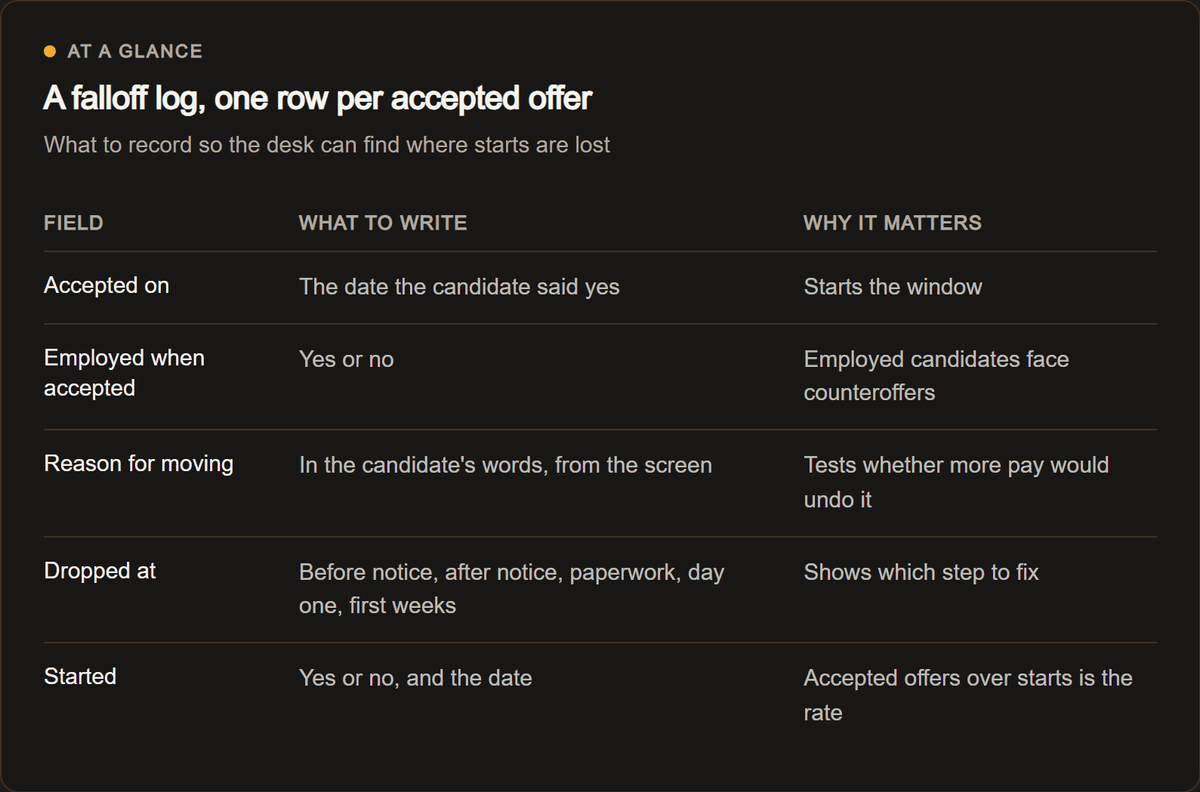
What the desk does: Build the log this week, back-fill six months, and write the rate down before the next review.
The window checklist
Use this for every accepted offer with a start date more than a few days out.
- Send the offer recap in writing on the day of acceptance.
- Send the I-9 Section 1 request after acceptance. It is due by the first day.
- Collect the FCRA stand-alone disclosure and written authorization before ordering any check.
- Where a fair chance law applies, run the criminal history check only after the conditional offer. In New York City and California, allow at least five business days to respond before any revocation.
- Book any DOT pre-employment drug test so a verified negative result is back before the first safety-sensitive duty.
- Hold the counteroffer conversation before the candidate resigns, and record their reason for moving.
- Call on the day of resignation.
- Send the first-day pack three days before the start.
- Log the day-before call and the first-morning check.
- Complete I-9 Section 2 and the E-Verify case by the third business day after the start.
- Record the start in the falloff log, or record the drop with its stage.
Conclusion: keep the placement until the first shift
An accepted offer is the moment the desk relaxes, and that is why the window deserves a plan. The recruiter has done the sourcing, the screening and the offer conversation, and the next search is already waiting. Meanwhile the candidate is still on the market, and the client is counting on a start date.
The surveys disagree on size, but agree on location. No public source gives a falloff rate for staffing placements, and the general-workforce figures vary with who was asked and how. Still, they point to the same place: the gap between yes and the first day. Three forces pull candidates away there. A better offer comes from the market, a counteroffer comes from the current employer, and silence comes from a desk that has moved on.
Each force has a scheduled answer. Dated contact answers the better offer. A counteroffer conversation before resignation, plus a call on the day the candidate resigns, answers the counteroffer. A useful reason to call answers silence. The legal steps supply those reasons: the I-9 request, the FCRA disclosure, any fair chance process, the drug test and the first-day pack. Each one is something the candidate has to act on, and a wavering candidate tends to show it when asked to act.
Treat the accepted offer as a short project. Give it a calendar, with a date and a named owner against every step. Keep it on the recruiter's active list until the candidate has worked the first shift, not until they said yes.
Then count what you lose. Record every accepted offer, whether it started, and the stage at which any drop happened. Your own start rate is the only number that matters here. The desk that knows it can see which step is failing, whether that is the counteroffer talk, the contact schedule or the first-day pack, and fix that step first.
How Hivemind handles candidates from inbound to offer
The steps in this playbook are the recruiter's: the counteroffer conversation, the calls, the judgement about whether a candidate is wavering, and the legal sequence the agency and its counsel own. No system makes those calls, and nothing here says one does.
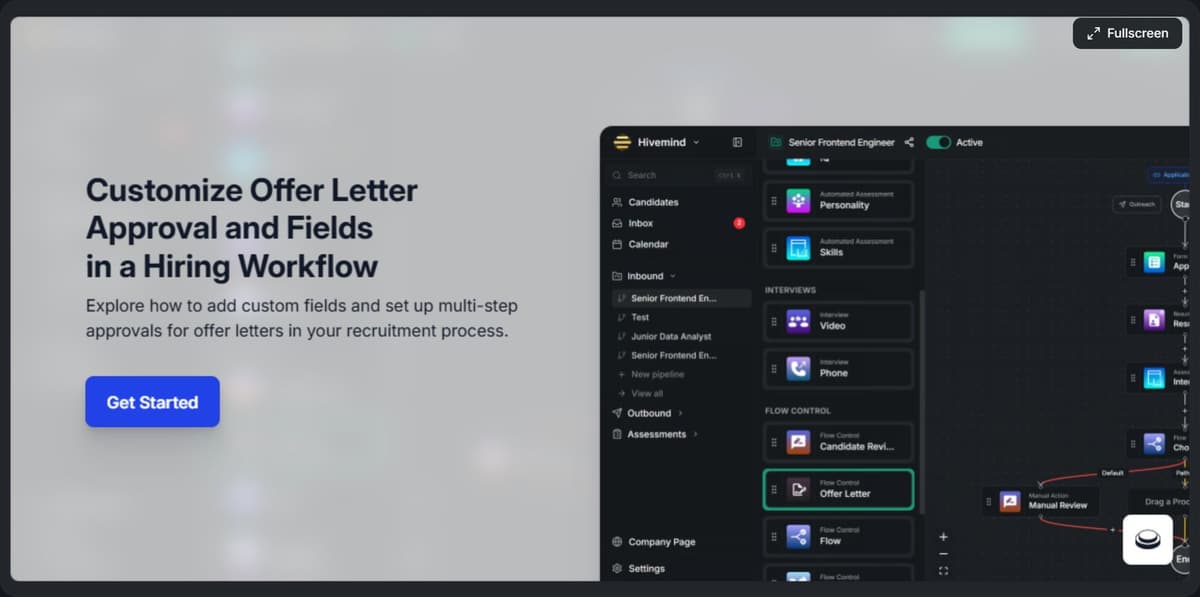
Around them sits the rest of the hiring work: sourcing, screening, interviews, offers, and the admin around them. Hivemind is the hiring OS: manage every candidate from inbound to offer in one unified workflow. Among its modules are Automated Emails: Smart Email Automation for Recruitment, and SMS Follow-Ups: Automated Candidate Text Messaging.
A team can run Hivemind end to end, connect your existing tools, or mix and match both. Hivemind has 15 Native Modules and 275 Integrations, so a desk can build the exact pipeline its team deserves.
Frequently asked questions
How common is it for a candidate to back out after accepting an offer?
Gartner reported that 33% of candidates in its July to September 2024 survey backed out after accepting an offer, down from 49% in October 2023.3 Other surveys ask different questions of different people, and no public source gives a rate for staffing placements. A desk should count its own accepted offers against starts.
When should a recruiter send the Form I-9?
After the offer is accepted. USCIS says an employer may not ask someone who has not accepted a job offer to complete Section 1. The employee must complete Section 1 no later than their first day of employment, and Section 2 must be completed within three business days of the date employment begins.
Can a staffing agency run a background check before the offer?
The FCRA requires a stand-alone written disclosure and the candidate's written authorization before a consumer report is obtained for employment. In New York City and California, the criminal history check comes after a conditional offer, and the candidate gets at least five business days to respond before the offer is revoked. Check the rules in every state and city where you place candidates.
Does a placement guarantee cover a candidate who never starts?
Usually not. The one staffing firm source used for this article, Frontline Source Group, describes a warranty for a placed hire and a refund window that runs from the start date. A candidate who never starts falls outside them. Your own client contract decides what applies.
Should a recruiter talk about counteroffers before the candidate resigns?
Yes, briefly and without scripting the answer. Robert Half Australia reports that 85% of Australian businesses made a counteroffer to an employee in the past twelve months. If you ask the candidate in advance what they would do if one came, you are likely to hear about it first.
How long does a DOT driver have to wait before driving?
Until a verified negative controlled substances test result has been received. Under 49 CFR 382.301, an employer may not let a driver it intends to hire perform safety-sensitive functions before then. Book the test early enough that the result is back before the start date.
Sources
- Frontline Source Group: What a staffing agency placement warranty actually covers ↩
- American Staffing Association: Staffing industry statistics ↩
- Gartner: Gartner HR research finds 63% of prospective candidates received a job offer in 3Q24, 16 December 2024 ↩
- Click Boarding: How ghosting is reshaping connection, 2026 ↩
- Resume.org via PRWeb: 1 in 10 employers refuse to hire Gen Z candidates due to ghosting, 25 June 2025 ↩
- CIPD: Over a quarter of UK employers have been ghosted by new recruits on day one, 25 September 2024 ↩
- SHRM: 2025 Talent Trends ↩
- US Bureau of Labor Statistics: Job Openings and Labor Turnover Survey news release and JOLTS Table 4, quits by industry ↩
- Federal Reserve Bank of Atlanta: Wage Growth Tracker ↩
- Robert Half Australia: Counteroffers ↩
- Greenhouse: 2024 Greenhouse Candidate Experience Report ↩
- US Citizenship and Immigration Services: Handbook for Employers M-274, completing Section 1 and completing Section 2 ↩
- E-Verify: User Manual, create a case ↩
- US Government Publishing Office, United States Code: 15 U.S.C. 1681b ↩
- HireRight: HireRight releases 2025 Global Benchmark Report ↩
- US Federal Trade Commission: Using consumer reports: what employers need to know ↩
- New York City Commission on Human Rights: Fair Chance Act legal guidance and 2025 Fair Chance rule revisions, certified text ↩
- California Civil Rights Department: Fair Chance Act FAQ ↩
- US Equal Employment Opportunity Commission: Enforcement guidance on preemployment disability-related questions and medical examinations ↩
- Electronic Code of Federal Regulations: 49 CFR 382.301 ↩
- GOV.UK: Handing in your notice ↩