

A staffing supplier in an MSP VMS program gets paid for measured performance. The relationship no longer decides who gets work. When a client moves its contingent spend into a managed service program, a rate card or markup cap sets the price. A program fee comes out of the supplier's side. A scorecard then decides who keeps receiving orders. It measures submittal speed and fill rate. It also measures retention.
Key takeaways
- Inside an MSP or VMS program the price is set by a rate card or a markup cap, and the next order goes to the supplier the scorecard favours.
- In North America, SIA reports 90% of MSP spend is associated with supplier-funded arrangements, so the fee usually comes off the supplier's margin.
- Massachusetts PRF85 sets a resume submittal goal of 3 Days with a target of 95% of requisitions, so speed to a strong first submittal is the lever a supplier controls.
- Ask before you join: is the program vendor-neutral or tiered, what is the rate card and fee, which measures are on the scorecard, and how are supplier payments held.
- Track your own scorecard every week on the program's definitions instead of waiting for the formal review.
This guide is for the VP of Operations at a staffing firm with around 60 recruiters. Your largest client has just moved its contingent spend into a managed program, or is about to. The guide explains what changes for your firm.
It covers how big the model is and who pays the fee. It shows how rate cards and markup caps work. It explains what the scorecard measures. It also looks at how tiers and release delays decide who sees an order first. Finally, it shows where the money risk sits and what to ask for before you sign.
A note on sources: The clearest evidence comes from public-sector programs, because their contracts are public documents. These include programs in Massachusetts, Tennessee, Virginia, Georgia and Arizona. Private programs rarely publish their terms, so those come from the annual filings of public staffing companies and from industry research. Where a source is a vendor describing its own product or market, the guide says so.
In this article
- What are MSP and VMS programs, and how much spend runs through them?
- Who pays for an MSP program?
- How do rate cards and markup caps set the price?
- What does a supplier scorecard measure?
- How do tiers and release windows decide who sees an order first?
- Does the relationship still matter inside a program?
- What changes in the first quarter after a client moves into a program?
- Where is the money risk for a staffing supplier?
- What should a staffing firm ask before it joins a program?
- How should a desk change its operating rhythm for program work?
- Conclusion: read the contract, then work the scorecard
- Frequently asked questions
What are MSP and VMS programs, and how much spend runs through them?
A managed service provider (MSP) runs a client's contingent labor program. It takes the client's requests and sends them to staffing suppliers. It collects candidates, manages the paperwork and reports on supplier performance.
A vendor management system (VMS) is the software the program runs in. The two are often sold together, but they are different things. The MSP is a service, and the VMS is a system.
Staffing firms that run programs describe them plainly in their own filings. TrueBlue says its MSP solution covers vendor selection, performance management, payrolling, compliance monitoring and risk management.1 Kforce says VMS tools aggregate spend and measure supplier performance.2 Vendor selection and measured supplier performance sum up what changes for a supplier.
The model is large and concentrated. MSP spend under management rose 4% to $244 billion globally in 2025, according to SIA.3 That is its strongest growth since 2022. The study covered 34 MSPs, which represent 88% of global spend under management.3 The seven largest MSPs account for more than 70% of it.3 Spend through vendor management systems rose 7% to $303 billion.3 SIA's latest data shows that 57% of staffing buyers use an MSP.3
For a firm with 60 recruiters, the takeaway is simple. If your large accounts are not in a program yet, they probably will be. Most buyers in SIA's data already use one, and a small number of MSPs run them. Programs decide how much of the demand in the Q4 staffing outlook reaches a mid-sized supplier.
The program can also be run by a staffing company that competes with you. In Massachusetts, Kelly Services manages the state's temporary help contract under PRF85.4 Kelly notes in its filing that, as a client's MSP, it may not be one of the underlying staffing providers. It also says large customers may not select or keep it as their MSP. Kelly adds that some companies want a single supplier to manage all their contingent talent demand.5
Public buyers outside the US use the same shape. The UK Crown Commercial Service buys its managed service provider as a single supplier.6 That supplier must deliver the full scope of the framework.
What to do now: Find out which of your clients run a program. Then find out which MSP runs each one and which VMS it uses. Put those three names on the account record.
Who pays for an MSP program?
In most programs, the supplier pays. SIA reports that 90% of MSP spend in North America is tied to supplier-funded arrangements.3 It also reports that 74% of MSP clients use a fee calculated as a percentage of spend. Airswift says most MSP programs are supplier-funded, so the staffing suppliers pay the provider and the client does not.7 KORE1 puts the share of percent-of-spend programs at 80%, based on its reading of Staffing Industry Analysts benchmarks. KORE1 is a staffing firm, so treat that number as its interpretation and not as SIA's own.
The fee is usually a small share of revenue. Kforce says administrative fees from MSPs, VMOs and VMS providers typically run from 1% to 4% of revenue.2 Arizona prints its fee exactly. Its MSP program charges vendors a 0.74% vendor-funded administrative fee.8 Cooperatives pay an extra 2% State administrative fee. That figure comes from the MSP's own vendor training deck for the State of Arizona.
Some programs build the fee into the client's price instead of deducting it from the supplier. Tennessee told bidders that the MSP fee is included in the bill rate the end user pays for each rate card role.9 It asked for a fixed fee, covering all VMS costs, for the full 84-month contract term.9 But when the bill rate is capped, a fee inside it still sits under a fixed ceiling. The cost lands on the supplier either way.
The model is under some pressure. SIA says supplier funding can cause pushback. It also says fee models that reflect outcomes, not transaction volume, are being discussed.3 That is only a discussion. None of the sources for this guide show a program that has moved to outcome-based fees.
What to do now: Model the fee against your gross margin per placement before you accept a program. A fee of 1% to 4% of revenue comes out of gross profit, not out of revenue you can spare.
How do rate cards and markup caps set the price?
Inside a program, the client sets the price ceiling through the MSP. Suppliers compete beneath it. There are two common ways to set that ceiling.
The first is a markup cap. PRF85 caps the hourly rate charged to a Commonwealth hiring entity at a maximum markup of 36.5% of the worker's hourly pay rate.4 The supplier sets the pay, and the bill rate follows from it, up to the cap.
The second is a maximum bill rate. Under Tennessee's pro forma, the contractor is paid on a maximum bill rate from the rate card.9 It may submit a lower rate but never a higher one. Allegis describes this as the client setting a maximum bill rate for given roles.10 Allegis runs MSP programs, so this is a provider's view of its own market.
Workers do not negotiate inside these structures. Virginia's IT contingent labor policy bars workers from negotiating their hourly rate with the agency.11 It states that hourly rates are based on contractual rate cards. Virginia also made its IT contingent labor contract mandatory for IT-related work at executive branch agencies and covered institutions of higher education.11 A supplier that wants that work has to be inside the program.
The MSP's job includes holding the line. OMNIA Partners, a cooperative purchasing organisation that writes for public buyers, says an MSP consolidates the supplier base and enforces rate card compliance.12 It also standardizes and manages supplier markups across contracts.
Squeezing too hard has a cost. Allegis warns that when a client dictates the markup, the best suppliers may opt out.10 The client is then left with sources that deliver candidates more slowly or with lower quality. That is a provider's warning to its own clients. It is also a supplier's best argument in a rate card review.
| Pricing term | Example in a public program | Effect on the supplier |
|---|---|---|
| Markup cap | PRF85: maximum markup of 36.5% of the hourly pay rate | Pay and markup must fit under the cap |
| Maximum bill rate | Tennessee: a rate lower than, but never above, the maximum | The bill rate is fixed above, and margin is what is left |
| Fee in the bill rate | Tennessee: MSP fee included in the bill rate | The fee sits inside the ceiling |
| Vendor-funded fee | Arizona: 0.74% vendor-funded administrative MSP fee | Deducted from the supplier's side |
| Rate card for workers | Virginia: no negotiation of hourly rates | No room to buy a candidate with pay |
What to do now: Get the rate card, the markup cap and the fee in writing before you submit anyone. Check that the pay rate the candidate expects fits under the ceiling with your margin intact. If it does not, decline the order early instead of submitting at a loss.
What does a supplier scorecard measure?
The scorecard is where the program decides who gets the next order. SIA says SLAs and KPIs are the building blocks of a supplier scorecard.3 Its research director writes that suppliers are held to specific KPIs, often centered on time to fill.3
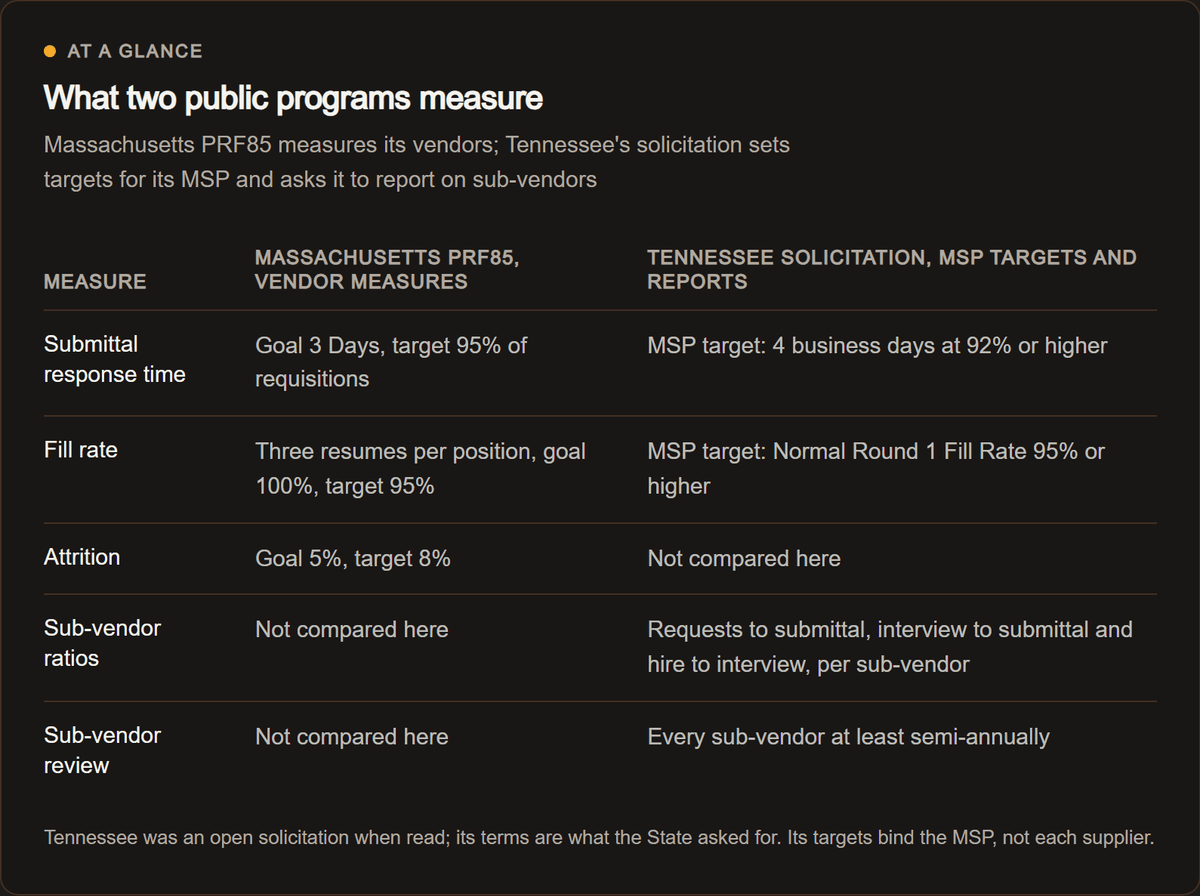
Massachusetts publishes its measures with goals and targets. PRF85 measures vendors on resume submittal response time. The goal is 3 days, and the performance target is 95% of requisitions. Where requested, a vendor must submit at least three resumes for every position. That is measured as a Request Fill Rate, with a goal of 100% and a performance target of 95%.4 PRF85 also sets an attrition goal of 5% and a performance target of 8%.4 This covers unplanned turnover not caused by the Commonwealth.
Tennessee's solicitation shows what a state asks an MSP to report about each supplier. The sub-vendor scorecard report must show three ratios for each sub-vendor: requests to submittal, interview to submittal, and hire to interview. The pro forma contract has the MSP evaluate every sub-vendor at least twice a year. The State then decides which sub-vendors may keep providing staffing services.9 Tennessee holds its MSP to a resume submittal response time of 4 business days at 92% or higher.9 It also sets a Normal Round 1 Fill Rate target of 95% or higher, which counts fills from the first round of resumes sent to the requestor.9 This document was still an open solicitation when the guide was researched. Read its terms as what the State asked for, not as a signed contract.
The client's view of the worker is collected too. In Virginia's IT contingent labor program, the VMS emails the engagement manager a survey on the worker's performance. It goes out after 30 days, after six months, and every year after that. Georgia's workflow ends each engagement with an evaluation completed in the VMS, and that evaluation is fed back to the supplier.13
Early rejection is also cheap for the client. Tennessee's pro forma lets an end user reject a placed worker within five business days and pay nothing for that worker's services.9 A poor fit in the first week means a week of the supplier's pay costs with no bill behind it.
Low scorecard numbers are read as a signal about the whole program, not just one supplier. Hays says low fill rates can point to inefficient processes, rate card issues, poor-performing suppliers or other basic problems in a program.14 Hays runs programs as well as supplying them, so this is a provider's view. It is still useful. A supplier with a low fill rate on a role should check whether the rate card is the cause before accepting the blame.
What to do now: Get the program's scorecard measures in writing, with the goals and targets. Track your own numbers on the same definitions every week. A supplier that learns its score at the quarterly business review has already lost a quarter.
How do tiers and release windows decide who sees an order first?
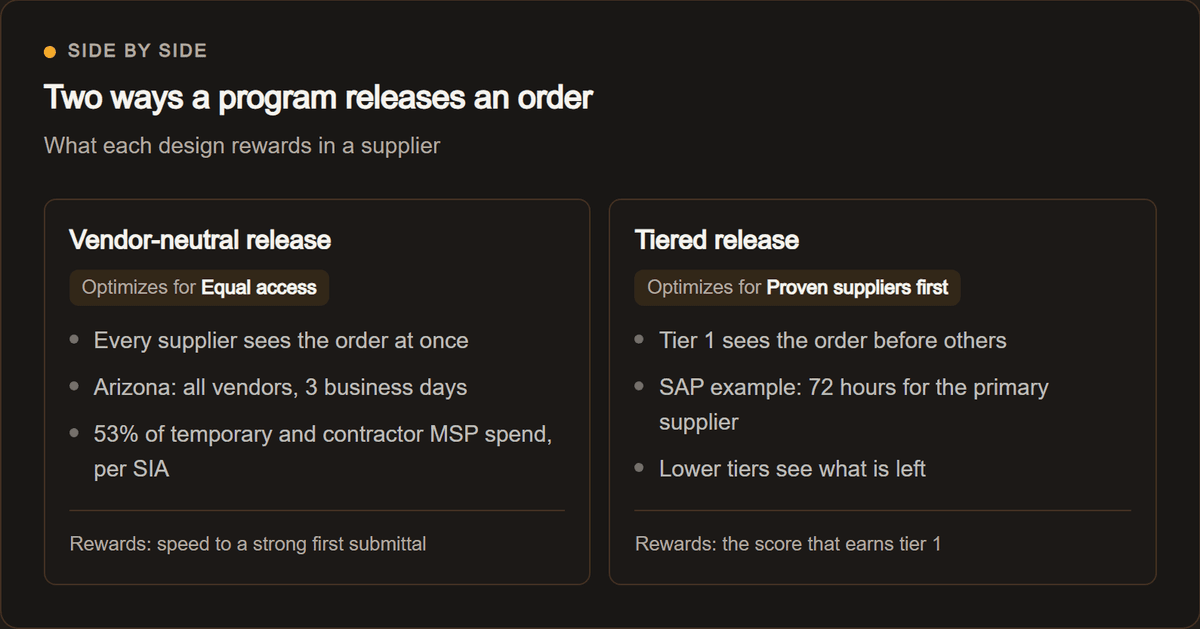
In a program, who sees the order first often matters more than who has the best candidate. The submittal window is short. Arizona's MSP sends resumes to the hiring manager for review within 4 business days.8 In Arizona's multi-temporary staffing program, the MSP releases a posting to all vendors serving that labor category at the same time for 3 business days.8 In Georgia's statewide contingent labor workflow, the MSP account manager screens candidates.13 The manager then forwards qualified ones to the agency within four business days.
Many programs go further and tier their suppliers. No public program found for this guide prints a tier cutoff or the score that moves a supplier between tiers. The mechanics here come from the VMS vendors' own product documentation.
SAP Fieldglass training material says supplier tiers identify when and if certain suppliers get priority over others for job postings.15 Its example gives a primary MSP supplier the postings before any other supplier for 72 hours.15 Beeline's VMS documentation says that inviting suppliers to a job posting later requires at least two tiers in a group.16
A supplier in a lower tier sees what is left. KORE1 is a staffing firm. It writes from its experience as a second-tier supplier in master vendor programs. The requisitions it received were the ones the primary supplier could not fill. That is one firm's account. It still shows the economics of a release delay: the harder orders reach the second tier.
Some programs are built to avoid that. Massachusetts PRF85 expects every pre-registered staffing supplier to get an equal opportunity to fill each request.4 The MSP may not give preference to a specific supplier. Tennessee's 2026 MSP solicitation requires every sub-vendor network to be sub-vendor neutral.9 That means no preference to any member, and open positions go to all members of the network. The same solicitation limits an MSP and its affiliates to no more than ten percent of the contingent workers in any job category. Payrolled workers are excluded from that cap. SIA reports that vendor-neutral programs account for 53% of temporary and contractor MSP spend globally.3
Release rules are also being adjusted for quality. An SIA council director reports hearing of organizations changing how they release roles. The aim is for suppliers to focus on quality instead of volume. That is a report of a direction, not a measured shift.
What to do now: Ask the MSP whether the program is vendor-neutral or tiered. Ask what the release delay is between tiers. Ask which measures move a supplier up or down. Then put a named recruiter on every new order in that program within the first hours of release.
Does the relationship still matter inside a program?
It matters less than it used to, and in a different place. In a vendor-neutral program like PRF85, the MSP may not prefer a supplier. A hiring manager's goodwill no longer routes the order to you.
The staffing companies that supply programs say what this does to them. Kforce says an MSP that combines a client's services into one program can bring significant buying power, and so pricing power.2 Kforce reports that client use of MSPs has in some cases compressed its gross margin.2 It has also led to added client share through vendor consolidation.
Kelly Services warns that large customers have shifted from relying on a few staffing partners to using a network of talent providers.5 It adds that moving from single-sourced to competitively sourced contracts may substantially reduce its future revenue from those customers.
MSPs are also building their own sources of talent. SIA reports that 91% of participating MSPs offer direct client sourcing.3 They do this through MSP-curated talent pools or candidate and project marketplaces. A supplier now competes with other suppliers. On some roles, it also competes with the program's own pool.
The relationship moves to two places. The first is the MSP's program team. They see your scorecard and handle your escalations. The second is the hiring manager's survey and end-of-assignment evaluation, which put that manager's view on record. Your account manager's job becomes making sure the people who fill in those forms rate your workers well.
What to do now: Name an owner for each program relationship, separate from the client account owner. Review the program's scorecard with the MSP's team every month instead of waiting for the quarterly review.

What changes in the first quarter after a client moves into a program?
The move usually feels sudden from the supplier side. Last month, the hiring manager called your account manager with an order. This month, the order arrives as a requisition in a VMS. It reaches every other supplier in your tier at the same moment. It comes with a rate card attached and a window that closes in days. The work is the same, but the order of operations has changed. The first quarter decides your score.
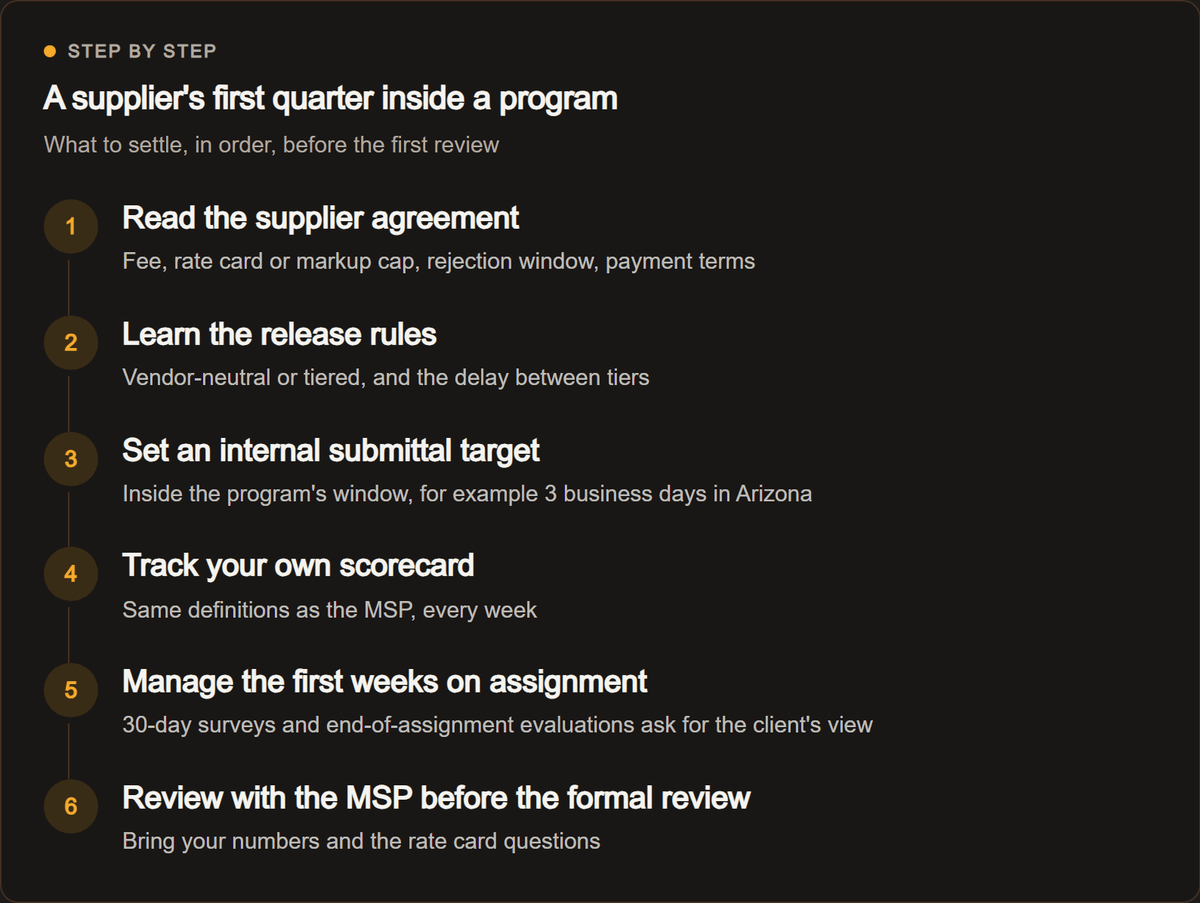
Weeks one and two: onboarding and paperwork. The MSP will send a supplier agreement, a rate card or markup schedule, and the program's rules. Ask every question now, because the answers are cheapest to get before your first submittal. Check the fee and the free rejection window against a real placement. Then decide whether the program pays.
Weeks three to six: the first orders. Expect a test. In a vendor-neutral program like the one Arizona's MSP describes, the posting goes to all vendors in the labor category at the same time for 3 business days. Your first submittals are measured against every other supplier's from the first hour. In a tiered program, you may start in a lower tier and see the orders the primary supplier did not fill. Either way, speed to a strong first submittal is the lever you control.
Weeks seven to twelve: the first score. The MSP will start reporting your numbers on its own definitions. Tennessee's solicitation asks the MSP to show three ratios for each sub-vendor: requests to submittal, interview to submittal, and hire to interview.9 It also asks the MSP to evaluate every sub-vendor at least twice a year. If your program works the same way, your first review covers orders you worked while still learning the rules. That is why the rules are worth learning first.
Two habits make the first quarter easier. First, keep your own copy of every requisition, submittal and outcome. That lets you check the MSP's numbers against yours. Second, keep hiring managers informed about your workers after the start. Virginia's 30-day survey and Georgia's end-of-assignment evaluation both ask for that view.11 Both are filled in by people who remember how the first weeks went.
What to do now: Write a first-quarter plan for each new program, with an owner for each step. Hold the first review with the MSP's team yourself instead of waiting to be called.
Where is the money risk for a staffing supplier?
Programs move money through a third party. That adds a risk the supplier did not carry before.
The American Staffing Association (ASA) warns that payments flow through an MSP or VMS provider.17 If the provider is financially unsound, buyers and suppliers both face financial risk. ASA notes that several MSP and VMS providers went bankrupt during the 2007 to 2010 industry downturn.17 That harmed the buyers and staffing agencies that supplied them. ASA recommends that contracts allow the provider to use money paid by buyers only to pay agencies.17 The provider should not be able to use it as collateral for loans.
The other money risk is margin. Several costs come out of the same gross profit. A markup cap or a maximum bill rate limits what you can charge. A fee of 1% to 4% of revenue comes off the top. A free rejection window, like the five business days in Tennessee's solicitation, means you can pay a worker and bill nothing.
Each of these is small on its own. Together, they can hurt. On a role where the candidate's expected pay sits close to the ceiling, a placement can hit every scorecard target and still lose money.
What to do now: Ask how supplier payments are held and when they are paid. Ask for the provider's financial standing where it is not public. Then model each program's fees and caps against a real placement before you accept it.
What should a staffing firm ask before it joins a program?
Most supplier agreements are offered on the MSP's paper. The questions below can still be answered. A program that will not answer them has told you something.
| Question | Why it matters | Where the answer usually is |
|---|---|---|
| Is the program vendor-neutral or tiered? | Decides who sees an order first | The program's supplier guide |
| What is the release delay between tiers? | A 72-hour head start changes what reaches you | VMS configuration, via the MSP |
| What is the rate card, markup cap or maximum bill rate? | Sets your ceiling | The rate card and the supplier agreement |
| What is the fee, who funds it, and is it in the bill rate? | Comes off your margin | The supplier agreement |
| Which measures are on the scorecard, with goals and targets? | Decides future orders | The scorecard definitions |
| How often are suppliers reviewed, and what happens on a low score? | Tells you how much time you have | The program's governance terms |
| What is the free rejection window? | A cost if the fit is wrong | The supplier agreement |
| How are supplier payments held and paid? | Protects you if the provider fails | The payment terms and ASA's guidance |
| What are the conversion and payroll fees? | Matters if you place payrolled or temp-to-hire work | The rate schedule |
The governance terms also show how a program treats a provider that underperforms. In Tennessee's pro forma, an MSP that shows little or no improvement at a second quarterly review is placed on probation.9 It then has one more quarter to improve its overall service score. That probation applies to the MSP itself. Ask what the review clock is for suppliers inside your program.
What to do now: Take this table to the MSP's supplier onboarding call and get the answers in writing. File them on the account so the next recruiter reads the same rules.
How should a desk change its operating rhythm for program work?
Program work rewards a different rhythm from relationship work. Three habits matter most.
First, speed to the first strong submittal. Release windows of three or four business days mean the first day decides most of the outcome. The intake discipline still applies, but intake is now a written requisition. Questions go to the MSP instead of the hiring manager. Read the requisition and check it against the rate card. Then decide within hours whether you can fill it.
Second, submittal quality over volume. Scorecards track interview-to-submittal and hire-to-interview ratios. An SIA council director also reports hearing of organizations adjusting how they release roles so that suppliers can focus on quality instead of volume.3 A submittal that gets interviews protects the ratios as well as the placement.
Third, retention after the start. Attrition targets, 30-day surveys and end-of-assignment evaluations all look at this stretch. The first weeks on assignment are now part of the sale.
What to do now: Run program orders as a separate queue. Give it its own morning check. Set a time-to-submittal target based on the program's window. Review the scorecard weekly.
Conclusion: read the contract, then work the scorecard
An MSP or VMS program changes what a client pays a supplier for. Inside a program, a rate card or a cap sets the price. In most of the market, a fee comes off the supplier's side. The next order goes to whoever the scorecard favors. The relationship does not disappear. It moves to the program team and to the forms the hiring manager fills in.
Read the contract first. Everything a supplier earns is shaped by terms set before the first order arrives. The markup cap or maximum bill rate sets your ceiling. The fee comes out of the same gross profit. The rejection window can leave you paying a worker with nothing billed. The release rules decide who sees an order first. Public programs print most of these terms, so use them as a guide to what to ask for. Where a private program does not publish its terms, ask for them in writing and file the answers where every recruiter can find them.
Then work the scorecard. The scorecard decides who keeps receiving orders. Learn the program's measures and track your own numbers on the same definitions every week. Do not wait for the MSP's quarterly review to tell you where you stand. Submit fast and well inside the release window. Then follow your workers through the first weeks on assignment, because surveys and evaluations ask how they went.
The supplier that wins inside a program does these things consistently. It knows the contract, knows its own numbers, and treats the program as a separate way of working.
Pick your largest program account. Get the rate card, fee, release rules and scorecard measures in writing. Then set up a weekly review of your own numbers.
How Hivemind handles the hiring work on every order
The decisions in this guide stay with the staffing firm: which programs to join, how to price under a cap, how to staff a desk for release windows and how to read a scorecard. No system makes those decisions, and nothing here says one does.
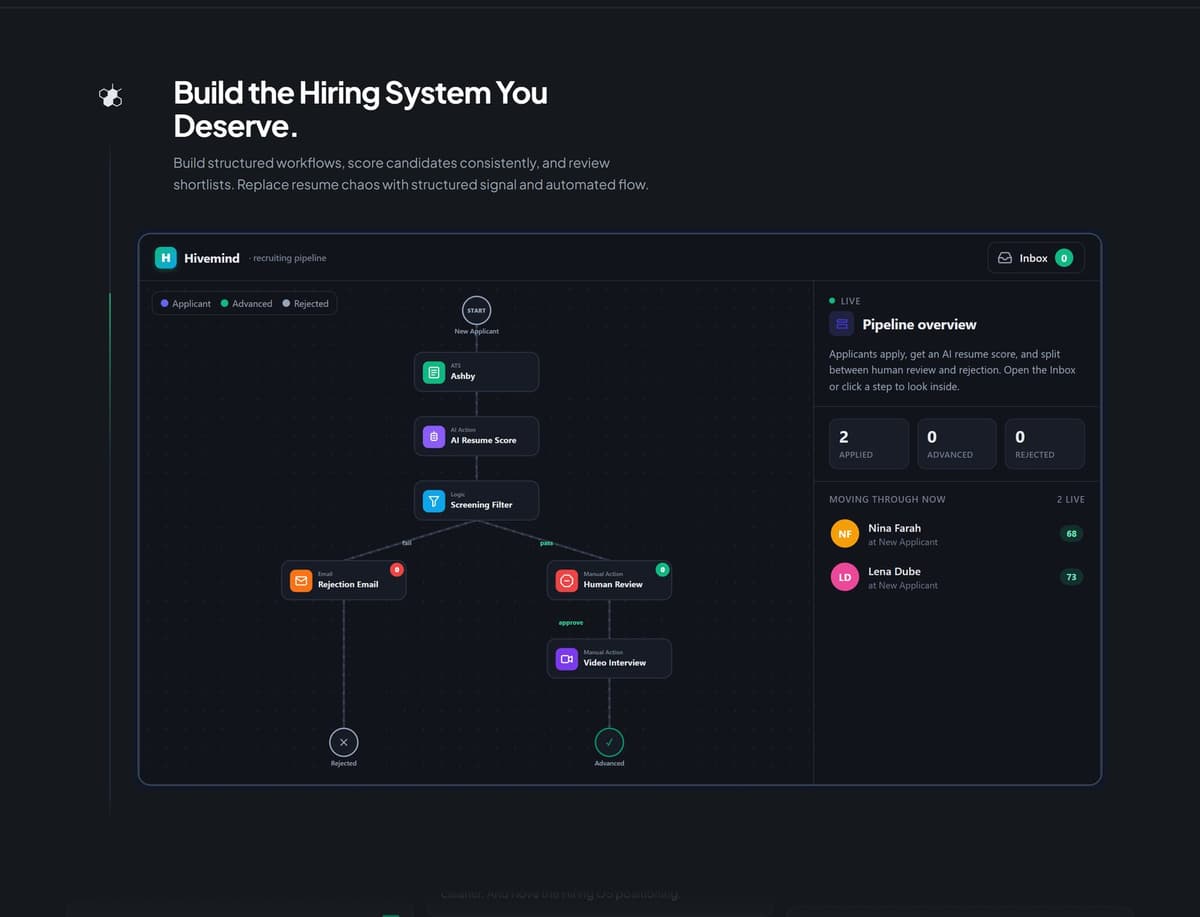
Around them sits the hiring work a recruiter does on every order: sourcing, screening, interviews, offers, and the admin around them. Hivemind is the hiring OS: manage every candidate from inbound to offer in one unified workflow, with Resumatic: AI-Powered Resume Filtering System, Automated Skills Assessments and Automatic Video Assessment: AI-Powered Video Interview Analysis among its modules.
A team can run Hivemind end to end, connect your existing tools, or mix and match both. Hivemind has 15 Native Modules and 275 Integrations, so a desk can build the exact pipeline its team deserves.
Frequently asked questions
What is the difference between an MSP and a VMS? An MSP is a service provider that runs a client's contingent labor program. A VMS is the software the program runs in. TrueBlue says its MSP solution covers vendor selection, performance management, payrolling, compliance monitoring and risk management. Kforce says VMS tools aggregate spend and measure supplier performance.
Who pays the MSP fee? In most North American programs, the supplier pays. SIA reports that 90% of MSP spend in North America is tied to supplier-funded arrangements. Kforce says MSPs, VMOs and VMS providers typically charge staffing firms administrative fees of 1% to 4% of revenue.
What is a vendor-neutral MSP program? It is a program where the MSP sends open positions to every supplier without preference. SIA reports that vendor-neutral programs account for 53% of temporary and contractor MSP spend globally. Massachusetts PRF85 expects every pre-registered supplier to get an equal opportunity to fill each request.
What does a supplier scorecard measure? It usually measures submittal speed, fill rate and turnover. Some also track the ratios between submittals, interviews and hires. Massachusetts PRF85 sets a resume submittal goal of 3 days, with a target of 95% of requisitions.4 It also sets an attrition goal of 5%, with a target of 8%.
How does a supplier move up a tier? No public program found for this guide prints the score that moves a supplier between tiers. Ask the MSP which scorecard measures decide tiering. Also ask what the release delay is between tiers.
Is an MSP program a financial risk for a staffing supplier? It can be. The American Staffing Association (ASA) warns that payments flow through an MSP or VMS provider. If that provider is financially unsound, suppliers face financial risk. ASA recommends that buyer payments for agency services be used only to pay agencies.
Sources
- TrueBlue, Inc.: Form 10-K for 2025 ↩
- Kforce Inc.: Form 10-K for 2025 ↩
- Staffing Industry Analysts: Global MSP spend rises 4% to $244B, VMS spend rises to $303B, Healthcare MSPs move beyond administration, Maximize VMS efficiency with your suppliers' feedback, SLAs and KPIs: reporting metrics that matter and The real test of a supplier partnership ↩
- Commonwealth of Massachusetts, Operational Services Division: PRF85 Enterprise Temporary Help Services contract user guide ↩
- Kelly Services, Inc.: Form 10-K for 2025 ↩
- Crown Commercial Service, Find a Tender: Workforce framework notice 007255-2024 ↩
- Airswift: MSP pricing guide ↩
- Knowledge Services, MSP for the State of Arizona: Vendor training presentation ↩
- State of Tennessee, Central Procurement Office: RFP 32110-38726, MSP Contingent Workforce and Amendment 5, questions and clarifications ↩
- Allegis: Bill rates versus markup ↩
- Virginia Information Technologies Agency: IT contingent labor policy ↩
- OMNIA Partners: Contingent labor services for public sector: a buying guide ↩
- Georgia Department of Administrative Services: Statewide contingent labor workflow, May 2024 ↩
- Hays: Key metrics for a contingent workforce MSP ↩
- SAP: Exploring job posting distribution lists, SAP Fieldglass ↩
- Beeline: Configuring supplier groups ↩
- American Staffing Association: Managing risks in VMS and MSP arrangements, issue paper ↩
- KORE1: MSP staffing guide