
For many companies, hiring in 2025 felt less like recruiting and more like playing catch-up, thanks to the skyrocketing number of applications. Open roles are attracting three times the number of applications they used to, yet hiring teams aren’t seeing three times better candidates. Instead, they’re buried under unqualified resumes, juggling slow screening cycles, and trying to move fast in a job market where the right talent is harder to secure than ever.
The result? Burned-out HR teams, delayed hiring processes, and costly mistakes that ripple throughout the organization.
This is exactly why the AI hiring platform demand exploded in 2025. As hiring pressure increased, more organizations turned to AI to automate the hiring process, reduce manual work, and scale recruitment with AI. Industry data shows a sharp rise in AI adoption across hiring teams, signaling a clear shift. Companies that want to compete for talent are no longer relying on spreadsheets, inboxes, and gut feelings alone.
If you’re still screening candidates manually instead of automating your candidate screening process, you’re not just moving slower, you’re operating at a disadvantage. That said, not all ai recruiting platforms are created equal. Many tools automate pieces of the process, but still leave recruiters stitching workflows together and making sense of fragmented data. What hiring teams actually need is AI that doesn’t just assist, but acts.
This is where HiveMind AI takes a different approach. HiveMind is built around an agentic AI model, AI that can autonomously screen candidates, perform skills-based AI assessments, rank applicants, and even engage candidates without constant human intervention. Instead of adding another tool to manage, it functions like an intelligent recruiting agent working alongside your team.
If you’re wondering how to choose the right AI hiring platform, how to automate your hiring process effectively, and how to scale recruitment with AI without sacrificing quality or fairness, you’re in the right place.
By the end of this article, you’ll understand what to look for, and why HiveMind’s agentic AI recruiter approach is setting a new standard for hiring in 2026.
What Is an AI Hiring Platform?
An AI hiring platform is an end-to-end recruiting system that uses artificial intelligence to manage the entire hiring workflow, from sourcing and screening candidates to assessing skills, scheduling interviews, and supporting hiring decisions.
Unlike traditional recruiting tools that simply store resumes or track applicants, an AI recruitment software actively does the work. It analyzes large volumes of applications, identifies qualified candidates based on skills and role requirements, and moves applicants through the hiring funnel automatically. The goal isn’t just speed, it’s better signal, better decisions, and more consistent outcomes.
This shift matters because hiring at scale is no longer manageable with manual processes alone. According to a Second Talent’s recruitment technology overview, organizations using AI recruitment platforms have seen up to a 33% reduction in time-to-hire, an improvement in hiring quality metrics as high as 21% when compared to traditional methods.
In a market where top candidates move quickly and competition is intense, those gains are no longer optional, they’re strategic. For teams hiring across roles, locations, or high applicant volumes, an ai recruiting platform becomes the foundation for scalable, modern recruitment.
How Does an AI Hiring Platform Differ From a Traditional ATS?
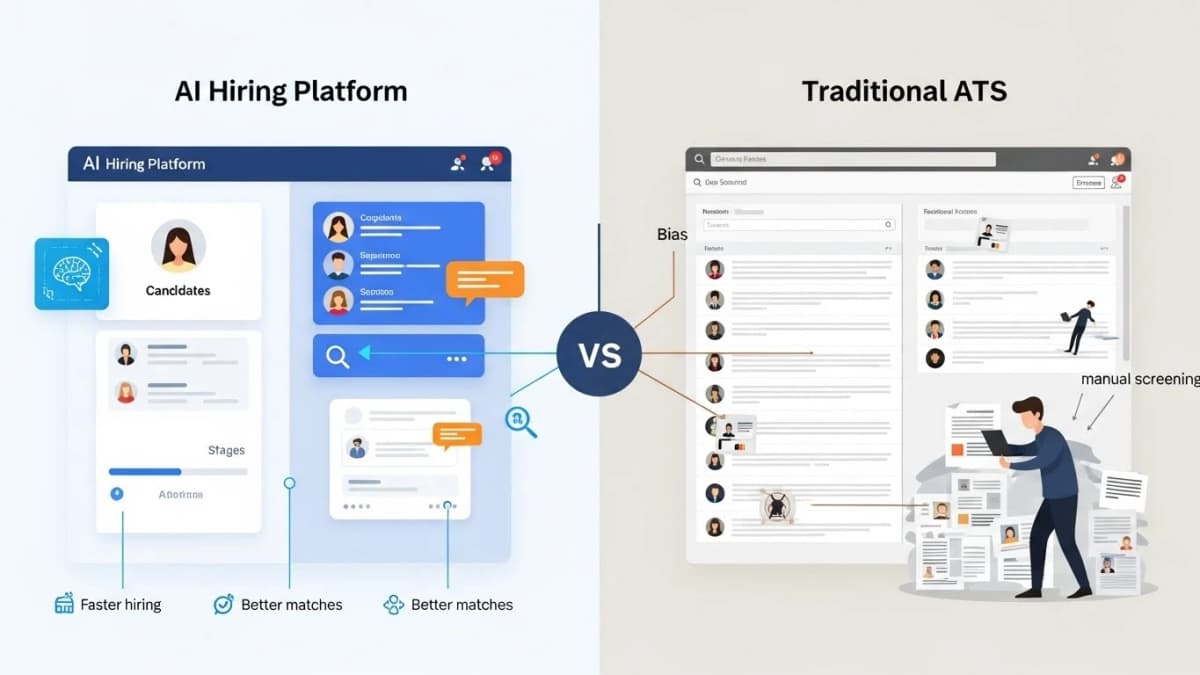
At their core, traditional ATS tools and AI hiring platforms serve very different purposes in the recruitment process.
Traditional ATS: An Organizer
A traditional Applicant Tracking System (ATS), tools like Greenhouse or iCIMS, is primarily designed to help recruiters stay organized. These systems:
-
Store resumes and candidate information
-
Track applicants through defined hiring stages
-
Support internal workflows and compliance
While an ATS is useful for managing applications, it doesn’t actively help you decide who to hire. If 200 candidates apply for a role, the ATS will surface all 200, and the work of screening, evaluating, and prioritizing those applicants still falls on your team.
AI Hiring Platform: A Smart Assistant
An AI hiring platform goes beyond organization and becomes an active participant in the hiring process.
Platforms in this category, such as sourcing and screening tools that scan job boards, talent databases, GitHub repositories, and professional networks, use AI to identify, evaluate, and rank candidates automatically. In many cases, this happens with minimal human involvement until the most qualified candidates are ready for review.
Instead of showing you every applicant, an ai recruiting platform focuses on signal over volume.
For example, while an ATS may report that 200 people applied for a role, an AI recruiting platform will identify the 5 candidates most likely to succeed, based on skills, experience signals, and performance data, not just resume keywords.
This means hiring teams spend less time sorting through applications and more time making informed decisions.
The Bottom Line
A traditional ATS helps you manage applications. An AI hiring platform like HiveMind transforms recruitment into a predictive, data-driven process, reducing time-to-hire, lowering hiring costs, and improving hiring outcomes.
Benefits of Using an AI Hiring Platform

By now, you’ve probably noticed a pattern: most hiring problems don’t come from a lack of candidates; they come from overload and inefficiency. This is where an AI hiring platform makes a measurable difference.
Here’s a clear breakdown of the biggest benefits you get from including AI in your hiring process.
-
Better Hiring Quality, Not Just Faster Hiring
-
Smarter Candidate Sourcing
-
Significant Time and Cost Savings
-
A Better Candidate Experience
-
Data-Driven Hiring Decisions You Can Trust
-
Scalability for High-Volume Hiring
-
Better Hiring Quality, Not Just Faster Hiring
One of the biggest advantages of an AI hiring platform is its ability to improve the quality of hires, not just speed things up. Instead of relying on resumes alone, AI evaluates candidates based on skills, experience, and role-specific criteria. Every applicant is assessed using the same standards, which helps reduce unconscious bias and ensures candidates are evaluated fairly.
More importantly, ai recruiting platforms core candidate suitability, making it easier to compare applicants objectively. When you’re choosing between several strong candidates, structured scoring is what prevents gut-driven decisions and costly hiring mistakes.
The result: fewer bad hires, stronger shortlists, and better long-term outcomes.
-
Smarter Candidate Sourcing
Sourcing has traditionally been one of the most time-consuming parts of recruitment. Recruiters spend hours manually searching platforms like LinkedIn, sending cold messages, and hoping the right candidates respond.
An AI hiring platform changes that. Instead of manual outreach, AI automatically sources candidates who already match your role requirements, pulling from talent databases, public profiles, and other relevant sources. It identifies candidates based on actual fit, not just job titles or keyword matches.
Because AI works continuously and at scale, it reaches more qualified candidates in less time than a human ever could, without burning out your recruiting team.
-
Significant Time and Cost Savings
Time-to-hire is one of the most expensive inefficiencies in recruitment. Ai recruitment software automates the hiring process by doing repetitive tasks like:
-
Resume screening
-
Interview scheduling
-
Candidate follow-ups
This frees recruiters to focus on strategic work, such as interviewing and stakeholder alignment. The impact is measurable. Studies show that AI recruitment tools can reduce time-to-hire by up to around 30%, while also lowering cost-per-hire and improving efficiency when compared with manual hiring processes. Cost Savings often come from:
-
Reduced recruiter workload
-
Fewer bad hires
-
Less reliance on external agencies
Simply put, AI allows more work to be done with fewer resources and with better results.
-
A Better Candidate Experience
Candidate experience matters more than ever, especially in competitive talent markets. A strong AI hiring platform improves the experience by:
-
Responding faster to applications
-
Providing clearer communication
-
Reducing uncertainty and ghosting
AI-powered chat and messaging tools can answer candidate questions instantly, share next steps, and keep applicants engaged throughout the process. Even when candidates aren’t selected, timely communication leaves a positive impression.
This level of responsiveness builds trust and strengthens your employer brand, something that’s hard to maintain manually at scale.
-
Data-Driven Hiring Decisions You Can Trust
An AI recruitment software doesn’t rely on instinct; it relies on data. By analyzing large volumes of hiring data, AI uncovers patterns that manual processes often miss. Machine learning models evaluate candidates against job requirements objectively, helping teams make more informed decisions.
These insights can also support predictive hiring, such as identifying candidates more likely to perform well or stay longer. In fact,SHRM data shows organizations using AI report major gains in hiring efficiency and quality, with nearly 90% reporting greater efficiency and improved outcomes when AI is used in hiring workflows.
When hiring decisions are backed by data, confidence goes up, and risk goes down.
-
Scalability for High-Volume Hiring
It’s no secret that high-volume recruitment is where traditional hiring methods break down.
An AI hiring platform, however, excels here by processing thousands of applications in minutes, without sacrificing consistency or accuracy. AI ensures every candidate is evaluated using the same criteria, maintaining fairness even when hiring across multiple roles or departments. Automated communication tools also keep candidates informed and engaged, even during peak hiring periods.
The ability to scale efficiently, without slowing down or lowering standards, is one of the strongest competitive advantages an ai recruiting platform provides.
The Bottom Line
An AI hiring platform doesn’t just optimize recruitment, it transforms it. By improving hiring quality, reducing costs, saving time, enhancing candidate experience, and enabling data-driven decisions at scale, AI gives hiring teams a smarter way to operate in today’s demanding talent market.
Key Features to Look for in an AI Hiring Platform

AI hiring platforms have lots of features that can set them apart from traditional systems, here’s a few you can look out for before picking one to integrate in your hiring process in 2026:
-
Anonymous resume screening to reduce bias
-
Live candidate ranking and shortlists
-
Automated hiring workflows
-
Hiring insights and performance reports
-
Easy integration with your existing HR tools
-
Flexible setup that scales as you grow
-
AI-powered resume filtering (e.g., eliminate 90% unqualified).
-
Automated phone/video screening.
-
Skills-based ai assessments (real projects, AI grading, anti-cheat).
-
Drag-and-drop pipeline builder (no-code automation).
-
Centralized inbox for team sync (recruiters, managers, AI).
-
Anonymous Resume Screening to Reduce Bias
A strong AI hiring platform should help level the playing field. Anonymous resume screening removes details like names, photos, age, and gender, factors that can unintentionally influence decisions. Instead, candidates are evaluated purely on skills, experience, and job relevance.
By focusing on what candidates can do rather than who they are, this feature helps reduce unconscious bias and supports more inclusive, skills-based hiring.
-
Live Candidate Ranking and Smart Shortlists
Manually reviewing hundreds of applications is inefficient and error-prone.
With live ranking and automated shortlists, an ai recruitment software evaluates candidates based on predefined criteria, such as skills, availability, salary expectations, and assessment results and ranks them in real time.
Instead of scrolling through endless resumes, you see the most qualified candidates first and can move straight to interviews.
-
Automated Hiring Workflows
If you’re still handling screening, scheduling, and follow-ups manually, you’re wasting valuable time. A modern AI hiring platform should automate repetitive recruiting tasks like:
-
Resume screening
-
Interview scheduling
-
Candidate scoring and status updates
This keeps hiring moving without delays and allows recruiters to focus on high-impact work, like interviews and decision-making.
-
Hiring Insights and Performance Reports
Better hiring decisions come from better data. An AI hiring platform should provide clear insights into:
-
Candidate performance and assessment results
-
Hiring funnel bottlenecks
-
Time-to-hire and cost-per-hire metrics
Advanced platforms can also spot patterns and help predict outcomes like on-the-job performance or retention. These insights make it easier to improve hiring quality over time, not just fill roles faster.
-
Easy Integration With Your Existing HR Tools
Adopting a new ai recruitment software shouldn’t mean abandoning the tools you already use.
Look for platforms that integrate seamlessly with your ATS and HR systems. For example, HiveMind can connect with tools like Greenhouse, allowing you to continue using familiar workflows while benefiting from AI-powered automation.
This reduces implementation friction and keeps your hiring stack connected.
-
Flexible Setup That Scales as You Grow
Your hiring needs today won’t look the same six months from now. A good AI hiring platform should scale with you, handling higher applicant volumes, new roles, and evolving processes without breaking down. It should also offer easy customization, such as:
-
Adjustable workflows
-
Custom assessments
-
Role-specific evaluation criteria
This flexibility ensures the platform adapts to your business, not the other way around.
-
AI-Powered Resume Filtering
High application volume is where AI shines.
Advanced ai recruitment software can automatically eliminate up to 90% of unqualified candidates early in the process, based on skills, requirements, and role fit. This dramatically reduces screening time while ensuring strong candidates aren’t missed.
-
Automated Phone and Video Screening
Instead of scheduling dozens of first-round calls, AI can handle initial screenings for you.
Automated phone screening or video interviews collect structured responses, assess communication skills, and surface insights, before a recruiter ever steps in. This saves time while maintaining consistency across candidates.
-
Skills-based AI Assessments
Resumes don’t always reflect real ability.
A strong AI hiring platform should support skills-based AI assessments, such as real-world tasks or job simulations, with AI-powered grading. Anti-cheat measures ensure results are reliable, helping you identify candidates who can actually perform in the role.
-
Drag-and-Drop Hiring Pipelines (No-Code)
Hiring workflows shouldn’t require engineering support.
No-code, drag-and-drop pipeline builders let you design and adjust hiring stages easily, whether you’re hiring engineers, sales reps, or support teams. This gives you full control without technical complexity.
-
Centralized Inbox for Team Collaboration
Hiring is a team effort.
A centralized inbox allows recruiters, hiring managers, and AI agents to stay aligned in one place, sharing feedback, updates, and decisions without scattered emails or tools. This improves collaboration and speeds up approvals.
By looking out for these features, you stand to choose an ai recruitment software that not only grows with your organization but becomes a crucial part of the team. It allows you to build a team that aligns strongly with the vision you’re aiming for.
How HiveMind Stands Out as the Top AI Hiring Platform
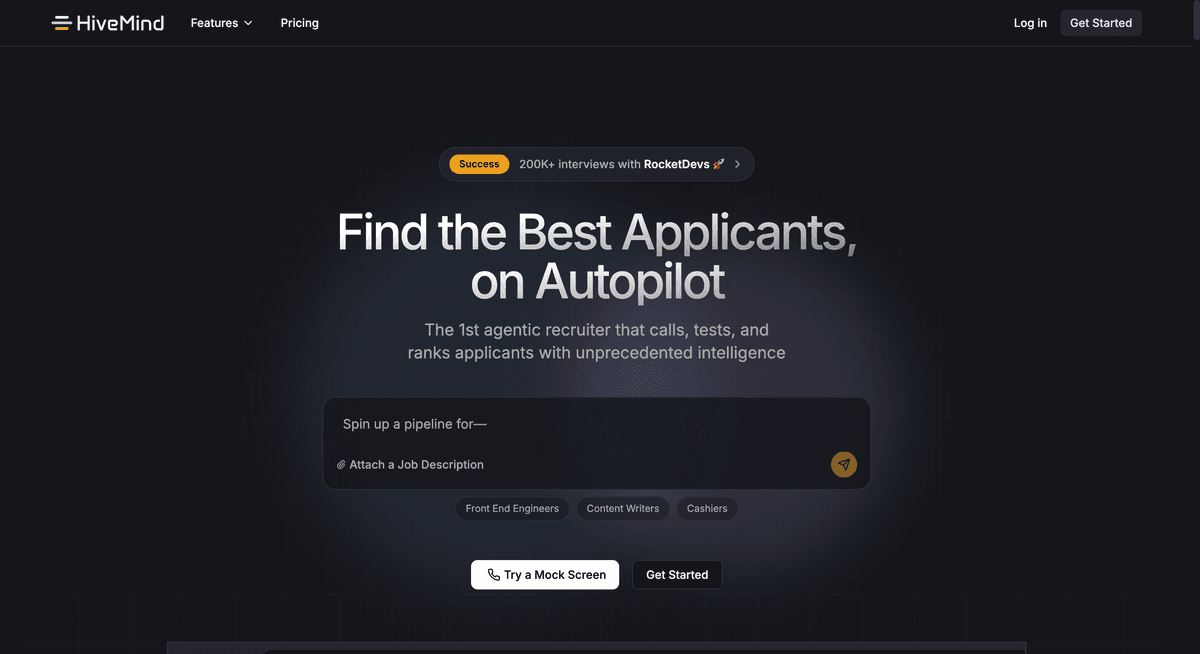
There are hundreds of AI hiring platforms, but clearly not all platforms are built the same. Most of these tools promise automation, but still leave recruiters buried in resumes, spreadsheets, and endless follow-ups. HiveMind AI, however, takes a very different approach.
Instead of acting like a passive system that waits for input, HiveMind is built like an active recruiting assistant, handling the heavy lifting so your team can focus on real hiring decisions.
Here’s what makes HiveMind stand out.
-
It Goes Beyond Resume Sorting (The Resumatic Feature)
Most traditional tools stop at keyword matching. HiveMind doesn’t. Its Resumatic feature doesn’t just parse resumes, it understands them. It ranks candidates based on real signals like relevant skills, experience matches, and role fit, so you see the best matches first.
This means you don’t waste time reviewing hundreds of applications that were never a good match to begin with, but go straight to the ones you need.
-
Built for Skill-Based, Bias-Aware Hiring
HiveMind supports anonymous resume screening and skill-based assessments, helping teams focus on what actually matters: whether someone can do the job. By removing identifying details early in the process, the platform helps reduce unconscious bias and improve hiring fairness, without adding complexity to your workflow.
-
End-to-End Automation, Not Just Tracking
Many ATS tools organize applicants. HiveMind actively moves candidates through the hiring process**.** From screening and assessments to ranking, follow-ups, and scheduling, the platform automates the hiring process by handling repetitive steps that usually slow teams down. Recruiters step in only when it’s time to interview the strongest candidates.
-
Seamless Integration With Existing HR Tools
Adopting a new AI hiring platform shouldn’t mean replacing everything you already use. HiveMind integrates smoothly with popular ATS and HR systems, allowing teams to enhance their current setup rather than disrupt it. This makes implementation faster and adoption easier across recruiting teams.
-
Clear Insights That Actually Help You Hire Better
HiveMind doesn’t just generate data, it turns it into insight. Recruiters get visibility into candidate performance, pipeline bottlenecks, time-to-hire, and quality signals that help improve hiring decisions over time. These insights make it easier to refine hiring strategies and scale without losing quality.
-
AI Phone Calls That Do the Heavy Lifting
Phone screens are essential, but they’re also time-intensive and repetitive. HiveMind’s AI phone call feature can take this off your plate. The system conducts automated calls with candidates to collect responses, assess communication skills, and gather key insights, before a human ever steps in.
Candidates get a consistent experience, and your team gets meaningful screening data without scheduling headaches.
-
1,200+ Pre-Built Skills Assessments
As a recruiter, it’s common knowledge that evaluating candidates based on resumes alone doesn’t tell you what they can actually do. HiveMind solves this with a library of 1,200+ pre-built assessments tailored to real job functions, from software development to sales, operations, customer support, and more.
These assessments go beyond multiple-choice questions, they simulate real work scenarios, measure capabilities accurately, and include AI-powered grading with anti-cheat safeguards.
The result? You can trust that your shortlisted candidates have the skills they claim.
What This Means for Your Hiring
When you combine these features that make HiveMind stand out, you get an AI hiring platform that not only saves time and reduces bias, but also helps you hire better candidates, not just faster ones.
Whether you’re filling high-volume roles or making strategic leadership hires, HiveMind makes each step more data-driven, more efficient, and more candidate-centric.
What Others Are Saying About HiveMind AI
When you’re evaluating an AI hiring platform, it’s one thing to read about features, and another to hear from real people who’ve put the tool to work. Across public review sites and community feedback, HiveMind consistently earns praise for making hiring faster, more organized, and more data-driven.
Product Hunt Feedback: Early Enthusiasm and Real Impact
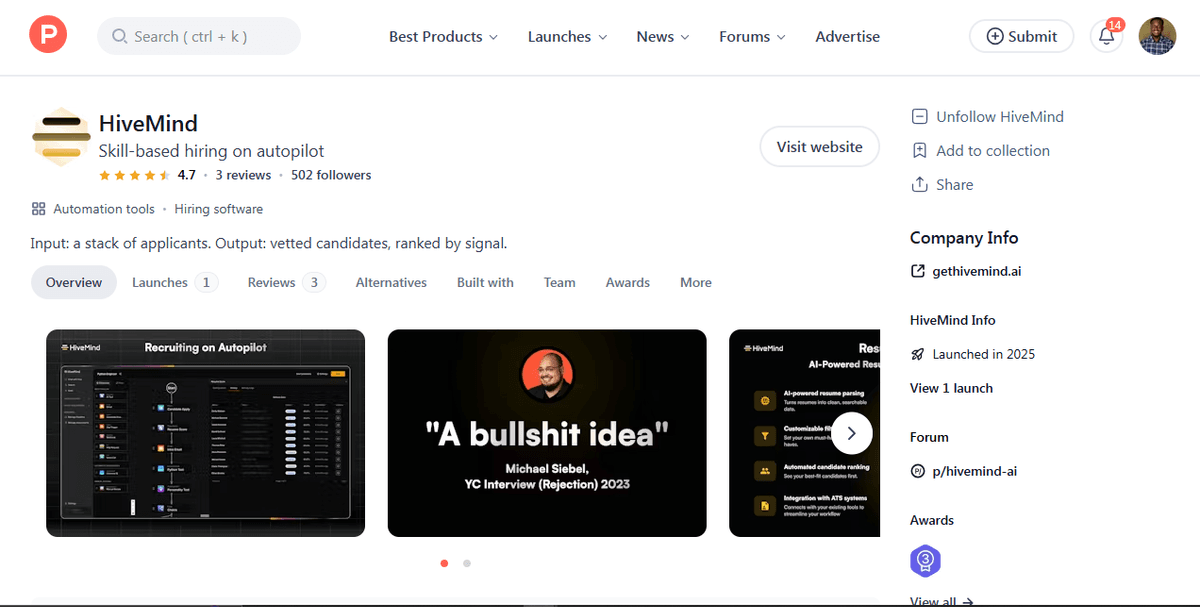
On Product Hunt, where HiveMind launched with strong community interest, users highlighted how the platform “feels like a breath of fresh air compared to traditional ATS tools”. Early adopters appreciated its focus on automation and meaningful candidate ranking, turning a pile of resumes into a ranked shortlist of vetted applicants. Many founders and recruiters noted that HiveMind helped them cut through manual hiring chaos and actually spend time with the candidates worth interviewing.

G2 Reviews: Recruiters Love the Efficiency
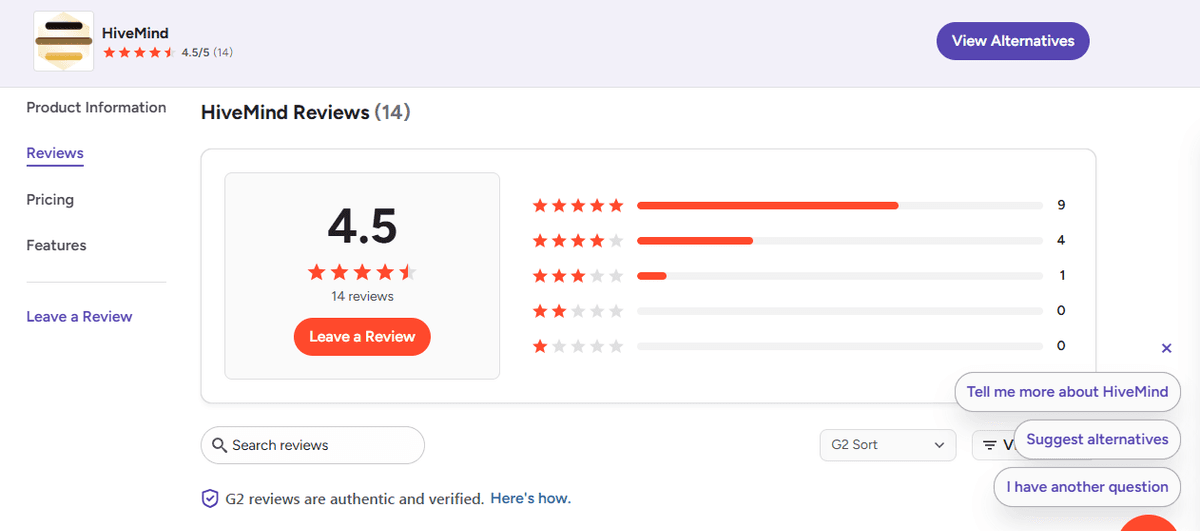
HiveMind’s reviews on G2 reflect solid user satisfaction with its role as an AI hiring platform. With an average rating above 4.5 stars, reviewers commonly point out the following themes:
-
Cuts through application overload: Users reported that HiveMind helped them quickly identify strong candidates, even when application volumes were high. One reviewer specifically said it “helped me cut through the noise and surface genuinely good candidates quickly,” thanks in part to structured tasks and report-style breakdowns.
-
Smoother workflows and pipeline clarity: Multiple users highlighted how HiveMind’s automated pipeline tracking ensured candidates didn’t fall through the cracks, making the recruiting process feel more organized and fair.
-
Consistent assessments: Several reviews mentioned that structured assessments gave them better consistency in how candidates were evaluated, leading to more professional and confident hiring decisions.
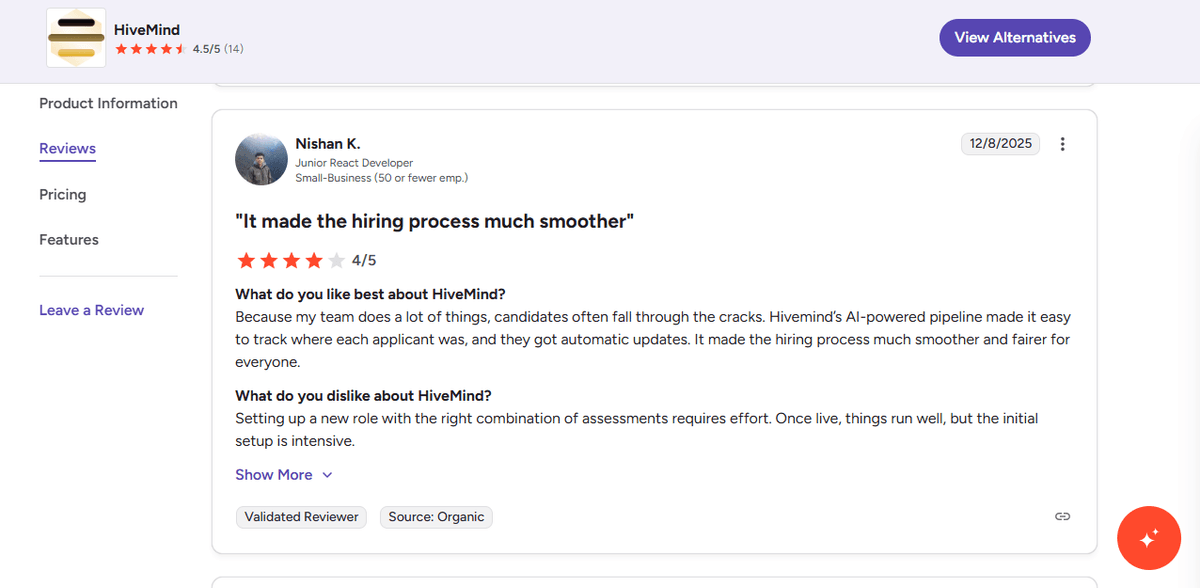
Of course, no tool is perfect; some reviewers did note a learning curve when first configuring assessments and pipelines, and a desire for more flexibility in dashboard navigation. But overall, the sentiment shows that HiveMind’s blend of automation, insight, and real hiring support is resonating with teams tired of manual recruiting workflows.
How HiveMind Compares With Other AI Hiring Tools
Here’s a quick comparison table showing how HiveMind stacks up against basic tools like traditional ATS systems and simpler AI recruiting tools, clearly illustrating why HiveMind stands out as the AI hiring platform that truly automates the hiring process.
| Feature / Capability | Traditional ATS | Basic AI Recruiting Tools | HiveMind (Top AI Hiring Platform) |
|---|---|---|---|
| Candidate Screening | Manual or keyword filtering | AI suggestions but limited context | Automated resume ranking & shortlists based on skills and fit (Resumatic) |
| Workflow Automation | Manual progression between stages | Partial automation (e.g., scheduling) | Full end-to-end workflow automation from screening to scheduling and follow-ups |
| Skill Assessments | None or basic screening questions | Separate tools, manual review | 1,200+ AI-graded skill assessments built-in |
| AI Phone/Video Screening | Manual scheduling and calls | Some tools offer limited AI interviewing | Autonomous AI phone calls and video interactions |
| Candidate Ranking & Shortlists | Recruiters manually rank | AI can suggest matches | Real-time ranking of candidates based on performance and fit |
| Interview Support | Manual note-taking | Limited or no live support | AI co-pilot assists and captures insights during interviews |
| Custom Pipelines | Basic stages | Often rigid | Drag-and-drop, fully customizable workflows |
| Centralized Team Collaboration | Basic comments or notes | Varies by tool | Unified inbox and shared candidate context |
| Candidate Experience | Standard application portals | Chatbots or auto-emails | Candidate portal with status tracking and smoother interactions |
| Predictive Insights & Data | Historical metrics | Limited analytics | Predictive performance insights and data-backed hiring decisions |
Challenges and Best Practices of AI Hiring Platforms
While AI hiring platforms may be on the rise and are being widely accepted by many industries, there are still some challenges and concerns that need to be tackled, and some of these include:
-
Addressing algorithm bias
AI hiring platforms aim to combat bias in the recruitment process; however, algorithm bias also poses a separate challenge. Algorithms tend to learn from previous data, data which may also have been biased in the first place, hence raising concerns about how really unbiased AI can be in hiring, when it’s built on the foundations of faulty data.
If such concerns are left unaddressed, it could lead to problems around unfair practices, like favouring a certain demographic, or picking candidates with certain qualities.
To tackle this issue, engineers are making sure to train AI software using a wide range of data, which is both diverse and clean. These algorithms are then audited regularly to refine any errors in the system, hence maintaining unbiased results.
-
Issues with data privacy and security
AI recruitment software handles a lot of candidate data, which most would consider private, so it’s only normal for concerns around privacy and security to be raised. I mean, no one wants the information on their resume, like contact details, and even employment history, falling into the wrong hands.
So, how are AI recruiting platforms addressing these concerns?
One way to do this is to comply with privacy regulations like GDPR (General Data Protection Regulation) or CCPA (California Consumer Privacy Act). This helps to build trust, plus it ensures that the candidate’s data is protected, as any breach or leak can be met by legal action, which can lead to a lack of trust from both recruiters and clients alike.
-
Balancing AI automation with human supervision
AI can do a lot of things, but if there’s one thing we know for sure, it is that human experience reigns supreme. AI is great at automating repetitive tasks, and ranking resumes, but it could never entirely replace human judgment. Over-reliance on AI by hiring teams can be a problem; it can lead to missed opportunities and errors in candidate evaluation.
For example, the AI might skip a candidate who has different qualifications or a special skillset and experience, but might actually excel in the chosen role, while a human could most likely spot this.
This is why it is important to maintain the right balance of Artificial Intelligence mixed with human supervision. This is something HiveMind AI does very well, as it allows humans to override at every step of the way, even though the AI handles most of the automation, thereby leaving room for human judgment.
By taking note of these challenges, AI hiring platforms, can maximize the benefits of AI in the hiring process, and avoid the potential risks that can occur from misuse or overuse of artificial intelligence in the hiring process.
Conclusion: Hiring at Scale Needs More Than Just Tools
Hiring in 2026 isn’t about posting jobs faster or reviewing more resumes. It’s about making better decisions, at scale, without burning out your team or compromising on quality. And that’s exactly where an AI hiring platform earns its place.
When used well, AI doesn’t replace recruiters; it removes the noise. It screens faster, ranks smarter, reduces bias, and gives hiring teams the data they need to focus on what actually matters: choosing the right people. As application volumes grow and competition for talent tightens, scaling recruitment manually simply isn’t sustainable anymore.
HiveMind AI, end-to-end was built for this new reality. Its agentic AI recruiter approach goes beyond basic automation, handling screening, assessments, ranking, and candidate engagement end to end. Instead of juggling disconnected tools, you get one AI recruiting platform that works like a recruiting partner, not just another system to manage.
If you’re ready to automate your hiring process, scale recruitment with AI, and hire better candidates without adding headcount, HiveMind is built for exactly that.
Frequently Asked Questions on AI Hiring Platforms
-
What is the best AI tool for recruitment?
There’s no one-size-fits-all answer, because the best AI hiring tool depends on your hiring needs. If you’re focused on automating end-to-end recruitment, from screening and ranking to assessments and candidate engagement, a modern AI hiring platform like HiveMind stands out because it goes beyond simple automation and actively manages workflows.
Other strong tools focus on specific tasks (e.g., sourcing or resume parsing), but for a complete solution that helps recruiters at every stage, an AI recruiting platform is often the most effective choice.
-
Which companies use AI for hiring?
A wide range of companies across industries now use AI in their hiring processes, from startups to enterprise teams. Tech companies often adopt AI early, but retail, healthcare, and consulting firms are increasingly using AI to speed screening, improve candidate quality, and reduce manual work.
Organizations that aim to scale recruitment, minimize bias, and improve hiring outcomes typically adopt an AI recruitment software as part of their HR tech stack.
-
What is the best AI platform to use for work?
The best AI platform for work depends on the job function you’re trying to support. For hiring specifically, an AI hiring platform that handles screening, assessments, communication, and analytics can help HR teams work faster and smarter.
For other business needs (like writing, scheduling, or data analysis), there are AI tools tailored to those functions, but for recruitment, a purpose-built AI recruiting platform delivers the most impact.
-
Which AI tool is best for HR?
Human Resources covers many functions, including payroll, benefits, performance, training, and recruitment. For the recruiting part of HR, the best-in-class solutions tend to be AI recruitment tools that automate and enhance hiring decisions. An AI recruitment software like HiveMind can reduce time-to-hire, improve candidate experience, and surface data-driven insights that help HR teams make better decisions.
Other AI tools may specialize in employee engagement or talent management, but for hiring automation, an ai recruiting platform is often the most valuable choice.