
A candidate relationship management (CRM) system helps recruiting teams build and maintain relationships with potential candidates before they apply and between job opportunities. It keeps prospects, past finalists and talent pools organised so recruiters can engage with suitable people when new roles become available. An applicant tracking system (ATS), by contrast, manages applications and candidates moving through active recruitment processes. Choosing between the two depends on how your team recruits, not simply what a software provider calls its product.
Key takeaways
- A candidate CRM holds relationships with people outside an open application, while an ATS runs applications to open jobs; in staffing software the word CRM often means the client side.
- Buying a CRM is easier than using one: Aptitude Research found only 14 percent of companies said their recruiters adopt a CRM once they invest in one.
- Check whether your ATS already searches and messages past candidates well before adding a second system with a second record per person.
- Every CRM sequence must honour opt-outs: the FTC says CAN-SPAM opt-outs are honoured within 10 business days, and the FCC's revocation rule takes effect on 25 November 2026.
- Write a retention period per record type: 29 CFR 1602.14 sets a one year minimum for hiring records, and UK GDPR says no longer than necessary.
This guide is for talent acquisition (TA) leaders, recruiters and staffing agency owners evaluating whether they need a candidate CRM alongside their existing ATS. It explains what candidate relationship management software does, how it differs from an ATS, what market data reveals about adoption and costs, and why staffing firms sometimes use the term differently. It also examines the email, text messaging and record-keeping requirements that recruitment teams must consider when using these systems. The legal information is based on guidance from the relevant regulatory authorities and is not legal advice. Requirements may change, so organisations should check the latest applicable rules.
In this article
- What is a candidate relationship management system?
- How is a candidate CRM different from an applicant tracking system?
- Why do recruiters keep candidates warm between roles?
- Does keeping in touch change how candidates respond?
- What does a candidate CRM do that an ATS does not?
- Do you need a separate CRM on top of your ATS?
- What does a candidate CRM cost?
- How do staffing agencies use a CRM differently?
- What rules apply when you email or text candidates from a CRM?
- How long can you keep candidate records in a CRM?
- How do you choose a candidate CRM?
- How do you tell whether a candidate CRM is paying off?
- Conclusion
- Frequently asked questions
What is a candidate relationship management system?
A candidate relationship management (CRM) system helps recruitment teams manage relationships with people who are not currently applying for an open position. These may include previously interviewed candidates, sourced prospects, past finalists and people who have joined a talent pool. SHRM's August 2024 explainer describes candidate relationship management systems as tools for building and nurturing pipelines of previously vetted talent and candidates who have not yet applied.1
Recruitment software providers describe the category in similar terms. Greenhouse defines candidate relationship management as a proactive approach to developing talent pipelines and engaging potential candidates in anticipation of future hiring needs.2 Rather than starting the sourcing process from scratch whenever a vacancy opens, recruiters maintain an existing network of people they can approach.
Gem takes a similar approach, describing its CRM as a way to identify previous candidates who match current vacancies, develop talent communities for frequently recruited roles and maintain relationships with prospects over time.
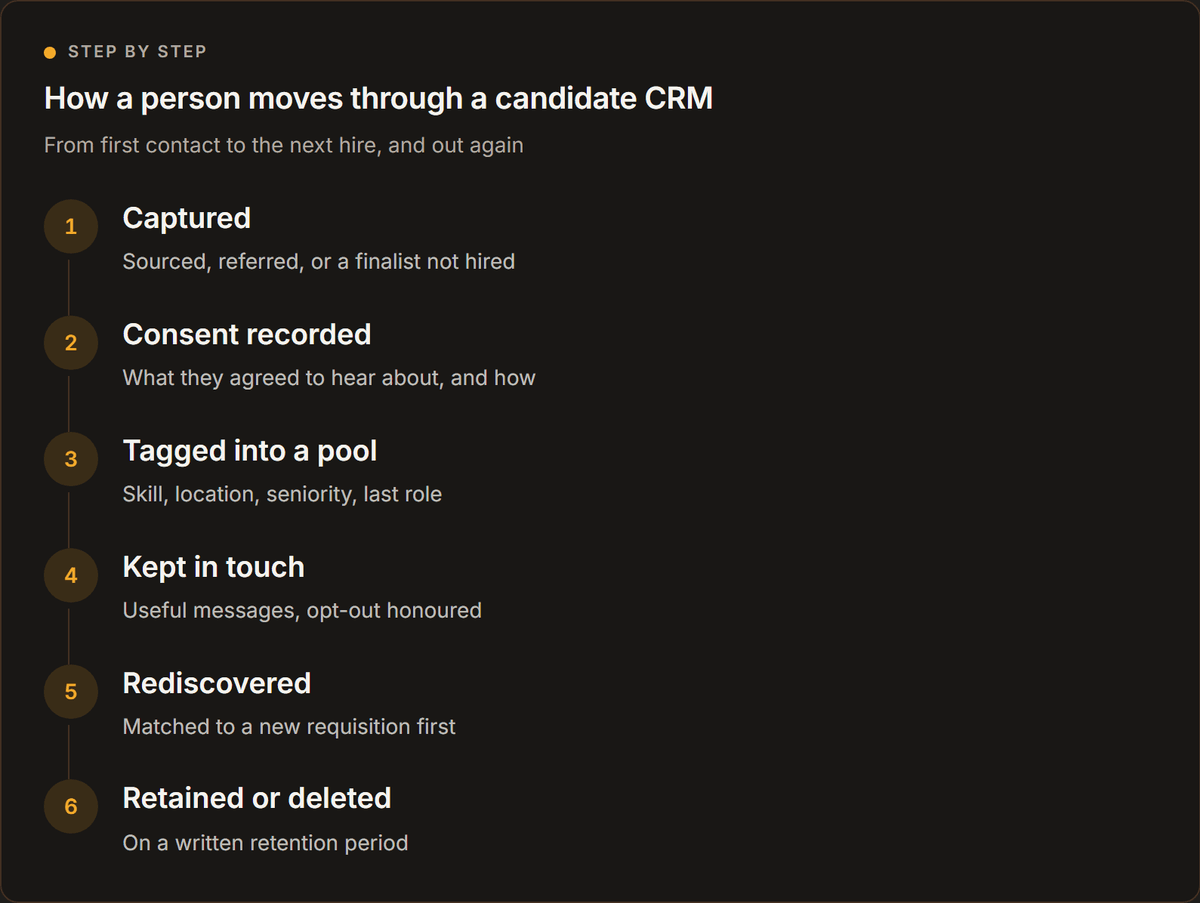
These descriptions point to three core functions:
- Remembering people. Maintaining searchable candidate profiles, including contact details, recruitment history and notes explaining why someone was not selected for a previous role.
- Staying in touch. Sending relevant, permitted communications to candidate groups over time, keeping potential applicants engaged between recruitment opportunities.
- Bringing candidates back. Identifying people already in the database who match a new vacancy before spending additional time and money sourcing fresh candidates.
An applicant tracking system (ATS) already handles some of the first function because it stores records of people who have applied for jobs. The difference lies mainly in the second and third functions, and in the primary focus of each platform. An ATS is organised around active vacancies and applications, while a candidate CRM focuses on maintaining relationships with people throughout the recruitment lifecycle, including periods when no suitable position is available.
There is no universally adopted analyst or standards-body definition that establishes a precise boundary between candidate CRMs and ATS platforms. The descriptions above therefore reflect the definitions published by SHRM and the respective software providers, rather than a formal industry-wide classification.
How is a candidate CRM different from an applicant tracking system?
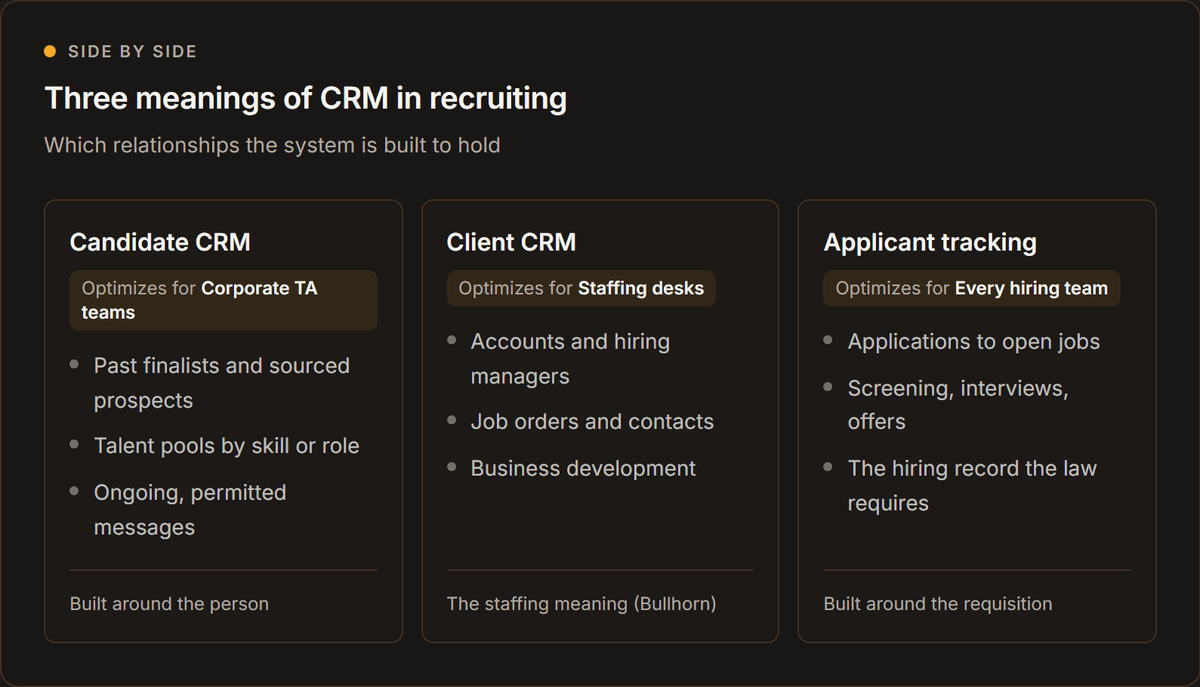
An applicant tracking system (ATS) is built around the job, while a candidate relationship management (CRM) system is built around the person. An ATS manages applications once a vacancy opens, moving candidates through screening, interviews and offers while maintaining the required recruitment records. A candidate CRM works across a longer period, helping recruiters build relationships with potential candidates before a vacancy exists and maintain those relationships after a role closes.
| Applicant tracking system | Candidate relationship management system | |
|---|---|---|
| Organised around | The open requisition | The person and the talent pool |
| Starts when | A candidate applies | A recruiter meets, sources or rejects someone |
| Main actions | Screen, interview, offer and hire | Tag, segment, message and re-engage |
| Messages | Transactional: confirmations, scheduling and decisions | Ongoing: updates, new roles and events |
| Typical owner | Recruiter responsible for the requisition | Sourcer, recruitment marketer or the wider recruitment team |
| Ends when | The job is filled or closed | The person opts out or the retention period ends |
Staffing software uses the same three letters to describe something different. Bullhorn, a staffing software provider, describes a recruitment CRM as a tool for managing relationships with clients and prospects, while its ATS handles candidates and placements.3 On a staffing desk, "the CRM" often refers to the client side of the business: accounts, contacts and job orders.
This distinction matters when comparing products. A staffing agency owner and a corporate talent acquisition (TA) leader may both say they need a CRM, but they may be looking for systems with very different functions. Before comparing providers, establish which relationships the system needs to manage.
Why do recruiters keep candidates warm between roles?
Recruiters maintain relationships with candidates between vacancies because people they have already met are often easier to reach than new prospects. Keeping in touch also means they are more likely to know when someone becomes available. Labour market data shows how quickly employment conditions and candidate availability can change.
The US Bureau of Labor Statistics (BLS) Job Openings and Labor Turnover Survey (JOLTS) recorded increases in job openings, hires and employee resignations between September 2025 and September 2026. The September 2026 figures are preliminary.
| BLS JOLTS, total nonfarm, seasonally adjusted | September 2025 | September 2026 (preliminary) |
|---|---|---|
| Job openings (thousands) | 7,169 | 7,523 |
| Hires (thousands) | 5,244 | 5,402 |
| Quits (thousands) | 2,990 | 3,365 |
| Quits rate | 1.9 | 2.1 |
These figures cover the entire US nonfarm economy, not a specific industry or candidate pool. They indicate changes in overall labour market activity rather than the size of the opportunity available to an individual recruitment team. However, the increase in quits suggests that more employees are voluntarily leaving their jobs. Someone who was not ready to move when a recruiter last contacted them may be open to a new opportunity today.
Employers also report continued difficulty filling vacancies. SHRM's 2025 Talent Trends report found that 69% of employers struggled to fill full-time roles.4 A low number of applicants was a challenge for 51%, while 41% said candidates ghosted during interviews. The survey included 2,040 HR professionals and was conducted between 3 and 12 February 2025.5 SHRM also reported that organisations offering flexible working arrangements and nurturing long-term candidate relationships experienced fewer hiring challenges.4
At the same time, higher application volumes do not necessarily mean better candidate quality. BambooHR's platform data shows that the average number of applicants per job posting almost doubled, from approximately 46 in 2021 to 95 in 2025.6 CIPD's Resourcing and talent planning report 2026 found that 58% of employers received more applications from unsuitable candidates, compared with 33% who reported an increase in suitable applications.7 The CIPD findings are based on a survey of more than 1,000 UK HR and people professionals.7
Gem's platform data illustrates how many applicants remain outside the final hiring decision. Across its platform, only 8% of applicants advanced beyond initial screening, while 0.5% received offers.8 That equates to roughly one offer for every 200 applications. Every recruitment process therefore leaves behind candidates who may have been screened or qualified but were not selected. A candidate CRM gives recruiters a way to retain those records and reconnect with suitable people when another opportunity arises.
Recruitment skills are also shifting towards relationship development. LinkedIn's 2025 Future of Recruiting report found that employers were 54 times more likely than a year earlier to list relationship development as a required skill in paid recruiter job postings.9 The report draws on LinkedIn platform data and a survey of more than 1,000 talent professionals.
Staffing firms face a similar need to maintain relationships, particularly because they regularly work with temporary and contract candidates. The American Staffing Association reported that total US staffing employment increased by 0.6% year over year in the second quarter of 2026, representing approximately 12,000 jobs.10 It also reported that staffing companies in the US hired 9.5 million temporary and contract employees during 2025.
At that scale, staffing recruiters may encounter the same candidates across multiple assignments. Keeping an accurate record of previous conversations, placements, availability and preferences makes it easier to identify suitable people for future roles. A CRM helps preserve that relationship instead of treating every new vacancy as a completely fresh search.
Does keeping in touch change how candidates respond?
The evidence suggests that poor communication can damage a candidate's willingness to engage with an employer again. In Survale's 2025 CandE benchmark, 15% of North American candidates said they would not engage with an employer again after a poor candidate experience.11 The same research found that 31% had not heard back from an employer after applying.11 The benchmark is based on more than 66,000 completed candidate surveys collected between 31 January and 31 August 2025.11
Ghosting is still an issue. Greenhouse's 2024 Candidate Experience Report found that 52% of candidates said an employer had ghosted them, although this represented a 22% decrease from the previous year.12 Gartner's research also highlights the challenge of keeping candidates engaged through the hiring process. Its July to September 2024 survey found that 33% of candidates withdrew after accepting an offer, compared with 49% in October 2023.13
How recruiters handle rejection can also influence whether candidates consider the organisation again. A peer-reviewed study involving groups of 264 and 259 mid-level candidates found that timely rejection communication improved candidate satisfaction, perceptions of fairness, willingness to reapply and likelihood of recommending the organisation.14 The study measured candidates' intentions rather than actual rehires, but the finding reinforces the value of respectful communication. Candidates who receive a clear, timely response are more likely to leave the process with a positive impression of the employer.
The potential return on maintaining candidate relationships is less well established by independent research. Gem's 2026 benchmarks, based on its customers' platform data, found that 46% of sourced hires came from candidates rediscovered in an existing CRM or ATS, compared with 26% in 2021.8 This is a vendor-reported finding from Gem's customer base, not an independently verified industry-wide figure. We found no independent study establishing how frequently rediscovered candidates go on to be hired.

What does a candidate CRM do that an ATS does not?
A candidate CRM focuses on people who are not currently part of an active recruitment process. Although features vary between providers, most candidate CRMs offer a similar set of core functions.
- Talent pools and tags. Recruiters organise candidates by skills, location, seniority or previous roles, including people who were finalists but not hired. Profiles can be updated as candidates gain experience or change jobs.
- Rediscovery search. When a new vacancy opens, recruiters can search existing candidate records for suitable people before spending time sourcing new prospects.
- Sequences and campaigns. Recruiters schedule emails or text messages for specific candidate groups, with responses directed back to the relevant recruiter.
- Consent and preference records. The system records who has agreed to receive communications, what they have agreed to hear about, which channels they prefer and when they opt out.
- Engagement history. Messages, replies and conversations are stored so that recruiters can continue a relationship without repeating previous discussions or losing important context.
- Reporting. Recruitment teams can track which talent pools and communication campaigns lead to applications, interviews and hires.
Gem's candidate CRM product description highlights three particularly useful capabilities: identifying previous candidates who match open vacancies, building talent communities for frequently recruited roles and maintaining relationships with candidates over time.15 These provide a practical checklist when evaluating CRM software: matching, community building and ongoing engagement. An ATS may offer some of these functions, but the depth and quality of its capabilities can vary.
Talent pools are also becoming more important in staffing. Staffing Industry Analysts (SIA) reports that 91% of participating managed service providers (MSPs) offer direct client sourcing through MSP-curated talent pools or candidate and project marketplaces.16 Staffing suppliers competing for these opportunities need accurate, up-to-date candidate pools and an effective way to reach suitable people.
Do you need a separate CRM on top of your ATS?
Not necessarily. In many cases, an ATS with strong candidate relationship management features is enough. The market is also moving towards integrated talent acquisition platforms rather than separate systems. SHRM's August 2024 article describes stand-alone CRM vendors as becoming less common as recruitment software providers incorporate CRM capabilities into broader platforms.1 It also identifies poor ATS integration, complicated features and weak analytics as common sources of dissatisfaction with CRM software.
Research suggests that adopting a CRM does not guarantee that recruiters will use it effectively. Aptitude Research reported that 76% of enterprise companies use or plan to use a CRM to support recruitment.17 Its research also found that 61% of companies spend more on their CRM than on their ATS, but only 14% said their recruitment teams adopted the CRM after purchase.17 Just one in four companies reported high satisfaction with their CRM provider, while only 15% said they would recommend their provider to another company.17
These findings should be considered alongside the research methodology. Aptitude Research's CRM research surveyed at least 400 talent acquisition and HR leaders, recruiters and IT professionals at companies with 250 or more employees.17 The report was sponsored by a sourcing vendor. Gem's hosted summary of Aptitude Research's 2026 CRM Index describes a separate study involving at least 450 talent acquisition leaders. It reports similar findings: 61% of companies spend more on CRM than ATS, only 14% fully adopt the tools and fewer than a third are satisfied with their CRM.18
The figures are useful indicators of enterprise adoption and satisfaction, but they do not establish what smaller businesses or staffing agencies should spend. The two studies also use different descriptions of adoption and satisfaction, so their findings should not automatically be treated as directly comparable.
| Aptitude Research finding | Figure |
|---|---|
| Enterprise companies using or planning to use a recruiting CRM | 76% |
| Companies spending more on CRM than on their ATS | 61% |
| Companies whose recruiters adopt the CRM after purchase | 14% |
| Companies highly satisfied with their CRM provider | One in four |
| Companies that would recommend their CRM | 15% |
| Companies that measure CRM return on investment | One in two |
For a recruitment team considering a second system, the decision should come down to whether the additional software solves a problem the existing ATS cannot handle.
- Does the ATS already search past applicants effectively? If recruiters can find previous finalists by skill and contact them easily, the ATS may already provide the most important CRM functionality.
- Will both systems maintain one consistent record per candidate? Duplicate profiles with different notes, contact details or consent records create the integration problems that SHRM identifies.
- Who will manage candidate campaigns? Without someone responsible for maintaining talent pools and sending relevant messages, a CRM can become a second database that quickly falls out of date.
- Can the team measure what the CRM delivers? Reporting should connect candidate engagement and talent pool activity to applications, interviews and hires. Without that visibility, it becomes difficult to justify the software cost at renewal.
If the existing ATS can handle these requirements, a separate CRM may add unnecessary expense and administrative work. However, organisations hiring repeatedly for high-volume roles or operating dedicated sourcing teams may benefit from a specialist platform. The important question is not whether a business needs a CRM because other companies have one, but whether its current recruitment system can maintain candidate relationships effectively.
What does a candidate CRM cost?
Published prices range from around USD 15 to several hundred dollars per month, depending on the provider, plan and pricing model. Some vendors sell candidate CRM software separately, while others bundle it with an applicant tracking system (ATS). The figures below are list prices published on vendor websites when this guide was prepared. Pricing can change, so check the provider's website before budgeting.
| Vendor and plan | Listed price | What the page says is included |
|---|---|---|
| Crelate Essentials | USD 85 per user per month, billed annually | An applicant tracking system and recruiting CRM |
| Crelate Business | USD 119 per user per month, billed annually or monthly | The next tier up |
| Loxo Core | From USD 149 per user per month, billed annually | A combined ATS and CRM |
| Manatal Professional | USD 15 per user per month | Limited to 10,000 candidates |
| Manatal Enterprise | USD 35 per user per month | Higher-tier features |
| Manatal Enterprise Plus | USD 55 per user per month | Higher-tier features |
| Workable Standard | USD 299 per month, or USD 3,588 annually, for the 1 to 20 employee band | Recruiting and HR features; texting available as an USD 89 per month add-on |
Crelate's Essentials plan combines an ATS and recruiting CRM for USD 85 per user per month when billed annually.19 Its Business plan costs USD 119 per user per month. Loxo's Core plan also combines ATS and CRM functionality, with prices starting at USD 149 per user per month on annual billing.20
Manatal offers a lower entry price, with its Professional plan at USD 15 per user per month and a limit of 10,000 candidates.21 Its Enterprise and Enterprise Plus plans cost USD 35 and USD 55 per user per month, respectively. Workable uses a different pricing model, charging USD 299 per month for its Standard recruiting and HR plan in the 1 to 20 employee band.22 Text messaging is available separately for USD 89 per month.
These prices are not directly comparable because vendors structure their plans differently. Some charge per user, others base their fees on company size, and some include CRM functionality in an ATS package while charging separately for additional features such as texting. Larger providers may also require prospective customers to request a quote rather than publishing prices.
The subscription is only part of the total cost. Candidate data migration, implementation, training and the time spent maintaining talent pools and running campaigns should also be included in the budget. As the Aptitude Research findings discussed earlier suggest, the bigger financial risk may be investing in software that recruiters do not consistently use.
How do staffing agencies use a CRM differently?
Staffing agencies manage two sets of relationships simultaneously: clients and candidates. As Bullhorn's definition illustrates, staffing software often uses the term CRM for the client side of the business, while its ATS manages candidates and placements. A corporate talent acquisition team has a different structure because it recruits for one organisation. Its candidate CRM focuses primarily on current and potential employees.
For a staffing agency, the candidate database is a valuable business asset. The American Staffing Association reports that US staffing companies hired 9.5 million temporary and contract employees during 2025.23 Many of these workers may become available again when their assignments end. An agency that can track their experience, availability and communication preferences can identify suitable people for new assignments without starting its search from scratch.
The client side of staffing recruitment is also changing. Staffing Industry Analysts (SIA) reports that 91% of participating managed service providers (MSPs) offer direct client sourcing through MSP-managed talent pools or candidate and project marketplaces. Staffing agencies therefore need to maintain accurate, current candidate records. If a client's own talent pool is more accessible and up to date, suppliers risk losing opportunities before they even submit candidates.
A staffing agency's CRM requirements consequently extend beyond the standard candidate relationship management features. They should also include:
- Availability dates. Track when each candidate's current assignment is expected to end, allowing recruiters to contact suitable workers before they become available.
- One consent record across desks. Maintain a single set of communication preferences and permissions, even when multiple recruiters contact the same person about different assignments.
- Linked client and candidate records. Track which candidates have been submitted to which clients and for which roles, reducing duplicate submissions and conflicting communication.
For more information about managing an existing staffing database, see the guides to staffing agency job board cost and staffing redeployment and the bench.
What rules apply when you email or text candidates from a CRM?
Candidate communications sent through a CRM are subject to the same rules as other bulk email and text campaigns. Text messaging can carry additional consent requirements, particularly when automated systems are used. Whether a recruitment message qualifies as commercial email or telemarketing depends on its content and the applicable law. The following requirements are based on guidance and rules published by the relevant authorities. They are not legal advice, so organisations should check how the rules apply to their own communications.
Email in the US
The CAN-SPAM Act applies to emails whose primary purpose is the commercial advertisement or promotion of a product or service.24 It does not provide an exception for business-to-business email. The Federal Trade Commission (FTC) says senders must honour opt-out requests within 10 business days. The unsubscribe mechanism must also remain operational for at least 30 days after the email is sent.24
Recruitment teams should therefore ensure that their CRM records unsubscribe requests and suppresses opted-out addresses from subsequent campaigns where CAN-SPAM applies.
Mailbox provider requirements
Mailbox providers impose additional requirements on bulk senders. Google's sender guidelines require organisations sending more than 5,000 messages a day to Gmail accounts to authenticate their domains using SPF, DKIM and DMARC.25 This requirement took effect on 1 February 2024. Google also advises all senders to keep the spam rate reported in Postmaster Tools below 0.3%.25 Marketing and subscribed messages must support one-click unsubscribe and include a clearly visible unsubscribe link in the message body.25
Microsoft announced on 2 April 2025 that Outlook.com would require SPF, DKIM and DMARC authentication from domains sending more than 5,000 emails a day.26 Recruitment teams using a CRM to send messages from their own domain should have the necessary authentication records in place before launching campaigns.
Texts in the US
The Telephone Consumer Protection Act (TCPA) and its implementing regulations restrict certain automated calls and text messages. Under 47 CFR 64.1200(a)(2), autodialled or prerecorded telemarketing calls to cellular numbers generally require the recipient's prior express written consent, subject to specified exceptions, including certain nonprofit and healthcare communications.27
The Federal Communications Commission (FCC) published a final rule on revoking consent for robocalls in the Federal Register on 26 October 2026, in volume 91, pages 67214 to 67219.28 The rule takes effect on 25 November 2026. It allows callers to designate certain exclusive methods for receiving revocation requests, including an automated voice or keypad opt-out during a call, a reply to a text using a standardised word, or a designated website or telephone number.28 The amended rule retains an outer limit of 10 business days for honouring revocation requests.28
We found no FCC guidance specifically establishing whether a recruiter's job alert or shift offer qualifies as telemarketing under these provisions. Recruitment teams should not assume that such messages are exempt. For a closer look at the requirements, see the guide to the TCPA revocation rule for staffing agencies.
People in the UK
The UK General Data Protection Regulation (UK GDPR) also affects how recruiters collect and use candidate information. Under Article 14, when an organisation obtains personal data from someone other than the individual concerned, it must provide the required privacy information within a reasonable period and no later than one month after obtaining the data.29 This is particularly relevant when recruiters add sourced prospects to a CRM using information from public profiles or other third-party sources.
Article 21(2) gives individuals the right to object at any time to the processing of their personal data for direct marketing.30 Under Article 7(3), withdrawing consent must be as easy as giving it.31 A CRM should therefore make it possible to record objections and withdrawals and ensure that the person's preferences are respected across future communications.
| Channel or place | Rule | What the CRM must do |
|---|---|---|
| US email | CAN-SPAM: honour opt-outs within 10 business days | Suppress the address across every applicable campaign and sequence |
| Gmail, more than 5,000 messages a day | SPF, DKIM and DMARC authentication; spam rate below 0.3% | Authenticate the sending domain and monitor spam complaints |
| Outlook.com, more than 5,000 emails a day | SPF, DKIM and DMARC authentication | Ensure the sending domain has the required authentication records |
| US texts | Revocation requests must be honoured within 10 business days; prior express written consent is generally required for autodialled telemarketing calls to cellular numbers | Store consent and opt-out records for each number |
| UK sourced prospects | Article 14 privacy information must be provided within one month | Send the privacy notice and record when it was provided |
| UK direct marketing | Article 21 right to object; Article 7(3) right to withdraw consent | Record objections and withdrawals and apply them to future communications |
A candidate CRM should make these requirements manageable rather than leaving recruiters to track permissions manually. Consent records, unsubscribe requests, communication preferences and retention periods need to be accessible and consistently applied. A message sent by the wrong recruiter, from a duplicate record or after an opt-out can create compliance risks for the organisation.
How long can you keep candidate records in a CRM?
Keep candidate records for as long as necessary to meet applicable record-keeping requirements, but no longer than needed for the purpose for which they were collected. These two obligations can pull in opposite directions: employment laws may require records to be retained for a minimum period, while privacy laws restrict unnecessary retention.
US minimum retention periods
Under 29 CFR 1602.14, employers must generally retain application forms and other hiring records for one year from the date the record was made or the relevant personnel action was taken, whichever is later.32 The Equal Employment Opportunity Commission (EEOC) confirms that its regulations require employers to keep personnel and employment records for one year.33
Federal contractors have longer obligations under 41 CFR 60-1.12.34 They must generally retain personnel and employment records for at least two years. The period is reduced to one year for contractors with fewer than 150 employees or no government contract worth at least USD 150,000.
The rule also includes specific requirements for records held in recruitment databases. Federal contractors must retain records identifying job seekers contacted about a position. For internal resume databases, they must also keep a record of each resume added, the date it was added, the position searched for, the search criteria and the date of the search. A CRM search can therefore create a record that must itself be retained.
Employment agencies face an additional requirement under the Age Discrimination in Employment Act (ADEA).
Once an enforcement action concerning a particular applicant is commenced, the EEOC requires the agency to retain the relevant records until the matter reaches final disposition.35 Any deletion schedule should therefore include a hold for records subject to a charge or enforcement action.
Privacy law limits.
The UK GDPR requires personal data to be kept in an identifiable form for no longer than necessary for the purpose for which it is processed.36 The Information Commissioner's Office (ICO) explains that data protection law does not prescribe a fixed retention period for recruitment records.3738 Recruiters must establish appropriate periods based on their own purposes and obligations.
The European Commission's GDPR guidance illustrates why indefinite retention is difficult to justify. It gives the example of a recruitment office keeping CVs for 10 years, describing this as disproportionate. The guidance also stresses that retained information must be kept up to date.
Market practice provides a reference point, but not a legal standard. The ICO's audit of AI recruitment providers found that most left retention periods to the recruiter. Where periods were specified, they were commonly one or two years after a vacancy closed and were often included in the contract. These were findings from the audit, not statutory retention requirements.
California
The employment-related exemptions under the California Consumer Privacy Act (CCPA) expired at the end of 2022, according to the California Attorney General. The California Privacy Protection Agency confirms that the law's privacy rights apply to California residents, including employees and job applicants.39
Businesses covered by the CCPA must tell consumers, at or before collection, how long they intend to retain each category of personal information or the criteria used to determine that period.40 They must not keep information longer than reasonably necessary for the disclosed purpose.
| Rule | Who it binds | Minimum or limit |
|---|---|---|
| 29 CFR 1602.14 | Employers | Generally retain hiring records for one year |
| 41 CFR 60-1.12 | Federal contractors | Generally retain records for two years, or one year for contractors below the specified thresholds; includes resume database search records |
| ADEA records rule | Employment agencies | Retain relevant records until final disposition of an enforcement action |
| UK GDPR storage limitation | Controllers processing UK personal data | Keep identifiable data no longer than necessary |
| CCPA retention notice | Businesses covered by California law | Disclose the retention period or criteria and do not retain data longer than reasonably necessary |
The practical solution is a written retention policy covering each type of candidate record. Specify how long rejected applicants, sourced prospects and past placements remain in the CRM, why the information is needed and what happens when the retention period ends. Configure the system to enforce those periods, while allowing records subject to a charge or enforcement action to be placed on hold.
How do you choose a candidate CRM?
Start by documenting what your recruitment team needs the system to do, then score shortlisted products against those requirements. The following checklist covers the main areas to assess.
Records
- One candidate record shared with the ATS, with no duplicate profiles created during data imports.
- Tags and talent pools that recruiters can manage without submitting a vendor support request.
- Search filters for skills, location, previous role, availability and last contact date.
Messages
- Email and text messaging linked to the same candidate record, with replies routed to the responsible recruiter.
- Consent and opt-out preferences recorded separately for each channel and applied across all campaigns and sequences.
- Support for sending-domain authentication using SPF, DKIM and DMARC.
Compliance
- Automatic retention periods for different record types, with the ability to place records on legal hold.
- A complete candidate data export to support access requests.
- A searchable log of candidate searches and contacts, where required for federal contractor record-keeping.
Reporting
- Reporting that tracks candidates from talent pools through applications, interviews and hires, broken down by source and communication campaign.
- Recruiter activity reporting to help managers identify whether the team is adopting the system.
Fit
- For staffing agencies: candidate availability dates, links between client and candidate records, and shared consent records across recruitment desks.
- Transparent pricing, including per-user, per-company or per-module charges, with additional costs for text messaging and data migration.
Before making a decision, test the shortlisted systems using your own candidate data rather than relying on a vendor demonstration. Import a sample of previous candidates, run a search for a real vacancy and test an internal communication sequence. Check whether records remain consistent between the CRM and ATS, whether replies reach the right recruiter and whether consent and opt-out preferences are applied correctly.
The adoption figures discussed earlier highlight an important risk: buying software is not the same as getting recruiters to use it. A CRM may have an impressive feature list, but its value depends on whether the team continues maintaining candidate records and using the system after the initial rollout.
How do you tell whether a candidate CRM is paying off?
Measure the results from the first week. Many organisations invest in recruitment software without consistently tracking whether it delivers a return. Aptitude Research found that only one in two companies measure the return on investment (ROI) of their CRM.17 CIPD reported that 46% of organisations still take an ad hoc approach to workforce planning, while just 19% measure the return on their recruitment investment.7 CIPD's findings are based on a survey of more than 1,000 UK HR and people professionals.
Candidate feedback is another useful measure. CandE's 2025 benchmark found that 75% of North American employers asked candidates for feedback after a hire, but only 42% did so after an application and 14% before candidates applied.11 A candidate CRM is designed to maintain relationships before someone enters an active recruitment process, making it a useful channel for gathering feedback earlier in the candidate journey.
The most useful performance measures are straightforward figures drawn from your own recruitment data:
- Hires from existing talent pools. Count how many people hired during the quarter were already in the CRM before the relevant vacancy opened.
- Time to first qualified candidate. Compare how long it takes to identify the first qualified candidate for a role filled from an existing pool against one sourced from scratch.
- Reply rates. Track responses by talent pool and message to identify outdated candidate groups and campaigns that are not generating engagement.
- Opt-outs and complaints. Monitor these figures as early indicators of communication problems and potential damage to your sending reputation.
- Recruiter adoption. Track logins and searches by recruiter to see whether the team is using the system consistently.
Vendor benchmarks can provide useful context when comparing your results. However, LinkedIn's 2025 Future of Recruiting report combines platform data with a survey of more than 1,000 talent professionals, while Gem's figures are drawn from its own customers.9 Neither dataset necessarily reflects the hiring conditions or performance of your recruitment team.
The most reliable measure of whether a CRM is paying off is therefore what happens on your own desk: whether recruiters use it, whether candidates respond and whether existing relationships lead to qualified applicants and hires.
Conclusion
A candidate relationship management system helps recruitment teams build relationships before vacancies open, maintain contact between hiring processes and rediscover suitable candidates when new opportunities arise. It can reduce repeated sourcing work and make better use of an organisation's existing talent pool, but only when candidate records are accurate, communications are relevant and recruiters use the system consistently.
A separate CRM is not automatically necessary. Before investing in another platform, assess whether your existing ATS can manage candidate relationships effectively. If it cannot, compare CRM options against your actual recruitment requirements, including integration, messaging, compliance, reporting and total cost.
Most importantly, establish clear measures of success from the start. Track hires from existing pools, time to qualified candidates, response rates, opt-outs and recruiter adoption. These figures will show whether the software is improving recruitment outcomes or simply adding another system to manage.
The right solution is the one that helps your team maintain meaningful candidate relationships and turn them into better hiring outcomes.
How Hivemind handles candidates from inbound to offer
Choosing whether to run a separate CRM, setting the retention policy and deciding what to say to a candidate stay with the recruiting team and its counsel.
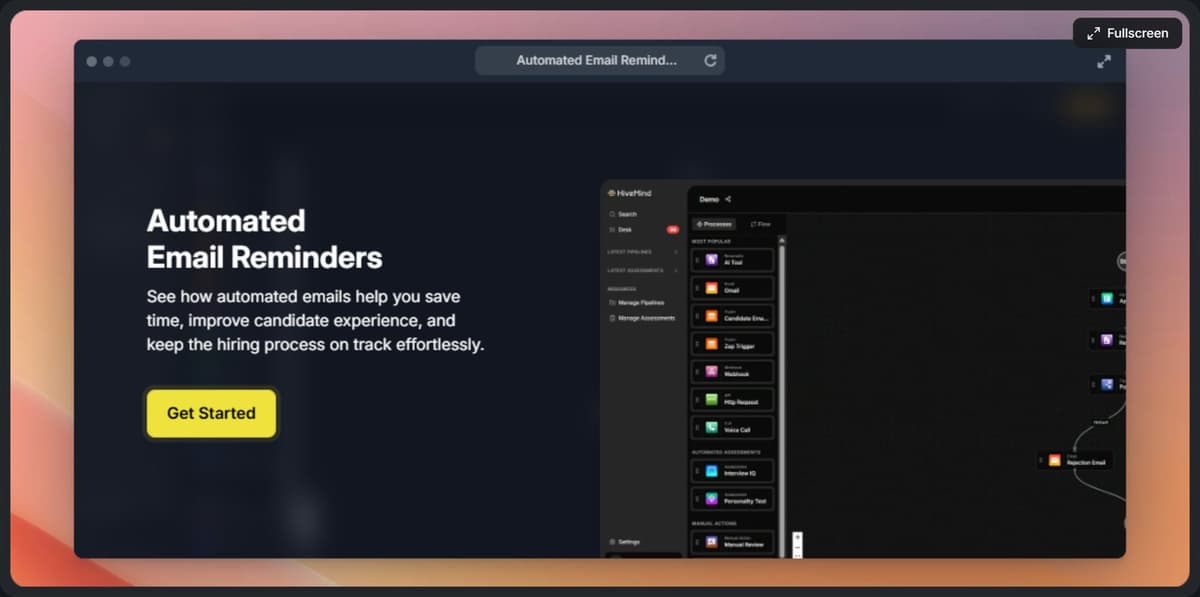
Hivemind is the hiring OS: manage every candidate from inbound to offer in one unified workflow. It covers sourcing, screening, interviews, offers, and the admin around them, with modules including Automated Emails: Smart Email Automation for Recruitment, and SMS Follow-Ups: Automated Candidate Text Messaging.
A team can run Hivemind end to end, connect your existing tools, or mix and match both, with 15 Native Modules and 275 Integrations to build the exact pipeline your team deserves.
Frequently asked questions
What is a candidate relationship management system?
A candidate relationship management (CRM) system helps recruiters maintain relationships with potential candidates before they apply and between job opportunities. It stores candidate profiles, organises talent pools and supports ongoing communication. SHRM describes these systems as tools for building and nurturing pipelines of previously vetted talent and people who have not yet applied.
What is the difference between a CRM and an ATS in recruiting?
An applicant tracking system (ATS) manages applications for active vacancies, while a candidate CRM focuses on relationships with people outside an active recruitment process. In staffing software, CRM can have a different meaning. Bullhorn, for example, describes it as a system for managing relationships with clients and business prospects.
Do I need a CRM if I already have an ATS?
Not necessarily. Many ATS platforms now include candidate relationship management features, reducing the need for a separate system. SHRM's August 2024 article notes the shift towards broader talent acquisition platforms that combine these functions. If your ATS can search, organise and communicate with past candidates effectively, it may already meet your needs.
How much does a recruiting CRM cost?
Prices depend on the provider, features and pricing model. For example, Manatal lists its Professional plan at USD 15 per user per month, while Loxo's combined ATS and CRM Core plan starts at USD 149 per user per month with annual billing. Remember to budget for additional costs such as data migration, implementation, training and text messaging.
How long can I keep candidate records in a CRM?
You must retain records for as long as applicable employment laws require, but no longer than necessary under privacy law. In the US, 29 CFR 1602.14 generally requires employers to keep hiring records for one year. The UK GDPR requires personal data to be retained only for as long as necessary, while the ICO confirms that it does not prescribe a fixed recruitment-record retention period. Establish a written policy that covers each type of candidate record.
Can I text candidates from a CRM?
Yes, provided your messages comply with applicable laws and carrier requirements. In the US, the Telephone Consumer Protection Act (TCPA) and FCC rules restrict certain automated calls and text messages. Prior express written consent is generally required for autodialled telemarketing calls to cellular numbers. The FCC's amended revocation rule, effective 25 November 2026, also requires covered callers to honour revocation requests within 10 business days. Your CRM should record consent and opt-outs for each phone number and apply them consistently across campaigns.
Sources
- SHRM (Dave Zielinski): Dave Zielinski, SHRM, How AI Is Turbocharging Candidate Relationship Management Systems, 8 August 2024 ↩
- Greenhouse Software: Greenhouse, What is candidate relationship management, glossary page dated 24 February 2026 ↩
- Bullhorn: Bullhorn, ATS and CRM product page, read 10 November 2026 ↩
- SHRM: SHRM press release on the 2025 Talent Trends report, 25 July 2025 ↩
- SHRM: SHRM 2025 Talent Trends ↩
- BambooHR: BambooHR, State of Hiring 2026 ↩
- CIPD (supported by Omni RMS): CIPD, Resourcing and talent planning report 2026, September 2026 (announced 22 September 2026) ↩
- Gem: Gem, Key takeaways from the 2026 Recruiting Benchmarks Report ↩
- LinkedIn: LinkedIn, The Future of Recruiting 2025 ↩
- American Staffing Association: American Staffing Association, Staffing Employment and Sales Survey, 22 September 2026 ↩
- Survale (CandE program: Survale, 2025 CandE Benchmark Research fact sheet ↩
- Greenhouse Software: Greenhouse blog, 2 May 2024 ↩
- Gartner: Gartner HR research press release, 16 December 2024 ↩
- Barattucci: Journal of Management & Organization, 2025, vol. 31, issue 5, pp. 2341-2359 ↩
- Gem: Gem, CRM product page, read 10 November 2026 ↩
- Staffing Industry Analysts: SIA MSP Global Landscape Summary 2026, as reported by SIA ↩
- Aptitude Research (Madeline Laurano): Aptitude Research, The Next Wave of CRM, sponsored by hireEZ, early 2024 ↩
- Aptitude Research: Gem, Aptitude Research 2026 CRM Index Report summary page, read 10 November 2026 ↩
- Crelate: Crelate, pricing page, read 10 November 2026 ↩
- Loxo: Loxo, pricing page, read 10 November 2026 ↩
- Manatal: Manatal, pricing page, yearly plans view, read 10 November 2026 ↩
- Workable: Workable, pricing page, read 10 November 2026 ↩
- American Staffing Association: ASA, Staffing Industry Statistics ↩
- Federal Trade Commission: FTC, CAN-SPAM Act: A Compliance Guide for Business, last modified 22 July 2025 ↩
- Google: Google Workspace Admin Help, Email sender guidelines ↩
- Microsoft Outlook team: Microsoft Tech Community, Strengthening Email Ecosystem: Outlook's New Requirements for High-Volume Senders, 2 April 2025 ↩
- Federal Communications Commission: 47 CFR 64.1200(a)(2), Electronic Code of Federal Regulations ↩
- Federal Communications Commission: Enhancing the Ability of Consumers To Control the Robocalls, final rule, 91 FR 67214, 26 October 2026 ↩
- UK Parliament (UK GDPR as retained: UK GDPR Article 14(3)(a), legislation.gov.uk, latest available revised text ↩
- UK Parliament (UK GDPR as retained: UK GDPR Article 21(2), legislation.gov.uk, latest available revised text ↩
- UK Parliament (UK GDPR as retained: UK GDPR Article 7(3), legislation.gov.uk, latest available revised text ↩
- US Equal Employment Opportunity Commission (29 CFR 1602.14): eCFR, 29 CFR 1602.14, Preservation of records made or kept, current text read 10 November 2026 ↩
- US Equal Employment Opportunity Commission: EEOC, Recordkeeping Requirements, read 10 November 2026 ↩
- US Department of Labor: 41 CFR 60-1.12 Record retention, Cornell Legal Information Institute transcription ↩
- US Equal Employment Opportunity Commission: 29 CFR 1627.4(a)(2), eCFR ↩
- UK Parliament: UK GDPR Article 5(1)(e), legislation.gov.uk ↩
- Information Commissioner's Office: ICO, Employment practices and data protection: keeping recruitment records ↩
- UK Information Commissioner's Office: ICO, AI tools in recruitment: audit outcomes report, November 2024 ↩
- California Privacy Protection Agency: California Privacy Protection Agency, Frequently Asked Questions ↩
- California Legislature: California Civil Code 1798.100(a)(3) ↩
- US Bureau of Labor Statistics: BLS JOLTS series JTS000000000000000JOL, total nonfarm, seasonally adjusted, data extracted 10 November 2026
- US Bureau of Labor Statistics: BLS JOLTS series JTS000000000000000HIL, total nonfarm, seasonally adjusted, data extracted 10 November 2026
- US Bureau of Labor Statistics: BLS JOLTS series JTS000000000000000QUL, total nonfarm, seasonally adjusted, data extracted 10 November 2026
- US Bureau of Labor Statistics: BLS JOLTS series JTS000000000000000QUR, total nonfarm, seasonally adjusted, data extracted 10 November 2026
- European Commission: European Commission, How long can data be kept and is it necessary to update it?
- California Department of Justice: California Attorney General, California Consumer Privacy Act (CCPA) FAQ, updated 28 August 2026