

The TCPA revocation rule that staffing agencies have been waiting for takes effect on 25 November 2026. Under FCC 26-67, a sender can name one exclusive way to opt out, such as replying STOP. An opt-out from an informational text may now be read as covering only that type of message. An opt-out from a marketing text still ends all marketing. Before the deadline, an agency should separate its job texts from its promotional texts and set its opt-out method.
Key takeaways
- The FCC's final rule on revoking consent was published in the Federal Register on 26 October 2026 and is effective 25 November 2026.
- From that date a sender may designate a STOP reply as the exclusive way to opt out, if it discloses the method in each text and honors every standardized word.
- An opt-out from an informational text may be read as covering only that category, while an opt-out from a marketing text ends all future marketing from the sender.
- No regulator has said whether a staffing agency's job or shift texts are informational, so keep promotion out of them and document each template's category.
- The outer limit for honoring an opt-out stays at ten business days, and the FCC's further notice asks whether to shorten it.
This guide is for owners of staffing agencies whose desks text candidates every day. Those texts include job alerts and shift confirmations. They also include interview reminders, and sometimes news about the agency itself. Texting is part of sourcing and screening, so a mistake is both a compliance problem and a candidate experience problem.
The guide explains what the Federal Communications Commission (FCC) changed and what the change replaced. It also covers what the FCC left undecided. It ends with the short list of changes a desk should make before 25 November. It builds on the earlier guide to the consent rules for texting candidates. That guide covered the TCPA and written consent. It also covered quiet hours. This piece focuses on what is new.
This is not legal advice. The rule is taken from the Federal Register and the FCC's own order, checked on 1 November 2026. Where law firms' readings are mentioned, they are attributed to the firm. No regulator or court text reviewed for this guide says whether a staffing agency's job or shift text counts as informational or marketing. The guide does not claim otherwise.
In this article
- What did the FCC change, and when does it take effect?
- What was the revoke-all rule, and why did it go?
- Does the rule reach a staffing agency's texts?
- Is a job text informational or marketing?
- What does designating an exclusive opt-out method involve?
- What happens when a candidate replies STOP after 25 November?
- What is still open?
- What should a staffing desk change before 25 November?
- Conclusion: decide the categories, then let the rule work for you
- Frequently asked questions
What did the FCC change, and when does it take effect?
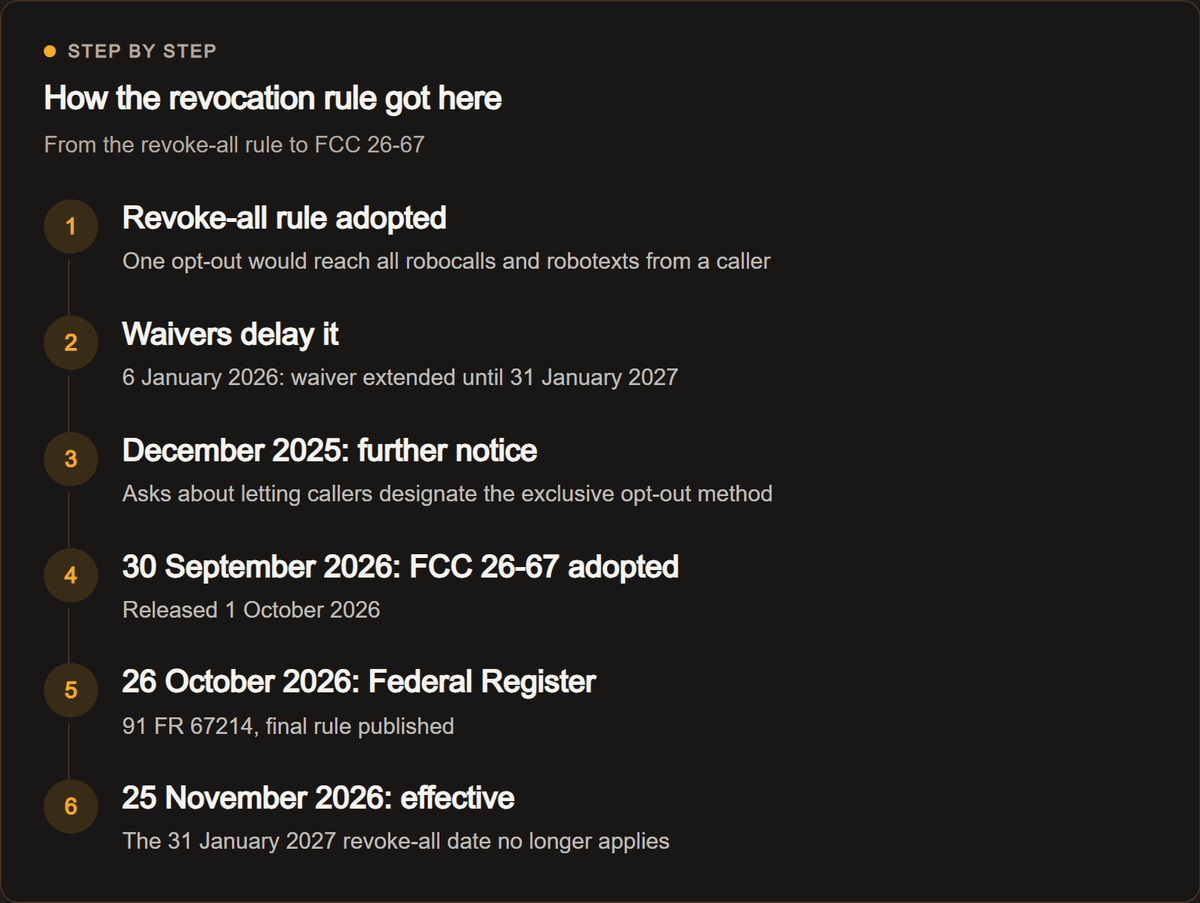
The FCC adopted FCC 26-67 on 30 September 2026 and released it on 1 October 2026.1 It is a Report and Order and Further Notice of Proposed Rulemaking in the TCPA docket. The final rule on revoking consent for robocalls was published in the Federal Register on 26 October 2026, in volume 91 on pages 67214 to 67219.234 It takes effect on 25 November 2026.
The order explains the timing. Its amendments become effective 30 days after Federal Register publication. The change to the revocation paragraph also supersedes the delayed effective date that had been extended to 31 January 2027.1 The FCC declined a request to extend the effective date by up to 12 months.1 Bass, Berry & Sims reported that the 31 January 2027 deadline for the old revoke-all rule is now moot.5
Three changes matter to a staffing desk.
1. The exclusive opt-out method. A caller may now designate one method as the only way to opt out. The listed methods are:
- an automated voice or key-press opt-out on a call
- a reply to a text using a standardized word
- a website or telephone number the caller designates to process opt-outs
A caller that designates one of these does not have to process opt-outs made any other way. A caller that does not designate one must keep honoring opt-outs made in any reasonable manner.
2. The category-specific opt-out. A caller may treat an opt-out made in response to an informational call or text as covering only that category. An informational message is one with no advertising or telemarketing. An opt-out made in response to an advertisement or telemarketing message is different. It revokes consent to all future such calls and texts from that caller.
3. The confirmation text. A text that confirms an opt-out does not violate the consent rules if it only confirms the request and has no marketing or promotional content. A confirmation sent within five minutes is presumed to fall within the candidate's prior express consent.
One thing did not change. The outer limit for honoring an opt-out is still a reasonable time, not to exceed ten business days from receipt.2
| Change | Before 25 November | From 25 November |
|---|---|---|
| How a candidate may opt out | Any reasonable method must be honored | The sender may designate one listed method as exclusive, if disclosed |
| Opt-out from an informational text | The delayed revoke-all rule would have ended all robocalls and robotexts | May be read as covering only that informational category |
| Opt-out from a marketing text | Ends marketing from the sender | Still ends all future marketing from that sender |
| Confirmation text | Allowed if it only confirms | Allowed if it only confirms; presumed within consent if sent within five minutes |
| Deadline to honor | Not more than ten business days | Not more than ten business days |
What was the revoke-all rule, and why did it go?
The part of the rule that FCC 26-67 replaces never fully took effect. It is the part of 47 CFR 64.1200(a)(10) that requires callers to treat an opt-out made in response to one type of informational message as applying to all future robocalls and robotexts from that caller.14 On 6 January 2026, the FCC's Consumer and Governmental Affairs Bureau extended its waiver of that requirement until 31 January 2027.
The FCC's December 2025 further notice, published in the Federal Register, then asked whether to change the approach.6 It asked whether callers should be able to designate the exclusive means of opting out. The alternative was honoring every opt-out made by any reasonable means.
The problem the FCC pointed to
The order gives its own example. Under the old revoke-all rule, a consumer who opted out of payment reminders would have forced the caller to stop unrelated robocalls.1 Those could include fraud alerts and multi-factor authentication codes. They could also include appointment reminders and utility outage calls. So the FCC changed its rules to let callers read an opt-out as applying only to the specific category of informational robocalls it was aimed at.1
Why marketing is treated differently
The FCC was explicit on this point. It reasoned that telemarketing robocalls are a category with no exemptions to the prior express consent requirement.1 It also stressed that the change does not alter the existing opt-out methods for exempted calls, or for calls that include an advertisement or constitute telemarketing.1
The cost to consumers
The FCC weighed this too. Some consumers may have to opt out more than once to stop different kinds of informational robocalls. The FCC called that burden minimal and said the order imposes no new compliance obligation.1
What this means for a staffing desk
Under the delayed rule, a candidate who replied STOP to a shift reminder might have had to be removed from every automated text the agency sends. That would include the next job alert. Under the new rule, the agency may treat that STOP as ending shift reminders only, as long as the shift reminder was informational.
Does the rule reach a staffing agency's texts?
It reaches the texts the TCPA's consent rules reach, which depends on how they are sent. Federal law makes it unlawful to make a call to a cellular telephone number using an automatic telephone dialing system or an artificial or prerecorded voice, unless the call is for emergency purposes or has the prior express consent of the called party.3 For this order the FCC defined a robocall as any call made or text message sent using an autodialer, or any call made using an artificial or prerecorded voice message.1
Whether a texting platform is an autodialer is a question about its equipment. In Facebook v. Duguid (2021) the Supreme Court held that a necessary feature of an autodialer is the capacity to use a random or sequential number generator to either store or produce the phone numbers to be called.7 No source held for this guide says whether any particular staffing texting platform meets that test, so this guide does not assume either answer. Ask your provider in writing.
Courts are also reading the statute for themselves. In McLaughlin Chiropractic v. McKesson (20 June 2025) the Supreme Court held that the Hobbs Act does not bind district courts in civil enforcement proceedings to an agency's interpretation of a statute.7 A court hearing a TCPA case may therefore read the statute differently from the FCC.
One appeals court has already narrowed one part of the statute for texts. Kirkland & Ellis reported that on July 14, 2026 the Seventh Circuit held in Steidinger v.8 Blackstone Medical Services that section 227(c)(5) of the TCPA does not govern text messages. Kirkland & Ellis noted that the Seventh Circuit expressly left undisturbed the regulation of text messaging under other provisions of section 227, including agency enforcement.8 That decision binds courts in one circuit, concerns one provision, and was held for this guide through the law firm's summary rather than the opinion itself.
State law sits on top. Florida section 501.059 requires a recipient to reply STOP to the sender before suing over text message solicitations, and gives the sender 15 days after the notice to cease sending text message solicitations.9 That is a Florida rule about solicitations, and it does not replace the federal ten-business-day limit.
And the carriers set their own expectations. CTIA's May 2023 Messaging Principles and Best Practices say message senders should support opt-in mechanisms and send messages only after the consumer has opted in to receive them.10 CTIA's principles say senders should support multiple mechanisms of opt-out, including phone call, email, or text, and that no further messages should be sent after the final confirmation message.10 CTIA's principles are an industry code, not law, but the carriers that deliver your texts apply them.
What the desk does: ask your texting provider in writing how its platform sends messages, and keep the answer on file. Then plan as if the federal opt-out rules apply, because a STOP line and a working suppression list cost little either way.
Is a job text informational or marketing?
No regulator has answered this question for staffing agencies. The FCC defined an informational robocall as one that has no advertisement and is not telemarketing.1 Telemarketing means contacting someone to encourage them to buy, rent or invest in goods, property or services.
Read plainly, a text about an accepted shift or a booked interview does not ask anyone to buy anything. One court has taken this view for calls. In Rockwell v. Medicus Healthcare (W.D.N.Y., 31 March 2025), the court noted that several district courts have found that job recruiting messages are not telemarketing.11 This was one district court ruling on calls and a do-not-call claim. It is not a rule for texts, and other courts may disagree.
A text can still cross the line. A job alert that also promotes your agency's services, a referral bonus or an event may count as encouraging a purchase. Marketing texts face stricter rules. An autodialed or prerecorded marketing message to a cell phone needs the person's prior express written consent. There are exceptions for tax-exempt nonprofits and certain health care messages.
Law firms agree on one practical step. Keep promotional language out of informational messages. If you send both kinds from one short code, consider splitting them.
The order does not say what counts as a "category" of informational message. Job alerts, shift confirmations and interview reminders could be one category or three. That choice is yours, and so is the risk. The FCC has not approved any staffing category.
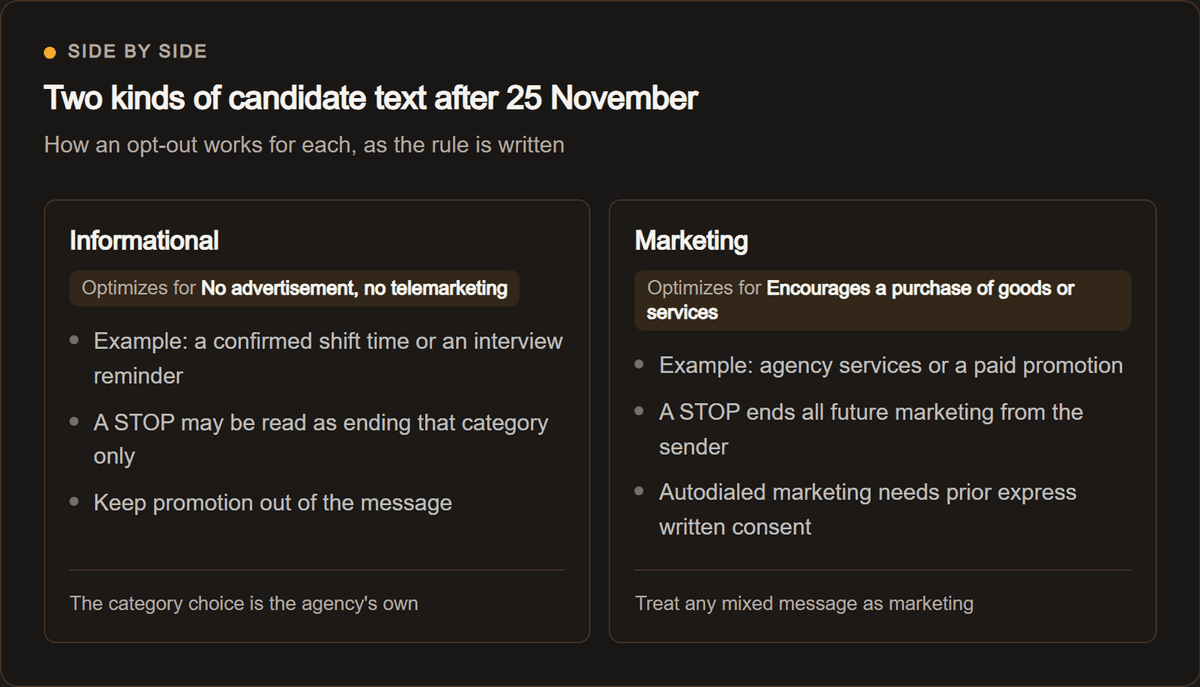
What your desk should do: List every text template your desk sends. Mark each one as informational or marketing. Remove any promotion from the informational ones. If a template mixes the two, treat it as marketing or split it into two messages.
What does designating an exclusive opt-out method involve?
Designation is optional. It only works if you tell people about it. The amended rule says you must disclose your chosen opt-out method clearly and conspicuously, either on the call or in the text.
If you choose reply texts as your exclusive method, you can meet this by naming at least one standardized word in each text. You must still treat every standardized word as a valid opt-out request. Nixon Peabody advised businesses to confirm that their platform recognizes all seven keywords, even if only one is shown.12 A receivables-industry trade publication reported the same.
The current rule says the opposite for now. The version of 47 CFR 64.1200 dated 26 October 2026 still bars callers and text senders from designating an exclusive opt-out method.14 The amendment is published at 91 FR 67219 on 26 October 2026, but it takes effect on 25 November. A designation made before that date is not protected. Keep honoring every reasonable opt-out method until then.
Firms also urge care. InfoLawGroup recommended a careful review of the order, and of your technical and organizational measures, before you designate an exclusive method or separate your informational texting campaigns.13
Your desk should decide whether to make reply texts your exclusive opt-out method. If you do, put at least one standardized word in every template. Test that your platform treats every standardized word as a stop. Switch the designation on from 25 November, not before.
What happens when a candidate replies STOP after 25 November?
It depends on what they replied to and how the agency has set itself up.
If the text was marketing, the STOP ends all future marketing from the agency. Nixon Peabody reported that an opt-out in response to a marketing call or text revokes consent to all future marketing calls and texts from that business.12
If the text was informational, the agency may choose to treat the STOP as ending only that category. Kelley Drye reported that informational opt-outs may be applied at a campaign level, while marketing opt-outs must be applied at the caller or texter level. Kelley Drye read the final rule as meaning that a revocation request for informational messages does not automatically revoke consent for marketing messages, and vice versa. That "vice versa" is Kelley Drye's reading; the rule text itself says a marketing opt-out reaches all future marketing, so be careful about relying on a marketing STOP to leave informational texts running.
Either way, the system has to know which category the STOP came from. Bass, Berry & Sims advised businesses to record in a central consent database which category an opt-out came from and push that preference to every system and vendor, while treating a marketing opt-out as an opt-out from all marketing messages.5 If your candidate database has moved systems recently, check that opt-out records came across with it.
The confirmation text should confirm and nothing more. Send it quickly, keep it free of promotion, and do not use it to ask the candidate which texts they meant. The further notice asks about that kind of question, which is a reason to wait for the FCC's answer before using it.
And the clock still runs. Honor the request within a reasonable time not to exceed ten business days from receipt, and faster where a state rule or your carrier requires it.

What the desk does: make sure every STOP is logged with the template it answered and the time it was honored, and that a marketing STOP removes the candidate from every marketing list the agency runs.
What is still open?
The FCC's further notice leaves a few questions unsettled. Staffing desks should watch them.
The first is how fast you must honor an opt-out. The FCC asks whether to cut the maximum time allowed. A joint letter suggested seven business days, unless the caller can show that more time is reasonable.
The second is whether reply texts must always work as an opt-out. The FCC asks whether senders of certain text messages should have to let recipients revoke consent by replying.
The third is whether senders can ask for clarification. Vibes asked that a sender be allowed to request the message category in a confirmation text.1 The FCC has asked for comment on this.
The dates are fixed. Comments are due on or before 25 November 2026. Reply comments are due on or before 28 December 2026.214
Two other points are also open. The sources reviewed for this guide found no court challenge to the order and no stay. No court has yet read the new paragraph. Courts are not bound by the FCC's reading of the statute, as McLaughlin made clear.
Plan for an opt-out window shorter than ten business days, because one may come. If your desk honors a STOP within a day or two, you are safe under either answer.
What should a staffing desk change before 25 November?
Six changes cover most of it.
- List and label every template. Mark each job alert, shift confirmation, interview reminder and agency message as informational or marketing. Remove any promotion from the informational ones.
- Separate your marketing. Run agency promotion as its own program. Get written consent where it is required. Treat any STOP to a marketing text as ending all marketing.
- Decide on designation. You may make the reply text your exclusive opt-out method. If you do, print at least one standardized word in every text. Make sure your platform honors all of them. This only applies from 25 November.
- Keep honoring other routes until then. Before 25 November, the regulation still requires you to honor every reasonable opt-out method. If a candidate emails a recruiter to stop, you should still stop their texts.
- Log the category and the time. Record which template a STOP answered. Record when you honored it. Push that record to every system that texts candidates.
- Check your platform. Ask your provider how it sends texts. Ask whether it can suppress by category. Ask whether it recognizes every standardized word. If it cannot suppress by category, treat any STOP as ending all texts. The category-specific reading is an option, not a duty.
Conclusion: decide the categories, then let the rule work for you
FCC 26-67 is mostly good news for a staffing agency that texts candidates about real jobs and real shifts. The rule gives your desk more room to work than it had before.
Here is what that looks like in practice: a candidate who stops one kind of text no longer has to drop off every list. Someone who is tired of job alerts can still get the shift confirmation for work they have already accepted. That keeps the candidate informed and keeps your placements on track.
A clearly disclosed STOP can also become the one opt-out route your desk has to watch. Today, a candidate might reply to a text, email a recruiter or tell someone over the phone. Each route has to be caught and acted on. If you designate the reply text and disclose it in every message, your team has a single place to look.
The rule only helps a desk that does three things first. It must decide what its categories are. It must keep marketing out of its job texts. It must be able to show its records.
Each of these is a choice that stays with your agency. The FCC has not approved any staffing category, so the sorting is yours to do. A text that mixes a job alert with a promotion can be read as marketing, and a STOP to marketing ends all marketing from that sender. Clean separation protects you and the candidate.
Records matter because a rule is only as good as your proof that you followed it. If a candidate says they replied STOP, you should be able to show which template they answered, when you honored the request and which systems were updated.
The agencies that benefit most from 25 November will be able to answer two questions for every text they send. Which category is it? What happened when the candidate said stop?
Settle that list this month. Label every template, remove any promotion from the informational ones and check that your platform can act on a STOP. Then the new rule can work for you instead of against you.
How Hivemind handles candidate texts
The decisions in this guide stay with the agency and its counsel: which templates are informational, whether to designate an exclusive opt-out method, how to honor a STOP and which states the desk texts into. No system makes those calls, and nothing here says one does.
Around them sits the rest of the hiring work: sourcing, screening, interviews, offers, and the admin around them. Hivemind is the hiring OS: manage every candidate from inbound to offer in one unified workflow. Among its modules are SMS Follow-Ups: Automated Candidate Text Messaging, and Automated Emails: Smart Email Automation for Recruitment.
A team can run Hivemind end to end, connect your existing tools, or mix and match both. Hivemind has 15 Native Modules and 275 Integrations, so a desk can build the exact pipeline its team deserves.
Frequently asked questions
When does the new TCPA revocation rule take effect?
On 25 November 2026. The FCC's final rule was published in the Federal Register on 26 October 2026. The order says this change replaces the delayed revoke-all date of 31 January 2027.
Can a staffing agency make STOP the only way to opt out?
Yes, from 25 November, as long as it tells people. The amended rule lets a sender designate a reply text with a standardized word as its exclusive opt-out method. The sender must disclose this in the text. It must also recognize every standardized word, not only the one it prints.
If a candidate replies STOP to a shift reminder, can the agency still send job alerts?
Possibly, if both texts are informational and the agency treats them as separate categories. The rule lets a sender read an opt-out from an informational text as covering that category only. A STOP to a marketing text ends all future marketing. No regulator has said how staffing texts divide into categories, so document your choice.
Are job texts telemarketing?
No regulator or court text reviewed for this guide answers that for staffing texts. The FCC defines an informational robocall as one with no advertisement and no telemarketing. A law firm reported that one district court noted several district courts have found that recruiting messages are not telemarketing. Keep promotion out of your job texts.
How fast must a staffing agency honor an opt-out?
Within a reasonable time, and no later than ten business days from receipt. The amended rule keeps this limit. The FCC's further notice asks whether to shorten it. A faster process is the safer plan.
Do state laws still apply?
Yes. Florida section 501.059 is one example. It requires a recipient to reply STOP before suing over text message solicitations. It then gives the sender 15 days after the notice to stop. Check the rules in every state your desk texts into.
Sources
- Federal Communications Commission: FCC 26-67, Report and Order and Further Notice of Proposed Rulemaking and DA 26-12, Order, 6 January 2026 ↩
- Federal Register: Final rule, Advanced methods to target and eliminate unlawful robocalls, 26 October 2026 (91 FR 67214) and Further notice of proposed rulemaking, 26 October 2026 ↩
- US Government Publishing Office: Federal Register, 26 October 2026, document 2026-21821 (PDF) and 47 U.S.C. 227 ↩
- Electronic Code of Federal Regulations: 47 CFR 64.1200, current and 47 CFR 64.1200 as of 26 October 2026 ↩
- Bass, Berry & Sims PLC: FCC replaces TCPA revoke-all rule, 16 October 2026 ↩
- Federal Register: Further notice of proposed rulemaking, 5 December 2025 ↩
- Supreme Court of the United States: Facebook, Inc. v. Duguid (2021) and McLaughlin Chiropractic Associates v. McKesson Corp. (2025) ↩
- Kirkland & Ellis LLP: Seventh Circuit holds text messages are not calls under the TCPA, 2026 ↩
- Florida Senate: Section 501.059, Florida Statutes (2026) ↩
- CTIA: Messaging Principles and Best Practices, May 2023 ↩
- Troutman Amin, via the National Law Review: Court dismisses TCPA class action: recruitment calls are not telephone solicitations, April 2025 ↩
- Nixon Peabody LLP: FCC scraps revoke-all and lets businesses pick how consumers opt out, 7 October 2026 ↩
- InfoLawGroup LLP: Analysis of the FCC revocation order, 12 October 2026 ↩
- Womble Bond Dickinson, via the National Law Review: Clock starts on FCC TCPA revocation order, 29 October 2026 ↩
- Kelley Drye & Warren LLP: FCC revises TCPA consent revocation rules, 13 October 2026
- Receivables Info: FCC revised TCPA consent revocation rules, 28 October 2026
- Rosenberger + Kawabata: What the FCC opt-out order means for businesses