
In 2025, hiring teams reached a tipping point. According to recent industry data, about 87% of companies now use AI somewhere in their recruitment process, and 99% of Fortune 500 firms leverage AI recruitment tools in some way, cutting time-to-hire by as much as 30 - 40% in the process.
That shift didn’t happen by accident. It happened because modern hiring has become overwhelming. Open roles now attract three times more applications than they did just a few years ago, but the quality hasn’t tripled; instead, recruiters are spending more time sorting through noise, not finding better talent.
This is where AI recruiting comes in. It is the use of artificial intelligence to automate and improve talent acquisition, everything from candidate sourcing and screening to assessments, interviews, and scheduling. Instead of relying on manual reviews, keyword matching, or gut instinct, AI helps hiring teams make faster, more consistent, and more data-driven decisions.
But the use of AI in recruiting didn’t start where it is today. Early tools focused on simple automation, basic resume parsing, or keyword filters layered on top of traditional ATS systems. Today, the technology has evolved into agentic AI: systems that don’t just assist recruiters, but actively run parts of the hiring workflow on their own. These tools can screen candidates, evaluate skills, rank applicants in real time, and even engage candidates through AI-driven conversations, without constant human input.
The payoff is significant. Companies using AI recruiting tools report faster hiring cycles, reduced bias through skills-based evaluations, lower recruiting costs, and better candidate experiences. It’s no surprise that the market is projected to grow to over $1.12 billion by 2030, as organizations race to scale hiring without sacrificing quality or fairness.
If you’ve read this far, it’s because you’re probably interested in how you can integrate AI into your recruiting process, and also see actionable results, not too worry, cause this guide breaks it all down. You’ll learn what AI in recruiting really is, how it works, the key benefits, real-world use cases, and examples of how companies are applying it today.
You’ll also see how modern platforms like HiveMind are pushing the use of AI in recruiting forward with agentic workflows, automated assessments, and intelligent candidate engagement, setting a new standard for how hiring gets done.
Keep reading!
What Is AI Recruiting?

AI recruiting is the use of artificial intelligence to automate and scale the recruitment process. Instead of relying solely on manual reviews and human judgment, AI uses technologies like machine learning, natural language processing (NLP), and generative AI to handle high-volume tasks while helping recruiters make better, faster hiring decisions.
AI in recruiting takes over the most time-consuming parts of hiring, such as resume screening, candidate matching, scheduling, and initial assessments, so recruiters can focus on what humans do best: building relationships, evaluating culture fit, and closing top talent.
How AI Recruiting Works
Modern recruiting platforms use AI across the entire hiring lifecycle using several core technologies like:
-
Resume parsing & screening: AI scans and interprets resumes, extracting skills, experience, and qualifications far beyond simple keyword matching.
-
Predictive analytics: Algorithms analyze historical hiring data to predict candidate success, retention, and performance.
-
AI chatbots & assistants: These tools engage candidates, answer questions, schedule interviews, and keep applicants informed in real time.
-
Skills-based assessments: AI evaluates candidates based on real skills and job-related tasks rather than surface-level credentials.
-
Video & behavioral analysis: Some platforms analyze speech patterns, responses, and engagement signals to add deeper insight (when used ethically and responsibly).
When paired with an ATS, AI hiring software turns static candidate data into actionable insights, helping teams spot top talent faster and more objectively.
How AI Recruiting Differs From Traditional Recruiting
Traditional recruiting is human-heavy and manual. Recruiters spend hours reviewing resumes, coordinating schedules, and managing spreadsheets. AI flips that model, it handle scale and data, screening thousands of applications, ranking candidates, and spotting patterns humans would miss.
Types of AI in Recruiting
Not all AI recruiting tools are the same. Today’s market includes:
-
Rule-based AI: Follows predefined rules and filters (e.g., basic resume screening).
-
Generative AI: Generative AI in recruiting creates content like interview questions, job descriptions, and candidate summaries.
-
Agentic AI: Operates autonomously, screening candidates, running assessments, ranking talent, and engaging applicants with minimal human input.
This shift toward agentic AI is redefining what’s possible in recruiting and setting the stage for platforms like HiveMind, which go beyond assistance to act as intelligent recruiting agents.
In short, the use of AI in recruiting isn’t about replacing recruiters, it’s about giving them leverage. When used correctly, it leads to faster hiring, fairer evaluations, and a better experience for both teams and candidates.
Top Pick: AI Recruiting Software: Tools, Platforms & How to Choose (2026)
AI Recruiting Benefits

Below are the most impactful benefits AI brings to the hiring process today.
-
Faster Hiring and Better Efficiency
-
Data-Driven Hiring Decisions
-
Better Candidate Experience
-
Lower Hiring Costs and Higher ROI
-
Scalability for High-Volume Hiring
-
Reduced Bias and More Inclusive Hiring
-
Faster Hiring and Better Efficiency
-
Data-Driven Hiring Decisions
-
Identify candidates most likely to succeed in a role
-
Forecast performance and retention
-
Spot hiring bottlenecks and optimize workflows
-
Better Candidate Experience
-
24/7 responses to candidate questions
-
Faster application feedback
-
Clear updates on next steps
-
Lower Hiring Costs and Higher ROI
-
Scalability for High-Volume Hiring
-
Automatically filter out up to 90% of unqualified applications
-
Apply consistent evaluation criteria across roles
-
Keep thousands of candidates engaged simultaneously
-
Reduced Bias and More Inclusive Hiring
One of the most immediate benefits of AI recruiting is speed. AI automates repetitive, time-consuming tasks that would otherwise consume hours of recruiter time.
Industry studies show that companies using AI in recruiting reduce time-to-hire by 30 - 50%, even when handling thousands of applications.
AI replaces guesswork with insight. By analyzing large volumes of historical and real-time hiring data, AI uncovers patterns that humans often miss.
With predictive analytics, recruiters can:
This data-driven approach leads to smarter, more confident hiring decisions.
AI recruiting improves the hiring experience for candidates, not just recruiters. Long response times, unclear next steps, and a lack of communication are major reasons candidates drop out of hiring processes.
AI-powered chatbots and messaging tools provide:
This level of responsiveness significantly reduces candidate drop-off rates and strengthens employer brand perception. Even rejected candidates benefit from timely, respectful communication, something that’s nearly impossible to maintain manually at scale.
Time delays and bad hires are expensive. The use of AI in the recruiting process helps reduce both.
By automating candidate screening, follow-ups, and scheduling, companies cut down on manual effort and external recruiting costs. Research shows that AI tools can reduce cost-per-hire by up to 30%, with some organizations reporting an ROI of over 300% within 18 months of adoption.
Simply put, AI allows hiring teams to do more with fewer resources, and with better outcomes.
High-volume hiring is where AI recruiting truly shines. Whether you’re hiring for seasonal roles, fast-growing teams, or multiple departments, AI can scale effortlessly.
Modern recruiting platforms can:
This ensures fairness, consistency, and speed, even during peak hiring periods. Tools like HiveMind’s Resumatic are designed specifically for this, ranking and filtering candidates in real time based on job-relevant skills.
When implemented correctly, AI helps reduce unconscious bias by focusing on skills, experience, and job relevance, rather than names, photos, or background signals.
By anonymizing resumes and applying standardized scoring, AI supports fairer, skills-based hiring and stronger DEI outcomes. Many organizations report improved diversity metrics after introducing AI into their recruiting workflows.
That said, AI is not perfect; poorly trained models can reinforce bias, which is why human oversight and ethical AI design remain essential.
AI in recruiting isn’t about replacing recruiters; it’s about empowering them. When paired with the right platform and human judgment, tools like HiveMind turn hiring into a faster, fairer, and more scalable process, without sacrificing quality.
Recommended: Top 37 HireVue Interview Questions with Smart Answers
Common Use Cases for AI in Recruitment

AI recruiting is no longer limited to one part of the hiring funnel. Today, organizations use AI across the entire recruitment lifecycle. The goal is simple: reduce manual work, improve hiring quality, and help recruiters focus on building relationships with the right talent.
Below are the most common and high-impact use cases of AI in recruitment, along with real-world AI recruitment examples.
Smart Candidate Sourcing
Automated Resume Screening
Job Description Creation and Optimization
Interview Scheduling and Coordination
Data-Driven Hiring Insights
Improving Diversity and Reducing Bias
Candidate Communication via AI Chatbot
Automated Skills-Based Assessments
-
Smart Candidate Sourcing
Finding qualified candidates, especially for niche or highly technical roles, can be slow and frustrating. AI recruiting tools simplify sourcing by scanning large talent pools and identifying candidates who match role requirements, even if they’re not actively job hunting.
How it works:
-
Recruiters input role requirements (skills, experience, location).
-
AI scans resumes, job boards, professional networks, and talent databases.
-
Candidates are ranked based on relevance and likelihood of success.
-
Passive candidates are tracked and flagged as their fit improves.
Real-world example:
IBM uses AI-powered sourcing through Watson Recruitment to improve candidate matching accuracy, helping recruiters identify better-fit candidates earlier in the funnel.
-
Automated Resume Screening
Resume screening is one of the most time-consuming tasks in recruitment, and one of the easiest to automate.
Modern recruiting platforms can scan and rank thousands of resumes in minutes, evaluating candidates objectively based on skills, experience, and qualifications. This speeds up hiring while reducing unconscious bias.
How it works:
-
AI parses resumes for relevant skills, certifications, and experience.
-
Candidates are automatically ranked and shortlisted.
-
Recruiters review only the most qualified applicants.
Real-world example:
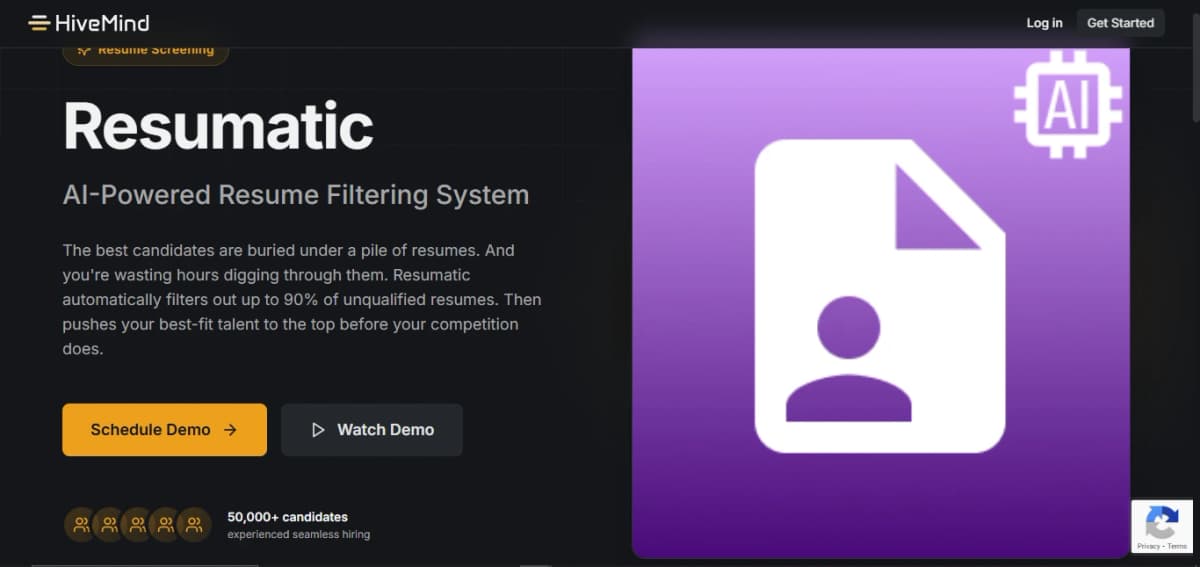
HiveMind’s Resumatic feature filters out up to 90% of unqualified applications, allowing recruiters to focus only on high-quality candidates. Teams using this approach report hiring cycles that are 70–90% faster.
-
Job Description Creation and Optimization
Writing effective job descriptions is harder than it looks. Poor wording can discourage qualified candidates or unintentionally introduce bias.
AI recruiting tools help generate and optimize job descriptions that are clear, inclusive, and optimized for visibility.
How it works:
-
AI generates role-specific job descriptions.
-
Language is analyzed for bias, clarity, and inclusivity.
-
Keywords are suggested to improve search visibility and applicant quality.
Real-world example:
Textio, an AI writing platform, helps companies improve job descriptions. Zillow Group used Textio’s AI job-description optimization to boost its recruiting performance, including a 16% increase in email responses and more qualified candidates after applying inclusive, optimized language.
-
Interview Scheduling and Coordination
Coordinating interviews across time zones, teams, and calendars is a logistical headache. AI tools automate this process entirely, by also acting as an interview co-pilot.
How it works:
-
Candidates select interview slots through an automated system.
-
AI syncs with recruiter and hiring manager calendars.
-
Automated reminders and rescheduling reduce no-shows.
Real-world example:
Companies using AI scheduling tools like Paradox reduced missed interviews by 25%, while significantly improving candidate satisfaction.
-
Data-Driven Hiring Insights
Beyond automation, AI recruiting provides insights that help teams hire smarter over time. AI analyzes recruitment data to identify patterns related to performance, retention, and pipeline efficiency.
How it works:
-
Predicts candidate success and long-term retention.
-
Identifies hiring bottlenecks and process inefficiencies.
-
Helps teams refine sourcing and screening strategies.
Real-world example:
Organizations using AI-driven recruiting analytics report more consistent hiring outcomes and improved workforce planning accuracy, especially in high-volume hiring environments.
-
Improving Diversity and Reducing Bias
Diversity and inclusion are priorities for many organizations, but unconscious bias can still creep into hiring decisions. AI helps reduce bias by focusing on skills and job relevance rather than personal identifiers.
How it works:
-
Anonymous resume screening removes names, age, and gender markers.
-
Candidates are evaluated using standardized criteria.
-
Historical bias patterns can be identified and corrected.
Real-world example:
Unilever famously used AI-based assessments and games in recruitment, leading to faster hiring and more diverse candidate pools, without compromising quality.
-
Candidate Communication via AI Chatbot
Candidates expect fast, clear communication. AI-powered chatbots help recruiters deliver this at scale.
How it works:
-
Chatbots answer FAQs 24/7.
-
Candidates receive instant updates on application status.
-
AI guides candidates through the next steps in the process.
Real-world example:
Conversational AI tools like Humanly and Paradox help companies maintain consistent candidate communication, significantly reducing drop-off rates during early-stage hiring.
-
Automated Skills-Based Assessments
Resumes don’t always reflect real ability. AI recruiting platforms increasingly rely on skills-based assessments to evaluate what candidates can actually do.
How it works:
-
Candidates complete real-world tasks or simulations.
-
AI grade assessments using predefined criteria.
-
Results feed directly into candidate ranking and shortlists.
-
Human reviewers can override or review results when needed.
Real-world example:
HiveMind offers AI-graded skill and personality assessments, including real coding tasks and role-specific simulations. This approach helps teams identify top performers early, while still keeping human judgment in the loop.
The Big Picture
Across these use cases, one pattern is clear: AI recruiting works best when it handles volume, data, and repetition, while humans focus on relationships and final decisions.
Companies using agentic AI systems report:
-
Faster hiring cycles
-
Better candidate quality
-
More scalable and fair recruitment processes
As platforms like HiveMind continue to evolve, AI in recruitment is shifting from a support tool to a full hiring co-pilot, one that helps teams hire better, not just faster.
Myths About AI Recruiting (And the Truth Behind Them)
As AI recruiting becomes more common across companies of all sizes, it’s only natural for misconceptions to follow. Some of these myths come from early chatbot tools, others from fear of automation. Let’s clear things up and separate fact from fiction.
Myth 1: AI Recruiting Is Just Chatbots
Because chatbots were one of the earliest visible uses of AI in recruitment, many people still think that’s all AI can do.
That’s far from the truth.
Modern use of AI in recruiting goes well beyond messaging candidates. Today’s tools handle resume screening, candidate ranking, skills-based assessments, job description optimization, interview scheduling, and even predictive hiring insights. Chatbots are just one small piece of a much larger system designed to reduce manual work and improve hiring accuracy.
Myth 2: AI Will Replace Recruiters and Hiring Managers
I know how this sounds, but we’re here to tell you, AI will not steal your job. AI cannot replace hiring managers, this is because no amount of automation can replace good old human judgment and resilience, and our ability to solve problems.
AI technology will not replace recruiters. It is simply a tool made for recruiters to make their lives easier, allowing them to be more productive and focus on the more complicated tasks or tasks that require a human touch. So no need to fear, AI is simply here to assist, not replace.
Myth 3: AI Recruiting Is Biased
This is one of the challenges of AI we covered in a previous article and honestly, it’s true that poorly designed AI systems can inherit bias from historical data. But that doesn’t mean AI itself is biased by default.
Engineers are making sure to train AI hiring software using a wide range of data, which is both diverse and clean. These algorithms are then audited regularly to refine any errors in the system, hence maintaining unbiased results. In fact, when implemented correctly, AI recruiting can reduce unconscious bias by evaluating candidates based on skills, experience, and job relevance, rather than names, photos, or background signals. Many platforms now use anonymized screening, audited models, and diverse training data to actively minimize bias.
That’s why a growing number of recruiters believe AI can support fairer, more inclusive hiring when paired with proper oversight.
Myth 4: AI Recruiting Is Only for Big Companies
There’s a common assumption that AI is only useful if you’re hiring at massive scale.
In reality, small and mid-sized teams often benefit the most from AI in recruiting. When you have limited headcount but still receive hundreds of applications, manual screening becomes risky and inefficient. One bad hire can cost far more than an AI tool ever would.
AI helps smaller teams compete by reducing cost-per-hire, improving candidate quality, and keeping hiring organized without adding more recruiters.
Myth 5: AI Recruiting Tools Are Hard to Use
This myth usually comes from experiences with older, poorly designed AI hiring software.
Modern AI recruiting platforms are built with usability in mind. If a tool requires an AI expert to operate, it’s already failed. The best platforms focus on intuitive dashboards, guided workflows, and straightforward onboarding, so teams can start seeing value quickly.
That’s exactly how HiveMind is designed. Instead of overwhelming recruiters with complex configurations, HiveMind simplifies the entire hiring workflow, from resume screening and assessments to candidate engagement and follow-ups all in one place. You don’t need technical expertise to use it; you just plug it into your process and start hiring smarter.
With the right platform, AI doesn’t complicate recruiting, it simplifies it.
The takeaway
AI recruiting isn’t a threat, a gimmick, or a tool reserved for large enterprises. When used thoughtfully, it’s a practical way to hire faster, reduce bias, and make better decisions, without losing the human element that makes recruiting work.
Conclusion
Hiring in 2026 isn’t about moving faster for the sake of speed. It’s about making smarter hiring decisions at scale without overwhelming your team or lowering the bar. That is why AI recruiting has become essential, not optional.
HiveMind AI was built with this reality in mind. Its agentic AI recruiter manages screening, skills-based assessments, candidate ranking, and engagement from start to finish. Instead of stitching together multiple tools, teams get a single AI recruiting platform that supports recruiters like a real hiring partner, not another system to babysit.
If you’re looking to automate and scale recruitment with AI, and consistently hire better candidates without expanding your team, HiveMind was built to support that next step.