
Hiring teams are under more pressure than they’re willing to admit.
By 2026, artificial intelligence will no longer be something recruiters experiment with on the side. It will be embedded directly into how candidates are sourced, screened, assessed, and shortlisted.
Industry forecasts suggest that more than 70% of HR leaders will rely on AI-driven workflows in the next hiring cycle, nearly double today’s adoption rate.
Yet many organizations still struggle with the same challenges: slow hiring cycles, rising mis-hire rates, and processes that break under applicant volume.
The truth is uncomfortable but clear. Manual recruiting does not scale. When decisions rely heavily on resumes, intuition, and overstretched recruiters managing hundreds of applications, the outcome is predictable.
Time-to-hire increases, bias quietly enters the process, and mis-hires, often estimated between 30% and 50%, continue to drain productivity, morale, and budgets long after roles are filled.
This is why interest in the best AI recruiting tools has surged.
Modern platforms promise faster screening without cutting corners, fairer evaluations grounded in skills rather than pedigree, and workflows that reduce recruiter workload instead of adding complexity.
In theory, AI should automate what slows hiring down resume screening, scheduling, and early assessments, while freeing humans to focus on judgment, context, and culture fit.
But not all tools deliver the same value. Some simply add automation to legacy systems, while others are moving toward agentic workflows that actively manage hiring steps end to end. As companies assess options in the era of AI recruiting tools 2026, knowing the difference matters.
This guide reviews and compares leading platforms to identify which solutions truly deserve to be called the best AI recruiting tools for modern hiring teams, a comprehensive best ai recruiting software comparison for teams planning their 2026 stack.”
Key Trends in AI Recruiting for 2026

AI recruiting in 2026 is being shaped less by novelty and more by depth. The question hiring leaders now ask is no longer whether a tool uses AI, but how fundamentally that AI reshapes sourcing, screening, interviewing, and onboarding. Several clear trends are defining which platforms deliver real value and which fall behind.
Agentic AI Takes Center Stage
The most significant shift is the rise of agentic AI. Unlike assistive tools that simply support recruiters, agentic systems autonomously execute hiring steps such as candidate outreach, screening, assessment, and ranking. These platforms operate with minimal human input while still following predefined hiring criteria.
This marks a move from AI as a helper to AI as an active participant in the hiring process, particularly in high-volume and technical roles. Forward-looking AI ATS 2026 systems are leading this charge.
Skills Over Resumes
Another defining trend is the decline of resume-first hiring. In 2026, leading platforms prioritize real skill signals over pedigree or job titles. Candidates are evaluated through job-relevant tasks, simulations, and projects that reflect actual work.
AI-driven grading, combined with anti-cheat mechanisms, ensures assessments remain fair and defensible at scale. This shift has proven especially effective in reducing bias and improving quality of hire. The rise of skill-based ai hiring tools is accelerating this transformation across the industry.
Ethics, Compliance, and Bias Audits
As AI adoption accelerates, so does regulatory scrutiny. Compliance with frameworks such as the EU AI Act has become a baseline expectation rather than a differentiator. Modern recruiting tools increasingly include bias monitoring, explainability features, and audit logs that allow organizations to validate how hiring decisions are made. Ethical AI is no longer optional, it is a requirement for enterprise adoption.
Deep Integrations Across the Hiring Stack
AI recruiting tools are also expected to integrate seamlessly with the broader hiring ecosystem. Native connections with ATS platforms, CRMs, communication tools, and video interviewing software ensure workflows remain centralized rather than fragmented. This interoperability reduces manual handoffs and improves data consistency across teams.
ROI-Driven Decision Making
Finally, outcomes matter more than promises. Leading platforms demonstrate measurable ROI, including significantly faster hiring cycles and dramatic reductions in mis-hires. In 2026, tools that cannot clearly quantify their impact struggle to justify continued investment.
Together, these trends explain why AI recruiting tools 2026 are evolving from feature-based software into full-stack hiring systems.
Top AI Recruiting Tools Reviewed
1. Hivemind.ai
Overview
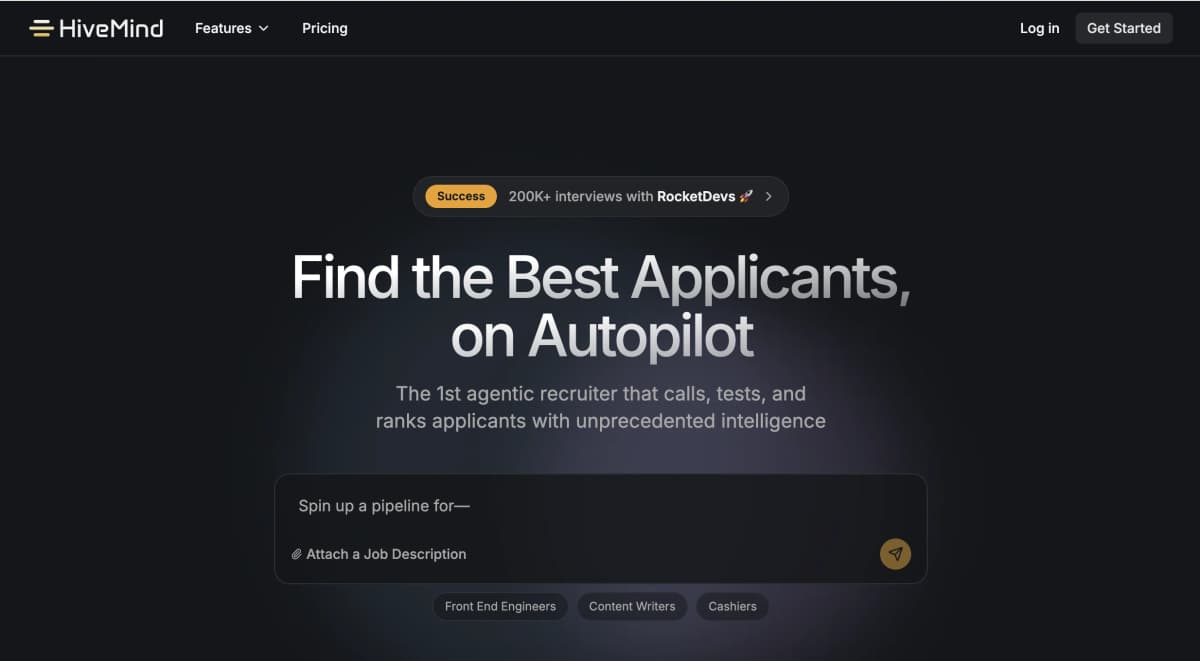
Hivemind.ai, one of the best AI recruiting tools, positions itself differently from most platforms in the recruiting market.
Rather than layering AI features onto a traditional applicant tracking system, it is built as a next-generation, agentic ATS designed to autonomously handle large portions of the hiring workflow. A detailed hivemind ai recruiting review shows why it stands out in the best ai recruiting software comparison.
In practice, this means Hivemind does not merely assist recruiters. It actively runs early-stage hiring activities such as resume filtering, skill assessments, candidate ranking, and initial engagement before a human ever steps in.
For startups and scale-ups hiring at volume, this directly addresses recruiter overload and inconsistent early-stage evaluation, two challenges that become more acute heading into 2026.
Unlike systems that still rely heavily on resumes and manual review, Hivemind is structured around skill validation and decision automation, making it one of the more forward-looking platforms in the AI ATS landscape, a true AI ATS 2026 contender.
Key Features
Hivemind’s feature set is centered on end-to-end automation rather than point solutions.
At its core is an agentic screening engine that filters up to 90% of resumes automatically using its proprietary Resumatic system. Instead of basic keyword matching, candidates are evaluated based on role relevance, skill signals, and experience patterns, significantly reducing manual review.
The platform places strong emphasis on skill-based hiring. It offers access to more than 1,200 role-specific assessments covering video responses, coding challenges, personality frameworks, and situational judgment tests. These assessments are AI-graded and designed to simulate real job scenarios. This makes Hivemind one of the strongest skill-based AI hiring tools available today.
Hivemind also includes AI-driven phone screening, enabling automated candidate calls, structured questioning, and consistent scoring before interviews begin. All communication, resumes, calls, assessments, notes, and rankings flow into a centralized inbox.
No-code, drag-and-drop hiring pipelines and integrations with tools like Greenhouse, Ashby, and Zapier allow teams to adopt it without replacing their entire stack.
Pros and Cons
Pros
-
Deep agentic automation across screening, assessments, and ranking
-
Strong shift away from resume-only evaluation
-
No-code setup suitable for fast-moving teams
-
Built-in anti-cheat mechanisms
-
Reported reductions in mis-hires and recruiter workload
Cons
-
Custom pricing may limit transparency for very small teams
-
Feature depth may exceed the needs of low-volume hiring environments
Pricing
Hivemind operates on custom pricing tied to hiring volume and organizational scale. Scale-up plans typically support up to ~1,000 applicants per month, while enterprise plans offer higher volumes, custom workflows, and deeper integrations. Pricing emphasizes ROI through reduced time-to-hire rather than seat-based costs.
Best For
Hivemind is best suited for startups and scale-ups hiring at speed, teams overwhelmed by applicant volume, and organizations prioritizing fair, skill-based evaluation over pedigree.
How Hivemind Stacks Up
Compared to traditional ATS platforms, Hivemind goes significantly deeper on automation. Where many tools focus on coordination and structure, Hivemind pushes into autonomous execution across screening and assessments, reducing manual intervention early in the funnel.
2. Greenhouse
Overview
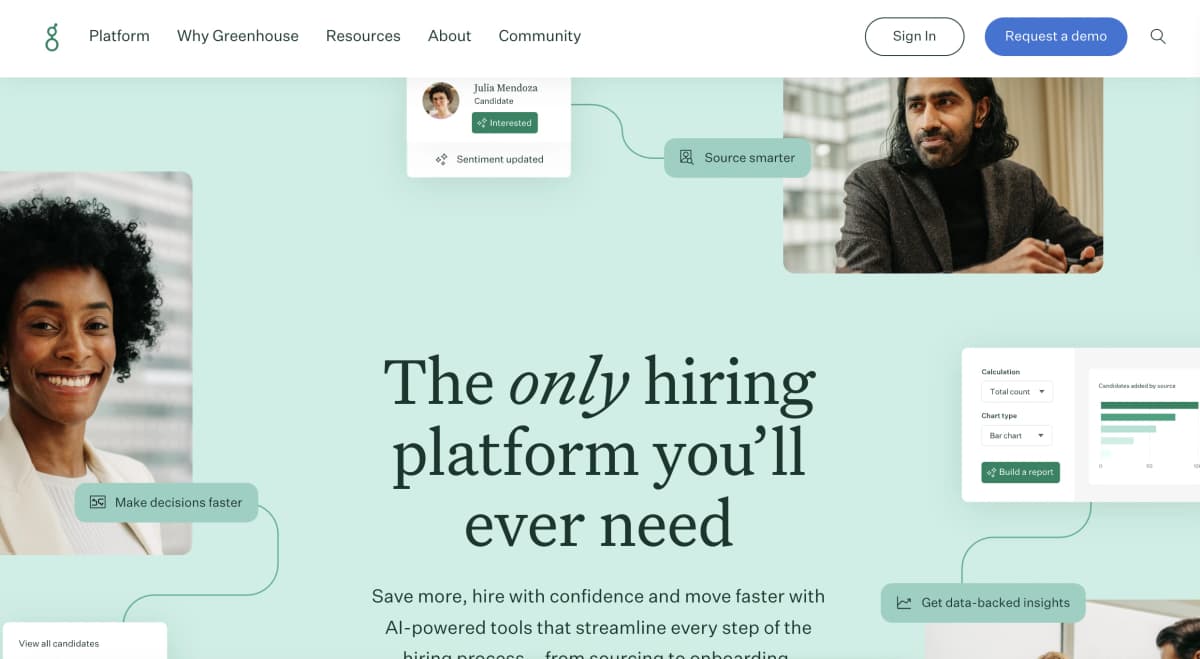
Greenhouse is one of the most established names in modern recruiting software, also marked as one of the best AI recruiting tools. It is best known as a structured ATS that emphasizes consistency, collaboration, and process discipline.
As AI adoption accelerates, Greenhouse has introduced AI-powered enhancements, primarily aimed at summaries, scheduling, and workflow efficiency rather than autonomous decision-making.
Key Features
Greenhouse offers structured interview kits, standardized scorecards, approval workflows, and assistive AI features such as interview summaries and scheduling support. It integrates deeply with HR tools, calendars, background check providers, and video interviewing platforms. Expanded analytics provide visibility into pipeline health and diversity metrics.
Pros and Cons
Pros
-
Strong structured hiring framework
-
Excellent collaboration tools
-
Robust integrations
-
Trusted enterprise brand
Cons
-
AI is largely assistive
-
Heavy reliance on resumes
-
Limited native skill assessments
Pricing
Custom pricing based on company size and hiring volume, typically positioned for mid-market and enterprise teams.
Best For
Organizations prioritizing structure, compliance, and collaboration over automation depth.
How It Compares to Hivemind
Greenhouse organizes hiring effectively, but it does not run it. Hivemind extends automation into screening and evaluation, reducing manual effort earlier in the funnel.
3. HireEZ
Overview
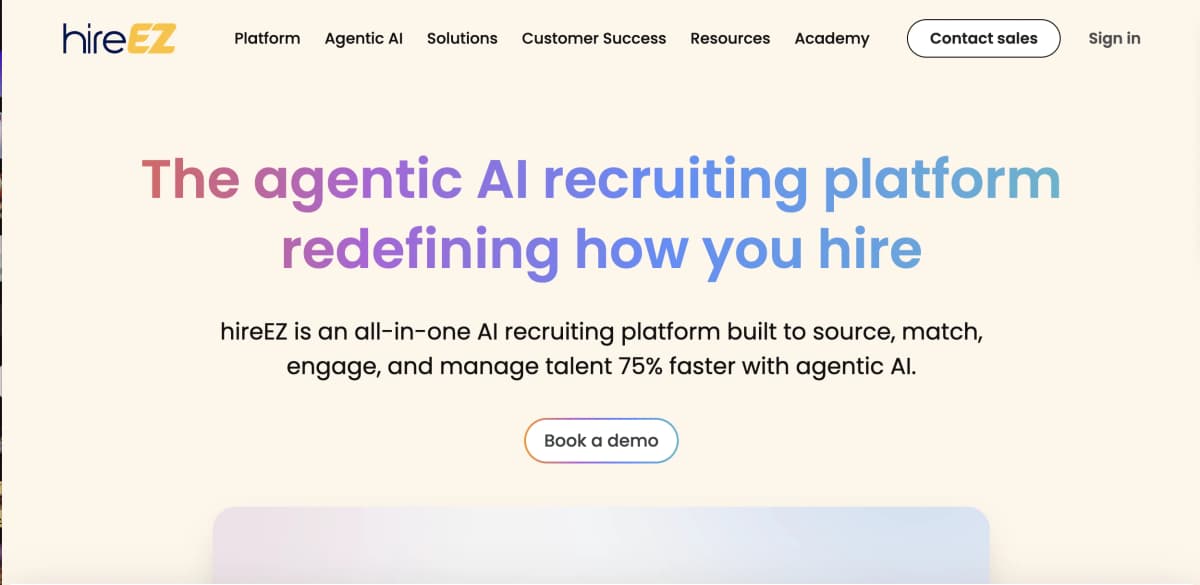
HireEZ is best understood as a specialized sourcing and outreach platform rather than a full recruiting system. Its strength lies in proactive candidate discovery and outbound engagement.
Key Features
HireEZ aggregates candidate data from multiple sources and uses AI matching to surface profiles based on skills and experience. It supports automated outbound email sequences and talent rediscovery from existing databases.
Pros and Cons
Pros
-
Strong sourcing and outreach workflows
-
Effective for niche roles
-
Complements existing ATS platforms
Cons
-
Not an end-to-end recruiting system
-
Limited screening and assessment automation
Best For
Teams with an existing ATS that want to strengthen top-of-funnel sourcing.
How It Compares to Hivemind
HireEZ accelerates candidate discovery. Hivemind focuses on automating what happens after candidates apply.
4. Metaview
Overview
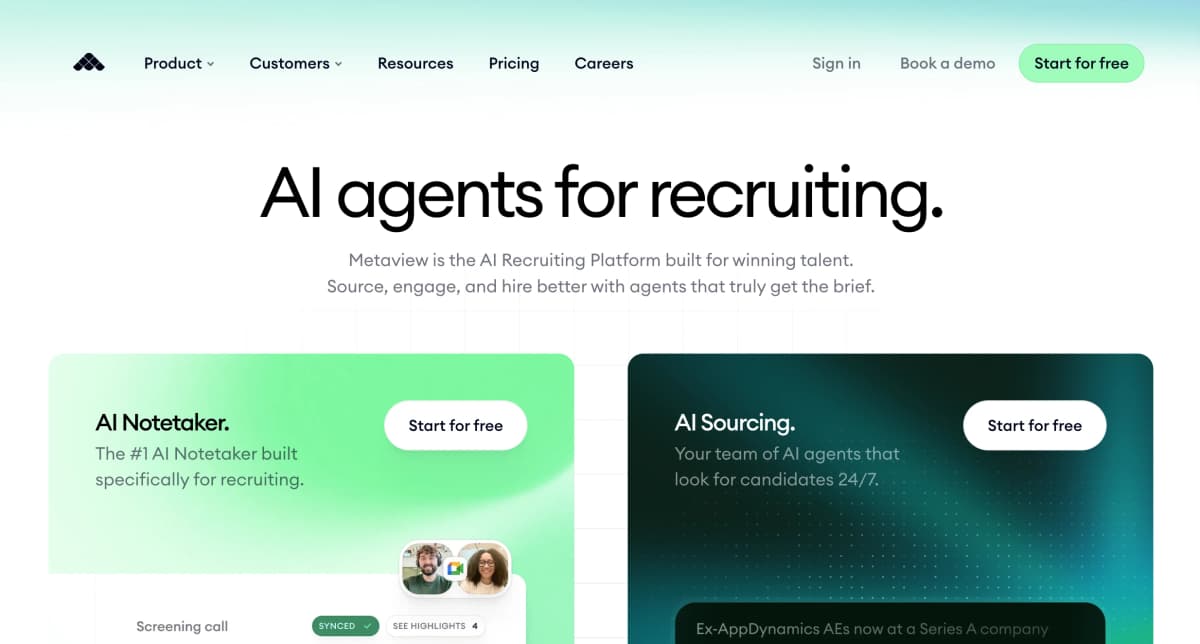
Metaview is not designed to manage candidates or move them through a hiring funnel. Instead, it focuses on a single but critical moment in the recruiting process: the interview itself. It is an AI-powered interview intelligence platform built to improve interview quality, consistency, and signal capture, particularly in remote and high-volume interview environments.
As hiring teams conduct more interviews across distributed teams and time zones, interview fatigue and poor note-taking have become common failure points. Metaview addresses this by removing the cognitive load of documentation from interviewers, allowing them to stay fully present while still capturing structured, usable data.
Within the broader AI recruiting ecosystem, Metaview operates as a specialist layer rather than a system of record.
Key Features
Metaview activates during live interviews. With candidate consent, it records and transcribes conversations, then generates structured summaries aligned to predefined competencies, scorecards, or interview rubrics. These summaries are not generic transcripts; they are organized around what hiring teams actually care about when comparing candidates.
The platform also standardizes feedback collection. Interviewers are prompted to submit evaluations immediately after interviews, reducing bias introduced by delayed or inconsistent feedback. Over time, this creates a more reliable signal across interviewers and roles.
Metaview integrates with major ATS platforms, so interview data flows back into the hiring system automatically, eliminating manual consolidation.
Pros and Cons
Pros
-
Significantly reduces interviewer note-taking burden
-
Improves consistency and clarity of interview feedback
-
Helps interviewers stay focused and engaged
-
Easy to layer onto existing ATS workflows
Cons
-
No sourcing, screening, or assessment automation
-
Limited impact on early-stage hiring speed
-
Does not reduce recruiter workload outside interviews
Best For
Teams that conduct a high volume of interviews and struggle with inconsistent feedback quality, particularly in remote or distributed hiring environments.
How Metaview Compares to Hivemind
Metaview improves how interviews are captured and evaluated. Hivemind reduces how many interviews are needed in the first place. For teams overwhelmed by interview volume due to weak early screening, Hivemind addresses the bottleneck further upstream.
5. Juicebox (PeopleGPT)
Overview
Juicebox approaches recruiting from a sourcing-first perspective which earns a place as one of the best ai recruiting tools. Rather than managing applicants, it helps recruiters discover potential candidates through conversational search across an extremely large dataset of profiles. Its defining feature is how users interact with data: through natural-language queries instead of complex Boolean logic.
This makes Juicebox especially appealing for exploratory sourcing, new role definitions, or markets where traditional job titles and keywords fail to capture the right talent.
Key Features
Juicebox indexes hundreds of millions of public profiles, allowing recruiters to search using plain-language prompts such as role requirements, industry experience, or geographic constraints. Results can be refined iteratively through follow-up questions, making sourcing faster and more intuitive.
Filters extend beyond basic keywords to include skills, seniority, company background, and inferred experience. Once candidates are identified, lists can be exported or synced into downstream systems for outreach and evaluation.
Juicebox does not manage engagement, screening, or interviews. It is designed to stop at discovery.
Pros and Cons
Pros
-
Extremely fast talent discovery
-
Eliminates complex Boolean sourcing
-
Massive global candidate dataset
-
Accessible to non-technical recruiters
Cons
-
No native outreach or engagement workflows
-
No screening or assessment capabilities
-
ROI depends heavily on downstream execution
Best For
Recruiters and sourcing teams focused on discovery, market research, or hard-to-define roles.
How Juicebox Compares to Hivemind
Juicebox helps teams find candidates. Hivemind helps teams evaluate and move candidates forward automatically. Juicebox improves search; Hivemind reduces manual decision-making across the hiring funnel.
6. Eightfold
Overview
Eightfold positions itself as a talent intelligence platform rather than a recruiting execution tool. Its core value lies in understanding skills, potential, and career trajectories across very large populations, including both external candidates and internal employees.
It is designed for enterprises facing workforce transformation, reskilling initiatives, and long-term talent planning rather than immediate hiring throughput.
Key Features
Eightfold’s AI-powered skills graph analyzes millions of career paths and transitions to infer potential beyond what appears on a resume. This allows recruiters and HR leaders to identify adjacent skills, internal mobility opportunities, and future-fit candidates.
Beyond recruiting, Eightfold places strong emphasis on workforce planning, internal mobility, and upskilling. Advanced analytics help leadership plan hiring and reskilling initiatives years ahead.
However, Eightfold does not run day-to-day recruiting tasks. Screening, assessments, outreach, and interviews occur in connected systems.
Pros and Cons
Pros
-
Deep, enterprise-grade skills intelligence
-
Strong support for internal mobility and workforce planning
-
Valuable for long-term talent strategy
Cons
-
Not an ATS or recruiting execution platform
-
Limited impact on time-to-hire
-
Requires significant data scale to deliver value
Best For
Large enterprises focused on workforce planning, reskilling, and long-term talent strategy.
How Eightfold Compares to Hivemind
Eightfold helps organizations understand talent. Hivemind helps teams hire it. Eightfold informs strategy; Hivemind executes hiring workflows autonomously.
7. Workable
Overview
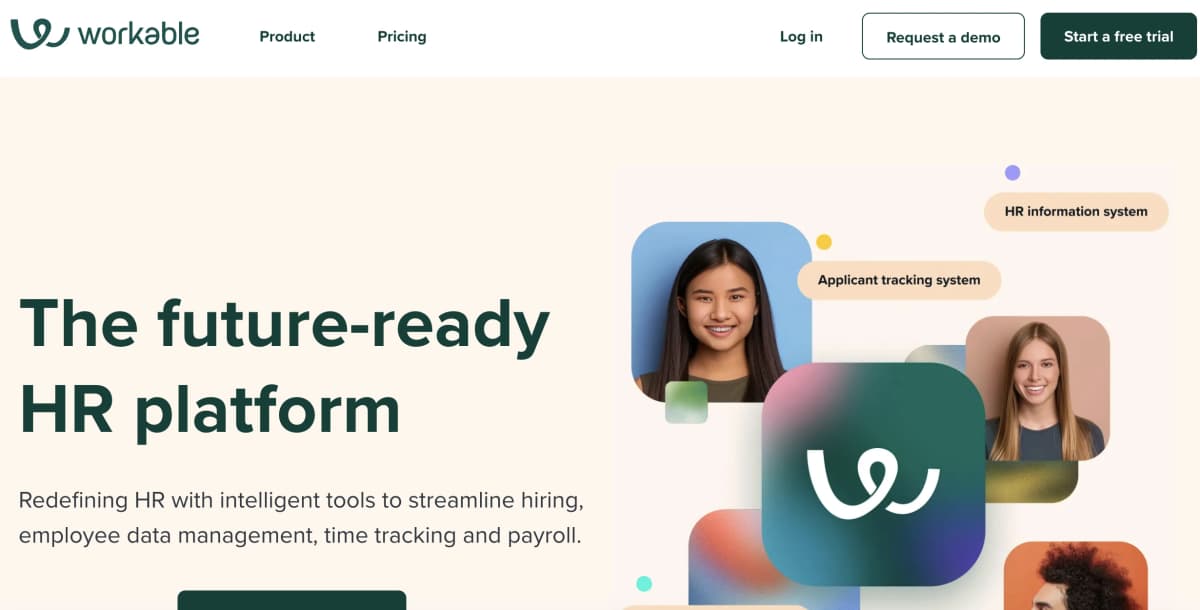
Workable is a widely adopted all-in-one recruiting platform designed primarily for small to mid-sized companies. Its appeal lies in simplicity: job posting, applicant tracking, collaboration, and basic AI support in a single system.
As AI adoption grows, Workable has introduced incremental AI features to improve sourcing and screening efficiency, while maintaining a traditional ATS foundation.
Key Features
Workable offers AI-assisted resume screening, access to a large candidate database, automated interview scheduling, and structured collaboration tools. These features help standardize hiring without overwhelming smaller teams.
However, its AI remains assistive rather than autonomous. Recruiters still drive screening, assessments, and decision-making manually.
Pros and Cons
Pros
-
Easy to use and quick to deploy
-
All-in-one recruiting solution
-
Suitable for SMBs
Cons
-
Limited automation depth
-
Few native skill-based assessments
-
Less effective for high-volume hiring
Best For
Small to mid-sized teams seeking convenience and light AI support.
How Workable Compares to Hivemind
Workable helps teams manage hiring. Hivemind helps teams offload it. The difference becomes clear as hiring volume increases.
8. SeekOut
Overview
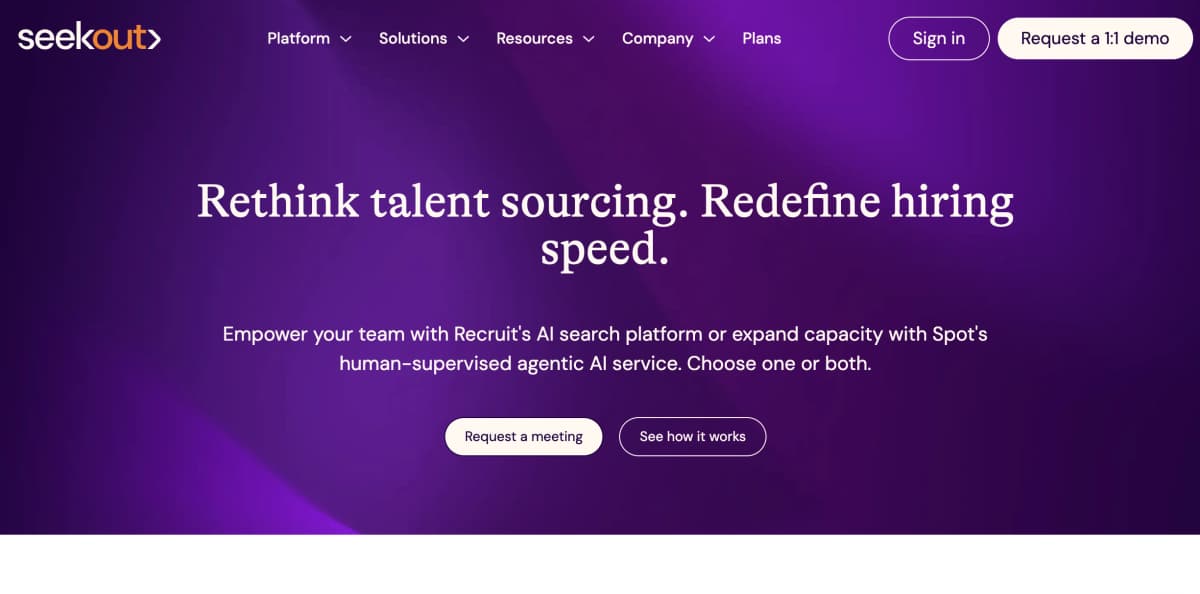
SeekOut sits between sourcing and talent analytics. It helps recruiters identify and analyze talent pools using advanced filters, inferred skills, and workforce insights, with a strong emphasis on diversity and compliance.
Key Features
SeekOut aggregates data from multiple sources and allows recruiters to search using granular criteria across skills, experience, education, and diversity attributes. Analytics tools provide insight into labor markets, pipeline composition, and sourcing effectiveness.
SeekOut does not automate screening or interviews. Candidates are passed into other systems for evaluation.
Pros and Cons
Pros
-
Highly detailed sourcing filters
-
Strong diversity and workforce analytics
-
Useful for strategic sourcing
Cons
-
No execution-level automation
-
Limited impact after sourcing
Best For
Teams prioritizing sourcing precision, diversity insights, and compliance.
How SeekOut Compares to Hivemind
SeekOut improves who enters the funnel. Hivemind improves what happens once they do.
9. Manatal
Overview
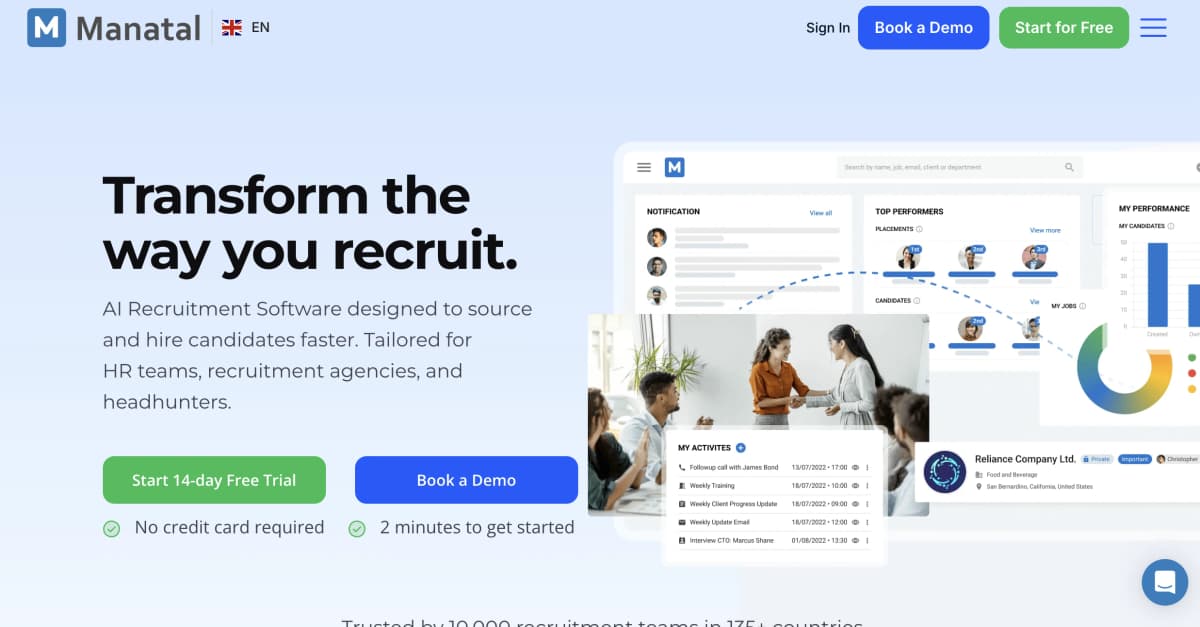
Manatal is an affordable ATS designed for teams transitioning away from manual hiring tools. It focuses on usability and light AI recommendations rather than deep automation.
Key Features
Manatal offers resume parsing, candidate recommendations, social enrichment, customizable pipelines, and basic CRM functionality. AI is used primarily to help recruiters prioritize candidates faster.
Pros and Cons
Pros
-
Affordable, transparent pricing
-
Simple interface and quick setup
Cons
-
Limited AI depth
-
No skill-based assessments
-
Not suitable for high-volume hiring
Best For
Small businesses and early-stage teams beginning their AI adoption journey.
How Manatal Compares to Hivemind
Manatal helps recruiters stay organized. Hivemind helps recruiters step out of the weeds entirely.
10. Findem
Overview
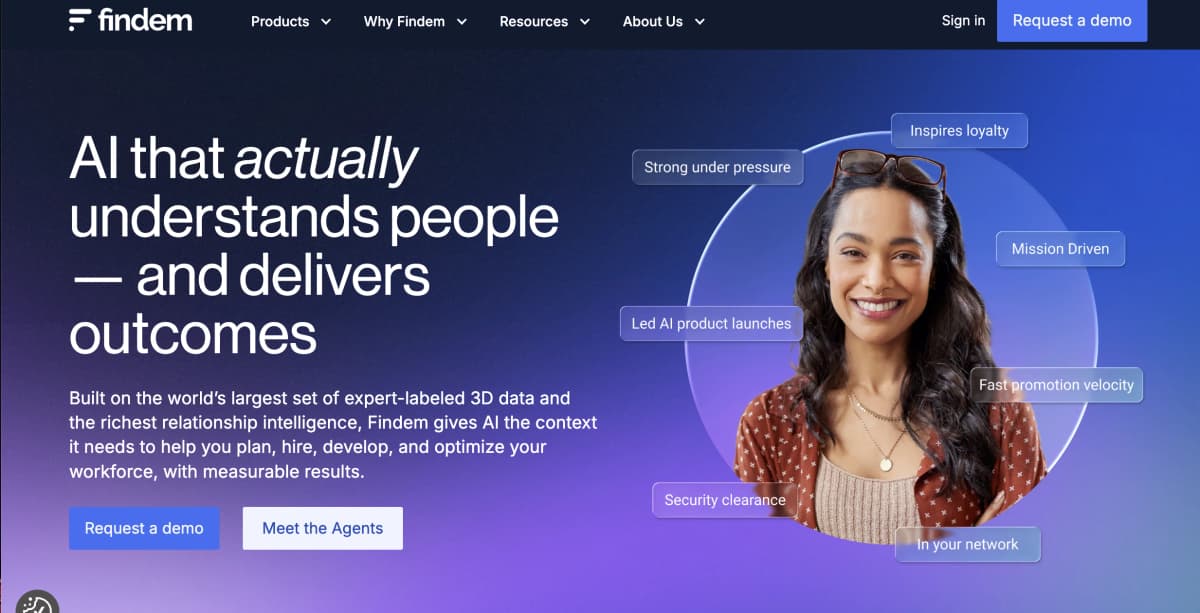
Findem focuses on attribute-based talent discovery, helping teams define ideal candidates based on patterns, skills, and career trajectories rather than resumes or job titles.
Key Features
Findem allows recruiters to build complex candidate profiles using multiple attributes, then identifies similar candidates across large datasets. It also provides analytics to understand talent supply and hiring patterns.
Findem integrates with ATS platforms but does not manage screening or interviews.
Pros and Cons
Pros
-
Advanced attribute-based sourcing
-
Strong analytics and talent mapping
Cons
-
No hiring execution capabilities
-
Dependent on downstream tools
Best For
Teams with advanced sourcing needs and mature recruiting infrastructure.
How Findem Compares to Hivemind
Findem helps define who to look for. Hivemind decides who moves forward, automatically.
How the Top AI Recruiting Tools Stack Up in 2026
| Tool | AI Innovation | Time Savings | Bias Mitigation | Scalability | User Rating* |
|---|---|---|---|---|---|
| Hivemind | Agentic AI (autonomous screening, assessments, calls, ranking) | Very High (30–90% faster hiring) | Strong (skill-based, auditable, structured) | High (built for scale-ups & volume) | ⭐⭐⭐⭐½ |
| Greenhouse | Assistive AI (summaries, scheduling, insights) | Medium | Medium (structured interviews, scorecards) | High (enterprise-ready) | ⭐⭐⭐⭐½ |
| HireEZ | AI sourcing & matching | Low–Medium (front-funnel only) | Low | Medium | ⭐⭐⭐⭐ |
| Metaview | AI interview notes & summaries | Low (interview stage only) | Medium (consistent feedback) | Medium | ⭐⭐⭐⭐½ |
| Juicebox | Conversational AI sourcing | Low (discovery only) | Low | Medium | ⭐⭐⭐⭐ |
| Eightfold | Advanced talent intelligence & skills graph | Low (strategy-focused) | Medium–High (skills inference) | Very High (enterprise scale) | ⭐⭐⭐⭐ |
| Workable | Assistive AI (screening, sourcing help) | Medium | Medium | Medium | ⭐⭐⭐⭐ |
| SeekOut | AI sourcing + diversity analytics | Low (pre-ATS only) | High (DEI insights) | High | ⭐⭐⭐⭐ |
| Manatal | Light AI recommendations | Low–Medium | Low | Low–Medium | ⭐⭐⭐⭐ |
| Findem | Attribute-based AI sourcing | Low (execution elsewhere) | Medium | High | ⭐⭐⭐⭐ |
How to Choose the Right AI Recruiting Tool for Your Team

By the time most teams reach this point, the challenge isn’t a lack of options, it’s clarity.
On the surface, many platforms look alike. They promise speed, automation, and better hiring outcomes. But choosing the right solution depends far less on feature lists and far more on how your team actually hires today, and where that process breaks down under pressure.
When evaluating AI recruiting tools, these are the questions that matter most in 2026:
-
Where is your team losing the most time?
Look closely at the stages that consume the most recruiter effort.
-
Resume screening and shortlisting
-
Scheduling interviews and follow-ups
-
Repeating early-stage evaluations
-
Managing candidate communication across tools
If hiring volume is high, the best AI recruiting tools are those that automate screening and ranking reliably, so recruiters only engage with top candidates instead of reviewing every applicant manually.
-
How are candidates being evaluated today?
Evaluation methods have a direct impact on fairness and quality of hire.
-
Heavy reliance on resumes often introduces bias and inconsistency
-
Unstructured interviews lead to uneven decision-making
-
Skill-based assessments provide clearer, job-relevant signals
Tools that prioritize validated skills and structured evaluation tend to perform better at hiring scales.
-
How well will the tool fit into your existing stack?
Even strong AI tools can slow teams down if integration is poor.
-
Does it connect with your ATS?
-
Can it sync with communication and interview tools?
-
Will it reduce handoffs or create new ones?
The goal is fewer systems to manage, not more.
-
Do you need assistive AI or agentic AI?
Be honest about your hiring maturity.
-
Assistive AI helps recruiters work faster
-
Agentic AI takes ownership of entire stages of the hiring process
Choosing the wrong level often leads to underwhelming results.
-
Can the impact be measured clearly?
Avoid tools that rely on vague promises.
-
Look for evidence of reduced time-to-hire
-
Lower recruiter workload
-
Improved candidate quality
-
Fewer downstream mis-hires
In 2026, AI recruiting tools should be judged not by what they claim to automate, but by what they actually remove from your team’s daily workload.
Conclusion: Hiring in 2026 Is No Longer a Manual Sport
By 2026, the recruiting conversation has fundamentally changed.
The question is no longer whether AI belongs to hiring. Market pressure, candidate behavior, and sheer applicant volume have already answered that. The real question now is what kind of AI teams choose to build their hiring process around.
Across the platforms reviewed in this guide, a clear pattern emerged:
-
Many tools use AI to assist recruiters
-
Improving sourcing
-
Organizing pipelines
-
Summarizing interviews
-
These systems make hiring more manageable, but they don’t remove the underlying workload. Recruiters are still responsible for most early-stage executions.
A smaller group of platforms takes a different approach:
-
They automate execution itself
-
Resume screening at scale
-
Skill-based assessments
-
Early candidate engagement
-
Automated ranking before human review
-
This shift toward agentic workflows is what separates incremental efficiency from structural change. It’s also what defines the best ai recruiting tools heading into 2026. For a deeper hivemind AI recruiting review and to see how it performs against competitors, many teams are turning to direct trials.
That’s why Hivemind stands out. Not because it replaces recruiters, but because it redesigns the hiring process around where human judgment actually adds value, and removes the work that never needed to be manual in the first place.
For teams hiring at speed, under pressure, or at scale, the competitive edge no longer comes from working harder. It comes from letting systems handle volume correctly, fairly, and consistently.
Ultimately, the best ai recruiting tools in 2026 won’t be judged by flashy demos. They’ll be judged by how much friction they quietly remove from everyday hiring.
If you’re planning your hiring stack for the year ahead, this is the moment to choose accordingly.
Ready for autopilot recruiting? Book a Hivemind demo today.
Frequently Asked Questions
What makes agentic AI different from traditional AI recruiting tools?
Traditional AI tools assist recruiters with suggestions like resume rankings or interview summaries. Agentic AI goes further by autonomously executing defined tasks such as screening, assessments, and early engagement. Humans stay in control of decisions, but enter the process later with better information.
Is Hivemind free to use?
Hivemind operates on custom pricing based on hiring volume and organizational needs. While pricing isn’t publicly listed, teams can request a demo or trial to evaluate fit before committing.
Are agentic AI recruiting tools suitable for small teams?
Yes, especially for small teams handling high applicant volume. Agentic tools can dramatically reduce recruiter workload, allowing lean teams to scale hiring without adding headcount.
Will these tools remain compliant with future regulations?
Platforms built with explainability, human oversight, and bias auditing are best positioned to adapt to evolving regulations such as the EU AI Act. Compliance readiness should be a core evaluation criterion, not an afterthought.