
In 2026, HR software is no longer a support tool; it’s the operational backbone of modern organizations.
Recent industry reports show that over 80% of companies are increasing investment in HR tech, with AI now influencing the majority of core HR processes, from talent acquisition to workforce planning and employee engagement. What began as digitizing paperwork has evolved into something far more strategic.
For years, HR teams gradually moved away from filing cabinets, spreadsheets, and disconnected tools. But today, the shift is complete. Modern human resources software doesn’t just store employee data, it powers entire HR tech stacks, automates people operations, ensures compliance across global markets, and provides real-time workforce intelligence.
And the landscape is evolving fast.
In this guide, we will walk you through the 2026 HR software ecosystem, the trends reshaping human resources, and how to design an efficient, AI-powered system that strengthens your people operations. We’ll also explore how platforms like Hivemind AI fit into the modern HR tech stack, helping organizations automate smarter, hire based on skills, and compete effectively in today’s global talent market.
Recommended: How to Create Perfect Candidate Personas (With Templates)
What Is HR Software and Why Does It Matter?
HR software is the set of tools that help you manage everything related to your people, from the moment a candidate enters your pipeline to the day they leave the company.
It covers hiring, onboarding, payroll, performance management, compliance, candidate engagement, and more. In 2026, it usually includes an HRIS, automation tools, analytics dashboards, and increasingly, AI-powered capabilities that support smarter decision-making across your organization.
But here’s why it actually matters.
Without modern Human resource software, people operations become slow, manual, and fragmented. Data lives in silos. Reporting takes days. Compliance becomes stressful, especially if you’re operating across multiple countries. With the right human resources software in place, everything connects.
Payroll talks to performance data. Recruitment integrates with onboarding. Workforce analytics inform strategic planning. HR automation handles repetitive tasks in the background so your team isn’t buried in admin work.
That shift changes the role of HR entirely. Instead of chasing paperwork and approvals, HR leaders can focus on:
-
Building stronger talent pipelines
-
Supporting skills-based hiring strategies
-
Improving employee experience
-
Planning workforce growth
-
Strengthening company culture
For growing organizations, human resource software isn’t just about efficiency. It’s about control, visibility, and scalability. It gives leadership real-time insight into what’s happening across the workforce and the tools to act quickly.
5 Benefits of Human Resources Software in 2026
To understand the real benefits of HR software, you have to look at what it replaces.
In the past, payroll, performance tracking, compliance, and recruiting often lived in separate systems, or worse, spreadsheets. That fragmentation created delays, errors, and limited visibility.
Modern human resources software brings these core functions together into a connected, intelligent system. When payroll runs smoothly, compliance is automated, recruiting is data-driven, and performance is measurable, HR shifts from reactive administration to proactive strategy.
Here are five major benefits of human resource software in 2026.
1. Centralized Data Security and Control
One of the biggest advantages of HR software is centralization. Employee records, contracts, payroll data, attendance logs, performance reviews, and compliance documentation are stored securely in one system instead of scattered across tools and inboxes.
Modern HRIS systems 2026 offer:
-
Role-based access controls
-
Encrypted data storage
-
Audit trails for compliance
-
Automated documentation tracking
For companies operating across multiple regions, centralized human resource software reduces compliance risk and increases transparency. Leadership can trust the data because it lives in one secure, structured environment.
2. Employee Self-Service That Actually Works
HR teams shouldn’t spend their days answering routine questions about payslips, leave balances, or policy documents. With modern human resource software, employees access this information themselves through intuitive dashboards. Self-service portals allow staff to download payslips, request time off, update personal information and even review benefits and policies
This is where HR automation makes an immediate impact. It reduces repetitive administrative work and allows HR professionals to focus on higher-value initiatives like culture, engagement, and workforce development.
3. Smarter Workforce Planning Through Data
In 2026, HR decisions are driven by insight, not instinct. Advanced HR software includes workforce analytics that help leaders:
-
Identify hiring gaps
-
Monitor engagement trends
-
Detect early signs of burnout
-
Track performance patterns
-
Forecast staffing needs
AI in human resource software is increasingly being used to support predictive workforce planning, helping organizations make smarter decisions about hiring, development, and resource allocation.
4. Faster, More Accurate Hiring
Recruitment has evolved significantly with the rise of AI-driven human resource software. Today’s systems support automated job posting distribution, resume screening, and shortlisting, and skills-based hiring tools.
Hiring is no longer guesswork. With AI in human resource software, organizations can match candidates based on skills, experience, and potential rather than just keywords or credentials. This improves both speed and quality of hire, a critical advantage in competitive global talent markets.
5. Improved Employee Retention and Engagement
Retention isn’t just about compensation. It’s about experience. Modern employee experience platforms integrated into HR software allow companies to:
-
Track engagement through surveys and feedback loops
-
Monitor performance and growth progression
-
Support continuous development
-
Identify disengagement early
Data-driven people operations give HR leaders a clearer view of what employees actually need. whether that’s career progression, flexibility, or recognition.
Top Pick: The Best 9 Talent Assessment Tools
The Difference between Modern Human Resource Software and Traditional HR Tools
Not all HR software is built for the world we’re operating in today. Traditional HR tools were created to reduce manual filing. But as organizations scaled, adopted hybrid work, and expanded globally, those systems began to show their limits.
Modern human resources software, especially in 2026, looks very different. It connects the entire HR tech stack into a unified, intelligent system, integrating data, automating workflows, and applying AI to improve decision-making.
Here’s how they compare:
| Feature | Traditional HR Tools | Modern HR Software (2026) |
|---|---|---|
| Primary Purpose | Administrative record-keeping | Strategic workforce enablement |
| System Design | Standalone modules, limited integration | Fully integrated HR tech stack |
| Data Usage | Historical reporting | Real-time analytics and predictive insights |
| Recruitment | Basic applicant tracking | AI-driven, skills-based hiring tools |
| Automation | Minimal; manual processes are still common | Advanced HR automation across people operations |
| Global Scalability | Limited multi-region compliance support | Built-in compliance management for global teams |
| Intelligence | Reactive reporting | AI in human resource software supporting proactive decision-making |
The biggest difference isn’t just functionality, it’s philosophy. Traditional systems focus on documenting what has already happened. Modern human resource software helps you anticipate what’s coming next. It can flag retention risks, identify skills gaps, automate repetitive tasks, and provide leadership with workforce intelligence in real time.
Traditional HR tools help you manage employee data. Modern human resource software helps you lead your workforce strategically.
Key 2026 Human Resource Software Trends and Innovations
Work has changed, and HR software has had to evolve just as quickly.
Employee expectations around flexibility, wellbeing, and inclusion are higher than ever. At the same time, emerging technologies are reshaping how companies hire, train, manage, and retain talent. In 2026, human resources software isn’t just digitizing HR tasks; it’s redefining how organizations operate.
Here are the 2026 HR trends shaping the future of human resource software this year:
1. AI Is Reshaping Everything
Artificial intelligence is becoming the engine behind HR systems. AI in HR software is now used for candidate screening, to predict employee turnover, recommend learning paths, generate recruitment emails, and even build skills-based career frameworks. Generative AI tools are helping HR teams communicate more effectively while reducing repetitive work.
But there’s a balance to strike. Leaders are asking important questions about bias in AI models, transparency in decision-making, and data ethics. The smartest organizations aren’t just adopting AI in human resource software; they’re implementing governance frameworks to ensure fairness and accountability.
2. AR and VR Are Transforming Training
Augmented reality (AR) and virtual reality (VR) are moving beyond gaming and into corporate learning.
Forward-thinking companies are using immersive training modules to simulate real-world job environments, from equipment handling to leadership simulations. For industries facing skill gaps or retiring expertise, this type of digital knowledge transfer is invaluable.
Integrated into advanced human resource software platforms, immersive learning tools are helping companies onboard faster and train more effectively, regardless of location.
3. Blockchain for Secure HR Data
Data security is a growing priority, especially as HR systems store sensitive payroll, identity, and compliance information.
Blockchain technology, known for its distributed and tamper-resistant structure, is beginning to appear in niche HR software applications. Companies are exploring it for secure credential verification, smart contracts, and cross-border payroll documentation.
Adoption is still early, but as compliance requirements increase globally, interest in secure, decentralized recordkeeping is rising.
4. Mental Health and Wellbeing Integration
Employee well-being is no longer treated as a side initiative. It’s embedded directly into modern human resources software.
Organizations are integrating wellness apps, mental health resources, engagement tracking tools, and burnout indicators into their HR systems. Leaders can now monitor workload patterns, engagement data, and absenteeism trends to proactively support teams.
5. Remote and Hybrid Workforce Optimization
Hybrid work isn’t a temporary adjustment; it’s the new normal.
As teams operate across cities, countries, and time zones, HR software has adapted with remote-first features: digital onboarding, virtual performance reviews, distributed payroll compliance, engagement analytics, and collaboration integrations.
Modern platforms are built to manage global, hybrid teams without sacrificing culture, accountability, or productivity.
What This Means for HR Leaders
The defining shift in 2026 isn’t just about new features. It’s about integration and intelligence.
Modern HR software is becoming more connected, more predictive, and more employee-centric. It combines AI, automation, analytics, and wellbeing tools into a unified ecosystem that supports both business growth and employee satisfaction.
Organizations that understand these trends won’t just modernize their HR systems, they’ll future-proof their workforce strategy.
Others Liked: 35+ Funny Hiring Memes of 2025
HR Automation and People Operations Best Practices

If there’s one thing defining HR software in 2026, it’s automation, but not the cold, robotic kind people once feared. Today’s automation is about removing friction so HR teams can focus on strategy, culture, and growth.
Automation Trends Reshaping HR
The biggest gains are happening in high-volume, repetitive workflows.
Onboarding, for example, is now largely automated. Offer letters are generated instantly, compliance documents are pre-filled, learning paths are assigned automatically, and managers are prompted with checklists to ensure nothing falls through the cracks.
Performance reviews have also evolved. Instead of annual, backward-looking evaluations, modern human resources software supports continuous feedback cycles, automated reminders, and AI-assisted summaries that highlight performance patterns.
Then there’s predictive turnover. Advanced HR software can now flag early warning signs, declining engagement, absenteeism spikes, and stalled promotions, giving leaders time to intervene before top talent walks out the door.
This isn’t about replacing HR judgment. It’s about equipping HR with sharper insight.
The Rise of People Operations
As automation handles administrative weight, HR teams are shifting toward People Operations, a more strategic, employee-centered approach.
In 2026, this includes:
-
Stronger DEIB (Diversity, Equity, Inclusion, and Belonging) tracking through measurable workforce data.
-
Structured hybrid work policies supported by digital performance tracking.
-
Experiments with four-day workweeks, guided by productivity analytics within HR systems.
Modern human resource software provides the data infrastructure that makes these initiatives measurable instead of aspirational. Leaders can track representation metrics, engagement levels, productivity trends, and compensation equity in real time.
Real-World Efficiency Gains
Some forward-thinking companies are reporting dramatic efficiency improvements after implementing AI-powered HR software.
Recruiting teams have reduced time-to-hire by automating candidate screening and scheduling. Payroll processing, once requiring multiple manual reviews, is now completed with minimal oversight. Workforce analytics dashboards allow executives to make decisions in minutes instead of weeks.
In many cases, HR teams are operating at two to ten times their previous capacity, not because they hired more staff, but because their systems became smarter.
Implementing HR Software: A Step-by-Step Guide
Adopting new HR software can feel overwhelming, especially if you’re transitioning from spreadsheets or disconnected systems. But with the right approach, implementation becomes a growth opportunity rather than a disruption.
Here’s how to do it right.
Step 1: Assess Your Needs
Before looking at vendors, get clear on your internal gaps. Are you struggling with payroll accuracy? Slow recruitment cycles? Poor workforce visibility? Compliance challenges across regions?
Map out your pain points. Prioritize the workflows that consume the most time or create the most risk. The best HR software is the one that solves your most pressing operational bottlenecks first.
Step 2: Select the Right Tools
Not every platform fits every business.
Look for human resources software that:
-
Integrates easily with your existing systems.
-
Offers scalability as your workforce grows.
-
Provides strong data security and compliance features.
-
Includes automation and analytics capabilities.
End-to-end platforms like HiveMind AI, for example, focus on intelligent automation across recruiting, onboarding, performance, and workforce analytics, making them suitable for companies looking to centralize their HR tech stack.
Step 3: Plan Integration Carefully
Implementation isn’t just a technical task, it’s an organizational shift. Work with IT and HR stakeholders to ensure clean data migration. Audit your existing employee records before importing them. Establish clear access controls and data governance policies from day one.
Poor data setup is one of the most common reasons HR software projects fail.
Step 4: Train Your Team
Even the best system won’t deliver results if your team doesn’t use it confidently. Provide hands-on training sessions. Create internal champions who can support colleagues. Offer simple documentation and clear workflows.
Adoption drives ROI.
Common Challenges to Prepare For
Two obstacles appear repeatedly:
Data privacy concerns. Ensure the platform complies with relevant local and international regulations, especially if you operate across borders.
Change management resistance. Employees may feel uncertain about automation or AI-driven processes. Clear communication about benefits, transparency, and data protection builds trust.
For You: Top 9 AI Recruiting Assistants to Hire Skilled Candidates Faster
How Hivemind AI Fits In
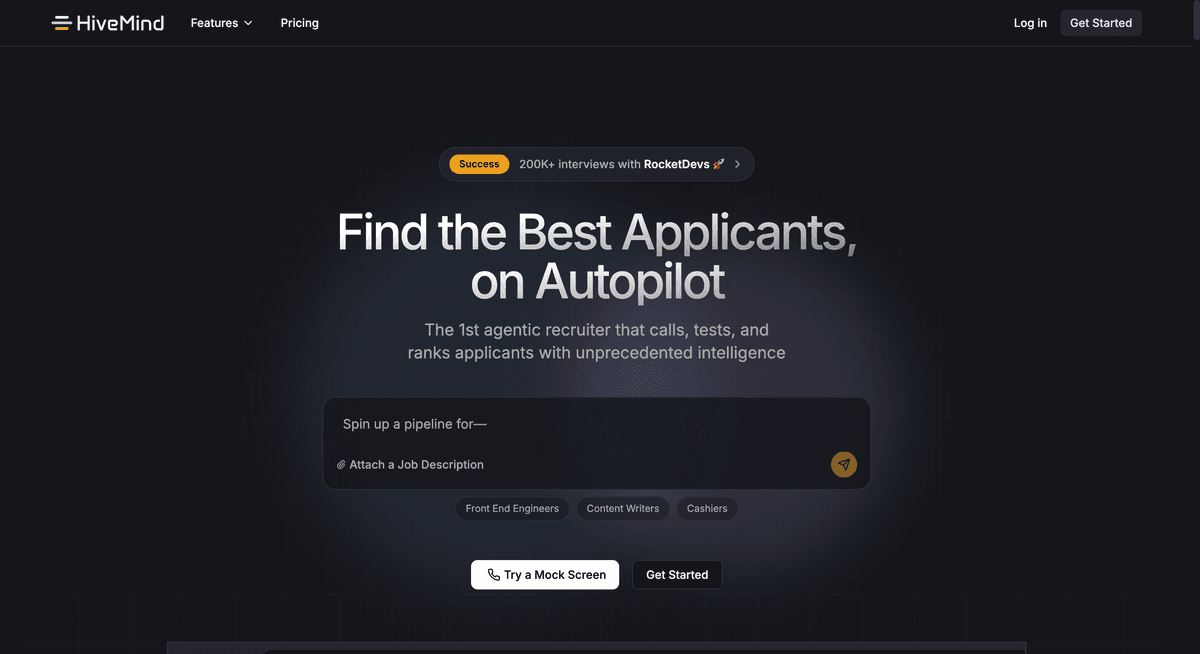
By now, it’s clear that HR software in 2026 isn’t just about digitizing paperwork. It’s about building an intelligent system that connects recruiting, onboarding, performance, workforce planning, and employee engagement into one seamless experience.
That’s where HiveMind comes in.
While many human resources software platforms focus on isolated functions, payroll here, applicant tracking there, HiveMind is designed as an integrated, AI-powered ecosystem. Instead of stacking multiple disconnected tools, businesses can centralize their people operations into one intelligent platform.
Built for Automation, Not Just Administration
HiveMind isn’t trying to replicate spreadsheets in a prettier dashboard. It’s built around automation from the ground up.
Recruitment workflows can be streamlined with intelligent candidate filtering and communication tools. Onboarding processes can be triggered automatically once an offer is accepted. Performance tracking becomes continuous rather than annual. Workforce analytics provide leadership with real-time visibility into hiring trends, retention risks, and productivity patterns.
This is modern HR software doing what it’s meant to do, removing manual bottlenecks and turning data into decisions.
Designed for Growing Businesses
Scalability is one of the biggest concerns when implementing HR software. What works for 50 employees often breaks at 500.
HiveMind is built with growth in mind. Whether you’re expanding into new regions, managing remote teams, or increasing hiring velocity, the platform adapts without forcing you to rebuild your tech stack every few years.
And because automation is embedded into its architecture, efficiency increases as your organization grows, rather than complexity.
The Bigger Picture
The real value of HR software isn’t in features. It’s in outcomes.
Faster hiring. Stronger retention. Better compliance. Clearer workforce planning. More engaged employees.
HiveMind positions itself at the intersection of AI, automation, and human-centered design, giving HR leaders the infrastructure they need to operate strategically in 2026 and beyond.
Because in today’s talent landscape, the companies that win aren’t the ones with the most tools.
They’re the ones with the smartest systems.
Frequently Asked Questions About HR Software
What is the best software for HR?
The best HR software depends on your company’s size, structure, and goals.
For small businesses, the ideal human resources software is simple, cost-effective, and strong in payroll, compliance, and employee self-service. Mid-sized and enterprise organizations typically need a more advanced HRIS or HCM platform that includes AI-powered recruiting, performance management, workforce analytics, and automation.
In 2026, the “best” human resource software is defined less by brand name and more by capability. It should integrate easily with your existing systems, automate repetitive workflows, provide real-time workforce insights, and scale as your organization grows.
The right platform isn’t just a database for employee records, it becomes the operational backbone of your people strategy.
What are the 5 C’s of HR?
The 5 C’s of HR provide a framework for effective people management, and modern HR software helps operationalize each one:
Compliance - Ensuring labor laws, payroll regulations, and data privacy requirements are met. Advanced HR systems automate compliance tracking and reporting.
Compensation - Managing salaries, benefits, and rewards fairly and transparently through structured payroll and benchmarking tools.
Culture - Building engagement, inclusion, and a strong workplace environment. Many HR platforms now include engagement surveys and feedback systems.
Communication - Keeping employees informed and aligned through centralized dashboards and internal communication tools.
Capability - Developing employee skills and leadership pipelines through performance tracking and learning management integrations.
Strong human resources software supports all five areas in one connected ecosystem.
What should you look for in an HCM platform in 2025?
When evaluating an HCM or HR software platform in 2025 and beyond, focus on long-term scalability and intelligence.
Look for:
-
AI-driven automation in recruiting and workforce planning
-
Real-time analytics and predictive insights
-
Strong data security and compliance features
-
Employee self-service functionality
-
Seamless integrations with payroll, finance, and collaboration tools
-
Support for hybrid and global teams
Modern HCM platforms should go beyond administration. They should help HR leaders anticipate turnover, identify skills gaps, improve engagement, and align workforce planning with business growth.
If a system only digitizes paperwork, it’s outdated. If it turns workforce data into actionable insight, it’s future-ready.
What are the 7 pillars of HR?
The 7 pillars of HR represent the core functions that human resources must manage effectively. Today, most are powered directly by HR software:
-
Recruitment and Talent Acquisition
-
Onboarding and Employee Experience
-
Performance Management
-
Learning and Development
-
Compensation and Benefits
-
Compliance and Risk Management
-
Workforce Planning and Analytics
Modern human resources software connects these pillars into one unified system. Instead of operating in silos, recruitment data informs onboarding, performance feeds into development plans, and analytics support workforce forecasting.
In 2026, the strength of your HR function often reflects the strength of your human resource software. The more integrated and intelligent the system, the more strategic your people operations become.