

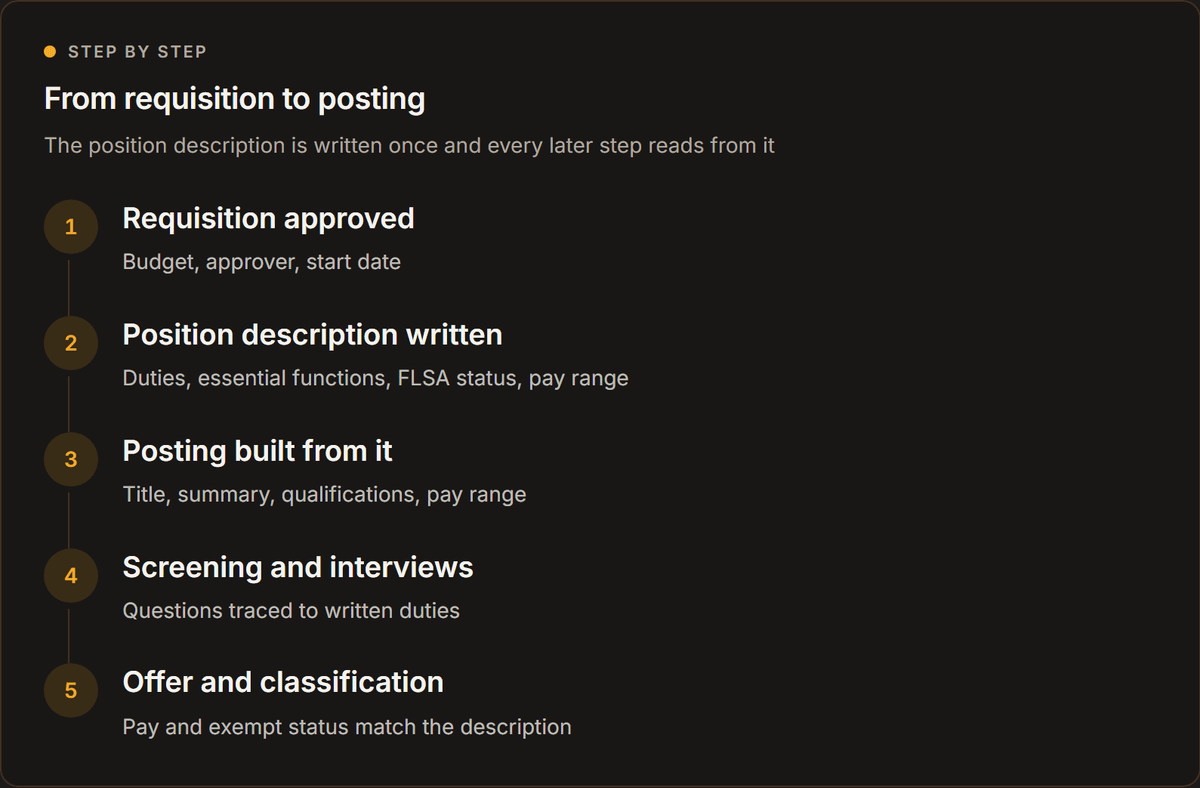
A position description template records a role's purpose, main responsibilities, essential functions, minimum qualifications, FLSA status and pay range. Complete it using the approved requisition before advertising the position. The EEOC considers written job descriptions prepared before a role is advertised or candidates are interviewed as evidence of which functions are essential.1 Accuracy matters from the outset because the document can help support later hiring and employment decisions.
Key takeaways
- Write the position description from the requisition before the job is posted: the ADA regulation lists a description prepared before advertising as evidence of which functions are essential.
- List the duties the role actually performs as essential functions, because the EEOC says writing a duty down does not make it essential.
- A job title does not decide FLSA exempt status; the FLSA regulation says the salary and the duties do.
- Put a real minimum and maximum in the pay field: New York State, California, Washington, Illinois and Colorado each require pay information on postings.
- Start task statements from O*NET, then reword them with the hiring manager until they describe this job.
This guide is for recruiters, talent acquisition (TA) teams, hiring managers and staffing agency account managers. It provides a practical position description template, explains what each section should include and outlines why the information matters. It is for general guidance and does not constitute legal advice.
In this article
- What is the difference between a position description and a job posting?
- The position description template
- Why write the position description before the job is posted?
- Which duties on a position description count as essential functions?
- How do duties and pay on the description affect FLSA exempt status?
- What pay information must the template carry into the posting?
- Does stating pay on the description change who applies?
- Where can a recruiter get task statements for a role?
- Conclusion
- Frequently asked questions
What is the difference between a position description and a job posting?
A position description is the internal record of a role, while a job posting is the public advert created from it. The US Office of Personnel Management defines a position description as a statement of a position's major duties, responsibilities and supervisory relationships.2 It also states that position descriptions must be kept up to date.
A job posting serves a narrower purpose: attracting applicants. Washington's Department of Labor and Industries defines it as a written or electronic notice advertising a specific available position and setting out its qualifications.3
The two documents are also connected under New York law. The New York State fact sheet states that job postings must include a job description when available.4 Employers must create one if it does not exist, unless the job title itself clearly conveys the duties.
| Category | Position description | Job posting |
|---|---|---|
| Audience | Hiring team, HR and payroll | Candidates |
| Purpose | Records the role's requirements and responsibilities | Attracts qualified applicants |
| Information included | Purpose, duties, essential functions, qualifications, reporting line, FLSA status and pay range | Job title, summary, qualifications, pay range and application instructions |
| When written | From the requisition, before advertising | Based on the approved position description |
| Used later for | Screening, interview questions, classification and accommodation requests | Attracting and informing applicants |
The position description should be the source of truth. Recruiters should build the posting from it rather than create two separate versions of the role. This helps keep advertised requirements consistent with the actual job and reduces confusion during screening and hiring.
The position description template
Copy the template below, complete every field and save the finished document with the approved requisition. The bracketed text indicates what information belongs in each field. Be specific, particularly when describing essential functions, minimum qualifications and employment classification.
POSITION DESCRIPTION

Job title: [the title used on the posting and in payroll]
Department or client: [team, or the client for a staffing job order]
Reports to: [title of the manager]
Supervises: [titles and number of direct reports, or "none"]
Work location: [site, city and state, or remote and where]
Schedule: [full time, part time, shift pattern]
Employment type: [permanent, temporary, temp to hire, contract]
FLSA status: [exempt or non-exempt, and the exemption relied on]
Pay range: [minimum to maximum, per hour or per year]
Benefits and other pay: [benefits summary, bonus, commission]

Purpose of the role:
[Two or three sentences: why the role exists and what it delivers.]

Essential functions (the duties the role exists to perform):
- [Duty, and roughly how much of the time it takes]
- [Duty]
- [Duty]

Other duties (marginal, could be reassigned):
- [Duty]

Minimum qualifications (required on day one):
- [Education, licence or certification, if truly required]
- [Experience, stated as what the person has done]
- [Skills the role uses every week]

Preferred qualifications (nice to have, not screened out on):
- [Item]

Physical and environmental requirements:
- [Lifting, standing, driving, travel, as the work actually requires]

Competencies the interview will assess:
- [Competency, and the essential function it relates to]

Prepared by: [name]   Approved by: [hiring manager]   Date: [date]
Important: Keep the position description aligned with the actual work. Avoid adding qualifications simply because they are common in similar job adverts. Every requirement should have a clear connection to the responsibilities of the role.
Why write the position description before the job is posted?
Writing the position description before advertising the role helps establish which duties are essential and provides evidence to support later hiring decisions. The Americans with Disabilities Act (ADA) regulation identifies written job descriptions prepared before advertising or interviewing applicants as evidence of whether a function is essential.5 The EEOC's employer guide also recognises these descriptions, alongside the employer's judgment, as evidence of essential functions.
However, a written description is not mandatory under the ADA and does not automatically settle disputes about a role's requirements. The EEOC Technical Assistance Manual explains that employers are not required to develop or maintain job descriptions.6 A description prepared before advertising is considered as evidence, but it is not given greater weight than other relevant evidence.
The document also provides a foundation for consistent recruitment. The Uniform Guidelines state that validity studies of employee selection procedures should be based on a review of information about the job, including a job analysis.7 Writing the position description first gives recruiters a documented reference for developing job postings, screening criteria and interview questions.
Which duties on a position description count as essential functions?
Essential functions are the fundamental duties a position exists to perform. Under the ADA regulation, they are the core responsibilities of the job that an individual with a disability holds or wants to obtain.
Simply including a duty in a written position description does not make it essential. The EEOC manual illustrates this with typing: listing typing as a job function does not make it essential if the employer has never required the employee to type or has only rarely required it.6
Recruiters and hiring managers should therefore describe the work as it is actually performed, rather than include hypothetical or outdated responsibilities. Separate essential functions from marginal duties that could be reassigned without fundamentally changing the role.

How do duties and pay on the description affect FLSA exempt status?
A job title alone does not determine whether a position is exempt from overtime under the Fair Labor Standards Act (FLSA). Classification depends on whether the employee's salary and actual job duties meet the applicable regulatory requirements.
This makes the essential functions section particularly important. It must describe the work the employee actually performs rather than rely on a title that might suggest a higher level of responsibility.
The executive exemption illustrates how specific these requirements are. Under 29 CFR 541.100, an employee must:8
- Receive a salary of at least $684 per week.
- Have management as their primary duty.
- Regularly direct the work of at least two full-time employees or their equivalent.
- Have the authority to hire or fire employees, or have their recommendations on hiring, firing and other employment decisions given particular weight.
A position titled "manager" does not automatically qualify for the executive exemption. For example, someone with a manager title who supervises no employees would not meet the executive exemption's supervisory requirements.
Recruiters should ensure that the position description accurately reflects the role's responsibilities and proposed pay structure. HR and payroll should then verify the FLSA classification against the applicable exemption criteria rather than relying on the job title alone.
What pay information must the template carry into the posting?
A genuine pay range is increasingly required in job postings across the United States. The position description should include the minimum and maximum salary or hourly rate the employer actually expects to offer. Recruiters should not use an open-ended range or publish figures that do not reflect the available budget.
Several states have specific pay transparency requirements:
| Jurisdiction | Who is covered | What the posting must show |
|---|---|---|
| New York State | Private employers with four or more employees | A pay range with a minimum and maximum for advertised jobs. Open-ended ranges are not permitted. |
| California | Employers with 15 or more employees | The pay scale, including when a third party is responsible for posting the job. |
| Washington | Employers with 15 or more employees | A wage scale or salary range, plus general descriptions of benefits and other compensation. |
| Illinois | Employers with 15 or more employees making specific job postings | The pay scale and benefits on internal and external postings. |
| Colorado | Employers posting jobs | The lowest to highest pay the employer believes it may offer for the specific position. |
New York's pay transparency law requires private employers with four or more employees to disclose a pay range for advertised job, promotion and transfer opportunities.4 The range must include a minimum and maximum rather than an open-ended figure.4
California requires employers with 15 or more employees to include the pay scale in job postings.910 If an employer uses a third party to advertise a position, it must provide the pay scale to that party for inclusion in the posting.9 Washington has similar disclosure requirements for employers with 15 or more employees recruiting Washington-based workers, including general descriptions of benefits and other compensation.11
In Illinois, covered employers making specific job postings must include pay scale and benefits information in both internal and external advertisements. Colorado requires employers to disclose a range spanning the lowest to highest pay they genuinely believe they may offer for the particular position.12
Staffing agencies should pay particular attention to New York's rules. The state's pay transparency law excludes temporary help firms seeking workers for other organizations. However, employers hiring through temporary help firms must still provide a pay range. This is a specific New York provision, so agencies should check the requirements in each state where they recruit.
Recruiters should consult the relevant state agency's current guidance before publishing a posting. The safest approach is to establish an approved, realistic pay range in the position description first, then carry that information consistently into every advertisement.
Does stating pay on the description change who applies?
Pay transparency has changed what job postings look like, although its effect on applicant behaviour is less certain. Indeed Hiring Lab reported that 60% of US job postings on Indeed included at least some salary information in February 2025, compared with 18% in 2020.13 The Minneapolis Fed also found that four states introducing pay transparency policies between 2019 and 2023 each experienced an increase of more than 50 percentage points in the share of job advertisements containing pay information, despite imperfect compliance.14
Research into the wider effects offers a more measured picture. An NBER working paper by Arnold, Quach and Taska found that employers increased the proportion of postings containing salary information by 30 percentage points after state pay transparency laws took effect.15 The researchers also found that wages rose 1.3 to 3.6 percent.15
However, the study found no measurable effects on pay dispersion, employment, the number of job postings, or skill and education requirements.
There is an important distinction between evidence about job postings and evidence about position descriptions. We found no publicly available study measuring whether a complete internal position description, independently of the job posting, improves applicant quality or reduces time to fill.
The practical case for using the template is therefore primarily about compliance, accurate role definition and consistent recruitment documentation. Recruiters should avoid presenting it as a proven way to improve hiring outcomes when the available research does not establish that connection.
Where can a recruiter get task statements for a role?
Recruiters can start with O*NET, the US Department of Labor's occupational database. It provides standardised information about occupations, including tasks, skills, knowledge and work activities that can help build an accurate position description.
O*NET's 31.0 database release added or updated task statement ratings for importance, relevance and frequency across 205 occupations.16 Each occupation profile includes tasks that recruiters can use as a starting point.
For example, O*NET OnLine describes Human Resources Specialists (13-1071.00) as professionals who recruit, screen, interview or place individuals within an organisation.17
These task statements should be treated as starting points, not copied directly into every position description. Recruiters should review them with the hiring manager and adapt the wording to reflect the actual responsibilities, seniority and working conditions of the specific role.
For staffing agencies, the intake call is a useful opportunity to collect and confirm these details with the client before preparing the job order. For a broader approach to coordinating recruitment activities, see the guide on how to build a recruitment and hiring plan.
Conclusion
A strong position description is the foundation of a well-structured recruitment process. It gives hiring managers, recruiters and HR teams a shared understanding of what a role requires, which duties are essential, what qualifications candidates need and what the employer is prepared to pay. Getting these details right before advertising also creates a useful record for supporting hiring decisions, assessing candidates consistently and meeting applicable employment requirements.
For recruiters and talent acquisition teams, the priority is accuracy over unnecessary detail. Base every requirement on the actual work, distinguish essential functions from marginal duties, confirm the pay range and verify the employment classification. Use the approved description as the reference point for the job posting, screening criteria and interview process. This reduces the risk of mismatched expectations between employers and candidates and gives everyone involved a clearer basis for making decisions.
Once the position is defined, the challenge shifts to executing the hiring process. Define the role properly, build the hiring process around it, and give every recruitment decision a clear foundation.
How Hivemind handles the step after the description
Writing the position description, setting the pay range and deciding which duties are essential stay with the recruiter, the hiring manager and counsel.
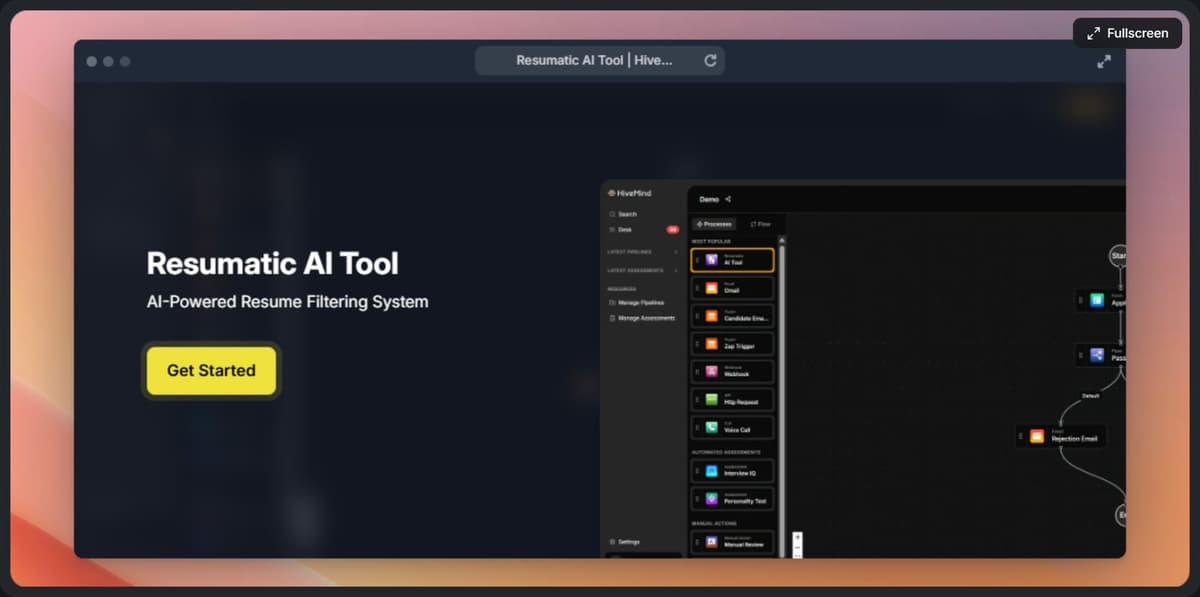
What follows is the hiring pipeline itself: sourcing, screening, interviews, offers, and the admin around them. Hivemind is the hiring OS: manage every candidate from inbound to offer in one unified workflow, and build the exact pipeline your team deserves. Its modules include Resumatic: AI-Powered Resume Filtering System, and Automated Skills Assessments.
A team can run Hivemind end to end, connect your existing tools, or mix and match both.
Frequently asked questions
What should a position description include?
A position description should include the job title, department, reporting line, purpose of the role, major duties, essential functions, minimum and preferred qualifications, physical requirements, FLSA classification and pay range. It should also identify the person responsible for preparing and approving the document. The US Office of Personnel Management (OPM) defines a position description as a statement of a position's major duties, responsibilities and supervisory relationships.
Is a job description legally required?
Not under the Americans with Disabilities Act (ADA). The EEOC Technical Assistance Manual explains that the ADA does not require employers to develop or maintain job descriptions. However, written descriptions prepared before advertising or interviewing can provide evidence of which duties are essential. New York State also requires job postings to include a job description when available, and employers must create one unless the job title clearly conveys the duties.
Do staffing agencies have to include pay ranges in job postings?
It depends on the state and the type of recruitment. New York's pay transparency law excludes temporary help firms seeking workers for other organisations, but employers hiring through these firms must provide a pay range.4 California requires covered employers to provide the pay scale to third parties advertising their positions. Staffing agencies should check the applicable state requirements before publishing job advertisements.
How often should a position description be updated?
Review a position description whenever the role's responsibilities, reporting structure, qualifications, working conditions or compensation change significantly. It should also be checked during recruitment to confirm that the advertised requirements still reflect the actual position. Keeping descriptions current helps prevent outdated duties and qualifications from influencing screening and hiring decisions.
Who is responsible for writing and approving a position description?
Recruiters or HR teams can prepare the initial document using information from the approved requisition and discussions with the hiring manager. The hiring manager should verify that the duties, essential functions and qualifications accurately reflect the role. HR or payroll should confirm the employment classification and pay information, while legal counsel can review requirements where necessary. The final version should be approved before the position is advertised.
Sources
- US Equal Employment Opportunity Commission: EEOC, The ADA: Your Responsibilities as an Employer ↩
- US Office of Personnel Management: OPM, Introduction to the Position Classification Standards, revised August 2009, section E ↩
- Washington State Department of Labor and Industries: Washington L&I, Job posting requirements factsheet F700-225-000 ↩
- New York State Department of Labor: NYS Department of Labor, Pay Transparency Law for Employers, P687 (09/23) ↩
- US Equal Employment Opportunity Commission: 29 CFR 1630.2(n)(1), eCFR, version dated 2017-01-03 ↩
- US Equal Employment Opportunity Commission: EEOC Technical Assistance Manual on the Employment Provisions (Title I) of the ADA, section on essential functions ↩
- EEOC and federal agencies: 29 CFR 1607.14(A), eCFR ↩
- US Department of Labor: 29 CFR 541.100(a)(1), eCFR, version dated 2026-05-15 ↩
- California Department of Industrial Relations: California DIR, Labor Commissioner's Office, Equal Pay Act FAQ (Labor Code 432.3) ↩
- Illinois Department of Labor: Illinois Department of Labor, Equal Pay Act Salary Transparency (820 ILCS 112/10(b-25)) ↩
- Washington State Department of Labor and Industries: Washington L&I, Equal Pay and Opportunities Act Q&A (RCW 49.58.110) ↩
- Colorado Department of Labor and Employment: CDLE INFO #9A, Transparency in Pay and Job Opportunities, last updated 29 May 2024 ↩
- Indeed Hiring Lab: Indeed Hiring Lab, 'A Stubborn Divide', 20 March 2025 ↩
- Federal Reserve Bank of Minneapolis: Federal Reserve Bank of Minneapolis, 'Postings with pay information soar', 26 March 2024 ↩
- David Arnold: NBER Working Paper 34480, issue date November 2025 (not peer reviewed) ↩
- O*NET Resource Center: ONET Resource Center, ONET 31.0 Database ↩
- O*NET OnLine: O*NET OnLine, Human Resources Specialists 13-1071.00 ↩
- US Department of Labor: 29 CFR 541.2, eCFR, version dated 2016-12-01