
The hiring process has come a long way from stacks of paper resumes and endless interview rounds. In 2025, machine learning in recruitment is no longer a buzzword.
It’s the backbone of how talent is discovered, evaluated, and hired. From intelligent resume parsing to predictive analytics that forecast a candidate’s likelihood of success, ML is transforming the way companies build their teams.
This evolution is the result of years of technological breakthroughs, shifting workplace demands, and a growing need for speed and precision in hiring.
In this study, we explore how machine learning has evolved in recruitment, the key innovations shaping 2025, and what the future holds for organizations that want to attract and retain the best talent in an increasingly competitive market.
How Machine Learning is Shaping Recruitment in 2025
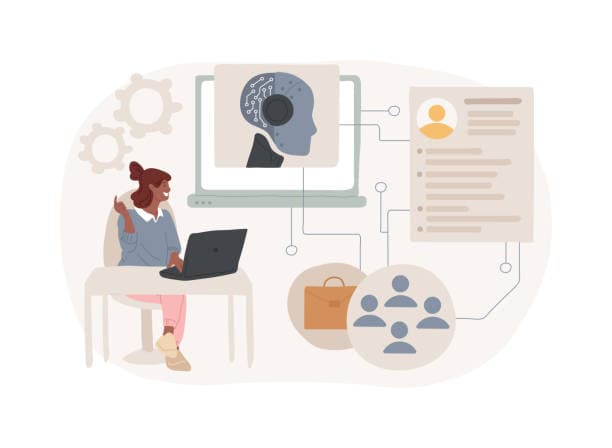
Recruitment in 2025 looks very different from just a few years ago. Machine learning has moved from being a nice-to-have tool to becoming a core part of how companies hire.
Today, algorithms can scan thousands of resumes in seconds, spot patterns in candidate profiles, and even predict which applicants are most likely to succeed in a role.
This shift matters because businesses are under more pressure than ever to hire the right people quickly.
With talent shortages in some industries and a flood of applicants in others, traditional hiring methods simply cannot keep up.
Machine learning in recruitment offers a way to work smarter, not harder, by taking over repetitive tasks and providing data-driven insights that help recruiters make better decisions.
2025 stands out as a milestone year because ML technology is no longer limited to large corporations with big budgets.
Affordable, easy-to-use platforms are now available to smaller companies too, making advanced hiring tools accessible to almost everyone. This is changing the game for employers and job seekers alike.
Top Pick: Top 17 Phone Screening Questions to Ask Candidates
A Timeline of Machine Learning in Recruitment: From Resume Parsing to Predictive Hiring
The rise of machine learning in recruitment has been a gradual journey, shaped by technological advancements and shifting hiring needs. Each stage brought new capabilities that changed how companies find and evaluate talent. Here’s a closer look at that evolution:
1. The Early 2000s: Keyword Matching and Basic Automation
Early Applicant Tracking Systems (ATS) were essentially digital filing cabinets. They searched for exact keyword matches from job descriptions in resumes. If a role asked for “project management” and a candidate wrote “managing projects,” the system might not pick it up.
The first web-based ATS, Resumix, launched in 1996, enabled recruiters to access candidate data online. By 2001, platforms like LinkedIn began to reshape talent sourcing.
Example: A marketing role that required “SEO” might filter out a candidate who only wrote “search engine optimization,” even though they had years of experience.
2. 2010–2015: Smarter Resume Parsing and Structured Data
During this period, natural language processing (NLP) began to improve resume parsing. Recruiters could capture synonyms and jargon, reducing reliance on exact keywords.
In general, resume parsing tools began filtering candidates more accurately, freeing recruiters from scanning resumes manually in just six seconds on average.
Example: If a recruiter searched for “software engineer,” the system could also include profiles labeled “developer” or “programmer” with relevant skills, even if the exact job title didn’t match.
3. 2016–2020: AI-Powered Candidate Ranking
Machine learning systems started to rank applicants using multiple weighted factors—such as skills, education, and experience.
By 2020, around 65% of recruiters were already using AI in the recruitment process.
That same year, companies reported improved efficiency and screening quality thanks to these tools.
Example: A retail chain might receive 500 applications for a store manager role, but the ML-powered platform would automatically present the top 15 most relevant candidates, complete with reasoning for each ranking.
4. 2021–2023: Predictive Hiring and Bias Reduction Efforts
Predictive analytics became mainstream. A McKinsey study reports that companies using data-driven hiring saw a 25% increase in employee performance and could reduce time-to-fill by up to 40%.
Another McKinsey report notes a 23% improvement in hiring accuracy and a 15% reduction in turnover.
At the same time, tools emerged to detect and mitigate bias in job postings.
Example: A tech company might learn that candidates from certain backgrounds were being screened out due to unintentional job ad wording, and adjust its descriptions to attract a more diverse pool.
5. 2024–2025: Fully Integrated, Intelligent Hiring Ecosystems
By 2025, machine learning platforms cover nearly every recruitment stage; from sourcing and screening to candidate outreach and onboarding.
Adoption is high: between 35% and 45% of companies now use AI in hiring, and the recruitment AI market is growing steadily at a compound annual rate of 6.2% through 2030.
Example: A startup can use a single ML-driven platform to identify candidates, automatically reach out with personalized messages, schedule interviews, conduct skills assessments, and even send tailored onboarding materials once a hire is made.
Related: The Best 15 Recruitment Books of 2025
Key Breakthroughs in 2025 Recruitment Technology
Machine learning in recruitment has hit a new level in 2025. The tools on the market now go beyond simple automation and offer capabilities that feel almost human, only faster, more consistent, and available 24/7.
Here are some of the most exciting breakthroughs shaping hiring this year:
1. AI Voice Interviews with Real-Time Analysis
Pre-screening interviews can now be handled entirely by AI voice agents that sound natural and conversational.
These systems ask questions, listen to responses, and instantly assess a candidate’s communication style, confidence, and skill knowledge. HiveMind AI’s phone screening feature does this effectively
Example: A sales candidate could be asked to pitch a product during the call, and the AI would evaluate tone, persuasion, and clarity, producing a scorecard for the recruiter minutes later.
2. Personalized Candidate Engagement at Scale
Machine learning in recruitment now personalizes the hiring experience for each applicant. Systems can send tailored emails, suggest relevant job openings, and even adjust interview formats based on candidate preferences.
Example: If an applicant applies for a remote role, the system can automatically suggest other remote-friendly positions in the company and arrange a fully virtual interview process.
3. Skill Gap Prediction and Upskilling Recommendations
ML models are now capable of identifying not just who fits the job today but who could fit it tomorrow with the right training. This opens the door for companies to invest in potential rather than just immediate fit.
Example: An AI might find that a candidate is a strong match for a junior developer role but lacks one programming language. It can recommend a two-week online course and re-assess the candidate after completion.
4. Real-Time Job Market Insights
Recruiters can now get instant updates on salary benchmarks, in-demand skills, and hiring trends based on live market data. This means job descriptions and offers can be adjusted in real time to attract top talent.
Example: If the system notices that competitor companies are offering flexible hours for similar roles, it can flag this and recommend updating the job post to stay competitive.
5. Automated Cultural Fit Assessments
Some tools now use behavioral data from online profiles, past work history, and personality assessments to predict whether a candidate will thrive in a company’s work culture.
Example: For a fast-paced startup, the system might prioritize candidates with a proven track record in high-growth environments over those from slower corporate settings.
By 2025, these innovations are no longer rare or experimental. They are quickly becoming the standard for companies that want to stay ahead in the talent race.
Impact of Machine Learning in Recruitment on Recruiters, Candidates, and Hiring Outcomes
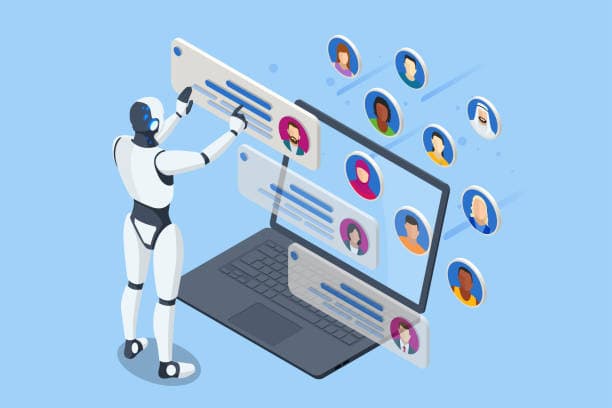
The influence of machine learning in recruitment is not just about faster processes. It is changing how recruiters work, how candidates experience the hiring journey, and the quality of the final hiring decisions.
1. For Recruiters
Machine learning is removing much of the repetitive, manual work that used to consume a recruiter’s day. Tasks like sorting resumes, scheduling interviews, and sending follow-up emails can now be handled automatically.
This frees recruiters to focus on more strategic activities such as building relationships with candidates and developing stronger hiring strategies. Many recruiters are now working more like talent advisors than administrative gatekeepers.
2. For Candidates
The hiring process is becoming more transparent and personalized. Machine learning tools can provide timely updates, give feedback on assessments, and match candidates with roles that truly fit their skills and career goals.
This creates a better overall experience and reduces the frustration that comes from waiting weeks to hear back or applying for jobs that are not a good fit.
3. For Hiring Outcomes
Companies are making more accurate and fair hiring decisions. By using data-driven insights, organizations can identify candidates who are likely to perform well and stay longer in their roles.
This reduces turnover and increases productivity. In addition, bias detection tools help create a more diverse and inclusive workforce by ensuring that decisions are based on skills and potential rather than subjective factors.
Machine learning is not replacing the human element in hiring. Instead, it is empowering recruiters and candidates with better information, faster processes, and more meaningful interactions.
Top Pick: 13 Must Have Tools in your Recruiting Tech Stack
The Future: Challenges, Ethics, and Opportunities of Machine Learning in Recruitment Beyond 2025

While machine learning is transforming recruitment, the journey is far from over. The next few years will bring both opportunities and challenges that companies must be ready to navigate.
Challenges Ahead
One of the biggest risks of machine learning in recruitment is over-reliance on automation. In fact, 82% of AI-based recruitment decisions are blindly followed by recruiters without human challenge.
This “automation bias” means qualified candidates may be missed if their profiles don’t align perfectly with algorithmic patterns.
Data privacy is another growing concern.
Although not recruitment-specific, a Business Insider investigation found that up to 70% of AI chat reviews at Meta included personally identifiable information, highlighting how AI systems often handle sensitive data without sufficient safeguards.
Ethical Considerations
Bias remains a serious issue in AI hiring tools. Studies show that AI resume screening is 50% more likely to select candidates with white-sounding names over those with Black-sounding names.
The AI model ChatGPT similarly favored Asian women’s resumes (17.2%) more than Black men’s (7.6%) in controlled tests; ideally, equal representation would be 12.5%.
Furthermore, researchers found that many generative AI systems replicate traditional stereotypes in job callbacks.
Lower callback rates for women in male-dominated roles, for example.
However, mitigation strategies have shown promise. Unilever saw a 16% increase in diversity hires after using Pymetrics, while Textio helped firms raise female applicant responses by 31% through inclusive language in job ads.
RocketDevs also saw a 65% reduction in bias hiring by using AI powered recruitment tool- HiveMind AI.
Opportunities for Growth
There’s great potential ahead in skills-based hiring and proactive workforce planning.
Employers are increasingly valuing skills over formal degrees.
In fact, from 2018 to mid-2024, demand for AI roles rose 21%, while degree requirements in such roles dropped 15%.
AI could soon help identify future skills gaps and suggest targeted upskilling or hiring strategies.
We might also see AI-powered systems acting as career coaches, guiding internal talent development and reducing turnover through tailored growth paths, in line with emerging trends toward predictive and supportive HR tech.
Related: The Best 15 Recruiting Podcasts You Can’t Miss
How HiveMind AI Leverages Machine Learning in Recruitment
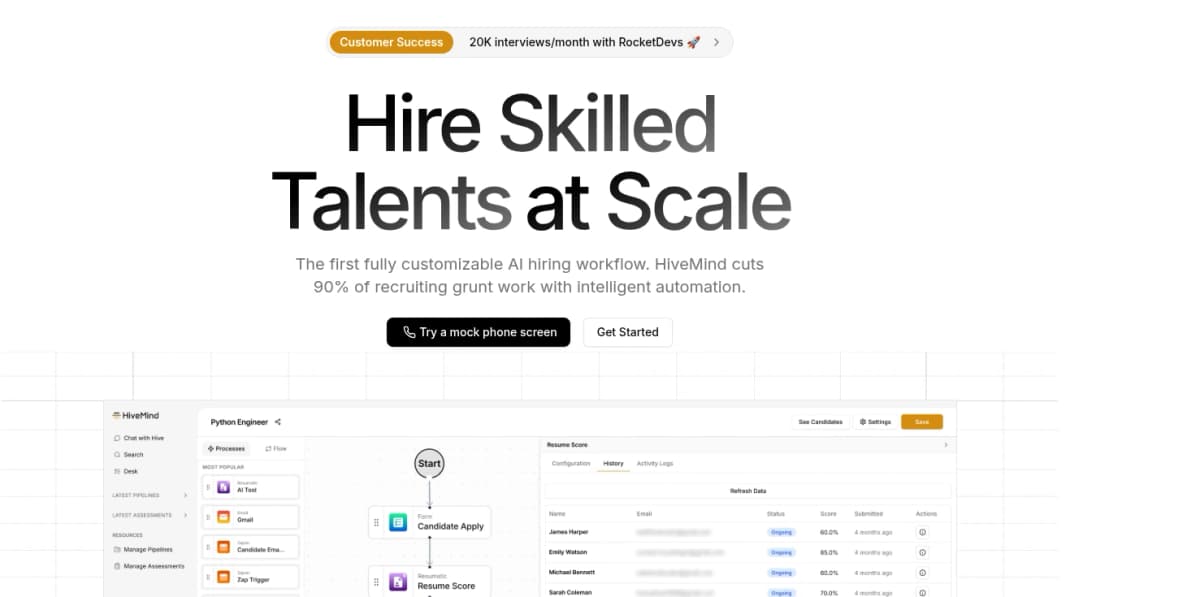
HiveMind AI is a real-world example of how advanced machine learning is redefining the hiring process in 2025. It is designed to handle the most time-consuming parts of recruitment while giving recruiters more control and better insights.
The platform can automatically source candidates from multiple channels, screen them through AI-led voice or text interviews, and rank them based on skills, experience, and cultural fit.
Its algorithms learn from every interaction, meaning the system gets smarter and more accurate over time.
One of HiveMind AI’s standout features is its ability to predict candidate success.
By analyzing historical hiring data and comparing it with current applicant profiles, it can forecast which candidates are most likely to excel and stay in the role long term. This helps companies make confident hiring decisions and avoid costly turnover.
Beyond efficiency, HiveMind AI focuses on creating a better candidate experience.
Automated yet personalized updates keep applicants informed, while skill-gap insights give them actionable recommendations for improvement. This ensures that the process feels fair and transparent for both sides.
In many ways, HiveMind AI captures the essence of how machine learning has evolved in recruitment.
It blends speed, accuracy, and human-like personalization, showing that the future of hiring is not about replacing recruiters but empowering them to hire smarter, faster, and better.
Learn More