
Startups don’t have the luxury of long hiring cycles. Every unfilled role slows product development, stretches founders thin, and risks missed opportunities. That’s why AI has become the new co-pilot for lean recruiting teams.
AI driven recruiting tools and advanced AI recruitment software are transforming the entire hiring process for startups by automating and streamlining every stage—from candidate sourcing and screening to interviews and onboarding.
The shift isn’t just hype, it’s measurable. SHRM’s Talent Trends shows that 64% of organizations already use AI for recruiting, interviewing, and hiring. Among them, 36% report reduced costs and 24% say AI helps them identify stronger candidates.
For startups, where every dollar and hire matters, those numbers point to a competitive edge: faster, smarter hiring without inflating budgets.
This guide will show you exactly how to capture that edge. We’ll cover the key features to look for, compare the best AI recruiting tools for startups in 2026, and explain how to evaluate them at different growth stages.
By the end, you’ll know which tools deliver affordability, scalability, and impact without drowning in generic lists or vendor hype.
Recommended:Best 7 Free AI Recruiting Tools
What Makes an AI Recruiting Tool Startup-Friendly
Choosing an AI recruiting tool isn’t about finding the flashiest features, it’s about finding the right fit for your stage of growth. Startups need tools that are lean, practical, and built to scale without draining limited budgets.
Here are the key factors to evaluate:
-
Affordability that scales. Startup-friendly pricing typically starts around $99–$300 per month, but watch for hidden costs like add-ons, extra users, or integration fees. What looks affordable upfront can creep up quickly.
-
Ease of use. Founders and lean HR teams don’t have time for long onboarding. Look for drag-and-drop workflows or plug-and-play setups that work straight out of the box.
-
Scalability. The tool you choose should flex with your growth. What works for your first 5 hires should also support your next 50 without forcing a costly migration.
-
Integration. If you already use an ATS, HRIS, or CRM, seamless integration is non-negotiable. If you don’t, prioritize tools that can function as a lightweight ATS until you’re ready for a full system. It’s also important to choose solutions with robust AI capabilities that can integrate with multiple platforms—such as ATS, HRIS, and CRM systems—to ensure seamless workflows and automation as your startup grows.
Recommended:Top 9 AI Recruiting Assistants
Benefits of AI Recruiting
AI recruiting brings a host of advantages to startups looking to streamline their hiring process and compete for top talent. By automating repetitive tasks like resume screening, candidate sourcing, and interview scheduling, AI recruiting software frees up hiring teams to focus on what matters most—building relationships with qualified candidates and advising hiring managers on strategic decisions.
AI tools can significantly enhance the candidate experience by providing timely updates, personalized communications, and faster feedback, which keeps candidates engaged and satisfied throughout the process. With data-driven evaluation, AI recruiting tools help reduce hiring bias, ensuring that every applicant is assessed fairly based on skills and job criteria rather than unconscious preferences.
Additionally, AI-powered recruiting tools offer valuable insights into candidate behavior and preferences, allowing organizations to refine their recruiting strategies and improve overall candidate satisfaction. For startups, this means a more efficient hiring process, better hiring decisions, and a stronger employer brand—all without the need for a large HR team.
Key Categories of AI Recruiting Tools
AI recruiting isn’t one-size-fits-all. Tools solve different hiring challenges, and knowing the categories helps you avoid paying for features you don’t need or missing the ones you do.
Many of the best AI recruiting tools for startups leverage AI agents—autonomous, programmable software assistants—to automate a variety of hiring tasks such as candidate sourcing, outreach, screening, interview scheduling, and engagement. These AI agents streamline recruitment workflows, making it easier for startups to manage hiring efficiently and focus on decision-making.
1. AI Sourcing Tools
These tools help you find and engage candidates before they even apply. They scan platforms like LinkedIn, GitHub, and niche job boards to uncover passive talent. Advanced sourcing tools personalize outreach at scale, saving hours of manual searching. Many of the best AI recruiting tools for startups now offer passive candidate sourcing and passive talent sourcing features, enabling you to identify and engage candidates who are not actively seeking new roles. This helps startups build long-term talent pipelines and supports more diverse recruitment strategies.
Startup payoff: Find hidden talent pools when your brand isn’t widely known yet.
2. AI Screening & Assessment Tools
These tools focus on evaluating candidates quickly and fairly. They can review resumes, score applications, and even run skills-based tests. Many of the best AI recruiting tools for startups leverage AI for comprehensive candidate evaluation, using structured scorecards and assessments to provide deeper insights. Advanced platforms also use AI-driven candidate ranking to prioritize applicants based on suitability, and can even predict candidate success by analyzing skills, experience, and fit for the role. SHRM data shows that 36% of companies using AI report cost savings, mainly because automation cuts out time-consuming tasks like resume screening and candidate scoring.
Startup payoff: Cuts wasted time on unqualified resumes and ensures every shortlist is high-quality.
3. AI Scheduling & Interviewing Tools
Interview coordination is a productivity killer for small teams. Automated interview scheduling features allow startups to schedule interviews efficiently, streamlining the interview process and reducing manual coordination. Scheduling bots and AI interviewers eliminate back-and-forth emails and conduct structured video or voice assessments.
Startup payoff: Founders can focus on evaluating talent, not juggling calendars.
4. AI Candidate Engagement Tools
Even the best candidates can drop out if communication lags. Engagement tools automate candidate communications by sending timely updates, answering FAQs, and personalizing follow-ups, ensuring candidates remain informed and engaged throughout the process. Many of the best AI recruiting tools for startups also use AI-driven assessments and predictive analytics to forecast candidate success, matching applicants to roles where they are most likely to thrive. This helps protect your employer brand, even when you can’t hire everyone.
Startup payoff: Builds credibility with talent and prevents candidates from ghosting.
Recommended:Best Recruiting Automation Software Comparison
Best AI Recruiting Tools for Startups in 2025
Startups don’t just need “the best tool”, they need the right one that fits their stage, budget, and hiring needs.
Each AI recruitment tool and AI recruitment software listed below is designed to help startups manage job openings more efficiently, from sourcing to onboarding.
Below, we’ve reviewed the top AI recruiting tools on the market. For each tool, you’ll see what it does, which categories it covers, pricing details, and what makes it startup-friendly (or not).
| Tool | Best Fit For | Standout Feature | Pricing | Categories Covered |
|---|---|---|---|---|
| HiveMind AI | Startups wanting an all-in-one stack with automation with control | Real-time AI co-pilot for live video interviews, automation with optional human review | Freemium available. Paid plans are custom, scaling with hiring volume (startup to enterprise). | Screening & Assessments, Scheduling & Interviewing, Candidate Engagement |
| HireEZ | Startups needing to uncover hidden or passive talent | Deep sourcing across LinkedIn, GitHub, and niche boards | Starts at $169/month; custom pricing for enterprise | AI Sourcing |
| Findem | Growth-stage startups with complex or high-volume sourcing needs | “People intelligence” with enriched candidate attributes | Custom enterprise contracts only | AI Sourcing |
| SeekOut | Teams prioritizing diversity and data-driven hiring | Advanced analytics and diversity insights | From $3,600/year (~$300/month); higher tiers for enterprise | Screening & Assessment |
| Paradox Olivia | Startups that need automated scheduling and consistent candidate communication | Conversational AI assistant for scheduling + candidate Q&A | From $500/month, custom for high volume | Scheduling & Engagement |
| HireVue | Teams wanting a proven, enterprise-trusted interview platform | Structured AI video interviews with scoring | From $35 per interview or $500+/month, enterprise available | Scheduling & Interviewing |
HiveMind
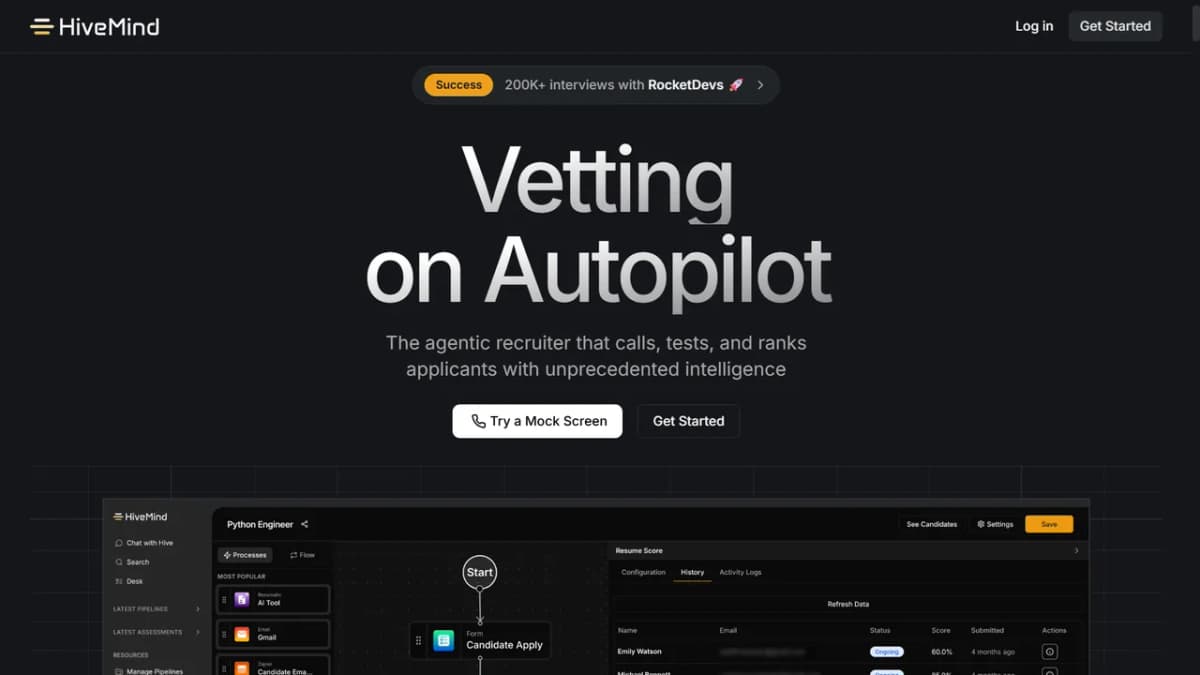
HiveMind is an all-in-one recruiting automation platform built for startups. It combines resume screening, AI voice interviews, and skill-based testing for 1,500+ roles, including interactive coding in 7 languages and 22 frameworks.
HiveMind helps automate hiring tasks by streamlining sourcing, screening, scheduling, and candidate evaluation, reducing manual effort for recruiters. The platform also provides clear visibility into the hiring pipeline, allowing startups to track candidates from application to offer and manage every stage efficiently.
It also functions as an AI co-pilot for live video interviews, supporting recruiters during real-time conversations with prompts, note-taking, and structured evaluation.
Beyond assessments and interviewing, HiveMind automates scheduling and candidate engagement, effectively replacing the need for multiple separate tools.
Why it works for startups: Startups save time by automating resume reviews (filtering out 90% of unqualified candidates) and mishires are reduced by up to 88%.
For lean teams, HiveMind replaces a three-tool stack (screening, interviewing, engagement) in one affordable package.
Keep in Mind: While HiveMind covers most categories, it doesn’t yet offer deep AI sourcing. Startups needing advanced outbound candidate discovery may need to pair it with a sourcing tool.
Why It’s Different: With HiveMind, recruiters decide how far automation goes. Resume screening, assessments, and scheduling can run on autopilot, but features like the AI co-pilot for live interviews and manual review keep humans at the center of hiring decisions.
Categories: Screening & Assessments, Scheduling & Interviewing, Candidate Engagement
Pricing: Start with a free plan, then scale with custom pricing for high-volume use or enterprise hiring.
HireEZ
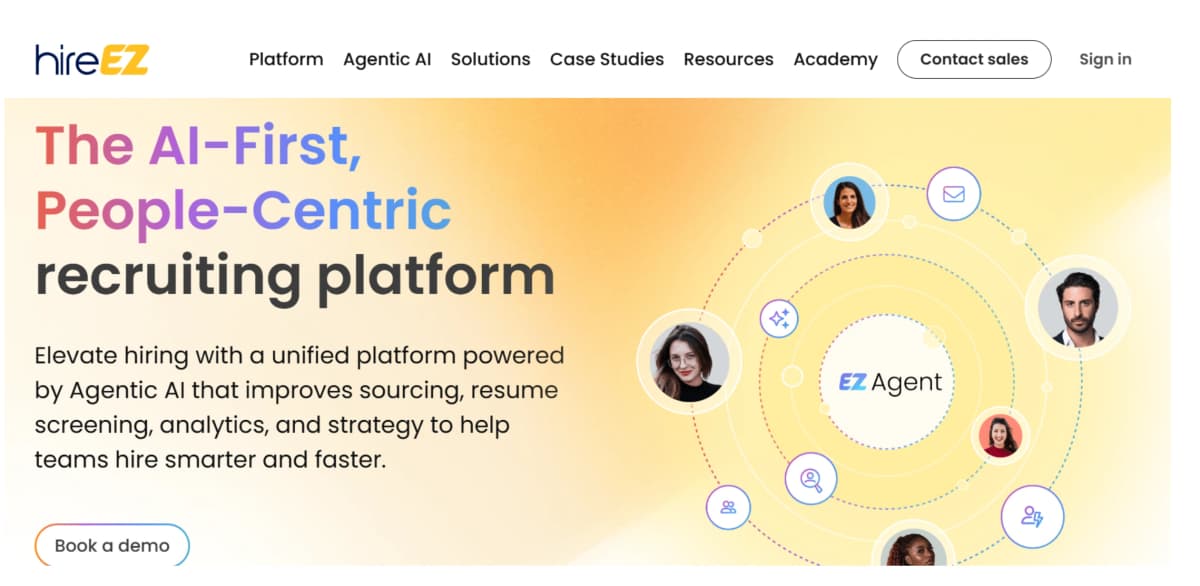
HireEZ (formerly Hiretual) specializes in outbound recruiting. It scours platforms like LinkedIn, GitHub, and niche boards to surface passive candidates, and allows recruiters to run automated outreach campaigns with personalization at scale.
Why it works for startups: For startups struggling with visibility, HireEZ helps discover and contact talent who aren’t applying directly. This is especially useful for early engineering or niche technical roles.
Keep in Mind: The tool is sourcing-only. Startups will still need separate solutions for screening, interviewing, and candidate engagement.
Unique Value: HireEZ integrates with major CRMs and ATS platforms, making it a strong choice for startups planning to scale into a more complex recruiting stack. It is also a popular choice for staffing agencies due to its ability to handle high-volume candidate sourcing and outreach.
Categories: AI Sourcing
Pricing: Paid plans start at around $169/month for basic features, with custom pricing for larger teams and enterprise use.
Findem
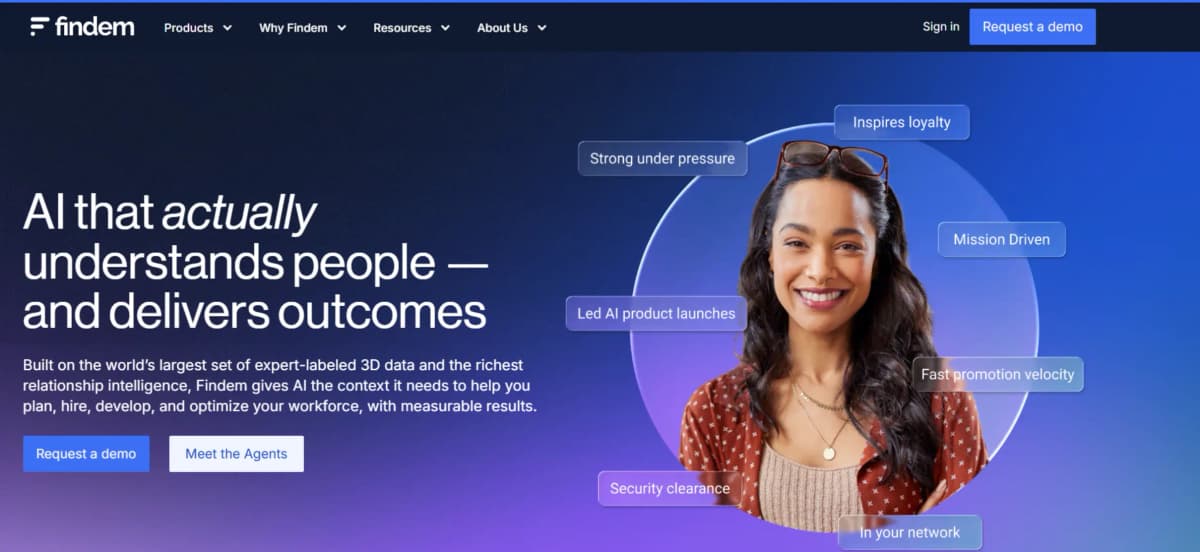
Findem markets itself as “people intelligence.” It enriches candidate profiles with hundreds of attributes, from career milestones to cultural alignment signals, helping recruiters go beyond resumes.
Why it works for startups: Provides powerful targeting when you need to refine candidate pools beyond job titles. This can help startups find “culture adds” rather than just “culture fits.”
Keep in Mind: Pricing and complexity may put Findem out of reach for very early-stage startups. It’s best for teams that are scaling aggressively.
Unique Value: Rich data enrichment makes it easier to identify non-obvious candidates, such as engineers with specific project histories or leadership growth trajectories. Findem’s enriched data can also be used to generate and enhance job descriptions for more precise hiring, and to support internal mobility by matching existing employees to new opportunities within the organization.
Categories: AI Sourcing
Pricing: No public pricing. Available through custom enterprise contracts.
SeekOut
SeekOut combines candidate search with advanced analytics, including diversity insights and AI-powered recommendations. It’s widely used by enterprise TA teams but has features that can help growth-stage startups.
Why it works for startups: If building a diverse team is a top priority, SeekOut’s analytics provide visibility into underrepresented talent pools.
Keep in Mind: SeekOut’s feature depth comes with a learning curve, and pricing can escalate quickly as your team expands.
Standout Capability: Strong diversity and inclusion dashboards, which are rare among competitors.
Categories: Screening & Assessment
Pricing: Starts at about $3,600/year (~$300/month) for small teams, with higher tiers for additional seats and enterprise features.
Paradox Olivia
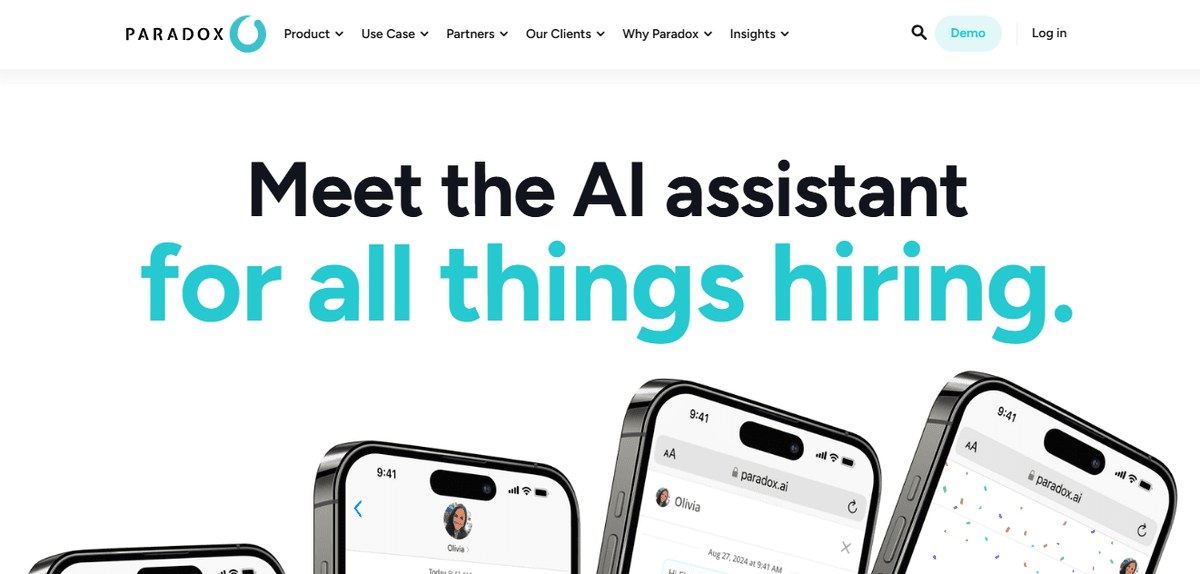
Olivia is a conversational AI assistant built by Paradox. It automates interview scheduling, answers candidate questions in real time, and keeps communication consistent throughout the process.
Why it works for startups: Saves hours of back-and-forth emails, freeing founders and HR leads to focus on actual interviews. Candidates also get a smoother experience, reducing the risk of drop-offs.
Keep in Mind: Olivia excels in engagement and scheduling but doesn’t handle assessments or resume screening, meaning you’ll need additional tools.
Notable Feature: Its chatbot-style experience feels natural for candidates, providing a human-like touch without requiring recruiter bandwidth.
Categories: Scheduling & Candidate Engagement
Pricing: Entry-level plans start around $500/month, with custom pricing for volume hiring or enterprise needs.
HireVue
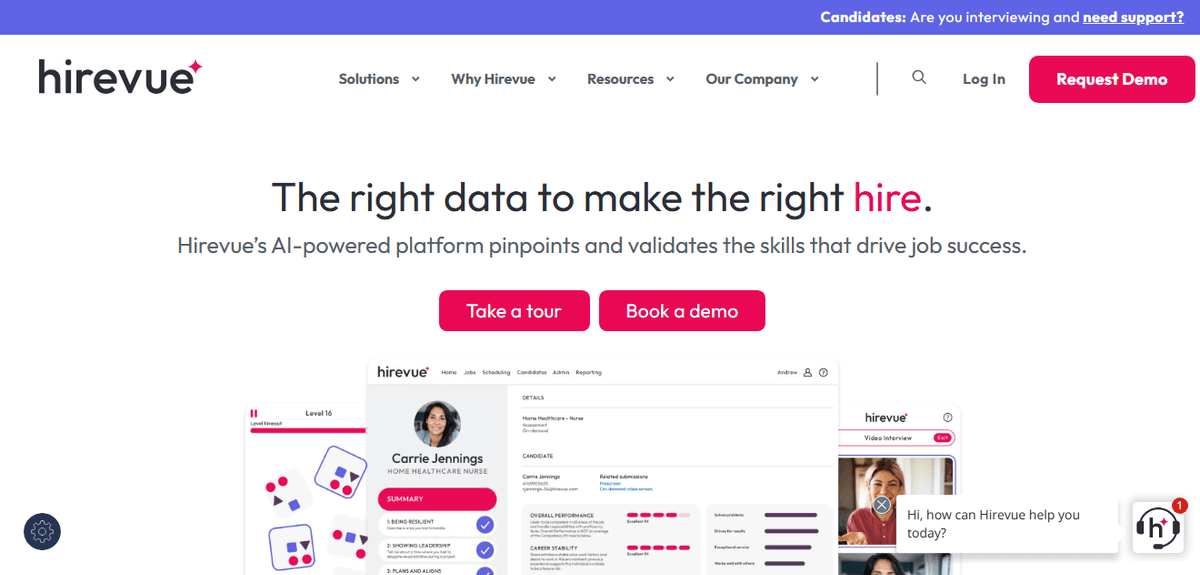
A pioneer in AI interviewing, HireVue provides structured video interview platforms, AI-powered candidate scoring, and scheduling capabilities. It’s used by large enterprises worldwide.
Why it works for startups: Trusted and established, with a broad range of interview tools that can give startups credibility in their hiring process.
Keep in Mind: Pricing and feature sets are often more than what early-stage startups need. Also, candidates may be wary of AI-driven scoring, which requires careful explanation.
Key Differentiator: Years of industry experience and proven scale, making it one of the most recognized names in AI interviewing.
Categories: Scheduling & Interviewing
Pricing: Typically priced at $35 per interview or $500+/month, with enterprise contracts available for high-volume hiring.
Recommended: AI-Powered Recruitment for Early-stage Startups
How to Choose the Best AI Recruiting Tool for Your Startup
There’s no one-size-fits-all recruiting stack. The right tool depends on your stage of growth, the number of hires you need to make, and how much time your team can spend on hiring. Recruiting leaders should assess which AI tools align with their team’s strategy, growth plans, and hiring goals.
Here’s a simple way to decide:
Seed Stage (1–10 hires per year)
-
Focus: Keep it lightweight. You don’t need a full recruiting stack yet.
-
Best fit tools: Resume screening and scheduling automation, like HiveMind AI’s freemium option, or simple scheduling bots.
-
Why: Saves you from spending days on manual screening when you only need to hire a handful of people.
Series A / B (10–50 hires per year)
-
Focus: Scale with confidence. Add sourcing automation and skill-based assessments to support a higher hiring volume.
-
Best fit tools: HiveMind AI (screening, interviewing, assessments) with a sourcing tool for passive candidate outreach.
-
Why: This combination gives you speed in screening and access to harder-to-reach talent pools.
Growth Stage (50+ hires per year)
-
Focus: Go full-stack. You’ll need deeper analytics, integrations with ATS/HRIS, and tools that support hiring across multiple roles and geographies.
-
Best fit tools: HiveMind AI for assessments and interviewing, paired with advanced sourcing or analytics tools as your needs expand.
-
Why: At this stage, compliance, diversity, and scalability matter as much as speed.
Bottom line: Start small and automate where it creates the most impact, then expand your stack as hiring demands grow. The key is keeping recruiters in control while letting AI handle the heavy lifting
Recommended: Best 9 Candidate Assessment Tools
Implementation and Integration
Successfully implementing AI recruiting tools starts with a clear understanding of your hiring needs and existing tech stack. It’s crucial to select an AI recruiting platform that integrates smoothly with your current systems, such as your ATS or HRIS, to avoid workflow disruptions.
A thoughtful rollout plan should include training for hiring teams to ensure everyone is comfortable using the new AI recruiting software and understands how to leverage its features. Customizing your AI tools to fit your unique hiring process—such as setting up specific workflows or automating certain recruiting tasks—will help maximize their impact.
Ongoing monitoring is essential to ensure your AI recruiting tools are delivering the expected results and adapting to your evolving hiring needs. Establish clear policies around data privacy, security, and compliance to protect both your organization and your candidates. With the right approach, AI recruiting software can become a seamless part of your recruiting process, empowering your team to hire smarter and faster.
Measuring Success and ROI
To get the most out of your investment in AI recruiting, it’s important to track the right metrics and regularly assess performance. Key indicators like time to hire, cost per hire, candidate satisfaction, and quality of hire will help you understand how AI recruiting tools are impacting your hiring process.
By monitoring these KPIs, you can pinpoint where your AI recruiting software is delivering value—whether it’s speeding up resume screening, improving candidate experience, or helping you identify stronger candidates. Calculating ROI should include not just direct cost savings, but also gains in productivity and improvements in candidate satisfaction.
Regularly reviewing your recruiting tools and strategies ensures you’re making data-driven decisions and continuously optimizing your approach. This way, your organization can maximize the benefits of AI recruiting and stay ahead in the competition for top talent.
Common Pitfalls and Challenges
While AI recruiting can transform your hiring process, it’s not without its challenges. One major concern is the risk of bias in AI algorithms, which can unintentionally reinforce existing patterns in hiring decisions. To address this, it’s essential to choose AI recruiting tools that are transparent, regularly audited, and designed to minimize bias.
Another pitfall is relying too heavily on automation at the expense of human judgment. AI recruiting tools should support, not replace, the expertise of your hiring teams. Maintaining a balance between automation and human oversight ensures that hiring decisions remain thoughtful and aligned with your company’s values.
Technical issues, data quality problems, and resistance to change can also hinder successful adoption. Investing in user training and clear communication about the benefits of AI recruiting will help your team embrace new recruiting tools and avoid common implementation hurdles.
Ethical and Legal Considerations
As AI recruiting becomes more widespread, startups must pay close attention to ethical and legal responsibilities. Your AI recruiting software should comply with all relevant regulations, such as EEOC guidelines and GDPR, to ensure a fair and lawful hiring process.
Transparency is key—candidates should know when and how AI recruiting tools are being used in their evaluation. It’s also important to establish strict policies for handling candidate data, safeguarding privacy, and ensuring information is used solely for legitimate recruiting purposes.
By prioritizing ethics and compliance, startups can build trust with candidates and create a hiring process that is both effective and respectful. This approach not only protects your organization but also strengthens your reputation as a fair and forward-thinking employer.
Next Steps
For startups, hiring speed and quality can make or break growth. AI recruiting tools cut down time-to-hire, reduce costs, and give lean teams the power to compete with larger companies. The key is choosing tools that are affordable, scalable, and built to keep humans in control.
HiveMind AI brings those benefits together by combining screening, assessments, interviewing, and candidate engagement in one platform, without the overhead of juggling multiple vendors.
Ready to see it in action? Sign up for HiveMind’s free version today and start automating your hiring process.
FAQ
-
What’s the cheapest AI recruiting tool for a startup? Entry-level AI recruiting plans often start around $99–$300/month, but many tools push advanced features into higher tiers. HiveMind offers a free version so startups can get started without upfront cost, and then scale into custom plans as hiring needs grow. Always check what’s included in the base plan to avoid hidden add-ons or integration fees.
-
Are AI recruiting tools worth it for early-stage startups? Yes. Even with a small hiring volume, AI tools save founders and lean HR teams hours of manual work. SHRM reports that 36% of companies using AI see reduced costs and 24% report better candidate quality. The return on investment comes from faster resume screening, automated scheduling, and fewer wasted hours on unqualified applicants.
-
Will AI recruiting software replace human recruiters? No. AI handles the repetitive work like resume screening, scheduling, and reminders, while recruiters focus on human-first tasks such as coaching, and closing offers. Tools like HiveMind even provide an AI co-pilot for live interviews, keeping humans in the driver’s seat of critical hiring decisions.
-
What are the main risks when using AI recruiting tools? The main risks include bias in hiring, compliance issues with EEOC (U.S.) or the EU AI Act, integration challenges, and candidate trust. If overused, automation can feel impersonal and hurt employer brand. The best approach is to keep recruiters in the loop, letting AI do the heavy lifting, while people handle judgment calls.
-
Which tool is best if my startup doesn’t yet have an ATS? Choose an AI recruiting tool that can double as an ATS while giving you room to scale later. HiveMind is built to handle this; it manages screening, interviewing, scheduling, and candidate engagement in one place. For growing teams, it also integrates seamlessly with popular ATS platforms like Ashby and Greenhouse, so you don’t outgrow your setup as hiring needs expand